Writing Fast

The hour glass in my occiput is dropping sand. I must write quickly. I brought the python home in a bag. Did your mother really worship F.D.R.’s chauffeur? I wish I had a ladder like that. They say 1939 was the greatest year for movies. I think its still coming. My neighbor who never leaves his house is making a movie about the stones in his shoes. I’m almost done. Herman Melville was wrong about the nature of war. He said all wars are boyish and are fought by boys. Boys are kidnapped into wars. And old Daddy Warbucks promises to let them out of the jar.


S.K. 

Dress Code Department

Well there it is, that old dress code again. In discrimination 101 the first thing you learn is that if you really have an irrational and wholly ungovernable dislike for a human being and accordingly you want to get rid of them lickety split you just trot out the old “D.C.” 

The following excerpt comes to us via The Inclusion Daily Express:

Employee With Prosthetic Arm Says Abercrombie & Fitch Humiliated Her
(BBC News)

June 24, 2009

LONDON, ENGLAND– [Excerpt] A woman claims clothing firm Abercrombie & Fitch made her work in the stockroom because her prosthetic arm did not fit the shop’s image.

Riam Dean told an employment tribunal she felt “diminished” and “humiliated” by the incident at its Savile Row store in central London.

The 22-year-old law student is suing for disability discrimination and seeking up to £20,000 in damages.

Miss Dean, who was born with her left forearm missing and wears a prosthetic arm, said she was granted special permission to wear a cardigan to cover the join in her arm.

But she told the tribunal she was later removed from the shop floor and made to work in the stockroom because the cardigan did not adhere to the strict dress code.

Entire article:
Disabled woman sues clothes store

http://news.bbc.co.uk/2/hi/uk_news/england/london/8116231.stm


**

As a disability advocate of a certain stripe I must say I particularly like the phrase “She was granted special permission to wear a cardigan to cover the join in her arm.”

In case you are curious: a few months ago the store in question hired half nude male models to advertise its grand opening. I wonder if “special permission” was granted for the boys to cover the join in their respective nether regions?

I expect that the feckless and shallow management of London’s new Abercrombie would on that occasion have enjoyed full frontal nudity but they knew this would be against the law.   

Well yes. And its also against the law to make people with disabilities “cover up” and its also against the law to demote them because of their physical differences. Yes, even on Savile Row.  


For more on this story visit the following sites:


http://www.dailymail.co.uk/news/article-1192674/I-banished-stockroom-says-disabled-shop-girl-suing-Abercrombie–Fitch-discrimination.html


http://zeldalily.com/index.php/category/riam-dean/


http://www.nydailynews.com/topics/Riam+Dean


http://en.wordpress.com/tag/riam-dean/


S.K.

Hello Dr. Strangelove: Its Time for My Close-up!

The film crew is silent for once. There’s no joking about hair loss or what their chewing gum tastes like. Thor (yes his name is Thor) from Schenectady (yes) wipes the Zeiss with an old undershirt. We’ll have to get this right. There’s only enough film for one take.

Strangelove takes his slow, simian walk to the director’s chair. He waves his one good hand with its soiled glove–waves for silence but the place is already silent and one poor soul from the sound crew thinks Strangelove’s gesture is a signal to talk and he says that he can hear a whole city block with his new “Ultra Ears” spy gizmo that he recently purchased in Tacoma and Strangelove shoots the man with one of those iddy biddy guns that prostitutes favor.   

My job is simple. In this scene I’m the pre-pathologized blind guy who can’t find his way out of his own living room and who is nothing more than a fly on the windshield of life. I do lots of groping and falling. Light the wrong end of a filter cigarette. I wear a food stained tee shirt and I’m several days unshaven.

Our film is being produced by the Defective People Industry which bankrolls “B roll” film footage of people with disabilities for later distribution to “Law and Order” and “CSI” and the tabloid news shows–even the reality shows. People with disabilities are perfect criminals in TV-Land and when they’re not bad guys they serve as reminders of what sub-existentialism will be like for you and you and you.

Sub-existentialism is not yet on Wikipedia but it will be soon. I, Stephen Kuusisto have invented it. Unlike Sartre’s existential world of no exit nausea at the cruel and crude meaningless of ruined civilization, sub-existentialism has no “on board” consciousness of any kind. Its Golem time. Its life inside a tree. Its like being a stone but without any poetry. The sub-existentialist is a mineral blank in a partially mobile body. Its possible that only your eyeballs still move. But really, you’re perfect. You look good Darling.    

In turn Strangelove has a good attitude. He’s “overcome” his disability with a superior work ethic and he has learned how to inspire others by attending meetings at “Toastmasters” and by reading the collected works of Leo Buscaglia.

The point is that people with disabilities need to be everywhere presented as lumber and in turn, the Defective People Industry requires a reliable cadre of “the disabled” who can give a great spiel about “overcoming” their “condition”–overcoming it with the help of the DPI of course.

The DPI represents the charity model of disability and no one can argue with the vastness of its size. Oh its big alright.

Poor Strangelove, still Victorian, caught in the Jekyll and Hyde dichotomy of the good versus bad disabled person and playing “it” for all its worth.

Of course  I’m just the B roll blind guy who stubs his Winston out in a lamp. The DPI and the “Law and Order” crowd wouldn’t have it any other way.

And surely I’m bitter until I overcome my personal flesh.


S.K.    

Dog Nose Department, Part 3

Kind friends have written to check my sanity. Bill points out that his Labrador has an affection for cat feces–a matter that is presumably tied to the olfactory predilections of canines. My pal “Bibliochef” points out the sheer improbability of the word “fud” but I swear that’s what we were smelling yesterday and I further swear that that’s the word for the hindmost netherpart of a rabbit. I am of course a fool. But to further split the point, fools can be sane. Shakespeare’s fools are invariably the sanest people on stage. So in truth I must declare (as if we were in a court of law) that I knew full well what I was doing when I proclaimed I would follow my dogs nose wherever it may point. The thing is: fools can and “do” take vacations. Again if you look to Shakespeare you’ll notice that the fools never get run through with poisoned swords or undergo a serious splitting from nave to chaps. Nope. Your true fool knows when to get the heck out of Dunsinane.

Accordingly I let Nira nose her nose this morning and I kept to the upright, stolid, Lutheran posture that my Finnish grandmother would have approved. When Nira checked out the jetsam and flotsam of the roadside I thought of Cotton Mather. I thought of Duns Scotus. I kept a fierce detachment. I held my nose aloft like the late William F. Buckley interrogating a Liberal. I was just another dog walker moving slowly among the red winged blackbirds and the yellow finches.

If I had a moralistic streak I would say something about the wisdom of letting fuds hide in the buds. But the fool in me knows better. Life is life wherever you find it.


S.K.

Day One: Following My Dog's Nose

Yesterday I announced I’d follow my dog’s lead and drop to the ground or lean in close to know more fully the whirligig of doggy nasturtiums and nosegays. Clearly I’m having a vague and occupational dementia–the kind of thing that happens when its very hot. The Iowa sun has mastered my wits. And the dog is just a dog. She does not know I’m officially crazy.

This morning Nira the yellow Labrador plunged her head and shoulders into a wall of brush that grows along a stone wall in my back yard. It was early and there was dew on the grass and drops of water fell from the disturbed leaves of the bushes. Nira’s whole body was in lockstep with her nose, her broad back trembled and the long leash whipped back and forth in my hand, all the motion driven in accord with the dog’s nostrils. There is not a word in the English language for attenuated motion driven by a dog’s nostrils. I imagine the Swedes have a word for this, something like “hundt-flenken” and I’ll have to look it up at some point. If the Swedes have such a word it will likely prove to be ancient. All the important words are ancient.

So NIra was really in there and “working it” as they say at the gymnasium. Her nose was alive and wide open like the soul of a Sufi dancer. She was receiving news of something bosky and yet plangent–a thing both rich and low, a thing dark and yet still capable of flight. I could feel the intelligence of Nira’s nose deep in my hands. “The thing” behind the wall of sylvan camouflage was alive and breathing. Its exhalations were going straight into the dog. The dog was zithing like a wire. “God Almighty,” I thought. “Now I’m going to have to go down on all fours and scent this trapped but living fragrance for myself.”

Its not so easy to muscle your way into the shrubs alongside a quivering dog but I did it. I was suddenly at the heart of a Mexican stand off under the folds and spills of the elderberry and lilac bushes. I knew I had to be fast. Dogs don’t think twice about scenting living things. This wasn’t a formal affair with multiple forks and knives: I had to plunge and sniff. I was aware that my ass was sticking out of the leaves. My brain was oddly fast and slow. I was simultaneously throwing my blind, naked face into the dank unknown while worrying that the neighbors might see my “plumber’s crack” pointing from a wall of greenery. I tried for just a second to concentrate on my shorts. Were they up? Yes they were up. No plumber’s crack. The only thing my neighbors could see (supposing they were positioned in accord) would be my khaki shorts shining like a bleached sail far away on the sea.

I had to go faster. Forget my shorts. Nira was snuffling like a torn accordion. The thing was right in front of me. I inhaled and tried to ignore the scratching sounds. The thing was at the wall. It smelled like a wet haystack. It smelled like a moldy rug. It smelled like leaves in a dead fountain. That’s when it began to dawn on me. Yes friend, the dawning was starting to happen. It was moving from my nose to the richly folded and tiny nautilus of my brain’s odor center. The odor brain knew what was going on but the cross circuits from the scent district to the conning tower were out of shape. Yes the dawning was taking too long. Wet haystack, clogged aqueduct–what “was” that scrabbling thing?  All the important words are ancient.

It so happens I know the Old English word for “the thing” that Nira and I were smelling. You can look it up in the Oxford English Dictionary if you wish. The word is out of use these days.

Yes my friend we, man and dog were smelling a “fud” –a rabbit’s rectum.

Getting out of the bushes was harder than getting in. Nira didn’t help. She was undergoing some kind of transfiguration and I left her to it.

I staggered to my feet. My Neanderthal Man’s nose was getting reacquainted with the post-modern language center. 

I owe it all to my dog.

I shall take thought for this canine-centric exercise anon.


S.K.

Dog Days Department

If you spend as much time as I do with a dog–(the only perk of blindness, eh?) you have the privilege of living a sort of dual citizenship. My yellow Labrador Nira and I fly together and go to classes together. We enter supermarkets and museums, amusement parks and churches (those yins and yangs of the spirit).

Now I resolve that henceforth whenever Nira stops to sniff I too shall drop to the ground and follow suit. I hereby announce that I’m throwing off my anthropomorphic and shallow notions of “ergo sum” for a new kind of “cogito” driven by odor and fragrance and all the declensions in between. 

Yes I’m going to learn about Nira’s world. I will keep you posted dear reader. And yes of course the pun is intentional. I shall hold nothing back. I will not fear gawking strangers. (Indeed the public “already” gawks at the blind guy anyway.)

I’m going to undertake graduate study with Nira who is, after all, a $45,000 dog.


Stay tuned.


S.K. 

The Poet in Academia

Los Angeles

By Andrea Scarpino

For the past two weeks, Zac and I have been on a writing retreat in our apartment. Every weekday, we write, read or do research from 8am to 3pm, with one hour over lunch we use to check email, read the news, make phone calls, etc. Zac is trying to finish his dissertation by the Fall, so the retreat is providing him with concentrated time to make serious progress, and I’m trying to finish (or abandon) a collection of poems.

So every weekday, at our two desks in the living room (we live in a one-bedroom apartment—hey, it’s Los Angeles!), we write and read for six hours as if we’re punching in a clock at the office. Evenings feel totally liberated—I can watch TV if I want to!—because I know that I’ve already put in my day’s work and there’s nothing hanging over my head. Weekends are so free, they actually scare me. Who is this woman who doesn’t spend all weekend grading papers or feeling guilty about not writing and instead, maybe, takes a nap? Reads the NY Times online? The weekend unfolds with so much possibility that I don’t even know what to do with myself for most of it. Which is something I haven’t felt for the better part of two years.

For the past two years, I’ve been working as an adjunct professor at one university and as a half-time professor at another. I haven’t taught fewer than five classes each semester in that time. I love teaching but I also wonder if academia is really the right place for poets and writers. Of course, I’m able to do the writing retreat in part because I have the month of June free from teaching (both of my universities end classes in May), so there is a definite privilege that comes with academia. But teaching also can be all-encompassing—there’s an amorphous quality to the job that makes checking out at the end of the day difficult. There’s always another student email to respond to, or late paper to grade, or lesson plan to write. Officially, I’m only on campus twice a week for a certain number of hours, but unofficially, my work stretches and stretches and stretches. And during crunch times like the end of the semester, my own writing falls into oblivion. I just don’t have time.

It’s in those moments when I wonder about the marriage between academia and writing. Maybe we would better serve students by having professors who just teach? Who don’t have their own projects pulling them in a million directions, but just love teaching. And maybe writers would have more time—entire evenings, entire weekends—to do their own work if they spent their day in non-teaching jobs. Poetic history is full of writers with non-academic jobs—who are doctors, insurance salesman, housewives, museum curators. . . And the nice thing about these jobs is that they’re concrete, with specific ending times and specific duties (well, except for the housewife, who’s “on” all the time). You clock in, do your work, and leave. Evenings are for you to use as you please, by writing perhaps.

Of course, I’ve worked office jobs, and those evenings were often lost because I was exhausted or had to run errands, or any other myriad things. So maybe that’s not the best solution either. But I have to believe there’s a way to earn enough money to live, and still have time to do the writing I want to do. And I’m not convinced it’s academia.


Andrea Scarpino is the West Coast Bureau Chief of POTB

You can visit her at www.andreascarpino.com
Virtual March on Washington in Support of Veterans

We have received the following announcement here at POTB and we intend to participate.


S.K.


Please Sign Up to Participate

First-ever virtual ‘march’ on Washington for disabled vets

http://march.dav.org/default.aspx

The DAV is organizing a march on Washington to raise public awareness and let lawmakers know voters care about veterans. But you won’t need to travel to participate and have your voice heard.

This march is going to be completely online, the first-ever Virtual March on Washington for Veterans. The DAV is working to ensure this will be the easiest and most convenient way ever to stand up for veterans. Together, we will generate greater public awareness and support for strengthening federal policies that provide health care and other earned benefits to disabled veterans.

To sign up to participate in the Sept. 15 virtual march, simply visit http://march.dav.org/default.aspx and enter your e-mail address at the top of the page. Your ZIP code will also be needed so lawmakers know which constituents care about the needs of veterans and their families. DAV will send you an e-mail the night before the “march” as a reminder. DAV will not share your e-mail address with or sell it to anyone, nor will DAV use it to solicit donations.

On Sept. 15, the official day of the march, there will be video messages posted from a variety of veterans, family members, veterans’ advocates, lawmakers and a few surprises. There will be opportunities to chat with those leading efforts to better the lives of veterans. And there will be easy-to-use tools for you to directly contact your representatives in Washington, D.C. If you cannot visit the site the day of the march, don’t worry; it will all remain online.

Remember, after you sign up, please help encourage others to do the same. Forward this e-mail, post links on your social networks, blog about it and tell everyone you know.

Those who have put their lives on the line for freedom are depending on you.

Thinking Quietly of America's Civil War Veterans with Disabilities

They are subjects of a complex history and we know them (if we know them at all) as brave and insistent men who fought a hard post-war fight for disability benefits.

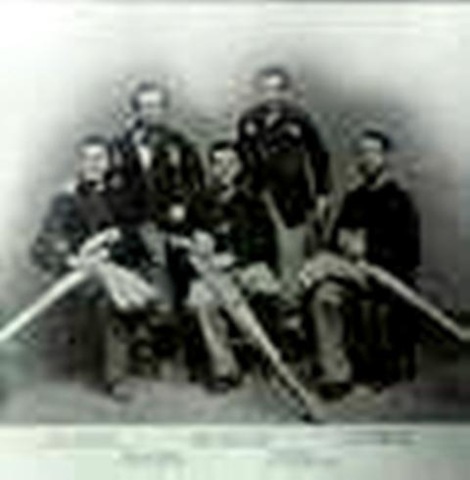
The soldiers of the Union Army pushed and pushed all over again for the first lifetime disability pension in American history. Initially the U.S. government offered disability pensions only for battlefield injuries. The soldiers pictured here at the famous Armory Square hospital in Washington, DC would have fit this category. Notice by the way that the men in the front row are holding their oversized crutches –the crutches were a “one size fits all” variety and In fact they were a liability when trying to walk.


Civil War Amputees  


Injuries received in war are more subtle and complex than they are instantaneous. Nowadays we all tend to understand this. (Or one hopes we do?) The soldiers who came home from the battlefields of the American Civil War were often crippled for life with maladies that included tuberculosis, infections, internal organ damage, progressive vision and hearing loss, not to mention post traumatic stress–which in those days was called madness.

The soldiers organized. The Union Army or “Grand Army of the Republic” kept marching for lifetime disability benefits. When President Grover Cleveland vetoed the first bill that provided for lifetime disability care for American veterans the veterans threw him out of office in favor of Benjamin Harrison who immediately signed the first guarantee of lifelong disability care into law.


I wonder if any of the men pictured above met the poet Walt Whitman who volunteered in the army hospitals in Washington. Whitman was a familiar figure in the dark and terrible wards. Thinking of this connection reminds me that just as we owe the immediacy of modern poetry to Whitman’s “Leaves of Grass” those of us in the disability rights communities owe a great deal to the soldiers who insisted that the care and treatment of disabilities should be a lifetime pact. Their work spurred on the adoption of 20th and 21st century social programs and laws that continue, however imperfectly to promise dignity to all.


S.K.