According to TypePad, the company that provides the platform
for this blog, one can now post via e-mail. I am wondering if this is true. I
haven’t been a credulous man since the Nixon administration. So I am
testing this e-mail feature. Here is a spontaneous limerick:
A limerick is an artform sublime
If you like to have smut that will rhyme:
What sounds just like sex, but carries no vex
That’s “truckin’” for “Tex” “on a dime”.
Okay I admit that made no sense. Here’s another:
A limerick is an artform disgusting
Since it’s never concerned with dusting:
There’s never a broom or a shot of perfume,
But always there’s old fashioned lusting…
I’ll keep my day job. Test Test…
Professor Stephen A. Kuusisto
Department of English
Department of Ophthalmology
The University
of Iowa
308 EPB
Iowa City, IA 52242
Office: 319-335-2608
Stephen-Kuusisto@uiowa.edu
Month: July 2010
Support for Evelyn Towry
The article below came to us via Inclusion Daily Express and you can read the full piece at the link. Whenever I see a story like this one I’m reminded that this could happen in my own community. It could happen anywhere in the United States, for indeed the public’s perceptions about disabilities and the concomitant failures of civic training regarding how to help people with disabilities remains a huge problem. I weep for Evelyn Towry. I applaud her parents. I’ll never forget what it felt like to be a kid with a disability in public school. And we thought things were supposed to be better nowadays?
S.K.
Parents Sue School District Over 8-year-old Daughter’s Arrest
(Spokesman-Review)
July 14, 2010
BOISE, IDAHO– [Excerpt] The parents of an 8-year-old autistic girl who was arrested at her northern Idaho elementary school are suing the school district and the sheriff’s department in federal court, contending the agencies violated the Americans With Disabilities Act.
Spring Towry and Charles Towry, along with their daughter, Evelyn, filed the lawsuit Friday in Idaho’s U.S. District Court against the Lake Pend Oreille School District and the Bonner County Sheriff’s Department.
The family claims the district discriminated against Evelyn because of her disability, and that the school failed to make reasonable modifications so she could access to school services and facilities. They are asking for unspecified monetary damages.
The case arose Jan. 9, 2009, when the Kootenai Elementary School third-grader was arrested, handcuffed and taken to the county’s juvenile lockup on suspicion of battery. School staffers said Evelyn had spit on and inappropriately touched two instructors. The child was later released to her parents, and the prosecutor’s office dropped the charge against her.
Entire article:
Parents sue over 8-year-old’s school arrest
http://www.InclusionDaily.com/news/2010/red/0714d.htm
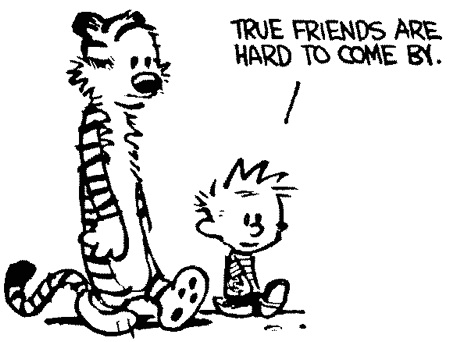
Calvin & Hobbes in a cartoon, wistful, Calvin saying: "True friends are hard to come by." I have always read Calvin & Hobbes as a story about a boy and his "guide tiger" –it's a service animal narrative. May you experience the Tao of the Anima wherever you are.
Taxiderming Trigger and Other Thoughts
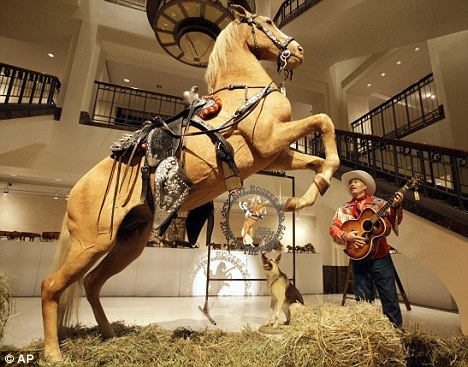
I woke this morning to the news that Roy Rogers horse “Trigger” has been purchased by a TV company in Omaha or someplace like it–I forget the details. I was sipping my first coffee of the day. Who would taxiderm his horse? Did Roy keep old Trigger in his living room? Did Trigger suffer the indignities of unused exercise equipment, underpants draped over his withers? Oh it’s just not right! Not right at all!
In the photo above one sees Trigger, not only stuffed, but arranged in mid-rearing, his front hooves high in the air. Oh it’s just not right! And look! There is the background is a mannequin dressed like Roy Rogers! Cowboy hat! Little cowboy suit! He has a guitar! He’s singing to his taxidermed horse which is causing the horse to startle in terror! Oh the whole thing is absolutely ghastly! Is it possible to be an animal torturer after death? Is this story related in any way to Mel Gibson?
**
Invective Against Horses
I suppose, like most people, that I one day will experience great good fortune… or a great calamity… and in either case these are one and the same. And like all such men I partake of magical thinking and believe that my thoughts will either spare me or damn me, for this is the way of superstition. I must engage in the lovely, indifferent thoughts of the holy man while making my way down the sidewalk on MacDougall Street. And if I should think the wrong thing someone somewhere may break his back and one of those obscure gods of philology will turn me into something inorganic.
**
If you have no sentimentality you will admit that horses are detestable. With their steam and speed they exemplify the dreadful ideas contained in my first paragraph. They are skittish, electrified, panicked, fearful of planting their hooves.
**
Rudyard Kipling (who I also detest) once said that fiction is truth’s elder sister. This sentence makes good sense when applied to the horse. The ancients told wonderful stories about horses: Pegassus, the winged horse of poetry; etc. The Phaedrus. Black horse. White. Equine tandem of noble philosophy. It’s all splendid. Too bad the horse, the literal, thistle eating, one ton horse is insane!
**
The Freudian horse: I was bitten as a child.
The Jungian horse: my not-so-hidden feminine libido.
The Reichian horse: I prefer to eat standing up.
The Republican’s horse: comes from Kentucky.
The Democrat’s horse: comes from Best Buy.
**
Truth in advertising department: my wife loves horses. I love the fact that she loves them. My wife would never stuff a horse.
S.K.
Sarah: Why we love her!
But McCain is a boy. His appeal among the fawning members of the Media who are his most ardent fans is supposedly based on his being a real macho man, but he is a boy. He has little self-control and no sense of cause and effect and doesn’t look either forward or backwards so that his moods are always dictated by the pressures of the moment and he is guided by his moods. He wasn’t gutsy enough to go with Lieberman. He wasn’t responsible enough to stick with Pawlenty. He was scared, desperate, and, probably, in a boy’s mood to say to all the responsible adults around him, Screw you, I’ll do whatever I want.
Trenchant analysis of McCain and by turns of his selection of Sarah Palin as his running mate. The story that won't go away…
The Symbolic Mind: A Disability Studies Polemic
I was in a Chinese restaurant in New York City last week. We were a disability-centric group: one of us had CP, another was a wheel chair user, one had HIV, one was visually impaired with a guide dog. One was a scholar of disability studies, another was a medical doctor. We sat at a table with a Lazy Susan, the garlic broccoli and the General Tso’s chicken spinning around. As conversation unfolded it became clear that one of us was blaming doctors for all the associated problems of people with disabilities. I knew “our doctor” “at table” as an ally, one who understands implicitly all the vagaries and dilemmas of disability discrimination. I could see that the doctor was willing to absorb some contempt but I felt, and not for the first time, a deep weariness with the cant of disability studies. I heard the voice of Bill Clinton in my head saying: “That dog won’t hunt.” Yes, there is a long history of medical insensitivity–and worse, a history of organized hypo-institutionalized discrimination against PWDs. Yes, contemporary medicine is still often divorced from sufficient awareness of how disability functions as a social construction, one that descends directly from a rather Victorian medical model of disability. And yet there are doctors who possess tremendous capacities of consciousness. There are many more than the brittle “blame it on the doctors” reflex of disability studies may admit.
When human beings confuse the negative facts of history with the symbol making power of of the psyche they invariably abandon insight. All of us prefer the think and pungent condensations of symbolism to the harder work of human psychology.
I know for a fact that the doctor in question was a bit wounded by hearing the “blame it all on doctors” rhetoric of the disability studies scholar. “Who the hell wants to be a doctor anymore?” she asked me later. “No one likes doctors. All we do is take abuse.”
It is wrong to pathologize the doctors just as it is wrong to pathologize those who seek treatment though perhaps they may not be curable–indeed may not with to be cured.
We all possess some magical incalculability. Let demons prove themselves so before assuming anything. A good practice.
S.K.
So I Went to New York

Going to “The Big Apple” offers me a fair slice of nostalgia for I used to live and work in the metro New York area and back in the year 2000 I was even (yes, hold onto your chair) I was even offered a job by Rudy Giuliani to direct the Mayor’s Office for People with Disabilities. I chose instead to return to teaching and that’s the name of the song. I really didn’t want to work for the Giuliani administration. There was plenty of cathected heartlessness in that bunch.
My term for cathected heartlessness is “The Shackleton Effect”. When things got tight Shackleton and his crew shot and ate their dogs. That’s how it goes when things get tight. Nowadays we see plenty of evidence that our nation’s political culture has adopted the Shackleton Effect. In the Giuliani administration there was a lot of noise about putting welfare cheats back to work. Funny how lots of those folks were actually people with disabilities.
Today, just across the Hudson River Governor Christie has adopted a state budged that wipes out programs for the disabled. He doesn’t want to hurt the millionaires. And as New Jersey goes, so goes the nation. The Shackleton Effect is becoming legion.
Yes, I’m using dogs as a metaphor. Dogs are loyal and they depend on their human partners. Right about now I’ll venture that people with disabilities need all the human partners they can get–especially in politics.
So anyway, I went to New York. I spoke at the New York Public Library as part of a panel on the ADA. Remember the ADA? Everyone is remembering it this summer because this is its 20th anniversary. Yes it is good to remember the ADA. We’re all for remembrance. But we’re also for the ADA “in the breach” or in the trenches.
Imagine my dismay when upon arrival at Newark International Airport late last Tuesday evening I was immediately denied a taxi ride. The driver in question, when confronted with the law, told me he didn’t give a shit. Said it right in front of the cab stand dispatchers and a long line of waiting customers. A guy behind me said: “Fuck, I’m not getting in that cab.”
The nest morning I endeavored to call the New York Taxi and Limousine Commission only to find that their telephone number has been incorporated into a city-wide system called “311”. Apparently the idea is modeled on 911. The system is supposed to streamline city services. But Lo and Behold its also a Byzantine loop of messages and hang ups. I never did get in touch with anyone who might help me file a complaint.
I’m quite pissed off. In general I don’t like being pissed off. But my mind is skinned. I will file a complaint however meaningless it may prove to be. However long it takes me.
**
It is hard to go places when you have a disability. The restaurant doesn’t have wheel chair accessible restrooms. The cab won’t pick you up. When you factor in the extraordinary unemployment rates for people with disabilities it leads one to ask: “Why go anywhere?” Indeed. Some days the whole matter seems hopeless.
To paraphrase Allen Ginsberg: “America I’m putting my crippled shoulder to the wheel.”
I guess that’s why I keep writing this blog.
**
Writing a blog feels a bit like being an old style Ham radio operator. Is anybody out there? “Come in, Rangoon!”
**
A long time ago, in a galaxy far away, I believed (with ardor) that the Americans with Disabilities Act would usher in a thrilling new era of employment opportunities for people with disabilities in this country. I was only 35 years old when the ADA was ratified and signed into law. I suppose you could say that I was just young enough to be uplifted by the adoption of a sweeping civil rights law. Young people are necessarily idealistic and thank heaven for that fact.
Still, 20 years later I can see how the organized “disableism” of corporate and cultural forces have worked assiduously to undermine the ADA and to further ensure that people with disabilities remain largely unemployed.
In fact, the U.S. Supreme Court has been so hostile to disability rights that Congress had to create legislation to restore the employment discrimination oversight powers of the ADA.
Disableism is in my view the organized and determined use of power to prevent people with disabilities from becoming full members of society.
I believe along with tens of thousands of other people who have disabilities that the highest court in our land is guilty of disableism.
Justices like Antonin Scalia believe that people with disabilities should be grateful just to be carried up a flight of stairs when there’s no ramp available in a federal building. You can look it up.
Disableism is still rampant long after the ADA.
Shame on our Supreme Court. Shame on employers who set back the cause of employment for people with disabilities.
In this month when disability rights advocates are blogging about the anniversary of the ADA I want to remind cyber space that the work for inclusion is perhaps even more critical now than it was when the ADA was first conceived. Remember, Governor Chirstie is taking books away from the blind and physically disabled in the Garden State.
Disableism is alive and well in the halls of government. Governor Christie does not believe in the rights of people with disabilities. He thinks cripples are on the dole. Such people are shameful, and I still believe that these politicians are out of step with our nation’s sense of fairness.
This is why I’m getting a crick in my neck while typing at this little laptop on a beautiful day.
S.K.
Moving
By Andrea Scarpino
(Somewhere in Michigan, we think…)
Driving across the country for four days with three cats, suitcases, computers, a printer and scanner, kitchen essentials and Subway sandwiches fit into every available inch of car provides ample material and opportunity for contemplation.
For one thing, the scenery changes. Brown swathes of desert give way to redder swathes, then small shrubs and evergreen trees appear, then tall grasses and farms, rolling hills and deciduous trees, small lakes. The people change, too. Their accents lilt one way and then another, and their language changes—from soda to pop, from like to you know. Their clothing, bumper stickers, political signs change.
This is a huge country, I kept saying to Zac, which of course is something I should have already known. I’ve visited many countries where a drive from end to end can take just one day, where a train can bring you through multiple customs stops in just one afternoon. But passing through state after state, day after day, really hits home just how expansive the United States really is, how many different types of people call it home, how many different ideologies and time zones and landscapes and climates interact in one space.
Almost every presidential election, I look at the blue and red colored maps all the news organizations produce and say, We’d really be better off if this country were divided in two. I would be happy, in those moments, to give Texas back to Mexico—in fact, to concede much of the southern and middle states, to build my own country of coasts. But as I drove through some of those middle states (states that Californians like to call flyover), as I watched the changing landscapes and cultures, I wasn’t quite so sure.
And I worried at my snobbishness. Who am I, after all, to cut out entire states just because I don’t agree with their politics? Who am I to stand on my soapbox and decry entire citizenries stupid or less than? Yes, I was terrified by the man pumping gas in Utah with a pistol visibly strapped to his waist. But I have family members who own guns and I’m not sure I’m ready to disallow them from the Union. No, I’m not a big fan of the lack of vegetarian options at restaurants between Los Angeles and Chicago. But I’m also not sure that warrants complete state-wide ostracization.
Driving across the country with most of my worldly belongings squeezed into our car, I thought about the presidential candidate speeches that used to rankle me—how candidates talk about traveling our great country or meeting people in small town America. How they act like seeing our country unfold from a tour bus or airplane helps them understand something about Americans. But now, I almost feel like I get it. Something shifted in my thinking as I drove across the country, as I watched the incredible diversity of the United States unfold from the seat of a car. I’m not sure what to call it or how long this feeling will last, but I feel, for the first time in my life, like all the varied and strangely cut pieces of our country actually fit. That that gun toting Utah man belongs in our country just as clearly as I belong (if, indeed, I do belong). That there’s something magical about so many types of people and landscapes and accents and climates coming together into one country, one populace, somehow, somehow, making it work most of the time.
Poet and essayist Andrea Scarpino lives now in Marquette, MIchigan and is a regular contributor to POTB. You can visit her at: www.andreascarpino.com
Melancholia on the Fourth
I have been trying to cheer myself, what with two suspect wars at hand and watching 4,000 young Iowans boarding planes for Afghanistan. “Cheer” is course the wrong word, trite in all its variations. But I have been opposed to these conflicts and continue to oppose them. I will try any spiritual nick-nack, any mega-theric penny candy I can find.
Today I remembered an anti-war poem from the Viet Nam era by Bill Knott entitled “Prosepoem to Hart Crane”. Knott’s poem is better than penny candy. I first encountered it in Robert Bly’s magazine The Seventies. Here are its opening lines:
India and China, please help, there is a famine here, an
American famine, there’s no longer enough America to
Feed Whitman or Poe, and I’m getting very thin. Oh drop-
ping bombs upon what no longer exists! Glances traveling
through life and death…
**
My melancholia on the fourth is marked by this unshakable sense that our nation is dying spiritually, that there are few heroes of the moment who might stand and say that our job is to feed the world, embrace human rights, and to finally, finally reject imperialism.
To paraphrase Lou Reed, somewhere an arms manufacturer is laughing til he pisses his pants.
My job, the job of conscience, the job of laughter that isn’t burnt, of tears that are not bled out is to play the same song over and over.
Here, for what its worth, is a poem I wrote against the “wars” almost three years ago.
Life in Wartime
There are bodies that stay home and keep living.
Wisteria and Queen Anne’s Lace
But women and children too.
And countless men at gasoline stations.
Schoolteachers who resemble candles,
Boys with metabolisms geared to the future,
Musicians trying for moon effects…
The sky, which cannot expire, readies itself with clouds
Or a perfect blue
Or halos or the amoebic shapes
Of things to come.
The railway weeds are filled with water.
How do living things carry particles
Of sacrifice? Why are gods talking in the corn ?
Enough to feel the future underfoot.
Someone is crying three houses down.
Many are gone or are going.
S.K.
P.S. We at POTB believe that Bill Knott and Robert Bly continue to be national treasures…
Finding Meaning in a Dropped Nail: Disabilities and Personal Archaeology


The Swedish poet Gunnar Ekelof wrote: “When you have come as far in meaninglessness as I/each word is interesting again…” These words are like things hidden in the dirt which we dig up with an archaeologist’s spade. Even the personal pronoun “I” can be retrieved from the loam of history. Ekelof holds the “I” up to the light, dirt still clinging to it. He says that perhaps it was a flint shard “that someone in his toothlessness used to scrape his tough meat”.
Pronouns are embedded in a long history of sufferings. Each generation must bury them in order to live. I remember first understanding this when as a teenager I dug up a 19th century burial ground of old bottles–patent medicines all. That was a burial site of spring and fall toothaches and infant deaths. And the high school students cleaned the bottles and took them home and put flowers in them.
Under the dark membrane of the cultural or collective unconscious are nails and broken wheels; spaces filled with unease; mutilated faces and broken hands; blind children, dark and alone; the smiles of consumptives; glittering rivers in their ancient beds; wounded soldiers making their ways on homemade crutches; oh and there are abstract assertions down there–crippled survivors are the merchants of catastrophes, the mendicants of the evil eye. The ancient pronouns with the dirt still clinging still have meanings, miscast though they may be, like the figures of an Italian circus. Human sentimentality has no sophistication. See, this man over here has the evil eye. We must kiss the bull’s horns.
Each generation must bury the sufferings of the past in order to live. And yet, when we dig these shards of mutilitation up, when we hold them to the sunlight, we must know that they stand for. This is the work of cultural advancement. We must know that torture is torture and not miscast it as an “enhanced interrogation technique” as the W. Bush white house (spelled small) did recently–an Orwellian miscasting that was glibly echoed by our mainstream press. Waterboarding is torture. It was always torture. Hold a buried pronoun up to the light. The people who came before us understood this matter.
This is why we pay attention to old suffering. We do not see it as prologue to our own. Susan Shweik’s excellent book on the history of “the ugly laws” in the United States tells us a good deal about the ways that civic spaces were closed to people with disabilities or people who were in any way deformed. The good and tasteful citizens of Chicago or Columbus, Ohio, or scores of other cities wanted people who made them uncomfortable “off the streets” for indeed, are not our civic byways places of recreation and amusement? By the late 19th century America had plate glass windows and the new ideal that our cities were places for shopping–the city was a new proscenium arch with its Santa Claus. No one wants to see a cripple in front of Macys. Hence the ugly laws.
Old suffering is not a prologue. But it informs. Troubles. In Iowa City, Iowa where I now live, the city fathers and mothers are trying to get the pan handlers off the down town streets. The pan handlers are not violent. They cause no trouble, unless of course the matter is essentially an aesthetic problem. And of course Americans won’t say this. They’ll say that the pan handlers are a nuisance. If being asked for a buck is a nuisance then of course we can create an enormous category of nuisances: the clock on the bank is a nuisance, for it causes me to recall that I’m in a hurry. Grazing cows are a nuisance: they make a man look away from the road. The fluidum of earning and paying is a nuisance. Yes, the economy is a nuisance. And purple Mohawk haircuts; rose bushes; other people’s lullabys–these are all aesthetic problems. They cause me to have to think. How I resent this! How I resent the other people! (Are we getting “close” to the “Tea Party” types yet?)
Here come the people with disabilities–both visible and invisible. They project the dread of the underworld to my easy eye–my lazy eye–my shopper’s eye. Oh I do not want to be inconvenienced by an old dirty bottle dug up from behind the shopping mall, a blue vial that once held patent medicine. I do not want to be inconvenienced by knowing of the infant mortality rates in the U.S. or the numbers of homeless veterans or the unemployment statistics for people with disabilities. Please do not make me think of these things.
The long struggle of people with disabilities lives in our contemporary language and it lives in our culture’s nonobservance. I would ignore the past if I could. But it is all around me.
Even so, I do not believe the past is prologue. Gene Robinson, the first gay bishop of the American Episcopal church does not think the past is prologue.
Again, Gunnar Ekelof: “the little word You, perhaps a bead that once hung from someone’s neck”
Let us imagine someone who was brave, who asked difficult questions, who held onto hope with everything she had. Who did not forswear imagination.
“Yes, I long for home,
Homeless I long for home,
Home to where love is, the one, the good,
Home to my real home!
That home is bright –
In my mind I open the door,
See everything awaiting me there.”
–Gunnar Ekelof
S.K.
 Planet of the Blind