The Poet's Tower

I’ve an old friend, the poet David Weiss. David and I go back a long way–we first met when we were teaching together at Hobart & William Smith Colleges back in the early 1980’s. David was married to the poet and memoirist Deborah Tall who also taught at HWS. Deborah passed away four years ago after a long fight with a virulent form of breast cancer.

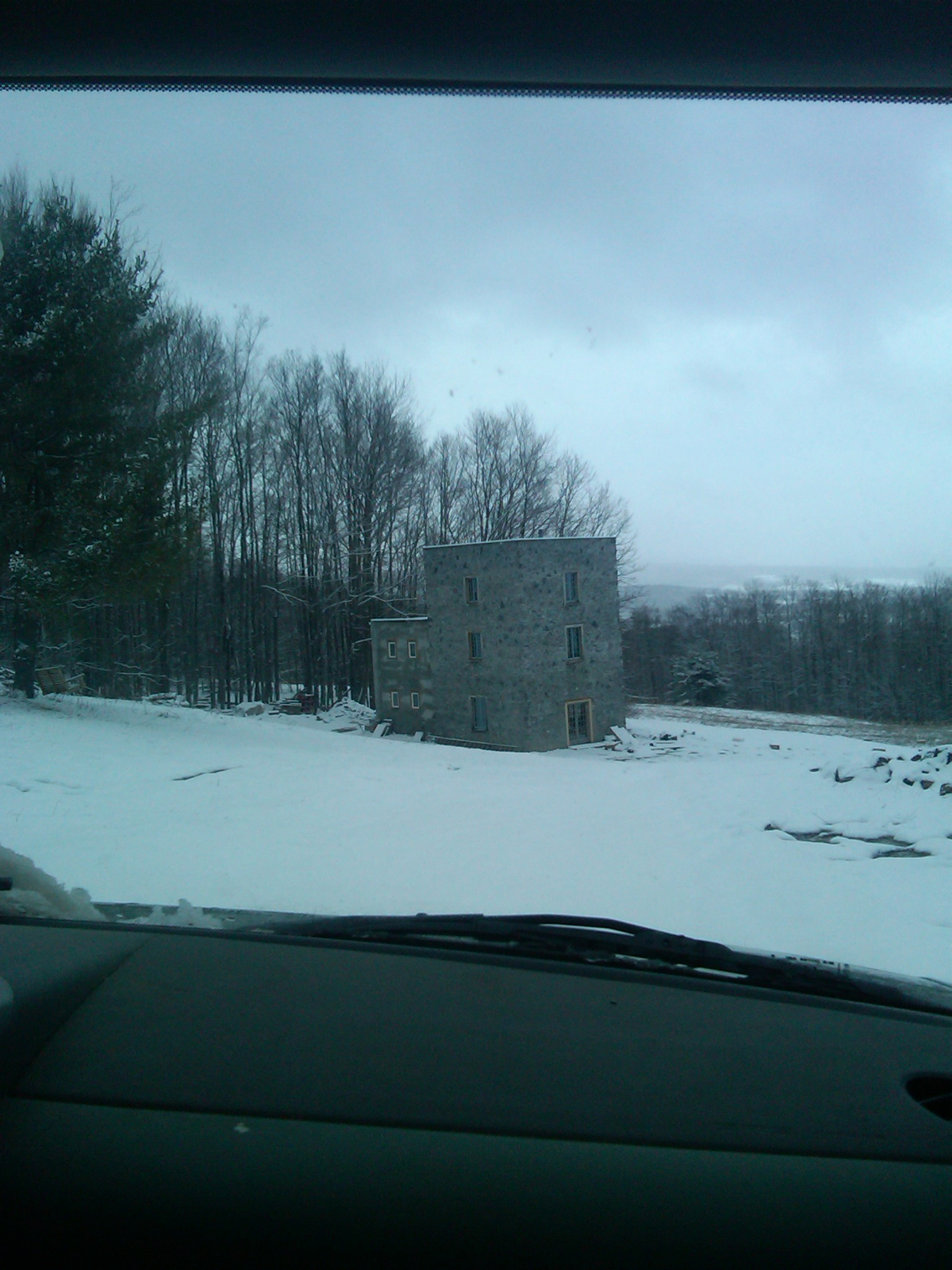
And now my dear friend has done what poets have often done in the dark seasons: he’s built himself a stone tower. The tower is in the woods outside of Ithaca, New York. The construction has been a labor of extraordinary proportions for David is in his mid fifties and he did an enormous amount of the work himself. He also had the wisdom to hire Amish carpenters who know some truly old world crafts and who also know how to find a good bargain when it comes to quarrying. But Amish help aside, the tower which is now almost complete is a rare and exacting testimony to poetry’s province for this is a room of one’s own–a building that’s so quiet you can hear the ringing of the air behind its foot thick walls.

The tower is also currently the home of a white rat who nibbles at David’s produce in the night. I’m urging him to tame the rat for surely it’s proper if you’re a poet in a tower to have a white rat as your guest.

We do not know what David’s lovely new wife Bobbi will think of the rat idea.

S.K.

The Poet's Tower

The Daily News story – Don't send us back to shelter!

Last August, after more than a year of struggle, Fantausha Nelson of Morris Heights climbed out of homelessness. Her daughters got their own bedroom and Nelson found a new job.Now her family could be headed back to the shelter system, because of a budget battle between Gov. Cuomo and Mayor Bloomberg.In response to a proposed state budget cut, the city has abruptly ended its Advantage rental voucher program for poor households, and 45,000 people will probably end up homeless again.The city Department of Homeless Services broke the news to 15,000 households by mail last weekend, panicking Advantage renters in the Bronx's poorest neighborhoods."I just got my life together," said Nelson, 23. "Now I don't know what's going to happen."DHS Commissioner Seth Diamond said Cuomo plans to slash the state's $65 million annual contribution and $27 million in related federal funds, and has faced little heat from state legislators."There is nothing stopping the city from continuing to support this program," said Jeffrey Gordon, Cuomo budget spokesman.But last week, the city withdrew its $48 million share. DHS has stopped signing Advantage leases and won't cut rent checks unless Cuomo changes his mind. His budget is due April 1.Advocates, including City Councilwoman Annabel Palma (D-Bronx), are blasting the cuts. Her General Welfare Committee reviews the decision today. "Eliminating a program that working families rely on…is simply not responsible," she said.But critics hope Cuomo's cut forces the city to adopt a new housing policy. "We don't support restoring funding for a program that's a failure," said Patrick Markee of Coalition for the Homeless.The program pays $1,100 a month toward rent for working people, lasting up to two years. It's supposed to keep them out of the shelter system, which costs taxpayers $3,000 a month per family.Diamond said 90% of people who complete the program don't become homeless again right away. But half of the thousands who leave the program wind up on another housing subsidy or reapply for shelter.Markee said the city should rely on federal programs, Section 8 vouchers and public housing. But Diamond warned that ending Advantage will force the city to build 70 new shelters.Local: http://www.nydailynews.com/ny_local/bronx/2011/03/24/2011-03-24_dont_send_us_back_to_shelter.html

Reading this on your mobile device? Try NY Daily News now by clicking http://nydailynews.com/mobile."

The Daily News story – Cuomo's plan unhealthy for nursing homes?

State nursing homes say Gov. Cuomo's budget will cripple them and force massive layoffs."As much as the owners truly regret being forced to do it, they know they must implement significant reductions in staff," the Coalition for Affordable Care, a group representing owners of 40 state nursing homes, warned health care workers in a letter this week.The coalition says the state has already slashed $1.4 billion in nursing home funding since 2007 – and could lose even more if Cuomo's budget is adopted."The last few years have ravaged the nursing home industry," said John Chobar, executive director of the group.Nursing homes may be forced to eliminate as much as a quarter of its staff, Chobar warned.He noted workers with the least seniority would be the first to go under union rules."You are going to find a tremendous amount of people being put out of work," predicted Bruce Peckman, owner of Highfield Gardens nursing home in Great Neck, L.I.New York's entire health care industry could face massive layoffs since Cuomo ordered $2.85 billion in cuts to Medicaid.The union representing most nursing home workers, 1199 SEIU United Healthcare Workers East, said it received the coalition's letter, but claimed it wasn't familiar with the group.It backs Cuomo's Medicaid plan.klucadamo@nydailynews.comLocal: http://www.nydailynews.com/ny_local/2011/03/24/2011-03-24_govs_plan_unhealthy_for_nursing_homes_say_owners.html

Reading this on your mobile device? Try NY Daily News now by clicking http://nydailynews.com/mobile."

Silent Pain

By Andrea Scarpino

Pain’s silence. From elementary school through college, I struggled with Reflex Sympathetic Dystrophy, used crutches to walk, took prescription painkillers by the handful. But I mostly struggled in silence, rarely telling friends why I missed every gym class, never played a sport, why I missed so much school. And they didn’t ask.

For the last 12 years, mastalgia, crippling pain in my breasts. I know this sounds bizarre. I know it’s uncomfortable, difficult to imagine. But the pain doesn’t care, lasting from three days to three weeks every month. And it’s not localized. It’s swelling, radiating heat, weight gain. It’s all-encompassing body pain. I can’t exercise. I can only wear certain shirts. When someone jostles me in a crowd, I fight back tears. Hugging a friend, my partner, makes me gasp. I know it’s bizarre, uncomfortable. Who has crippling pain in their breasts?

I’ve gone to a bevy of doctors and specialists, many of whom are also clearly uncomfortable when I present my symptoms and the years of charting I’ve done to track the pain, try to understand why it ebbs and flows. I’ve tried everything from acupuncture to eliminating from my diet soy/caffeine/salt/dairy. I’ve had mammograms, ultrasounds, extensive blood work. I’ve rubbed iodine on my wrists, eaten only cruciferous vegetables, taken B vitamins, Evening Primrose Oil, birth control pills, progesterone. Nothing has brought lasting relief. Nothing has even come close.

So here it is, this silent pain. Again, I seldom tell friends—it’s a boring conversation to have again and again—yes, 7 days of pain this month. Yes, 11 days last month. I mostly don’t even tell Zac any more, though he can tell when things are getting bad—he can feel heat radiating from my chest, feel my body tense protectively when he comes close. Mostly, I struggle with mastalgia silently. The first thing I do every morning is scan my body for pain. When I’m in pain, the last thing I do every night is try to position myself comfortably, take a few slow, deep breaths, imagine the pain will be gone when I wake up. After 12 years, I’m starting to realize mastalgia is part of me; not a part I choose, of course, and a part I would trade most anything to be done with. But hating the pain doesn’t make it go away. Neither does raging, begging or crying. It just stays.

So I’m trying, trying to live with it, in silence mostly. Trying to ebb and flow as it does. Trying to be okay with pain, with silence. As Samuel Beckett writes at the end of The Unnamable:

It will be the silence, where I am? I don’t know, I’ll never know: in the silence you don’t know.

You must go on.

I can’t go on.

I’ll go on.

Andrea Scarpino is a poet and essayist who currently lives in Marquette, Michigan. Visit her at: http://www.andreascarpino.com
Syracuse University

I spoke here yesterday on lyric writing and disability studies to a group of students and faculty who hailed from every corner of this large university. It was clear that they weren’t just there for the cookies. (Though the cookies were mighty good and I had two of them.)

Lyric writing is dynamically fractured as are all reveries–there’s a diastolic cycling of forceful intelligence with delicacies of feeling–a matter that I believe reflects the psycho-social experiences of people with disabilities.

I mentioned a great 20th century Italian lyric poet Salvatore Quasimodo and in a lovely bit of synchronicity the carillon rang.

That’s why nonfiction is so great! Who needs to make anything up?

S.K.

Getting the Word Out About Mental Disabilities

Myths And Stereotypes About Mental Disabilities Greatest Barrier To Employment
(U.S. Equal Employment Opportunity Commission)
March 16, 2011
Excerpt from Inclusion Daily Express
WASHINGTON, DC– [Excerpt] The greatest barrier to employment for people with intellectual and psychiatric disabilities are employers’ myths and fears about their condition, not the disabilities themselves, the U.S. Equal Employment Opportunity Commission learned at a hearing held today. The hearing focused on a group whose rate of unemployment and underemployment far exceeds the national average.

“We want job seekers, workers, and employers to understand the requirements of the Americans with Disabilities Act and be well equipped to comply with them,” said EEOC Chair Jacqueline A. Berrien. “Today’s Commission meeting provided an important opportunity to dispel myths and learn about effective ways to dismantle barriers to employment for people with disabilities.”

Sharon Lewis, Commissioner of the Administration on Developmental Disabilities, U.S. Department of Health And Human Services, underscored the need to dismantle barriers for people with intellectual disabilities, noting that “the proportion of the population of people with disabilities who are employed is estimated to be 17 percent, compared to 63 percent for people without disabilities.”

As Ruby Moore, Executive Director of the Georgia Advocacy Office, the designated Protection and Advocacy System for People with Disabilities in Georgia, told the Commission, “one of the biggest obstacles to employment is consciously and unconsciously-held beliefs about people with psychiatric, cognitive or intellectual disabilities.”

She further testified that most of the accommodations individuals with mental disabilities require can be provided in a well-managed, flexible workplace often without any out-of-pocket costs to the employer. She stated that these flexibilities have the effect of aiding all employees, not just those with disabilities.

Entire article:
Myths and Stereotypes About Mental Disabilities Greatest Barrier to Employment
http://www.eeoc.gov/eeoc/newsroom/release/3-15-11c.cfm
Related:
Meeting of March 15, 2011 – Employment of People with Mental Disabilities
http://www.eeoc.gov/eeoc/meetings/3-15-11/index.cfm

On Division, Mark Twain, and Trips to the Woods

“To get the full value of a joy one must have someone to divide it with,” said Twain. I believe he also said a contingent thing about grief—that it can take care of itself. I will look it up, as Twain would say, by and by.

How many times have I divided joy with someone? What does dividing joy mean? I think the division is often unspoken though not always.

I remember my sister, now a physician in New York, once telling me about a holy woman, a guru, who emanated joy without speaking; how her followers just swelled up with the electrolysis of divinity; that the whole thing was quite sincere. I didn’t make a joke. Her story was of unaffectedness, naturalness, human beings around a fire—never mind it was imaginary. And there’s nothing wrong with an imaginary fire, unless of course you need a real one. The unspoken joy is longitudinal; it spreads like motes.

But I like not having to say a thing. A miniscule joy? The smallest joy in the world. A friend to see it also.

How it happens:

I’m in the woods with my friend David. We’re walking among trees. We’re respectively trying to not poke our eyes out on the small branches. We’re each trailing spider silk from our ears and pates. We’re shivering on the inside. I remember someone saying that delicacy in women is strength. I imagine I’m a strong womanly man among spiders, sunlight falling before me, sweaty hands outstretched.

Then we are laughing. Neither of us has said a thing. One of us may have swallowed a spider but won’t say. One of us has inoculated himself against trepidation by climbing through an invisible window. You can’t say a thing about that while walking between trees. What would you say: “Friend, I’ve just climbed through a window on Mt. Athos, called by incense dating back to the ur-villages of the Red Sea.”

No you wouldn’t say this. Nor would your friend quote Alexander Pope aloud: “The spider’s touch, how exquisitely fine! Feels at each thread, and lives along the line.” He would perhaps think of it. But then a twig would catch at his leftward eye socket. He’d be driven back to shuddering.

But there it is, two men trembling without spoken words and moving among trees. This is a fine thing.

There’s the proverb: “Silence is also speech” but this kind of sentiment tends toward the truisims of emotional intelligence—“There is no reply to the ignorant like keeping silence.”

I’ve always liked Alduous Huxley’s assertion: “After silence, that which comes nearest to expressing the inexpressible is music.”

S.K.