Payment in school bullying revealed
Sent from my iPhone
Payment in school bullying revealed
Sent from my iPhone
…oh, dear lord, not this again. This is what happens all the time. For some reason, and I will never figure out why, people seem compelled to insist that, if we just look past his Dickhead Tourette's, Newt Gingrich has an interesting mind. (And, no, he really doesn't. He has a mental steamer trunk full of Rube Goldberg contraptions, some history he bought cheap off the "Irregular" pile, and toy dinosaurs.)
We thank Señor Mannion for bringing us this priceless quote by Charles Pierce…
Just eight days before last Christmas, the light of Kara Dorsey's life died. Birch, the yellow lab who helped guide Kara through the world, passed away in her arms, on the bed where she had often stroked his tummy. Birch, who was 14, was wearing the blue service vest he earned as a canine companion to Kara, who is paralyzed from the chest down and struggles to use her hands.
Loving a faithful service dog and saying goodbye: the hardest journey of all. I still have my beloved Corky's ashes always near.
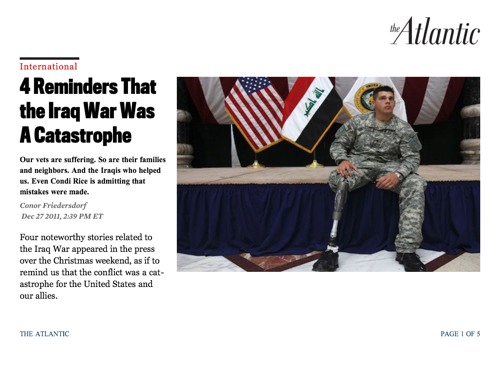
4 Reminders That the Iraq War Was A Catastrophe
(Sent from Flipboard)
Stephen Kuusisto
Director
The Renee Crown University Honors Program
University Professor
Syracuse University
The eyes are silent until one listens. A doctor I know can hear your eyes turning softly like leaves on Thoreau’s pond–one chooses Walden, a tabula rasa, the seasons written on water.
The doctor, my doctor, hears a blind child’s eyes with their animal faith, the essence whispered of thousands of consequential worlds.
Every eye is the electrolysis of drama. Each eye holds the predicament and labor of
life, even a blind one with its involuntary confusions.
In the flux and rumble of the sea, a hagfish, a long tunnel of living darkness evolved twin patches that sensed the light–diurnal, hunting, feeding.
How beautiful its ephemeral hallucinations must have been, driving upward into sun.
How beautiful to have seen in vacuo: light as light, light as the existence of unseen things. How beautiful to hear the light throughout your body, paleocene glimmerings of life itself.
The eyes are silent until you listen with ardor. One sees they were never silent. The optic nerve of the hagfish, a tuning fork, the vibrations of uncritical instinct…
& the lamprey, first creature with risen, exophthalmic lenses, cameras of the deep lakes, what fanciful histories could its eyes tell? Black animal with no mouth, who drifts in and out of consecutive visions…
A blind child knew all the rains of summer & one night, beyond the pines, he saw the moon through two glass dishes, which, of course, they called his eyes.
– Posted using BlogPress from my iPad
http://www.latimes.com/entertainment/news/la-et-big-daddy-20111227,0,4747407.story
Stephen Kuusisto
Director
The Renee Crown University Honors Program
University Professor
Syracuse University
Why at 65 was I just discovering one of the truly significant poets of my era? Let me give two self-serving answers to justify my ignorance: we have never had an effective means to discover the best poets among us — think Emily Dickinson — and Ruth never learned how to play the game. Perhaps she took Whitman seriously when he urged the poets of the future never to humble themselves to anyone.
See full piece at NY Times:
– Posted using BlogPress from my iPad
Tell New York to stop chemical restraint of people with disabilities:
Sent from my iPhone
I saw this story on the BBC News iPad App and thought you should see it.
** Why were people once put in ‘human zoos’? **
An exhibition in Paris looks at the history of so-called human zoos, that put inhabitants from foreign lands, mostly African countries, on display as articles of curiosity.
< http://www.bbc.co.uk/news/magazine-16295827 >
** Disclaimer **
The BBC is not responsible for the content of this e-mail, and anything written in this e-mail does not necessarily reflect the BBC’s views or opinions. Please note that neither the e-mail address nor name of the sender have been verified.
Stephen Kuusisto
Director
The Renee Crown University Honors Program
University Professor
Syracuse University
There is more than one way to be blind. My pal Leo sees through his own periscope. He is the commander of a private submarine–the USN Leo Hauser and though his sighted options are limited, they're still fair. He drives his car in a gated community in Arizona largely because he can still do it. Sometimes he honks his horn. And though he's looking through a tube, the day is glossy and brilliant as a an old Kodachrome. Leo can tell you that while blindness is not always a preferred experience it's often more interesting than sighted people suppose. For some of us the colors are beyond compare.
Another friend–I'll call her Karen–(not everyone wants to be known for folly) runs through a field in Nebraska though she sees only light. But the light is so gold, so dappled and evanescent that her description makes you want to cry. The average sighted person can learn from her how daylight spins between brown and yellow tonic, the drafts she drinks between the clock and the sun. Just run beside her.
Sight is an immoderate thing, never static. It is, perhaps, the dearest sense. The flickering light of a fire, shadows on a hearthstone; the laughing element of sun on water; early morning eastern skies; the cold and steady light at mid ocean–many blind people know these things. Nowadays more blind people see something of the world than is commonly understood. When next you see a person with a white cane or a guide dog, imagine they have beauty both inside and out.
 Planet of the Blind