NYTimes: Christopher Hitchens, Consummate Writer, Brilliant Friend

A stunning piece on Christopher Hitchens’ last weeks by Ian McEwan:

From The New York Times:

OP-ED CONTRIBUTOR: Christopher Hitchens, Consummate Writer, Brilliant Friend

Where others might have beguiled themselves with thoughts of divine purpose (why me?) and dreams of an afterlife, Christopher had all of literature.

Stephen Kuusisto
Director
The Renee Crown University Honors Program
University Professor
Syracuse University

NYTimes: The Sound of One President Caving

President Obama has caved on his promise to protect the civil liberties of Americans. See Andrew Rosenthal’s excellent OpEd piece.

From The New York Times:

THE LOYAL OPPOSITION: The Sound of One President Caving

President Obama won’t veto the dangerous National Defense Authorization Act.

Stephen Kuusisto
Director
The Renee Crown University Honors Program
University Professor
Syracuse University

NYTimes: A Columnist Steps Away After More Than Three Decades on the Beat

From The New York Times:

SPORTS OF THE TIMES: A Columnist Steps Away After More Than Three Decades on the Beat

Writing about sports and the human condition from a broad canvas of topics, George Vecsey bids farewell to his Sports of The Times column.

Stephen Kuusisto
Director
The Renee Crown University Honors Program
University Professor
Syracuse University

Article: When An Atheist Dies: Religious Reflections On Christopher Hitchens' Death

Excellent piece by Paul Raushenbush in Huffpo:

When An Atheist Dies: Religious Reflections On Christopher Hitchens' Death

(Sent from Flipboard)

Stephen Kuusisto 
Director
The Renee Crown University Honors Program 
University Professor
Syracuse University

BBC E-mail: Google patents self-driving car

I saw this story on the BBC News iPhone App and thought you should see it.

** Google patents self-driving car **
The search giant is awarded a US patent for a system that tells driverless cars when to take control of the wheel.
< http://www.bbc.co.uk/news/technology-16197664 >

** BBC Daily E-mail **
Choose the news and sport headlines you want – when you want them, all in one daily e-mail
< http://www.bbc.co.uk/email >

** Disclaimer **
The BBC is not responsible for the content of this e-mail, and anything written in this e-mail does not necessarily reflect the BBC’s views or opinions. Please note that neither the e-mail address nor name of the sender have been verified.

Sent from my iPhone

Speaking about Iowa

Old Capitol Building U of Iowa


There's a dustup of sorts over at the Atlantic Monthly's website. The central concern is about "who speaks for the University of Iowa"–a matter that in this writer's view represents one of the social weaknesses of our age, for though Athens put Socrates to death (see: long history of fighting for the Agora) Socrates' comeuppance was a consequence of warring ideas. In the University of Iowa's case the war is over money. Briefly, UI professor of journalism Stephen Bloom wrote an article for the Atlantic in which he candidly and subjectively covers the insularity of Iowa's citizens and the post-industrial struggle for survival of rural Americans in an age of growing poverty. Bloom's article "Observations From 20 Years of Iowa Life" suggests that Iowans are rather red necky, addicted to hunting, largely ignored, (Iowa is a "fly over" state) and that the University of Iowa, once a standout institution in the Big 10 is so starved for dollars that it has admitted astonishing numbers of students from China in an effort to garner scarce tuition dollars. If you follow the "dustup" link above you can read UI President Sally Mason's response to Bloom in which she argues convincingly that Bloom doesn't speak for the university. Let me go on record as saying that I like Sally Mason. I know her and think that she's doing a fine job as the leader of a great midwestern university. She has been at the helm of the UI during a terrible time. A massive flood destoryed several of the university's buildings in the summer of 2008 and then the ersatz depression put the institution in a serious financial hole. I wouldn't want Sally Mason's job for all the coo coo clocks in Bavaria.

President Mason has presided at the University of Iowa during a time of draconian budget cutting. The arts campus of the university is still largely a ghost town some four years after the flood. The Regents of the university are more conservative and culturally unambitious than their forebears who took pride in the university's well deserved reputation as the arts school of the Big 10. Under the current Regents, the UI is largely conceived of as a small fry version of Michigan–heavy on the hospitals and clinics but content to bask in an old reputation as a destination point for the arts. Sally Mason points out that Iowa City is a great place–that it's a world city of literature (as designated by the UN) but this stems from the remarkable accomplishments of the alumni of the "Writer's Workshop" and the provenance of the International Writing Program and the Nonfiction Writing Program–all of which are struggling for basic funding so they can admit graduate students. The humanities are in trouble at Iowa and that a distinguished journalism professor would write an essay declaiming the malaise of Iowans is hardly surprising. President Mason writes vigorously in defense of Iowans, demonstrating their character and stamina. She's right. During and after the flood in 2008 people from all walks of life gathered on the UI's campus to fill sandbags and save the library. But this demonstration of grit doesn't change the fact that Iowa's Regents and politicans are starving their university and that across the state poverty and despair are on the rise. Who speaks for the university? We all do. I'm an alum. I think the UI needs all the help it can get. But Stephen Bloom has some solid points. The old gray mare, she ain't what she used to be…


The Biggest Loser


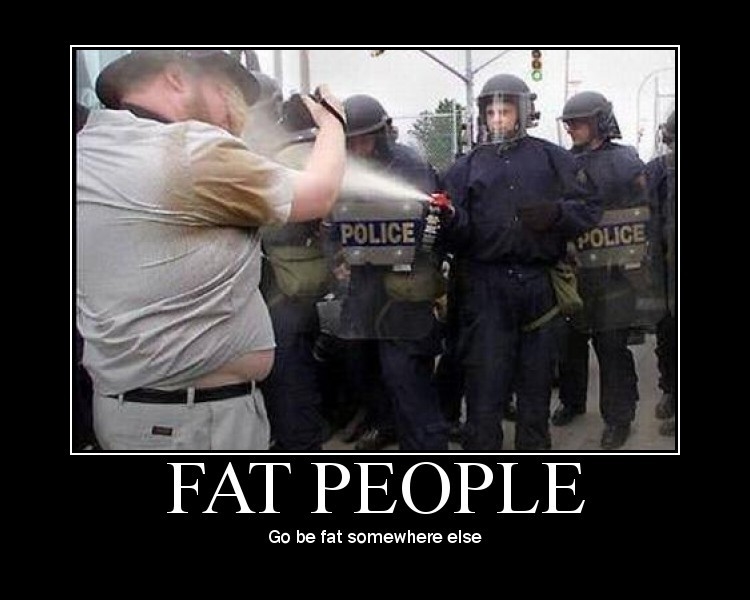
Picture of police with water cannon attacking fat man


By Andrea Scarpino


The Biggest Loser—a group of “overweight” contestants shipped to a ranch in Southern California to learn about nutrition, exercise fanatically, and compete for the most weight lost and a $250,000 prize. Reality television at its—finest? 

I only started watching in the past several weeks, and only reruns I can download from hulu, but I find it fascinating—the physical transformations, yes, but more than that: the show’s language about the body, societal body norms transmitted by the trainers and contestants, what those norms tell us about other aspects of the body, about health, ability, disability.

First, the construct of weight, the numbers we’ve decided demonstrate “normal,” and the numbers “over” those norms. There is actually very little medical evidence linking a larger body with more disease and a smaller body with less—and the standard BMI measurement of acceptable body weight has been widely derided. Of course, you wouldn’t learn this from watching the show.

Then there’s the body as object, fetish. There’s no reason we need to see the contestants weigh-in wearing nothing but a sports bra and shorts. Except that we want to see their flesh, want to compare our bodies to theirs, want to feel superior—don’t we?

And the language of the body: how much success and failure is personally attributed to each contestant’s “work” or lack of work. All the contestants talk about having “done” their weight to themselves—and are encouraged to accept responsibility for what they have done. Of course, I generally believe personal responsibility is a good thing. But I also try to be realistic about how much power I actually have in the world, how much power any of us has.

And the way we construct power and responsibility through language often has a hidden downside: if we see ourselves as responsible for every aspect of our body, then what does it mean when our body does something unexpected? If we get cancer, are “overweight,” are raped—then doesn’t that mean we have failed?

This worries me. Last week, I went to a new doctor in Green Bay who was openly shocked by my breast exam. He doesn’t see women with as many calcified cysts as I have until they’re “much older, at least post-menopause.” This puts me at a much higher risk for breast cancer, among other things. And yet, I’m a vegetarian eating organic, exercising almost daily, trying every possibly solution from specialists and international medical journals. Does my body’s “failing” mean I’m not working hard enough? That I don’t want badly enough to be healthy?

Or should we balance personal responsibility with an awareness that our bodies work in mysterious ways, ways science doesn’t understand? That our bodies are partly social constructs, that our “norms” are chosen by us. It may be true that The Biggest Loser contestants have lost sight of healthy eating and exercise habits, but it’s also true that there is a limit to how much personal responsibility can alter our body, how far “hard work” will get us. And there are dangers with thinking that health, success, ability, etc. derive only from how hard we’re willing to work, derive only from ourselves. 


Poet and essayist Andrea Scarpino is a frequent contributor to POTB. You can visit her at: www.andreascarpino.com