Listening

By Andrea Scarpino


Monday morning: exhaustion. 10 days of non-stop work for my university’s twice-yearly Residency, of faculty discussions and seminars taught, of student meetings, dinners, of answering questions, negotiating personalities, taking notes, of being attentive, expanding my ‘to-do’ list. I’m exhausted. Ready to go home. Ready for quiet. Ready not to speak with anyone.


In the hotel lobby, an elderly woman wears sandals despite the cold temperature, glittery gold nail polish painted on each toe. On the lawn outside the hotel: dozens and dozens of robins, red chests flashing in muddy green grass. I look across to the hillside where I saw two deer days before.


The airport van arrives, and the driver loads my suitcases for me. An older man, wearing a green Tartan hat and scarf. As soon as he starts the ignition, he’s talking: he used to live in a house right where the hotel is now, went to the Air Force and when he returned, his house was gone, new buildings gone up. He points to other buildings as we pass them, what this one used to be, how his high school days brought him up and down these streets.


A moment of flashing anger—I don’t want to talk. I don’t want to listen to stories. I’m exhausted. I want silence. But the driver’s scarf—a plaid my uncle would wear. His hat, a hat my father would have worn. Compassion, I think. And I ask a question. And the man unfolds his life: four years in the Air Force, then 25 as a firefighter, mostly in downtown Cincinnati, but later in a quiet suburban firehouse. Then early retirement before he turned 50. A second career as a college women’s volleyball coach. Then finally, his wife’s illness. How he drives the van two days a week. How he loves to see his grandchildren. A lifetime summarized in twenty minutes. His smile in the rearview mirror.


When we reach the airport terminal, he slows the van—we’re barely moving—to finish his final story. ‘I just want to get to the end,’ he says. Then we’re stopped, and he’s pulling out my suitcases, setting them on the sidewalk. And I want to hug him, to take his hands in my own.


‘I hope I’ll see you again,’ he says, and I nod. ‘I’ll keep your wife in my thoughts,’ I say.


And he drives away. And I think the rest of the day about this man, his Tartan scarf and hat, the cinnamon gum he stuck on the dashboard when it was clear I was willing to listen to him talk. And I think about what I would have missed if I sat stone-silent in the backseat, determined to be exhausted, determined not to engage. Compassion, I had thought. But really what I meant was, listen. Listen.


Nick Flynn writes, ‘Perhaps everyone has a story that could break your heart.’ Perhaps. Perhaps not. But how will we ever know if we don’t show interest enough, if we don’t step outside ourselves long enough to listen.

Fraudulent Writing about Autism Over at Slate Magazine

There’s a recent article by Amy Lutz over at Slate entitled “Is the Neurodiversity Movement Misrepresenting Autism”? –its title an embedded question designed to illicit a yes, as all rhetorical questions address the prima facie supposition (unspoken) between asker and reader that answers are not just known, but mutually known. Moreover, in a culture wedded to conspiracy theories, even those who know little about autism (or care little about it) will see in the word “movement” an oversized red flag. Movements inevitably “misrepresent”. Factor in “neurodiversity” and you have the semiotics of multiculturalism–an instigation of nausea to neo-liberals, who, like their conservative counterparts, imagine diversity represents something nefarious and un-canonical. (Politics is knowing who’s paying for your lunch, per Gore Vidal; all diversity types steal the canapés.)

Slate is scarcely reliable when it comes to autism. George Easterbrook’s piece, “TV Really Might Cause Autism”–offers a synopsis of an imprudent study at Cornell University arguing 3 year olds who watch too much TV may be neurologically damaged. Slate, is to autism writing, as a Potemkin village is to urban planning. Let us be clear. 

Ms. Lutz reissues the tired ableist “voice over” narratives of non disabled people who talk on behalf of those who can’t. Her exhausted, nay, enervating reassertion that FC (Facilitated Communication) is a hoax is composed of ad hominem attacks on talented autistic people who have learned how to type. One is reminded of the old Harvard professors who exclaimed that Helen Keller was just a ventriloquists dummy for Annie Sullivan. 

Shame on Slate. As for Ms. Lutz, you ought to read some serious philosophy and sharpen your monads. Piffle, darling, you’ve written offensive piffle. 

Why A Young Man Died In A Nursing Home, A State Away From His Mom

Why A Young Man Died In A Nursing Home, A State Away From His Mom
(National Public Radio)
January 17, 2013

MONTGOMERY, ALABAMA– [Excerpt provided by Inclusion Daily Express] Zach Sayne was 25 when he died earlier this month at the place that had been his home for 15 years — a children’s nursing home in Alabama.

But that was too far away, 200 miles too far, for his mother in Georgia. Nola Sayne was trying to bring him back, closer to her home. The story of why she couldn’t reveals the bureaucratic traps, underfunding and lack of choices that plague state Medicaid programs.

We told the story of Nola Sayne and her son Zach in our 2010 series, Home or Nursing Home: America’s Empty Promise to Give the Elderly and Disabled a Choice. One story was about the surprising number of young people — teens and those in their early 20s — living in American nursing homes.

The story explained Nola Sayne’s dilemma and why parents often had no choice about placing their young sons and daughters into nursing homes.

For Nola Sayne it happened 15 years ago when Zach was just 10 and had a feeding tube inserted into his stomach. Zach had cerebral palsy and seizures. He was partly blind and couldn’t talk. No other after-school program would take him.

Entire article:
Why A Young Man Died In A Nursing Home, A State Away From His Mom

http://tinyurl.com/ide0117134
Related:
Home Or Nursing Home: America’s Empty Promise To Give The Elderly And Disabled A Choice

http://www.npr.org/series/131105200/home-or-nursing-home

Amy Sequenzia: "These Fights Are Not Over And We Are Not Giving Up"


(Autism Women’s Network)

January 14, 2013

LINCOLN, NEBRASKA– [Excerpt provided by Inclusion Daily Express] I have written about my year in autism self-advocacy. I have a lot to celebrate and a lot to be thankful for. I think 2012 was a year of great accomplishments for our community, despite moments of deep sadness, moments of fear and moments of injustice toward us.

Some days were so sad, many of us could barely keep breathing.

But we did not remain silent.

We did not stop questioning, demanding, petitioning and coming together to respond to those sad and unjust events. Sometimes we joined, or were joined by, other disability communities. And we have many neurotypical allies standing with us.

In 2012 we took the time to celebrate the disabled victims of murder, in response to the media that often chose to ignore their lives. Following one self-advocate’s idea, we organized vigils, because their lives were, like ours is, worth living.

Entire article:

Autism in 2012: What We Have Done (Amy Sequenzia)

http://www.autismwomensnetwork.com/article/autism-2012-what-we-have-done

Quiet Car Rule Making

Quiet Car Rule Making


The National Highway Traffic Safety Administration (NHTSA) has released the long-awaited rule making for the Pedestrian Safety Enhancement Act. This proposed regulation seeks to require hybrid and electric vehicles meet minimum sound emission standards in order to make all pedestrians aware of their presence. The public will have 60 days to comment after the proposed rule is published in the Federal Register which is expected to take place tomorrow.

Link to proposed rulemaking

Click to access Quiet_Vehicles_NPRM.pdf


Link to Fourteen Sample Sounds


http://www.nhtsa.gov/SampleSounds


Article from NHTSA’s web site

U.S. Department of Transportation Proposes New Minimum Sound Requirements for Hybrid and Electric Vehicles

Monday, January 7, 2013

Contact: Karen Aldana, 202-366-9550

Proposal Would Allow All Pedestrians to Detect Vehicles that Do Not Make Sound


WASHINGTON – As required by the bipartisan Pedestrian Safety Enhancement Act of 2010 (PSEA), the U.S. Department of Transportation’s National Highway Traffic Safety Administration (NHTSA) is proposing that hybrid and electric vehicles meet minimum sound standards in order to help make all pedestrians more aware of the approaching vehicles.

“Safety is our highest priority, and this proposal will help keep everyone using our nation’s streets and roadways safe, whether they are motorists, bicyclists or pedestrians, and especially the blind and visually impaired,” said U.S. Transportation Secretary Ray LaHood.

Electric and hybrid vehicles do not rely on traditional gas or diesel-powered engines at low speeds, making them much quieter and their approach difficult to detect. The proposed standard, Federal Motor Vehicle Safety Standard No. 141, would fulfill Congress’ mandate in the Pedestrian Safety Enhancement Act that hybrid and electric vehicles meet minimum sound requirements so that pedestrians are able to detect the presence, direction and location of these vehicles when they are operating at low speeds.

“Our proposal would allow manufacturers the flexibility to design different sounds for different makes and models while still providing an opportunity for pedestrians, bicyclists and the visually impaired to detect and recognize a vehicle and make a decision about whether it is safe to cross the street,” said NHTSA Administrator David Strickland.

The sounds would need to be detectable under a wide range of street noises and other ambient background sounds when the vehicle is traveling under 18 miles per hour. At 18 miles per hour and above, vehicles make sufficient noise to allow pedestrians and bicyclists to detect them without added sound. Each automaker would have a significant range of choices about the sounds it chooses for its vehicles, but the characteristics of those sounds would need to meet certain minimum requirements. In addition, each vehicle of the same make and model would need to emit the same sound or set of sounds.

NHTSA estimates that if this proposal were implemented there would be 2,800 fewer pedestrian and pedalcyclist injuries over the life of each model year of hybrid cars, trucks and vans and low speed vehicles, as compared to vehicles without sound.

NHTSA will send the proposal to the Federal Register today. Upon publication, the public will have 60 days to submit comments on this NHTSA action.

Tasered Blind Man Seeks Damages From Lancashire Police


(BBC News)

January 11, 2013

CHORLEY, ENGLAND– [Excerpt provided by Inclusion Daily Express] A blind man Tasered by a policeman who apparently mistook his white stick for a samurai sword has lodged a claim for damages from the Lancashire force.

Colin Farmer, 63, was stunned by an officer who was responding to reports of a man walking through Chorley with a sword on 12 October.

His solicitor said a claim had been registered for false imprisonment, assault and breach of human rights.

Mr. Farmer, who is registered blind and has suffered two strokes, said he had thought he was being attacked by thugs.

Entire article:

Tasered blind man Colin Farmer seeks damages from Lancashire Police

http://www.bbc.co.uk/news/uk-england-lancashire-20966632

Related:

Blind man seeks Taser compensation (Shropshire Star)

http://tinyurl.com/ide0111136b

Dogs, Kyoto, Poetry and Friendship


“Does a dog have Buddha nature?” “No,” said a great master to a student. And to another student with the same question the master said “yes.” Who has compassion understands compassion. Who transcends sorrow lives “now” and dogs and humans do or do not know this according to their lights.

Ah but there are dogs who possess tremendous capacities for empathy. Studies at universities from Portugal to Sweden to North Carolina and Japan tell us that some dogs not only experience the emotions of their human partners, they also understand those emotions. And when human beings are anxious or sad, dogs will endeavor to ameliorate those same emotions. This isn’t new news to dog owners. But what is new is a growing understanding that dogs are far more sophisticated than human beings have customarily thought. Dogs possess empathy.


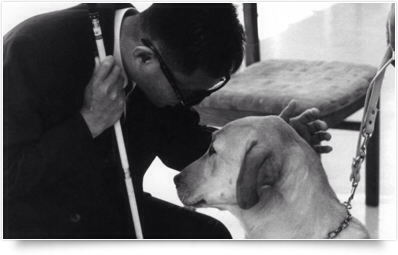
Did human beings some ten to fifteen thousand years ago see team work and empathy in dogs and in turn become their students and not their masters? This is what I’ve come to think after living these past twenty years with three soulful guide dogs.


Here in Kyoto, right next door to my hotel, is the Sanjusagendo temple containing a thousand statues of Kannon, the Buddha of compassion. I plan to go there today and sit and breathe in the sweet, invisible tinctures of caring. I remember how my first guide dog Corky once barked at the compassionate Buddha in the Cornell University art museum. Corky was not known for barking. She fixated in the Buddha, her body suddenly rigid. And she barked once.


Perception: a Guest Post by Author Sheila Applegate

Sometimes the miracles of life are just beyond the rules of logic.
When we change our perspective, we just might let a little magic into our life!


Please help me welcome new author and CNY neighbor Sheila Applegate to the Planet of the Blind.  Sheila is hosting a virtual book tour, assisted by my wife, Connie, via Authors' Virtual Solutions.  In her guest post below, Sheila brings a fresh new perspective to this planet of mine.

Tell me, have you ever had an experience like this?  If so, please feel free to share it in a comment below.

Perception

by Sheila Applegate

How we perceive the world around us has everything to do
with how we experience this world.

Have you ever been faced with a frustrating situation that
no matter how hard you tried to solve there just seemed to be nothing you could
do to change it?

Finally there is the moment of surrender in which you give
up because you do not know what else to do. 
Then out of nowhere you are presented with an alternative that you never
would have believed possible. A simple change in perspective seems to create an
opening for a magical solution.

I experienced this in the middle of an apple orchard on a
beautiful autumn day just this past September.

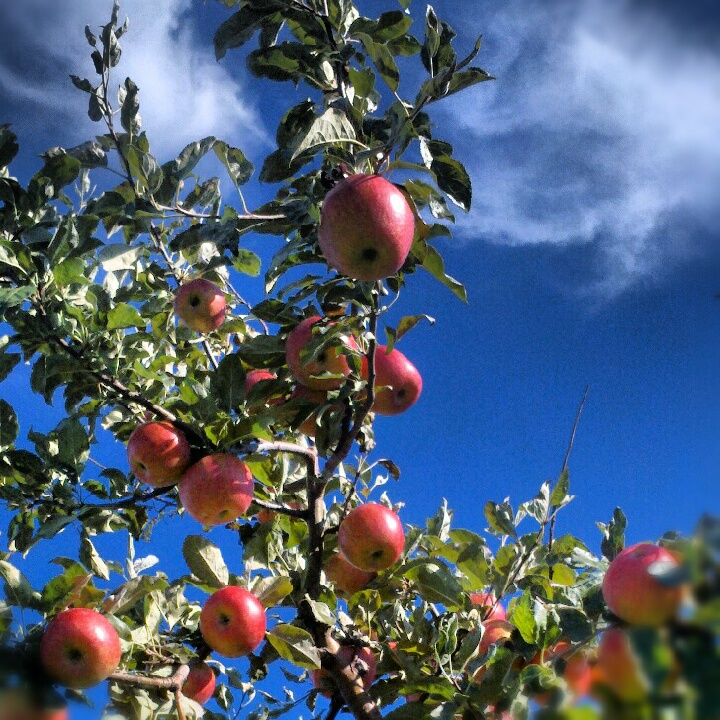
IMG_20120911_194137Image: photo taken looking up at branches of an apple tree highlights ripe red apples against a bright blue sky

The leaves were just beginning to change, radiating warm
colors against a crisp blue sky. As soon as my kids got home from school, I
piled them into the car for our first apple-picking excursion of the season.

We arrived at the orchard just in time to hop onto the wagon
for a ride deep into the orchard. My 7 year old niece was with us. She was
filled with such excitement that even my teenage children were as giddy and excited as they were when they were her
age.

As we arrived at the designated section the tractor driver
instructed us to stay within the two red flags, giving us about 5 rows to pick
from.

It was a picture perfect day as we picked apples and nibbled
on a few as we went. My kids showed their younger cousin how to take a bite of
an apple while it remained on the tree, a favorite prank their dad had
taught them when they were young.

It was a perfect afternoon.

Once our bags were full we piled them onto the wagon and
climbed up for the ride back to the parking lot. By now we were hot, thirsty and ready to head home. I reached into my
pocket for my keys, only to find an empty pocket. After a long search at the
car we all piled back onto the wagon, explaining to the perplexed driver why we
were heading back into the orchard.

This time, as he told the newly arriving apple pickers to
stay in between the flags he also announced to the group that we had lost a set
of keys, asking people to keep their eyes out for them.

Walking up and down the lanes of trees over and over we
could not find the keys anywhere. Wagonloads of people came and went. Each new group was instructed to keep an eye out for our lost keys.

Nothing.

The kids reached their limit. So I called for help. My
sister came to drive the children home. My friend brought me the spare key I had
at home. Unfortunately, the spare key did not have a computer chip and was
limited to opening the doors. So it was of no use in starting the car.

A call to AAA informed me that a locksmith would be sent to
the orchard to make a new key for a mere $200!  My bagful of fresh apples was starting to look
very expensive!

As my friend and I
waited for the locksmith we decided to walk into the now-closed orchard for
one more look. My friend threw his keys onto the ground in front of me.
Pointing out how easily it should be to
see my lost keys in the grass

I was shocked. As the
search had drawn out for so long, I was now starting to feel like I was looking for a needle in
a haystack. How on earth could I be missing something so easy to spot?

We reached the
familiar red flagged area and as my friend began his search I felt like I was past
my limit.

The thought of walking down this same grassy tree line again
gave me a stomachache. It was as if I could not look for one second longer.

Then I heard a voice from within,  "change your perspective".

A little intrigued, I lifted my gaze from the muddy earth
and once again noticed the incredible view of the horizon that had filled me
with such surrendered joy only a few hours earlier.

I felt my body begin to relax.  As I scanned the horizon, breathing the beauty
in for the first time in hours, I suddenly caught the shimmering silver of my
keys!

They were chest high, hanging on a branch, five trees away from where I stood, deeper into the
orchard than I even believe I had gone! 

I actually paused before going to them as my brain
recalculated the impossible.

There is still no logical answer for how those keys got into
that tree. Everyone has his or her own idea of how this happened. Not one of them
seems logical.

Sometimes the miracles of life are just beyond the rules of
logic.

When we change our perspective, we just might let a little
magic into our life!


~~~~~~~~~~~~~~~~~~~~~~~~~~~~~~~~~~~~

SA_image2

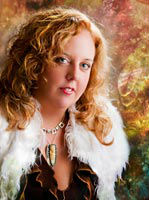
As a clinical therapist, motivational presenter, author & teacher, Sheila's passion is to provide a forum for people to process emotion & integrate spiritual understanding into their daily lives. Her new book, Enchanted One: The Portal to Love, provides readers with a guide to embracing love in every moment. www.sheilaapplegate.com
In celebration of the release of Enchanted One, Sheila is offering this raffle contest for multiple chances to win one of two Amazon Gift Cards.

TAKE NOTE (if I may be so bold)! PLEASE… Share your thoughts and comments below and to show my appreciation and support I am making this special offer (in addition to the raffle contest offer above!).
(Click all links for details).