On Dining in the Dark and Other Staged Disability Events

It is hardly a surprise to those of us with disabilities when we hear of staged events inviting participatory empathy—moist occasions when the sighted pretend they’re blind and the bi-pedaled imagine themselves living with wheelchairs. There are other variants: men wearing high heels walking college campuses in support of abstract women has been a recent fad. One may  shiver at these meretricious and tawdry events but they represent something big and Disney-esque about neo-liberalism, mainly that all identity is essentially exchangeable with the right accoutrements—the citizen as consumer.


In disability land the worst offenders are the non-disabled who earnestly wish to share the idea that “disability is neat”. That disability is essentially value neuter like coconuts doesn’t matter to the Disney-non-disabled because assigning value is what the citizen as consumer does. Its a “dress up” world.


Dining in the dark is popular because the sighted get to imagine they’re in the half-sinister land of the blind—AND—they are consumers. It is an erotic economic pursuit with a hint of medieval alum.


A friend on Facebook has written to say her university is planning a dining in the dark event, sponsored by the disability student services office. That real blind people would find this understandably offensive is immaterial because, as I’ve said already, “its a dress up world” and moreover, no actual blind people were harmed in the making of this film.


Ableism exists without easily identifiable flags—a guide dog school hosts a dining in the dark event for its sighted donors because its all in fun; a university does the same.


But I don’t believe citizens are consumers first.


If I am here, entire, it does not matter how I cut my meat.


The half-sinister, erotic land of the blind can’t be put on a credit card—because it doesn’t exist.


How They Make Us Old

In 1959 when I was four and Nikita Kruschev was sixty five I heard a neighbor in Helsinki explain to my mother the Russians wanted to make everyone old. She was reacting to the Soviet navy’s war games in the Baltic. The comment stuck. I’ve spent my meagre years believing the purpose of colonialism is to age the colonized.

Of course colonial aging differs from hermetic aging. The Chinese poet Han Shan (Cold Mountain) left the world of busyness and devoted his mature years to ardent contemplation. The poetic trope of aging is often one of acquisition and spiritual immanence. It should be obvious and hardly worth saying but old men and women seldom experience fruitful and meditative lives living in occupied territories. This denial of soulful life is the core of occupation. You may substitute for soulful life “free inquiry” if you like but I’m concerned with something that spiritual language best reveals—the wisdoms and satisfactions that come with a dignified and free old age. At its core colonialism robs people spiritually and financially. But you can rob people of their money and natural resources repeatedly if you’ve looted their brains and hearts first.

“The older I grow,” wrote H.L. Mencken,  “the more I distrust the familiar doctrine that age brings wisdom.” Mencken lived in the bloodiest century yet recorded though the 21st is jockeying for apparent calamities.


Disability and the Life of the Moon

Each day I wonder afresh how to keep my dignity. Blind, walking, the stares of generally everyone I meet are omnipresent. Every disabled person knows this story. Sometimes I can repress my feelings about the “display” and other times I feel weary and let my emotions arise. Yesterday I said hello to a new student in the honors program I direct at Syracuse University. I am blind, and don’t make good eye contact. I looked right at her, said “hello” and she looked past me. I said “hello” again. She looked past me. Then I said: “I’m the director of the honors program, I’m blind, and I’m saying hello to you.” “Oh,” she said, and stuck out her hand.


One can say as Eleanor Roosevelt once said—no one can make you feel bad about yourself without your permission. I think that’s what she said. But disability is a social signifier larger than the self—you belong to a caste when you present with a wheelchair or weak, googley eyes. People will look past you. They’ve made a judgement. And so one does have to wonder afresh how to keep one’s dignity. I think of this as my daily chewing.


I often think of the moon as searching for its lost possessions, its silver spoons and icicles. Disability is, in social spaces, more than a little like the life of the moon.


Remembering Veterans Who Are Disabled


The New York Times published an article on August 24th titled “Remembering Veterans Who Were Wounded”. You can read it here.


Perhaps its persnickety of me to point out the distinction between my title and the Times’ headline but my point is simple—disability is forever. Even if some days you feel better than others; even if you learn to walk with a cane after years of using a wheelchair; learn to travel with a service dog; become proficient with cutting edge prosthetics—you are always affected by the social, political, and physical complications of disability. In America we love the past tense when it comes to disability—he was wounded but now he’s rehabilitated; now he’s differently abled; “you wouldn’t know he had a disability”; “he’s just like everybody else”. Like the Puritans who got the ball rolling in North America we believe in mind over matter. Why if you have the right attitude you can overcome anything. But disability stays. You can learn to climb mountains, compete in triathlons, play wheelchair basketball. And even so, disability stays. It stays when the taxi won’t take you because the driver doesn’t want to be bothered with a wheel chair; stays when the airline doesn’t have the proper wheelchair transfer equipment; stays when a veteran with PTSD who has a newly trained service dog to help her navigate in the loud and random world is denied entrance to a fast food restaurant. Would it kill the New York Times to say “Veterans Who Are Disabled?”


We have a big muscle in America—its a clenched jaw of the imagination—we say people were wounded but now they’re free. It is a lie.


Dawkins We Hardly Knew Ye

No one who studies disability and its place in culture can overlook the severity of abstraction. As Ernst Cassirer famously said, we are symbol making animals. Abstraction means symbolism—the semiotics of analogy—blindness represents disarticulation and powerlessness for instance, but there’s a secondary dynamic of abstraction that has to do with positioning. One must plant a symbol like lunar astronauts sticking flags in the moon, and in this way symbolism is not simply a reflection of cultural habits but a conscious matter. The mind behind abstraction is deliberative. It believes disability has no value and seeks to enforce metaphors of abjection whenever disability enters the conversation. In fact abstraction and ableist conversation nearly always take the place of genuine encounters with disabled people. This has been on my mind for the better part of the past week ever since Richard Dawkins announced that women who discover their unborn children will have Down Syndrome should abort their babies on moral grounds. In order to believe this Dawkins must engage in deliberative abstraction, one might call it abstraction “squared” for what can be more cumulative and abject than disability and pregnancy? Another way to think of this is to say that the only thing worse than a disabled child is a prospective disabled child. Why would this be? Because “prospective” is the tenor of abstraction which is the generative faculty of symbolism. Remember that symbols are not value neuter and they’re not sprung from a vacuum. As a disability studies scholar and poet I tend to think of Dawkins as a bad poet. He knows nothing more about the future than the people who clean his office; knows zero about life with disability; but he has thousands of cliches for hopelessness at his disposal. As an amateur Buddhist I know rather unshakably that anything I may say about the future is driven by fear or ego and is largely worthless. As a person with a disability I know physically deviant life is precious, fascinating, and entirely indescribable by conventional habits of thought.


I should add that I bought Dawkins memoir last winter and found it to be gassy, self-absorbed, devoid of comic irony. Memoir depends on the latter for its value. A simple way to think of it is to ask yourself what do I know about my habits of mind “now” that I didn’t know last week? Dawkins can’t do this because he’s addicted to deliberative abstraction, which is like being addicted to switch flipping. One pictures early adopters of electric lights, demonstrating for their credulous houseguests what happens when you flip the toggle.


On Disability and Not Grabbing

My world is never singular, not self contained. A disability does this for you. I’m not free to imagine the vaporous abstract life privileged Americans believe is their right. I can say with both irony and confidence I’m OK with my representational life, one that’s misunderstood, mistaken, occasionally affirmed and always in the terrain of the outlier. I’m blind and people stare. Some imagine I must be poor. Some think I need the healing powers of prayer. Others believe I might be stupid or contagious. All in all I’m terribly real to pedestrians who see all their prejudices in me.


How can I say I’m OK with my representational life? “You’re alright with people wanting to pray for you?” you ask. I’m OK. Everyone in the world has sad appetites. Some want cake, others need primitive validations. Those lacking compassion and emotional irony want every stranger to be just like themselves. As I near 60 I recognize these sad appetites and know they’re not mine to feed. I’ve discovered some of the power of hopelessness—what Pema Chodron calls “not grabbing”. I don’t want to be you my friend; don’t want to hear about your unbridled hunger.


I am, in effect, becoming an old, hard nut—sweet on the inside, largely impervious in my circumference. This means I know happiness is small. Happiness is deliberative and minor. When I want “big happy” I listen to Beethoven. Minor happiness is walking safely to my destination. Its having an hour of contented and thoughtful conversation with a dear friend or a new friend. Its feeding the horse.


My moments of happiness are essentially about “not grabbing”—not wanting something more; not resolving the feelings of able bodied people who don’t “get” disability. I won’t be unkind. But I will only influence the world by indirection. Perfect. I think I’m starting to learn blindness after all.


Ode to Edith Sodergran

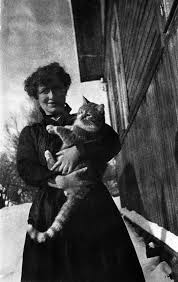
Edith Sodergran with her Cat

I was with a cat last night, one of those dream animals and we were discussing apprehension, the three types—“first the body, recurrent dust,” I said to the cat. “We walk and meet other animate dust clouds, we know the world mostly as rain,” I said and the cat was unimpressed. “Then there’s comic irony, the best you can get from spiritual and intellectual life,” I said. Then I woke up before I could tell the cat number three…