I’ve had many thrust:
Blind, disabled, angry—
Please, a silver toothpick,
The banquet is ended.
Soon we’ll be taking dark roads home.
I’ve had many thrust:
Blind, disabled, angry—
Please, a silver toothpick,
The banquet is ended.
Soon we’ll be taking dark roads home.
I am a blind star gazer. Sometimes, looking up I see lights. Sometimes I think I’m imagining them. In any case, this is the condition of the first people on earth.
I take this feeling with me into the house. Clutching a spoon I’m the first spoon man. Yes I made it at home with a private forge.
Don’t you know there are wonders in the ordinary room?
Sure. Tell me to go to hell. You’ve got big things on your mind.
Here I am with my Sanskrit dust mote eyes and imaginary stars.
It used to be otherwise:
On the moon I was
A collector of sticks
For I was always blind
Probing and tapping
But here
Where splint and spleen
Are unknown
A red electrolysis
Of dust is the best teacher
And songs
Are a spirit force.
The politics of the personal matters. In the disability communities we say “nothing about us without us” and for good reason—the disabled are often left out of critical discussions about our needs. If you’re black and disabled you’re left out of multiple conversations. The politics of the personal is a matter of life and death. If you’re an indigenous American and disabled you can count on horrific health care and a reduced life expectancy. It matters who we are. Lives are in the balance.
Two weeks ago I critiqued a joke on Twitter that I thought was ablest because it made exercise into a white thing, and a comically compulsive thing. All I could think of was just how many veterans with PTSD, women who’ve experienced sexual violence, people with serious depression and other mental health issues—just how many of them are running for their lives. Are white people in spandex funny? Yes. But the sub-text of the joke was problematic beyond race.
The disabled no matter their ethnicity, gender or sexual orientation are ten times more likely to die early from lack of access to health and wellness programs. I was instantly targeted as a racist for daring to suggest the joke was problematic. This is the ugly side of identity politics—a severe, unscrupulous cry that no one outside your identity club should have the right to critique something downright ugly. We’re now seeing this with the horrific Snoop Dog attacks on Gayle King—she did her job as a journalist bringing up the scandal in Kobe Bryant’s life. She’s now facing death threats. I call it the new Stalinism and it is a tool in every identity camp. The sub-narrative is “don’t mess with my identity. I’m perfect. You’re inconvenient, or worse.” On Twitter people called for me to be “collected” which from a disability perspective is vicious. The disabled have always been collected, sequestered, imprisoned, experimented upon, and yes, killed outright. That’s how bad the current climate is.
Racism is deep and wide in America. I’m a blind white person. I’ve had my share of white privilege. I was the son of a college president and went to college for free. I’ve been able to secure loans, buy a car for my wife, get health care for my children. These should be rights for everyone. I’ve spent my life saying so. But being blind also means not being allowed into restaurants with my guide dog, being denied access to the materials and materiality of inclusion in a hundred settings. I’ve been told by professors that I didn’t belong in their classes because of my blindness. Is it wrong for me to say that my white privilege is hardly a comfort zone? Is it wrong to say that ableist humor can undermine efforts to secure life affirming health options for the vulnerable? That’s how bad the current climate is. One shouldn’t have to ask.
“When there’s a person, there’s a problem. When there’s no person, there’s no problem.”
Josef Stalin
You can’t go home again. Home is where they have to take you in. Home is sentimental. Home is where they stab you in the bath. It’s where you make the best of it.
“Home’s where you go when you run out of homes.” (John Le Carre)
“Perhaps home is not a place but simply an irrevocable condition.” (James Baldwin)
“The ache for home lives in all of us. The safe place where we can go as we are and not be questioned.” (Maya Angelou)
“A home filled with nothing but yourself. It’s heavy, that lightness. It’s crushing, that emptiness.” (Margaret Atwood)
“Home is a notion that only nations of the homeless fully appreciate and only the uprooted comprehend.” (Wallace Stegner)
Here: this morning I think of the globalization of homelessness.
“We are not meant to be in this country. We did not want to come. We were forced to flee or die. Americans perceive desperate brown masses swarming at their golden shores, wildly inventing claims of persecution for the opportunity to flourish in this prosperous land. The view from beneath the bridge is somewhat different: reluctant refugees with an aching love of their forsaken homeland, of a homeland that has forsaken them, refugees who desire nothing more than to be home again.” (Edwidge Danticat)
As a disabled person I think of home as receptivity. Home can be public or private so long as it lets me and people like me in.
Refugees with disabilities are being turned away across the globe. The current American president has made immigration a dynamic of health. Do I smell eugenics?
As the Nazis used to say, the disabled are useless eaters.
The homeless are bound up in the rhetorics of uselessness.
In The Revenger’s Tragedy by Christopher Middleton, Vindice avenges the murder of Gloriana by the Duke who’s tricked into kissing Gloriana’s skull which has been treated with poison.
Jacobean theatrics offer an excellent example of what’s come to be called “cancel culture” since love, lust, advantage, politics, and poison are in plain view, center stage, and one fairly wonders if social media “posters” recognize tragic irony as it requires knowing everyone sins and understanding what love requires of citizens.
There is no such thing as an unpolitical cry. And we must cry. But to cry for justice requires love not skull kissing. Any Jacobean viewer would get the point. Try explaining this to the trolls for whom single issue politics and resentments are the tinctures de jour.
Anne Sexton wrote: “live or die, but don’t poison everything.” One can only imagine what she’d say about Twitter. I say its often the kissing of skulls.
I know disabled people who believe all non-disabled people are disability bigots or guilty of ableism. Since this cannot be true its just a poisoned prop. All poisoned props are falsehoods but they’re irresistible. Most people would rather believe in toxicity than see beyond it. In identity politics anyone who’s not like you must surely have bad motives.
Watching last night’s democratic debate I saw the variant toxicities on display. There was a lot of skull kissing going on. If you like Mayor Pete you’re a heartless shill for billionaires; if you like Bernie you have to believe that the rich are un-American. Each candidate has his or her variant of this. You can say this is politics as usual and yet the code switching and winks to singular toxicities is everywhere apparent which means the democrats will likely fail to unite. Skull kissing is never the art of winners.
Some mornings snow comes to the trees like an illness. Or is this my blindness playing tricks? It hardly matters. Look: here comes a white eel across the snow. And childhood dread is in its attached sleigh, tricked out as a wind up monkey with cymbals. He asks himself will the day get better? He wants to call Carl Jung on the phone. And if he could call Jung why not his dead parents? Why not Steven Biko? He’d like to talk to the great, dead human rights activists. Instead he has a toy monkey of the imagination.
Tietääkseni en ollut syntyessäni yksin. (Pentti Saarikoski)
“As far as I know I was not alone when I was born.”
No Pentti, your mother was there. And who knows, a doctor, a midwife?
Occasionally poetic lines sound so good one writes them in fealty to the half mystical and you leave out your mother. Even women writers can do this. The imagination is like one of those old time radio magnets that eliminates plurality.
Of the dark present day I admit my mother. She was a sufferer who had a sense of humor.
You can’t go home again says the rainbow which is how it breaks your heart. No way back to Alpha Centauri or the mustard blossom planet your spirit sailed from. No way back. And that ratty little clock in the corner sneering all the time. And your damned neighbors laughing drunkenly at their open windows. And the racist sheriff; the dog whistler; the pick-pocket high school principal; the priests with cold semen; the high tech robber who preys on the old; that man who kicks crutches—peel away their bandages and they’re lonely, nauseous, frightened by their own hands. As the bard said: don’t have any kids yourself.
**
It’s a gloomy morning and I don’t want to shave. I made a mistake, woke early, read the news.
**
Once, in China, among eight sighted people, I alone threw the coin that hit the sacred bell. You know, the blind advantage.
**
It’s a gloomy morning. My father once taught me Morse code. Rain at the window just sent a message: “small boats should lie down on the sand.”
**
Have me you winter birds.
**
“One of the best attested miracles in all profane history, is that which Tacitus reports of Vespasian, who cured a blind man in Alexandria, by means of his spittle, and a lame man by the mere touch of his foot; in obedience to a vision of the god Serapis, who had enjoined them to have recourse to the Emperor, for these miraculous cures.”
Excerpt From
An Enquiry Concerning Human Understanding
David Hume
https://books.apple.com/us/book/an-enquiry-concerning-human-understanding/id506317433
**
I love the word spittle. I adore David Hume. Of the god Serapis I know almost nothing. He was eaten by the rainbow.
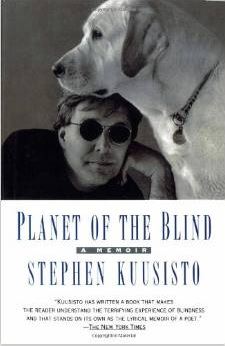
 ABOUT: Stephen Kuusisto is the author of the memoirs Have Dog, Will Travel; Planet of the Blind (a New York Times “Notable Book of the Year”); and Eavesdropping: A Memoir of Blindness and Listening and of the poetry collections Only Bread, Only Light and Letters to Borges. A graduate of the Iowa Writer’s Workshop and a Fulbright Scholar, he has taught at the University of Iowa, Hobart and William Smith Colleges, and Ohio State University. He currently teaches at Syracuse University where he holds a University Professorship in Disability Studies. He is a frequent speaker in the US and abroad. His website is StephenKuusisto.com.
Have Dog, Will Travel: A Poet’s Journey is now available for pre-order:
Amazon
Barnes and Noble
IndieBound.org
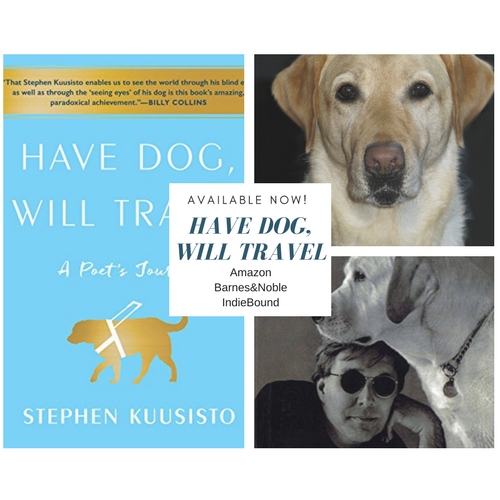
(Photo picturing the cover of Stephen Kuusisto’s new memoir “Have Dog, Will Travel” along with his former guide dogs Nira (top) and Corky, bottom.) Bottom photo by Marion Ettlinger

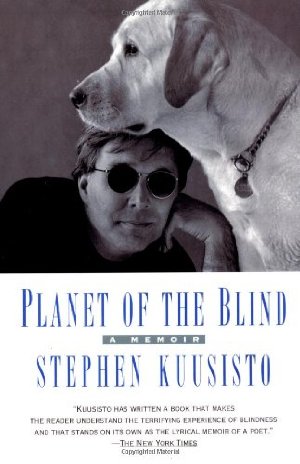
 Planet of the Blind