The Toy Theater

If you spend enough time trapped in your head you eventually become nostalgic even if you’re young. My guess is even a ten year old recalls her first stuffed dog with fondness. As a child in Helsinki I had a toy monkey which I hid in a little cupboard and together we had our own private toy theater. I also had a wooden top that sang while spinning. My first playthings. One can say nostalgia “is” a puppet theater with figures moving in and out of shadows, vivid for a moment then less so.

G. K Chesterton was perhaps the greatest connoisseur of the toy theater. As Gary Wills puts it: “he was led to wonder what thing, however slight and trivial, was not fathomless by reason of its existential act.” Chesterton wrote: “If living dolls were so dull and dead, why in the world were dead dolls so very much alive? And if being a puppet is so depressing, how is it that the puppet of a puppet can be so enthralling?”

In Chesterton’s view existence reduced to its bare minimum is a mystical excitement and all we should ever need. I view nostalgia as the unbidden, quiet reminder of this.

**

Camus got it right. “Every act of rebellion expresses a nostalgia for innocence and an appeal to the essence of being.”

**

Long ago when I was young enough to think about style for the first time I thought suede shoes were excellent—not the Chet Atkins variety but the “Hush Puppy” kind, the beige ones. I was 13 and those were some good shoes. The shoes of nostalgia will fuck you up.

Of the Hush Puppies I recall after wearing them for a day or two they tended to stink. Then my father said: “Your shoes smell like dead rats.” “How do you know what dead rats smell like?” I asked. “I was in WWII,” he said.

BTW I could never get my father to talk about the war. He fought in the Pacific. There were lots of rats.

What I’m getting at is not all memory items are properly Chestertonian. Toy monkey, yes. Beige Hush Puppy no.
Tartuffe in the Faculty Senate

College faculty are (to my mind) like those lobsters you see in restaurant tanks.

There are of course many kinds of professors. In the faculty senate you’ll meet the following Moliere-esque figures:

The “Tartuffe” is an administrator, usually a dean or provost who will tell you with affected gestures that he, she, they, what have you, cares a great deal about blah blah blah but never helps out.

The “Harpagon” is also an administrator, but he, she, they, can also be a faculty member. The Harpagon is driven by rhetorics of cheapness but he, she, they, generally drives a nice car.

Statue du Commandeur: a rigid, punctilious, puritanical type—“this is the way we’ve always done it. If we changed things for you, we’d have to change things for everybody. Yes, it certainly must be hard…” See:

The Geronte: when his son is kidnapped he says: “Que diable allait-il faire dans cette galère?” (What in the deuce did he want to go on that galley for?” In other words, he brought this upon himself. “Really, shouldn’t you try something easier? I could have told you.”

“I am, I fear, Inclined to be unfashionably sincere.”

–Moliere

The Rutabaga Party

I remember a poem by James Tate about a man who walks into a field and eats raw rutabagas–I think that’s right, though this may not be exactly what Tate wrote and I could look it up but I’m not going to and anyway no one really cares. Maybe it was turnips. The point is that there’s in each of us a desperate poverty of imagination and a terrible hunger also and we’re not likely to solve the problems with our current tools. So much for poets. They suggest what ails us. Poets are not generally problem solvers. Kurt Vonnegut Jr. used to say that if you’re looking for the smartest people in any given university you should avoid the English department and head over to Physics.
But I suspect they eat turnips over there as well.

So I’m sitting on the couch in my tattered bathrobe and the planet is dying and the politicians are talking about cancel culture. They think wearing a mask during the pandemic is a cultural issue and by god they have the right to spread the virus and nothing is more important than defending Mr Potato Head. I’d prefer it if they said: “raw rutabagas for everyone!”

This would be better for the nation in many ways. The rutabaga contains the following: Calcium: 60mg (6% of the recommended dietary allowance for adults) Iron: 0.6mg (8% of the RDA for adult men; 3% for women) Magnesium: 28mg (7% of the RDA for men; 9% for women) Phosphorus: 74mg (11% of the RDA for adults)
Potassium: 427mg (13% of the RDA for men; 16% for women)
Zinc: 0.3mg (3% of the RDA for men; 4% for women).

You see? You won’t get rickets if you eat rutabagas. But all you’re going to hear about is how the liberal elites are trying to cancel your superstition and hatred.

One more thing about the rutabaga. It contains phytonutrients, including lutein and zeaxanthin. These antioxidants are important for eye health, and consuming enough of them may help prevent cataracts and macular degeneration, two eye diseases related to aging.

I think unhappy centrist Republicans should start the Rutabaga Party.

Ode to Doofuses Everywhere

Of the word doofus these are its principal synonyms:

berk [British], booby, charlie (also charley) [British], cuckoo, ding-a-ling, ding-dong, dingbat, dipstick, featherhead, fool, git [British], goose, half-wit, jackass, lunatic, mooncalf, nincompoop, ninny, ninnyhammer, nit [chiefly British], nitwit, nut, nutcase, simp, simpleton, turkey, yo-yo…

Now of course if you’re disabled like me and you had a disabled childhood you heard a lot of demeaning terms during your formative years. I make no excuses for those who still use them nor am I cheering ableism. Half-wit is ugly, as is simpleton, nutcase, nut, lunatic, mooncalf and fool.

But I do like ding-dong and yo-yo.

**

Doofus is thought to be related to goofus. Some say it’s akin to doo-doo.

Why do I care?

Because there’s an innocence to the word.

**

Stan Laurel is a doofus, saintly.
Moms Mabele, Kurt Vonnegut, doofuses, saintly.
I grieve the steady erosion of land upon which the doofus can stand.
You can’t be a doofus, saintly, if you’ve a manifesto.
Charlie Chaplin! Doofus!
Walt Whitman!

**

Yes I’ve lived in Doofus-ville. Most of my life actually.
Here’s a tip: the saintly comic innocents are never to be found in city hall.

**

Here’s a quote from G.K. Chesterton that helps illuminate the necessity of the doofus:

“Every confession that man is vicious is a confession that virtue is visionary. Every book which admits that evil is real is felt in some vague way to be admitting that good is unreal. The modern instinct is that if the heart of man is evil, there is nothing that remains good. But the older feeling was that if the heart of man was ever so evil, there was something that remained good—goodness remained good.”

You see the doofus stands for what remains good when the human heart is ever so small “e” evil.

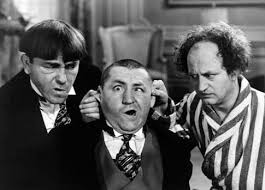
One of my favorite quotes from the Three Stooges:

“How’re we gonna get in pictures? We know nothin’ about movies!” “There’s a couple o’ thousand people in pictures now who know nothin’ about it… three more won’t make any difference.”
(Curly & Moe)

The doofus knows there’s a good-goodness about showing up.