Remembering Veterans Who Are Disabled


The New York Times published an article on August 24th titled “Remembering Veterans Who Were Wounded”. You can read it here.


Perhaps its persnickety of me to point out the distinction between my title and the Times’ headline but my point is simple—disability is forever. Even if some days you feel better than others; even if you learn to walk with a cane after years of using a wheelchair; learn to travel with a service dog; become proficient with cutting edge prosthetics—you are always affected by the social, political, and physical complications of disability. In America we love the past tense when it comes to disability—he was wounded but now he’s rehabilitated; now he’s differently abled; “you wouldn’t know he had a disability”; “he’s just like everybody else”. Like the Puritans who got the ball rolling in North America we believe in mind over matter. Why if you have the right attitude you can overcome anything. But disability stays. You can learn to climb mountains, compete in triathlons, play wheelchair basketball. And even so, disability stays. It stays when the taxi won’t take you because the driver doesn’t want to be bothered with a wheel chair; stays when the airline doesn’t have the proper wheelchair transfer equipment; stays when a veteran with PTSD who has a newly trained service dog to help her navigate in the loud and random world is denied entrance to a fast food restaurant. Would it kill the New York Times to say “Veterans Who Are Disabled?”


We have a big muscle in America—its a clenched jaw of the imagination—we say people were wounded but now they’re free. It is a lie.



Dawkins We Hardly Knew Ye

No one who studies disability and its place in culture can overlook the severity of abstraction. As Ernst Cassirer famously said, we are symbol making animals. Abstraction means symbolism—the semiotics of analogy—blindness represents disarticulation and powerlessness for instance, but there’s a secondary dynamic of abstraction that has to do with positioning. One must plant a symbol like lunar astronauts sticking flags in the moon, and in this way symbolism is not simply a reflection of cultural habits but a conscious matter. The mind behind abstraction is deliberative. It believes disability has no value and seeks to enforce metaphors of abjection whenever disability enters the conversation. In fact abstraction and ableist conversation nearly always take the place of genuine encounters with disabled people. This has been on my mind for the better part of the past week ever since Richard Dawkins announced that women who discover their unborn children will have Down Syndrome should abort their babies on moral grounds. In order to believe this Dawkins must engage in deliberative abstraction, one might call it abstraction “squared” for what can be more cumulative and abject than disability and pregnancy? Another way to think of this is to say that the only thing worse than a disabled child is a prospective disabled child. Why would this be? Because “prospective” is the tenor of abstraction which is the generative faculty of symbolism. Remember that symbols are not value neuter and they’re not sprung from a vacuum. As a disability studies scholar and poet I tend to think of Dawkins as a bad poet. He knows nothing more about the future than the people who clean his office; knows zero about life with disability; but he has thousands of cliches for hopelessness at his disposal. As an amateur Buddhist I know rather unshakably that anything I may say about the future is driven by fear or ego and is largely worthless. As a person with a disability I know physically deviant life is precious, fascinating, and entirely indescribable by conventional habits of thought.


I should add that I bought Dawkins memoir last winter and found it to be gassy, self-absorbed, devoid of comic irony. Memoir depends on the latter for its value. A simple way to think of it is to ask yourself what do I know about my habits of mind “now” that I didn’t know last week? Dawkins can’t do this because he’s addicted to deliberative abstraction, which is like being addicted to switch flipping. One pictures early adopters of electric lights, demonstrating for their credulous houseguests what happens when you flip the toggle.


On Disability and Not Grabbing

My world is never singular, not self contained. A disability does this for you. I’m not free to imagine the vaporous abstract life privileged Americans believe is their right. I can say with both irony and confidence I’m OK with my representational life, one that’s misunderstood, mistaken, occasionally affirmed and always in the terrain of the outlier. I’m blind and people stare. Some imagine I must be poor. Some think I need the healing powers of prayer. Others believe I might be stupid or contagious. All in all I’m terribly real to pedestrians who see all their prejudices in me.


How can I say I’m OK with my representational life? “You’re alright with people wanting to pray for you?” you ask. I’m OK. Everyone in the world has sad appetites. Some want cake, others need primitive validations. Those lacking compassion and emotional irony want every stranger to be just like themselves. As I near 60 I recognize these sad appetites and know they’re not mine to feed. I’ve discovered some of the power of hopelessness—what Pema Chodron calls “not grabbing”. I don’t want to be you my friend; don’t want to hear about your unbridled hunger.


I am, in effect, becoming an old, hard nut—sweet on the inside, largely impervious in my circumference. This means I know happiness is small. Happiness is deliberative and minor. When I want “big happy” I listen to Beethoven. Minor happiness is walking safely to my destination. Its having an hour of contented and thoughtful conversation with a dear friend or a new friend. Its feeding the horse.


My moments of happiness are essentially about “not grabbing”—not wanting something more; not resolving the feelings of able bodied people who don’t “get” disability. I won’t be unkind. But I will only influence the world by indirection. Perfect. I think I’m starting to learn blindness after all.


Ode to Edith Sodergran

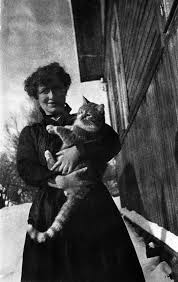
Edith Sodergran with her Cat

I was with a cat last night, one of those dream animals and we were discussing apprehension, the three types—“first the body, recurrent dust,” I said to the cat. “We walk and meet other animate dust clouds, we know the world mostly as rain,” I said and the cat was unimpressed. “Then there’s comic irony, the best you can get from spiritual and intellectual life,” I said. Then I woke up before I could tell the cat number three…


Dog Walking 101

If you walk for your health I hope you have a dog. Generally a cat won’t make it no matter what feline lovers might say. Let me admit my prejudice: I’m a guide dog man, blind, fast, and adventurous. No cat will do for me. Take truth serum my friends—would you trust your life to a cat?

My guide walks so fast my jogger friends are often amazed. “That’s some pace you guys have,” they say. There’s no doubt we’re speedy. We have great cardio. This can be a problem when we’re out with friends—my dog and I are suddenly half a block ahead and vanishing over the urban horizon. Often we must stop and wait for our able bodied, sighted, doddering pals. We don’t mind. We understand the deficiencies of visual people.

Whether you’re sighted or blind, walking a dog has numerous benefits. Some days I can’t decide if the bigger payoff lies with endorphins or with a quasi spiritual sensation of being allied with a generous but independent creature who has decided I’m okay. I might even be more than okay—I sing for both of us, sing the silliest songs. Show me a cat who cares when you do this. My guide dog thinks its a good bit of fun.

When I was a kid I loved a song by Pete Seeger, the title of which I can’t recall, but it had the refrain: “All around the kitchen, cock-a-doodle-doodle-do”. I played the record until my phonograph needle was a nub. The song was a kind of “call and response”—Seeger would sing: “You put your right foot out, cock-a-doodle-doodle-do”; “you put your left foot out” etc. That song was irresistible! Nowadays though I’m in my late fifties and my kids are grown I still sing it. And all I can say is my dog loves me for it. She gets me, my Labrador girl. She dances right along.

Her name is “Nira” my Labrador. She’s comes from Guiding Eyes for the Blind in New York. She’s a light yellow Lab with honey colored ears and she tilts her head from side to side when I sing. She loves Pete Seeger but she’s okay with almost anything. I could sing “The Volga Boatman” and she’d think it was a good development. This isn’t because she’s naïve or smitten. Her good cheer is a function of the canine genome. Dogs are happy in the morning. They are happy in ways your spouse or your children or cats are not. They’re happy in the morning because dogs are predators. They know that because they’ve lived through another night they will have the chance to eat again. Don’t underestimate the joys of breakfast; the happiness of walking and singing about the kitchen; what I like to call “the thrill of morsel and dance”.

Yes, if you walk for your health I hope you have a dog. Here I shall conclude with a bit of canine philosophy. In ancient times when the wind spoke to men and women it also spoke to dogs. When an ancient dog heard wind he heard everything. I believe this is not customarily understood. Anthropologists say dogs came to the human realm because we were throwing out the bones. But you can’t understand a creature just by its appetites. Dogs have always understood the air is enchanted all around us. They have always understood the telegraphy of swallows crossing the sunbeams between trees. Like an arrow they came just to tell us the good news. And dogs know the darkening tunnel inside the wind. I tell you they know who lives there. That is what you hear when a dog is dreaming. I tell you, dogs pour out in choirs their dreamy souls.

And then they go for walks.


The Sunday Night Post-Modern Compulsory Blues

For eight years on this blog I have tried to describe disability as a way of knowing. To that end I’ve been ardent, philosophical, poetic, and often nuanced, for the provenance of this idea owes a great deal to the late Enlightenment rather than the early, and accordingly degrees of doubt are the correspondent self-questioning rhetoric one requires. I know as a blind person my intuitions and doubts are the friends of my psyche and whatever it is I call my personality. In turn doubts are more interesting to me than precepts. I’m in mind of this because I find as this century unfolds I no longer have intellectual affection for one of the tenets of disability studies, the nearly ubiquitous claim that culture has produced and continues to produce compulsory able-bodied-ness. My take is that culture is poorly understood by rhetoricians and cultural theorists and all too often what’s meant by compulsory able-bodied-ness is what Bobby Seale used to call “the Man”—all fine and well, but Seale knew he was using a metaphor and I’m not convinced many in disability studies know the same.


Culture is so elastic its nearly impossible to describe. The Victorians, understanding this, entered into a century long taxonomic mania, cataloguing, classifying, photographing, measuring, statisizing everything from mollusks to milk maids. But in the end history outlasted them, and if not history, women, people of color, the colonized. Culture cannot create compulsory hetero-normativity, able-bodied-ness. It can only insist on these things and then fail.


Disability studies isn’t sufficiently interested in how the “compulsory” fails. In fact many theorists have a vested interest in arguing that it continues. I understand. It pays for sabbaticals and conferences. It props up academic journals. The “it” an affection for a neo-Victorian ideal that has long since died.


It takes the oppressed a long time to know they’re free.


I suppose I’m reflecting Jameson’s notion of superficiality. In this instance I’m rejecting a much older signifier and signified.


Thoughts on a Sunday night. Our age is decentralized and infinitely plastic. Let us hope for sharper class consciousness. The issue is still labor.


Where’s my TV remote?


On Depression

When I was younger and green under my shirt I went alone to Scandinavia to study poetry. I learned many things in solitude—things superfluous and sometimes divine. One night walking on a bridge in Helsinki with sleet driving into my face I met an intoxicated woman who said she was a vampire. She asked for a cigarette. I gave her the whole pack. “It is a privilege,” I said, “to give a pack of cigarettes to the queen of blood.” Then I went my own way. “If there’s anything sorrier than a vampire, its one who smokes,” I said half aloud. I knew, even in my early twenties, that “half aloud” was my vocal register for depression—more than writing, more than shared words. Half aloud was where my depression lived. Sometimes I spent whole weeks alone. I whispered often. One night I discovered a poem that perfectly captured my brand of depression by the Swedish-Finnish poet Edith Sodergran who lived and wrote in the early years of the 20th century. Here’s her poem:

Vierge Moderne


I am not a woman, I am neuter.

I am a child, a tomboy, and a rash decision,

I am a laughing streak of scarlet sunlight—

I am a net for all ravenous fish,

I am a toast in honor of all women,

I am a step toward chance and ruin,

I am a leap into freedom and the self—

I am the blood’s whisper in men’s ears,

I am the soul’s fever chill, the desire and denial of the flesh,

I am an entrance sign to a new paradise,

I am a flame, searching and bold,

I am a body of water, deep but daring up to the knees,

I am fire and water in an earnest union on free terms…


—translated from the Swedish by Malena Morling and Jonas Ellerstrom

Its safe to say that poetry has always been the place of rash decisions, ravenous fish, chance and ruin. Lyric smarts are fast, “daring up to the knees”; pushed by desire and denial. Doors open and close; branches sway; sunlight is something more than half mad. 

The year I discovered Sodergran I knew I was a person who would live his life with depression. I understood only a small portion of the depression would have to do with my blindness. I was sad in the way of anyone who steps toward chance and ruin and who leaps into freedom and the self—for all such impulses must be sad; for they are the stuff of the child, a tomboy, the maker of rash decisions. And they are the stuff adulthood abjures and you may read anything you like for adulthood—capitalism, Sunday School, post-analytic philosophy. It hardly matters the name…

People who live with depression know about free terms—Sodergran’s line suggests an ecstatic electrolysis of transcendent and elemental joy. People with depression know this vision. You can again call it anything you want—but you can’t call it depression itself—for the vision is what depression knows.

Half aloud. I am a child, a tomboy, and a rash decision…

Depression says I am the blood’s whisper in men’s ears…