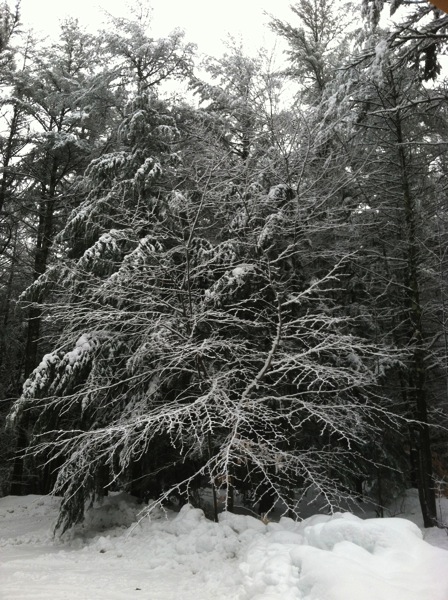
Holy smokes! I’m alive! I have a flag that says “Nocturne” and a dog named Chopin. I have a good name, though not in church circles. Alive! Early snow. Unchristened whiteness! What a day!
Holy smokes! I’m alive! I have a flag that says “Nocturne” and a dog named Chopin. I have a good name, though not in church circles. Alive! Early snow. Unchristened whiteness! What a day!
Just the other day. He didn’t like me–I’m the product of leniency and trust—or worse. (How can a blind poet be worthy of a professorship?)
Boring monster. Immodest as a preacher. Strangled by rhetorics of insufficiency. To paraphrase Auden, his brain a hive whose honey is envy.
Nanao Sakaki, the great Japanese Zen poet said “break the mirror”—for its reflections are not us. Out here, where the soul has no footsteps I stand dis-mirrored. I may relapse during the day, seeing myself as others will, but not just now. Blind guy before the bathroom vanity…
I can’t see much and certainly mirrors evade me, but I know this slick glass is the place of both articulation and despair. I also know its immodest tone for reflections are speech and mostly barbarous. Petit mal, little stains, blotching, one eye wandering like grackle, all eternity’s offense is there. And worse with disability. Worse because you’ll be tricked into the peculiar discipline of looking good for the able bodied—what they call in disability studies “the super crip”—half poster child, half fucking Batman. What’s in your reflection? Overcoming. Inspiration porn. Slum dog vanity. Time for a Zen mirror break.
How small it is, the mirror. Thanks be to God, it gets smaller the more I “look”.
Break the Mirror
In the morning
After taking cold shower
—what a mistake—
I look at the mirror.
There, a funny guy,
Grey hair, white beard, wrinkled skin,
—what a pity—
Poor, dirty, old man,
He is not me, absolutely not.
Land and life
Fishing in the ocean
Sleeping in the desert with stars
Building a shelter in the mountains
Farming the ancient way
Singing with coyotes
Singing against nuclear war–
I’ll never be tired of life.
Now I’m seventeen years old,
Very charming young man.
I sit quietly in lotus position,
Meditating, meditating for nothing.
Suddenly a voice comes to me:
“To stay young,
To save the world,
Break the mirror.”
Every day it seems, I get another chummy “zap” from Senator Al Franken. I like Al. I think he’s as close to being an ethical creature in the Senate as one may find in these scurvy times. But he’s not my Senator. He doesn’t appear on national television. He has Franken-circuits—his own cyber festival of happy hoplites. And I’m glad for him. Glad he has national followers. Why shouldn’t he have loyalists? even Pee Wee Herman has loyalists. I’m all for Franken. But I’ve grown to hate his unsolicited and relentless emails. I dislike them because they’re buddy-buddy, over-familiar, and just a wee bit spitty—like the dentist who nearly phlegms you when your mouth is filled with cotton and he’s leaning close and talking about fishing. I don’t know how I got on Al’s air command radar. I must have signed a petition or something. That’s how it is. You try to save the boundary waters and then you’re in Al’s coffee klatch. Dear Al: I’m the Santa Claus of loneliness. I like it that way. I wish you well. You’ve got plenty of work ahead of you. I understand. But we’re not friends. I won’t be coming down your chimney.
In college on a whim I read Boolean Algebra for a semester. After meeting Bill and Reba, my first guide dog’s puppy raisers, I began working on a personal equation—man “plus” “minus” blindness, multiplied by dog “over” associated love (bracket) puppy raisers, dog trainers, multiple volunteers) equals optimism plus the unknown world before him.
Or maybe my new “dog and man take on the world” sensation of connectedness was akin to the expressive sweep and intuition of the two violins in Bach’s “Double Concerto” —stereotactic intelligence was surely overcoming me. It was more than just the trust in a guide dog—it was a wider trust—wider by far.
There’s an enigmatic grammar to growing: poets try to outline it, dancers bend space so we may feel it. Dog growth and the unique temptation to explore had been choreographed for me not by a single artist but many.
Then I began daydreaming about dogs in history. Corky and I, Reba and Bill—we were just links in a long chain, for dogs had always lead human beings into light. There’s the story of Abraham Lincoln who as a boy fell into a deep cave. This was when he was around 14. In those days Kentucky was still a wilderness and rescue was not very likely. Lincoln had fallen a long way and though he hadn’t broken any bones he was weak from the blow. He tried to scale the walls but slick rocks made climbing out impossible. This is not a guide dog story—and then again, it is—Lincoln suffered from life long bi-polar depression, a condition inherited from his father. Young Abe and old Abe thought about suicide many times and in many respects it was his love of dogs that brought him solace. At 14 he’d bonded with a stray who he quickly named “Honey” and as he lay at the bottom of the cave Honey ran in widening circles barking furiously. She was like the television dog “Lassie”. She caught the attention of a traveling farmer who came to Lincoln’s rescue. Faith in a dog is faith in the unknown world before us. Accordingly during his years as a circuit riding attorney Lincoln was always accompanied by dogs.
**
I try to express my thanks most days—not with the easy gratitude of school rhymes but by means of a harder thing. As a person with a disability I’ve spent years cultivating articulate despair. The harder thing is not gratitude, not precisely, but understanding indebtedness to others and acknowledging that sometimes you’re lucky. Dogs are luck. Ah, but people are luck, a more difficult stance. Hardly anyone wants to say it. People are luck.
Luck in America is its own capacious subject, fit for a variorum edition, fit for top floor of a major research library. One night, early in my relationship with Corky, alone in my lonesome apartment, I found myself watching rather inexplicably “Larry King Live” because while channel surfing I discovered he was interviewing Paul Newman. I was always fond of Newman. I was fond of him long before his charitable work (which became legendary)—I liked him outside his movies, liked him for being a real human being. In the puke-carnival of celebrity Paul Newman had always seemed to me both thoughtful and decent. Newman was talking about luck. And so I put down the remote.
He explained that in the years just after World War II when he was getting his start in the theater and working in New York, there were lots of actors who were far more talented than he was. But on one unforeseeable night he was called on to take the leading role in a Tennessee Williams play when the primary actor was ill. In turn, that was the night the New York Times reviewer was there. Maybe I’ve got the story just a little “off”—it might have been a reviewer from “Variety” and the play might have been by Chekov. I could probably look up the transcript but I don’t want to. What matters now, and mattered to me then, was Paul Newman’s exceptional clarity and humility—his career was shaped by and impelled by chance, a thing he understood perfectly well. And damned if that wasn’t why he was working so ardently to develop charities.
“Hell,” I thought, “in America if you talk about Luck you’re some kind of Communist.” All that “pull yourself up by your own bootstraps; independent cowboy; titanium spine BS”—the creed of neo-liberalism. And there was a great actor, smiling gently, telling the truth—that something one can’t influence must happen for your door to open.
In the year before I went to get a guide dog I was both unemployed and deeply depressed. Formerly a college professor (albeit an adjunct one, hired year to year) I was living on food stamps, disability Social Security and section 8 housing relief. What was luck? And what, if any role, did talent play in a life? Of course I got up every day, brushed my teeth, went to the gym, visited a therapist, wrote poetry, and endeavored to keep glum dispositions out of my hair. Don’t get me wrong—good luck or bad you have to keep working. Its that or die.
But hearing Newman with my guide dog on my lap I realized that something ineffable, something unknowable, even wildly improbable had been occurring during my year of solitary struggle. Bill and Reba Burkett and their children, Bill Jr. and Anne—they were raising a puppy for me—though they did not know me—though they lived four states away. Luck is bigger than any one of us.
**
I’ve been thinking about luck ever since. Today on the first day of snow in Syracuse, New York, I’m “lucking out” because of my new friendship with James Wolcott who last week visited my class on public intellectuals and the digital commons—then yesterday he wrote about the experience on his blog at Vanity Fair.
Luck. Wolcott also understands it. His probative and sharply nuanced memoir “Lucking Out” is top shelf reading, especially if you’re interested in the early days of contrarian journalism in New York during the early 1970’s. I cut my teeth reading literary journalism in just that period, though as I said to Jim—he was in the city, living the life of a writer, I was tippy-toeing around the known streets of my small town, unsure how to live in the world as a blind person. I lived vicariously through his work. Felt I was “there” at CBGB. And many other places.
Luck. Its body half undressed, beckoning, half of the imagination, met by chance in the real world. Who can say what it is? One senses talking about luck is like dissecting a joke.
Luck. I want to set it against the shrill, spiritual disorder of our time. Reckon it.
Something’s happening here…what it is isn’t terribly clear…
Last night I dreamt I about one of my undergraduate professors. She was essentially a character in a Louis Auchincloss novel—down on her luck, selling off her family heirlooms. Somehow her furnishings wound up in a mansion owned by Sotheby’s. And then I was there, discussing how she could buy back her Empire sofa and a fireplace treatment on credit.
Auden said “in human dreams earth ascends to Heaven” but the good poet wasn’t always right, and sometimes dreams head straight for the Devil. Failing to procure the proper funds, my professor vanished, as people do in dreams and life. Then the entire thing became about vengeance and someone (Freud would say it was me) stalked Sotheby’s killing the Ivy League bastards one by one.
We are often selected to mourn for our age. That’s how it is. Do they dream of political economy on other planets?
End of summer. Birds sing shorter notes. Dying requires only the smallest arias, eh Puccini?
NB: of Puccini and birds all I know for sure is the maestro loved duck hunting—the joke is, he ate every duck in Italy.
For a poignant theme, remember all songs are time sensitive. Meantime:
let us praise our maker, sing a little air—these fake teeth will outlast me—like love we don’t know where.
—contemporary Finnish folktale
The northern wind is (unaccountably) making my grandfather silly—though he’s in his grave—though he was (unaccountably) Lutheran—though he redacted joy during his sojourn on earth.
He gets in touch. “Pine turps and baby coffins,” he says, via Morse, with a branch and a window. Then, for a long time, he’s silent, drinking in the marl-ish ichor of eternity. Then, tap tap tap:
“Winter wind. Stop. Bells ringing in underworld. Stop.
The dead laugh, throw spoons in snow.”
Disability Studies came to me on a flaming pie as Paul McCartney would say. The pie flew in the window while I was half asleep. The year was probably 1985 or ’86—somewhere in there, Reagan was sawing the nation in half and I was fresh out of graduate school in creative writing, home after two years of study in Europe, feeling discomfort with the way disability was used as metaphor both in literature and in public. I read and re-read Susan Sontag’s Illness as Metaphor and began studying blindness and figurative language. I spent considerable time in the archives at The American Foundation for the Blind. I envisioned writing a book with the working title: “The Cyclops and the Seer: Blindness in Literature and Film” or something along those lines. The sharp dichotomy of vision loss as symbol either spelled abjection, monstrosity, blankness, or death—or it spelled compensatory powers of divination, intuition, spiritual grace—none of which has anything to do with real blindness. I began writing turbid, abstruse prose about reification, valorization, disambiguation, and god knows what else and then it dawned on me that I’m essentially a creative writer and I should write something in the manner of Joan Didion, nonfiction as story—the term “creative nonfiction” didn’t yet exist—but I knew what I wanted: lyric prose, prose like poetry, steeped in scholarship, rich with personal detail, and which, if properly composed would take non-disabled readers on a journey through blindness—a strange, rich journey, for though blindness is not what the metaphors say it is, its more interesting than able bodied people customarily allow. This approach eventually lead me to complete my first book, a memoir entitled Planet of the Blind.
I didn’t know at the time there were others in my generation—that we’d become “wave one” of disability studies—Simi Linton, Kenny Fries, Brenda Brueggemann, Rosemarie Garland-Thomson, Lenny Davis—and so many many more. All of us were coming of age and entering the public square at the very same moment. As I say, I didn’t know there were others because my blindness in the 1980’s and early ’90’s was still a mountain—less figurative than might be supposed—for I couldn’t navigate on my own and spent my time in the smallest neighborhoods where I knew the streets. And while provincial life and poor navigation kept me isolated I also lost my adjunct teaching job at Hobart and William Smith Colleges—a loss that lead me to sue the school. They settled with me out of court and all I can say about the matter is it was disability related and ugly. I was in serious distress. I called the New York State Commission for the Blind, hoping they would help me find a new job.
**
I felt like a bald man in a barber shop: people stopped talking when they saw me. Colleagues who I’d once thought friendly shied away. I’d lost my job in the summer and then it was autumn and with legally blind eyes I saw the trees flare into gold and I walked with a bent white cane and a cd player and listened to Viennese love songs, songs like cream puffs, and I decided it was time to get married. I would marry a dog. I’d been reading about guide dogs in the public library. I figured I’d marry a dog though all I owned was a suitcase tied with a rope.
Of course I owned more than a suitcase. I had hundreds of poetry books and opera records. And I owned the streets with their long shadows. When you’re legally blind you can see a little but the window of my sight was growing smaller owing to mid-life cataracts. I went to a famous eye surgeon who said that removing the cataracts would destroy my retinas. He said it was better to go entirely blind. I went home and played Verdi’s La Traviata on my stereo and wept. It wasn’t the blindness that bothered me, it was the prospect of nothing. And the poetry books whispered you can surely count on nothing. I remembered Wallace Stevens’ closing lines from his poem “The Snowman”–The nothing that is not there/and the nothing that is.
Then I was visited by a man from the agency for the blind. He was very nice—affable, with a voice you might hear on the radio. He wanted to help me find a new job. We spent long minutes talking about my resume: graduate school for poetry writing; eight years of part-time college teaching with administrative experience thrown in. As I say, he was very nice, which meant he couldn’t lie. “I don’t think you’ll ever find another job,” he said. And the poetry books agreed. What instruments we have all agree/the day of his death was a dark cold day.
Leaves flew past the windows. Some struck the glass and I thought of them as little counsels. As the agency man talked I thought of some lines of poetry by Christina Rossetti who was imagining the advantages of being dead:
I shall not see the shadows,
I shall not feel the rain;
I shall not hear the nightingale
Sing on, as if in pain;
And dreaming through the twilight
That doth not rise or set,
Haply I may remember,
And haply may forget.
Meanwhile, as I was thinking about dying, the agency man added there was a local manufacturing company that made plastic lemons–the ones you see in the grocery store with the lemon juice inside. He said that they occasionally hired blind people. I might be able to sort the plastic lemons. I lit a cigarette then, and inhaled deeply. I’d give up smoking later that year but for the moment smoking was repressed laughter for I saw myself among thousands of plastic lemons in a cramped shed. I was wearing a suit made of moonlight. I could see myself juggling the lemons like a metaphysician. I was half in love with the idea. I had secret aspirations that I’d never be able to share.
When the agency man left I grabbed the telephone and called the guide dog school. In the white tent of my mind I had a future.
**
To this day the only diploma I’ve framed is from the guide dog school, as in March of 1994 I became an independent traveler for the first time. While others in the disability studies movement were gathering at the Modern Language Association, starting the arduous work turning academic attention to disability and social constructions of embodiment, I was walking with a guide dog around New York City, learning how to go places.
We rode the subway to Fort Tryon Park in northern Manhattan to see “The Cloisters”—the Metropolitan Museum’s replica of a medieval monastery. We took the A Train to 190th St.—a trip that would have been unimaginable just a month before. People on the train loved the sight of my guide dog Corky. An old man said: “That dog looks strong as a tree!” And she did look strong. I could feel Corky’s strength in large and small ways—through her harness, and when she was simply lying at my feet on a rocking train.
At 190th St we took the M4 bus about a block. Poof! We were in the middle ages.
We were visiting the unicorn tapestries, man and dog. We were in a quest. Corky was pulling hard, happy with the day. The tapestries depicted a hunt for the unicorn, a creature all school children know. We were early at the Cloisters and a guard offered to describe things. With a dog and a kindly stranger I entered the world of a unicorn hunt.In the last panel a unicorn, half goat, half narwhal, glowing like Jupiter, sat under a pomegranate tree, radiating magic against a backdrop of stars.
**
Although I’m part of disability studies, I’m provisional within the field, my own choice perhaps, but maybe not. I distrust essentialism. I’m weary of the balkanization of alterities—suspicious of identity flags. Perhaps this has to do with my physical location which is always precarious and risky. Maybe I’m sufficiently Marxian to feel uncomfortable at the crossroads of neoliberalism and postmodernism. I’m fond of the book Marxism Against Postmodernism in Educational Theory, edited by Dave Hill, Peter McLaren, Mike Cole, and Glenn Rikowski. To whit:
“Following tectonic shifts in the geopolitical landscapes of the 1980s and 1990s, postmodern social and political theory—with its preening emphasis on language, culture, and identity—has become the de rigeur conceptual attire among social scientists attempting to make sense of contemporary social life within late capitalism. Mining the terrain of identity politics, consumer fetishism and privatopia has become a central academic activity and is now considered theoretical chic. In contrast, Marxism has been mummified along with Lenin’s corpse, and its scholarly exercise has been likened to tampering with historical relics.
The joint ambition of uncovering the hidden ideologies secreted within Western representations of the ‘other’ and refashioning the antifoundational self, has disposed postmodern theorists to dampen their euphoria surrounding social transformation at the level of relations of production and to heighten their regard for reforming and decentering dominant discourses and institutional practices at the level of cultural transactions. According to Sam J. Noumoff, postmodern politics attempts (a) to separate culture from ideology, (b) to employ culture as a construct that diminishes the centrality of class, (c) to insert a neoliberal political system of intelligibility and policy agenda, (d) to perpetuate the belief in the ultimate futility of the[…]”
Excerpt From: Dave Hill. “Marxism Against Postmodernism in Educational Theory.” iBooks. https://itun.es/us/ylrtE.l
I just can’t be convinced that sexual politics, gender oppression, racial discrimination and disability abjection are remediated by performativity or deconstruction, for these activities are all privileged by the circuits of an economic system that relies precisely on privatopia and its variegated forms of consumer fetishism.
I was late to the disability studies party because I was learning how to walk. I’m still late to the party because I don’t believe decentering dominant discourses of normative rhetoric does enough to protect the most vulnerable among us. I started with “Flaming Pie” and will end with an apology to Paul Simon—“Still Provisional After all These Years…”
I am writing a poem in mist
Deer eating the fallen apples—later it will snow.
As a child I talked to my hands
Blind and alone—later it would snow.
Later night was quiet
Like a dream of dreaming—
Boyhood was that way,
I could look down
See myself asleep at our piano.
When I say I love my life
I’m playing there, that dream instrument—snow at the window.
 Planet of the Blind