The Dog Deal

Little dog and big one pull apart a rubber toy as I write. Later they’ll carry away pieces of the thing hiding them under arm chairs and in closets. Little dog is a rescue guy, part Lhasa Apso and something else though we don’t know what. He resembles a small sheep dog, black and white with long dreadlocks falling in his face.  He smiles a lot–that little dog smile that’s both affirming and vaguely naughty. 


Big dog is Nira, 2N2206–my guide dog. She’s a Yellow Labrador. Some people call them “golden Labs” but there’s no such thing. She’s the color of excellent French pastry–part honey and half of cream. And she’s big for a girl dog. When I’m out in public  strangers think she’s a boy. All my guide dogs have had huge frames and generous heads. Nira’s the possessor of a sweet face and beautiful, kindly chestnut eyes and of course those trademark floppy Lab ears that rise like sails when she’s excited about something. Right now she’s excited about little dog whose name is Harley. She loves Harley because he’s a good sport as she drags him around the tile floor in my finished basement–though its more than dragging, their tug of war is the canine equivalent of Archimedes’ leverage. Nira pulls in such a way that Harley’s feet leave the floor and then she really drags him. And Harley’s legs scramble for purchase to no avail and then he’s momentarily in the air.


Their joy is something from the deep, blue reaches of ancient life. While I struggle with the clouds of my day they are alive in such pure play that I’m envious and reminded of the essential mystery of both joy and friendship. Dogs have friendships and live in the moment. Me? I carry a heavy green book up and down the stairs, worry about tomorrow, fear the unknown. Which of us has the better deal? The dogs of course. 


Vonnegut's Eel and Paul Ryan

What will happen when the final final rationalization for coded solipsism is absorbed by the American body politic? If Kurt Vonnegut was here he’d say that giant lamprey eels will eat Indianapolis, but let’s be serious, Mid-American gas and electric has already done that. When people speak in self-serving metaphors about other people’s losses then we have the Paul Ryan plan and the Obama “chained cpi” and other forms of heartlessness tricked out in board room codes. This is not ok. How feeble that protest sounds. But how true it remains. We now talk about letting the poor fend for themselves by suggesting they are a drag on American growth. In fact social programs allow the most vulnerable to participate in the miserable buying and selling that has taken the place of civic life. Stop supporting food stamps, medicaid, medicare, social security disability, WIC, special education, rehabilitation programs for people with disabilities–(its a long list of targets in the coded solipsism industry) then, in turn, you shut down ten thousand shops and drugstores, mini-malls, Walmarts, not to mention of course, putting people in the streets. 


In New York the other day I was reminiscing with a friend about the state of Grand Central Station in the 1970’s when the place was run down and filled with homeless people. Remember? That’s the Ryan plan. Forget Vonnegut’s eel. 


I just felt like writing these words. They remind me that I’m not a heartless man. 


Riding to the Airport, New York City

Hold on Yoko, Yoko hold on its gonna be alright,

You’re gonna make the flight…


On my way to JFK in NYC, find myself thinking of John Lennon. Now I understand him as a survivor of childhood abuse, probably with PTSD. And look how humane he was able to become. The heart chakras are always there, waiting on us, supplanting the toxic. Just give chakras a chance.

How I miss Lennon, who’s voice right now in this age of surveillance would be wise and witty.

How I can’t stand Peter King, who, as folksinger Christine Lavin would say, is “a prisoner of his hairdo.”

Reading Poetry at 30,000 Feet

By Andrea Scarpino


A little bit of magic isn’t it, poetry, flying.


Ruth Stone writes:


​‘In August we carried the old horsehair mattress

​To the back porch

​And slept with our children in a row.

​The wind came up the mountain into the orchard

​Telling me something;

​Saying something urgent.

​I was happy.’


I used to be terrified of flying, would break out sweating as soon as I stepped onto the plane. My fear didn’t stop me from traveling, but it felt like a miracle every time I arrived at my destination safely. I marveled that anyone would choose to work as a pilot or flight attendant: what a crazy suicide.


When I grew tired of being afraid, I started reading books on flight, the inner workings of planes, the job of the pilot, the jobs of the flight crew. I read about the physics of flight, how planes launch themselves into the air, how they stay aloft, how they land. And still, I return to this: magic. I’m no longer afraid of flying, but I still think of it as magic. A little bit of miracle.

​‘The green apples fell on the sloping roof

​And rattled down.’


And poetry, also: magic. Hard work, yes, hours of dead-ends and deleted lines, stacks of discarded paper to fold into the compost bin. But sometimes, a spark, a something that launches you into the air, that moves you in a new and unexpected direction. Sometimes something magical.


I usually bring silly things to read while flying, magazines or popular novels, things that don’t require too much of my brain so when I lose a page to announcements or a loud seatmate, it doesn’t matter. This trip, I brought back issues of Poetry Magazine. I read Ruth Stone.


​‘The wind was shaking me all night long;

​Shaking me in my sleep

​Like a definition of love,

​Saying, this is the moment,

​Here, now.’


‘This is the moment,’ I read at 30,000 feet. And ‘I was happy.’ And ‘Here, now.’

Tweezer Man and the Guide Dog


In the “Viand” coffee shop on Madison Avenue in Manhattan a short, wiry little man wearing five tee shirts and intricate shorts with many microscopic pockets (as if he might be a medical examiner with innumerable scalpels) and with industrial headphones–the kind worn by men using jackhammers–and tiny black dress shoes and white socks approaches my guide dog Nira who is lying on the floor behind me.


“Hello, baby,” he says, “Did you give up your life for daddy so he’ll be safe?”


He pets her. She ignores him. “Do you keep daddy safe?” he says to her, ignoring me.


I debate the matter. Should I say something or punt? With my residual vision I see the man looks eerily like Adolf Eichmann. He has thinning black hair and creepy dark horn rimmed glasses. How many dumb conversations have I had with strangers because of my guide dogs? Too many. I say: “She didn’t give up anything to be a guide dog. She has tons of play time and gets to go everywhere.”


He looks at me then, says: “I hate people. I just hate them.”


Then he’s out the door with his shorts full of tweezers.


Mr. Cellophane and Disability

I was born in the year of the iron lung. In another year the number of breathing machines would start to decrease. I went to school in the age of “no people with disabilities allowed” and learned a great deal about shame. And now I’m shiny and sticky! Imagine! (With thanks to the ghost of Frank O’Hara).

About shame: there’s an invisible playing field for the thing. Erving Goffman wrote well about the politics of ruined identity, but he was silent on the matter of its gridiron. The politics of space requires people with disabilities to play by their own rules.


From a Notebook

When you’re splitting in two like John Berryman, remember there’s a third person, call him whatever you like–he’s the comic ironist you need for the long haul. Animals like him.

At the exhibit of Soviet underwear, the brassieres have wires, like farm tools. No further comment necessary.

I lived in Iowa for a time. I know several pig jokes. It’s easy in the Midwest to fall into a rut.

Once in New York City I heard a man drop his end of a plate glass window. It sounded like Stockhausen’s gramophone.

When I was six years old I was selected to care for the classroom’s hamster over Thanksgiving vacation. But the first night home my cat ate it. My first lesson in art: “Don’t worry,” my mother said, “We’ll go to the pet store and get another one–no one will ever know.” She was right.


A Book for President Obama

There were lots of jokes about the George W. Bush Presidential Library’s holdings when the opening ceremonies occurred. Why not? “W” is likely the least interesting man in the world: “I don’t always read books, but when I do, I read The Klingon Hamlet. Stay incoherent my friends.”

With the exception of Thomas Jefferson there is little evidence books play a large role in the shaping of America’s presidents, though FDR had a considerable library and Lincoln knew his Shakespeare. JFK liked Ian Fleming. Jimmy Carter disastrously read Christopher Lasch. Reagan loved Whittaker Chambers. When our presidents sit down to read, the servings should be tasted first by a loyal and brave servant. (On the matter of brave White House servants, there’s the story of Rutherford B. Hayes who, fearing the newly installed electricity, had a butler flip the switch.) Hayes liked American biographies, so he knew how to delegate.

Now we have the curious case of Barack Obama who, in the matter of human rights appears more of a Quisling than the public may have supposed. Still, according to AbeBooks.com, Obama is a serious reader:

In May 2008, he was photographed carrying Fareed Zakaria’s The Post-American World as he walked across the tarmac at an airport in Bozeman, Montana. The book outlines America’s declining influence in international politics – was he formulating policies for dealing with rising powers like China, India and Brazil?

In October 2008, the New York Times asked Obama to provide a list of books and writers that were significant to him. Here goes – Ralph Waldo Emerson, Thomas Jefferson, Mark Twain, Abraham Lincoln, James Baldwin, W. E. B. DuBois’ Souls of Black Folk, Martin Luther King’s Letter From Birmingham Jail, Toni Morrison’s Song of Solomon, Graham Greene’s The Power and the Glory and The Quiet American, Doris Lessing’s The Golden Notebook, Alexander Solzhenitsyn’s Cancer Ward, John Steinbeck’s In Dubious Battle, Robert Caro’s Power Broker, Studs Terkel’s Working, Adam Smith’s Wealth of Nations and Theory of Moral Sentiments, and also Robert Penn Warren’s All the King’s Men – a novel about a corrupt Southern governor (Rod Blagojevich anyone?). And then there were his theology and philosophy influences – Friedrich Nietzsche, Reinhold Niebuhr and Paul Tillich.


That’s heady stuff for a man who’s now presiding over the NSA’s warrantless wiretapping of American citizens, who believes in his authority to execute his own citizens on foreign soil without trial, and who has reneged on his promise to close the criminal enterprise we have come to call “Guantanamo”.

Of course what a man says he reads and what sits on his bedside table makes for interesting speculation. Nixon said his favorite book was “War and Peace” but aside from the likelihood he skipped some chapters, I suspect Nixon’s favorite book was “The Castle of Otranto”. (“He was persuaded he could know no happiness but in the society of one with whom he could for ever indulge the melancholy that had taken possession of his soul.”)

I reckon the books Obama says he reads are in fact precisely what he reads. It benefits no man or woman to sneer at the list of books above. But in a time when press freedom, personal privacy, and the right to a fair and speedy trial are all under siege, one wishes the President would take up Milton’s Areopagitica:

And though all the windes of doctrin were let loose to play upon the earth, so Truth be in the field, we do injuriously, by licencing and prohibiting to misdoubt her strength. Let her and Falshood grapple; who ever knew Truth put to the wors, in a free and open encounter.


Ode to John Ashbery


A man without music–cumulonimbus,

Opens in daylight. A job is a job. Everything else

Is of or pertaining to the dead (which

Has much of irony, little of melody)

But he sells it. Light and form

Sell almost anything

Though its not fashionable to say so,

Even in the arts.

I wish for allotropic precision but

Get Impressionism at least

Most days which is one of the

Tributaries of poetry.

A poem is grazing on the graves

We care about–


Explaining American Exceptionalism to People with Disabilities in Uzbekistan

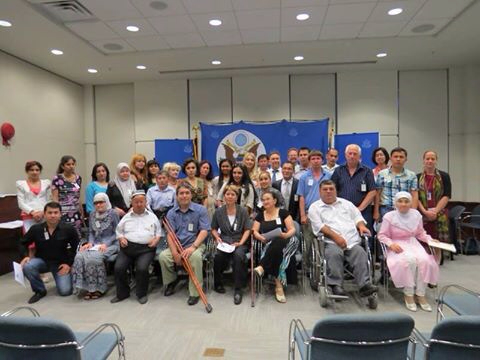
Photo: American writers Christopher Merrill. Ann Hood, Chinelo Okparanta, and Stephen Kuusisto, posing with disability rights advocates from Tashkent, Uzbekistan at the United States Embassy.

Last December when the United States Senate failed to ratify the UN treaty on disability rights I said to a friend: "only people who do not travel abroad or who do not have any friends or family members with disabilities could be so cruel." As I recall, I also said that "cruel" is related to "crude" by way of its French origins–the etymology highlights the worst aspects of American "exceptionalism". Opponents of the treaty (all of them on the far right) argued that ratifying a treaty affirming disability rights around the world would compromise American independence–a position so absurd and willfully ingrown one might conceivably treat it with penicillin.

The GOP's opposition to a treaty that calls for human rights for people with disabilities worldwide was hard to stomach for most decent citizens. USA Today wrote:

"This week, when the Senate rejected a United Nations treaty banning discrimination against the disabled, the vote received relatively little attention. And why would it? The United States already has laws that prevent such bias. They've made curb cuts and wheelchair ramps common sights across America.

But the Senate's failure to ratify the U.N. Convention on the Rights of Persons with Disabilities was nevertheless remarkable — for what it said about the state of domestic politics. Despite GOP efforts to recalibrate after last month's election losses, the treaty vote reflected the continuing influence of a fringe that gets frantic about anything involving the United Nations."

What scares the right more than an African-American president? The specter of "black helicopters" –some kind of international government takeover of the United States by forces too dreadful to name but that didn't stop Senator Jim Inhofe (R) Oklahoma:

“I do oppose the CRPD because I think it does impinge upon our sovereignty. Unelected bureaucratic bodies would implement the treaty and pass so-called recommendations that would be forced upon the United Nations and the U.S. … This would especially affect those parents who home-school their children. … The unelected foreign bureaucrats, not parents, would decide what is in the best interests of the disabled child, even in the home.”

In addition to the canard that affirming disability rights around the world would prevent Americans from home schooling their children (perhaps the most fatuous argument they mustered) opponents also claimed that children with congenital disabilities might be euthanized by sinister UN forces which of course do not exist–but they might you see?

After the treaty ratification failed CNN wrote rather sensibly:

"There is a broader and more disheartening message that the world hears from Washington on this year's International Human Rights Day: The United States is losing its moral voice on human rights because it is not leading by example."

**

The passages above offer the background. As an American who has a disability and who teaches disability studies, I am counting on Senator Harry Reid's promise to bring the UN treaty's ratification back to the Senate floor this year. But the word "cruelty" won't go away. I find myself thinking of blind children in North Africa who are believed to be demotic and are denied education; of people without basic prostheses or job training in every part of the world. Certainly I think of my own experiences with international travel. In Italy I was denied entry to a historic site with my guide dog. I was even denied entry to the hotel restaurant. In short, I might have rights abroad, but then again, I might not. The world wide violations of disability rights are not imaginary like the silly prospect that the UN will prevent you from home schooling your disabled child. Shame on Rick Santorum who pushed that dishonest argument for all it was worth. In the end it was worth 38 votes in the Senate, just enough to derail a treaty that promised hope to vulnerable people–the most vulnerable people in the world.

Enter Tashkent: in May I was afforded the opportunity to travel as a cultural ambassador under the auspices of a program sponsored by the US State Department and the International Writing Program at the University of Iowa. Picture, if you will, four American writers speaking to Uzbek disability rights advocates about literature and self-affirmation (among other things). Chris Merrill (who directs the U of Iowa's International Writing Program) is a poet and journalist who has written a good deal about the effects of war, and he spoke about how writing clarifies our understanding of human experience. Ann Hood is a widely read and honored American novelist who has written about the death of her daughter and how to find a path after grief. Chinelo Okparanta is a recent graduate of the Iowa Writers' Workshop and the author of a brand new collection of short stories due out this fall–stories that draw on her experience as an immigrant to the US from Nigeria. Together we spoke about the abiding and peculiar nature of America–that almost everyone comes from someplace else, that we tend as a nation of readers and writers to value stories that exemplify the struggle for human rights. I spoke about my experiences as a blind person–how I struggled with my identity, fought for an education, and described what it was like to live my childhood and early adult years before the passage of the Americans with Disabilities Act. This is when the question came. A man who uses a wheelchair asked how it was possible–how it was at all conceivable–for the US to refuse to sign the UN treaty on disability rights.

I told the truth–the truth with a wishful forecast. I said that the broad majority of Americans is unhappy with the Senate's failure to ratify the treaty. I said that even people who presently have no direct connection with disability were horrified by the Senate vote. I pointed out that Senator Reid has vowed to bring the treaty vote back this coming year. And I said it would pass. A blind guy can dream can't he?

But the question persisted–someone else asked again "how was it possible for the treaty to fail?" (128 countries have signed the treaty, even China has signed it.)

Explaining there's an extremist fringe in Washington that doesn't like the United Nations is, to say the least, an unenviable task. At best all you can do is explain the embarrassment of exceptionalism, which, in turn, is a high minded way of saying the US has abandoned moral leadership–an abandonment the world can ill afford, whether you have a disability or not.