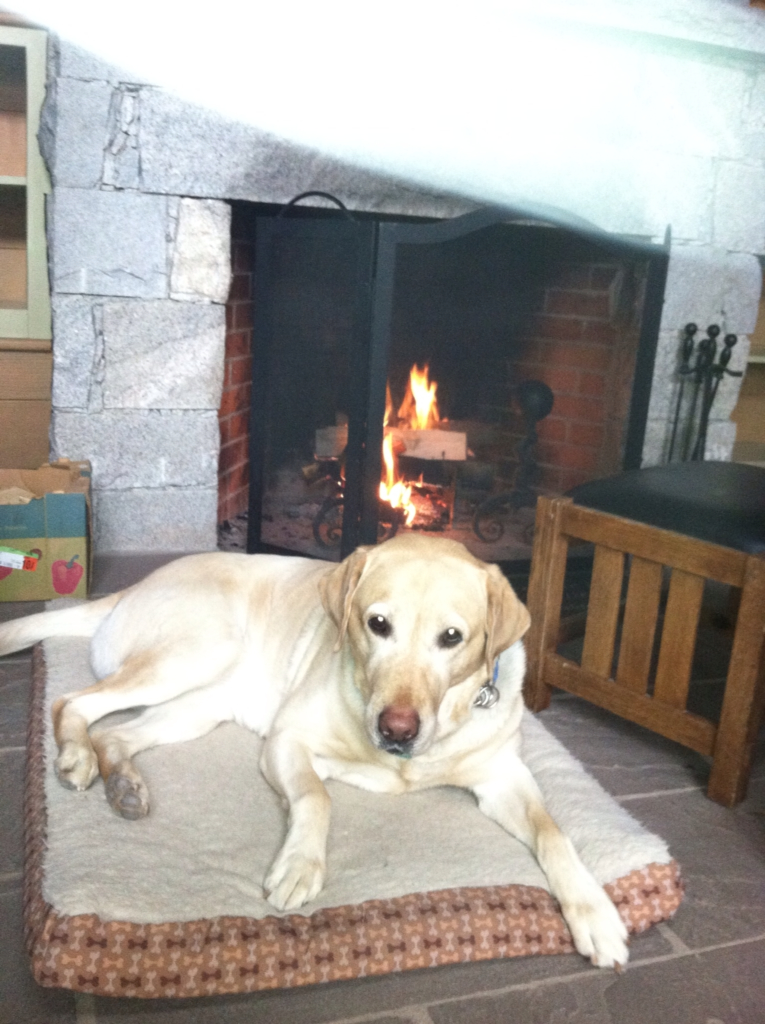
Here’s the plain truth: you’re at home wherever you go.
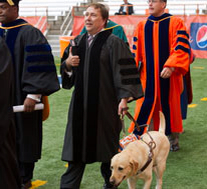
Writing of the sun Robert Bly says: “He guides his life on his dreams” and why not? Let’s personify the sun as a sleeping giant who doesn’t feel his heat. There’s no reason not to. Let’s personify the sun as a woman who allows her children to roam at will. No reason not to. I’m learning. I walk in the morning with the dogs and small pebbles on the road shine, even for a blind guy.
Easy walking, late spring… I remember early in boyhood catching a fish. I brought it home alive and was astounded to find the cat had eaten it during the night. That may have been my first lesson about night. I knew right away the cat was just night’s henchman.
This is why I love the mornings. Water in the road stares up at the boy who jumps from place to place.
**
My parents have been dead for almost 14 years. They were difficult people, two souls with demons. They had metallic vision: if the world was hard they would be harder. Their tragedy lay in not being hard at all.
When I jump from place to place I think of them, feigning heroism but without sufficient psychological muscle.
I think of them in their Egyptian boat of the afterlife, the hull paper thin, the two of them learning to steer with their better thoughts.
**
From a Finnish poem: “sometimes I see a child/see in him what I was like/and I want to say I’m sorry”.
Jumping from place to place, and the dogs dancing right along with me.
Easy walking…
“I said SHAKEN not stirred!!!”
“Mr. Bond, its only stool softener.”
“Same old dream of world domination, eh Doctor No?”
Around three AM last night I woke with jet lag delirium and turned on the VoiceOver screen reader on my IPad. I read for two hours from the “Quotable Hitchens” which is both spirited and alphabetized. It is strange to read another man’s witticisms and pith while drifting in and out of sleep–one feels escorted by a devil, a redoubtable and jocular daemon, who might well be an atheist but still has the tinctures of zeal.
Meanwhile in the waking world I’m trying to imagine a hat made of metaphor–half of wind, half of sail that takes you to a far shore where money is useless. Americans need such hats. I will give them away if I find them.
**
Years ago I heard an old woman in a Helsinki coffee bar tell her companion, who was also an old woman, that she had murdered her husband. What to do? I waited by the women’s room for the companion. “I’m sorry, but I heard your friend say she killed her husband,” I said. “Oh yes,” said companion lady. “But she’s never had a husband. It’s all in her mind. She kills him every day.”
**
Hitchens doesn’t have metaphor. He’s the cock of the walk and loaded with palaver. A politician. One you might very well want on your side. This is, of course why he hung out with Martin Amis and Stephen Fry. Two men with big metaphorical hats.
About homecoming, what’s to say, luck and more luck,
the darkness opens and old rooms receive you.
I am a seahorse, I am made entirely of numbers.
Life is a floating equation.
“I am an American woman:
I turn that over”
–Adrienne Rich
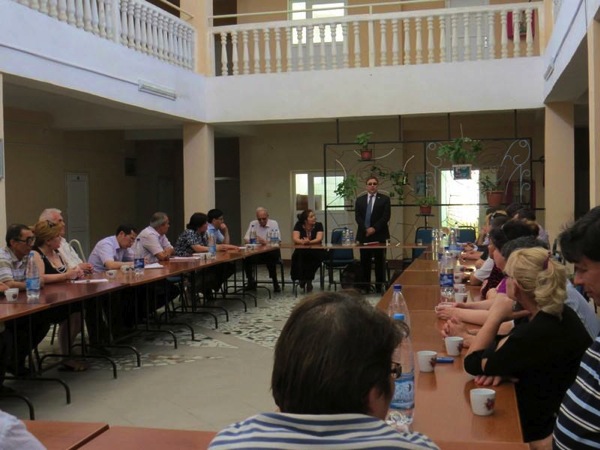
One is back again from a long trip, the air opening like realization itself for sometimes the air is smart. Even the air in Newark, New Jersey where a tough customs agent wants your story–why have you been in Uzbekistan and Turkmenistan–and my friend and I stumble, tell him we’re writers, we were on a trip for the State Department, cultural ambassadors, etc. and he looks at us with a wheel turning in his head, decides we are too cartoonish to be any real trouble for I am blind with a stick and my friend, a woman, has lots of blond hair and sentiment wins out. America for all its fevers still has sentiment.
I think about this in a state of jet lag. Sometimes jet lag is a good thing, like a quality hangover. You think, if nature does not mourn our existence why should America? Then you think, America should be a large consciousness just as Walt Whitman said. Isn’t that why I became a poet? I believe love should win in my country, and therefore I believe in love as an export. Thoughts when tired.
A policeman who does not know us, escorts my friend and I from the terminal for he sees my white cane and doesn’t want us to stand in a five mile line of passengers. He is kind, thinks helping a blind person is a good idea. And I’m grateful. This is American decency. For all our fevers we still have decency.
In Turkmenistan I spoke to a room full of people with disabilities. They wanted to know many things: do people with disabilities in the US have jobs? How do they go to college? What is “Inclusive Education” all about? Then someone asked me why the US Senate refused to ratify the United Nations Charter on the Rights of People with Disabilities. In effect I told them that sentiment will win out–that the treaty will come before the Senate again, that the American people want to see it pass. But the real question was: “how can something that’s unambiguously good be voted down”?
How do you tell people who are still suffering for freedom that there are senators in the USA who don’t like the United Nations and will even refuse to endorse freedom and dignity for people with disabilities to make a crude point–namely that no one tells America what to do?
And that’s when it hit me. My nation’s policemen and firemen are the people I want in the Senate.
First thought. Best thought. Eh Mr. Kerouac? I’m home.
My mother tells a story of my father picking dandelion greens from the front lawn of the Women’s Club up the street from their house when they were married. My father, who wore dress pants and a dress shirt even to mow the grass, kneeled on the front lawn, digging up weed after weed.
“The women would get so angry,” my mother says, laughing. “This man kneeling in the grass of the Women’s Club.”
Spring, finally, in Marquette: trees budding leaves, forsythia in bloom, blue skies and warmer temperatures. Zac and I bought starter plants for the tiny garden next to our apartment’s driveway: Lucia and slicer tomatoes, all kinds of spicy chilies. Dandelions are in bloom everywhere, hillsides of tiny suns not yet mowed away.
Walking home from a run, I tell Zac the story of my father and the dandelion greens.
“I guess we could pick these,” I say, pointing to dandelions in the grass along a public walkway.
And then we are bending, pulling dandelions by the roots, collecting bunches of greens in our hands. At home, I trim the leaves, soak them in batch after batch of water. Zac mixes them into salad greens— “Like chewing an IPA,” he says—I blend them into my smoothies.
Gay Talese tells a story of immigrant Italian Americans refusing to eat arugula because poor Italians back home used to pick it from country hillsides. When I was raving once to my cousin about buying purslane at a farmer’s market in Santa Monica, she informed me purslane grew as a weed in most southern Californian yards.
What is a weed, after all, but a plant we’ve decided we don’t want?
How and when we label something “food” or “weed.” How and when we label most things: disability, gender, race. How and when we choose what we value, what we throw away.
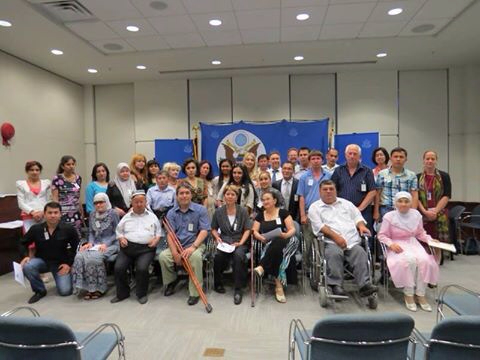
A couple of days ago I had the pleasure to lead a panel of American writers in a discussion at the American Embassy with Uzbek disability rights advocates about identity and imagination. This was a powerful experience for me on many levels. Perhaps the most significant thing was the challenging level of conversation we had with people with disabilities from Tashkent. One man wanted to know why the US Senate refused to ratify the UN charter on the rights of people with disabilities. I told him that there was widespread outrage about this in America and the issue isn’t over. But still they wanted to know why. Sitting in the embassy, facing an audience of people with many types of impairments I felt embarrassed for my country, embarrassed because by voting down the simple ratification of the treaty the Senate abandoned people with disabilities around the world, both literally and figuratively. They asked me a second time how this could happen and I had to explain the hostility that certain hard line politicians have about the United Nations. As the poet Theodore Roethke said: “such waltzing was not easy” and I wanted Jim DeMint in that room so he might see with his own eyes what American exceptionalism costs in the global village.
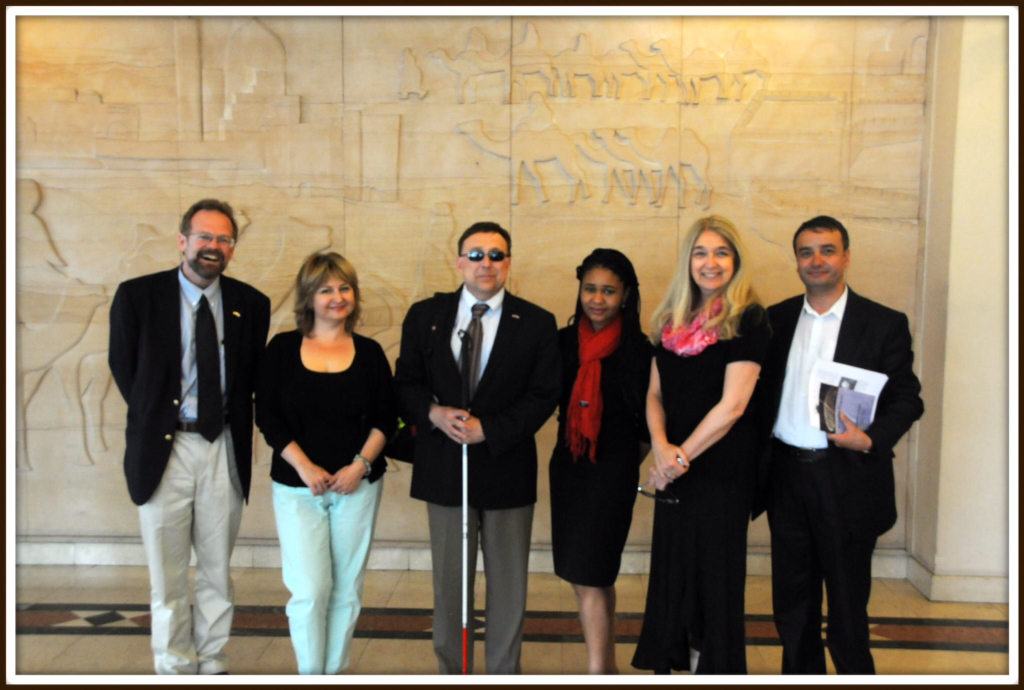
When my friend Ann Hood posted a photo from our trip to Tashkent on Facebook one of her friends wrote, in seriousness, to say that she liked the looks of her body guard, not realizing it was just I, a blind guy with dark glasses and a business suit. The white cane is a ninja thing.
News that an immigration bill has passed committee in the senate by tabling immigration rights for same sex couples is devastating. There is, of course, no reason to prohibit people from immigrating according to sexual orientation–it’s as absurd as blocking people because of their height. Senators (even in these despicable times) wouldn’t dream of an overt prohibition on people who are 5’2″.
I have always known that as a person with a disability I’d have been thrown out at Ellis Island. I’m sad for my gay and Latino brothers and sisters.
 Posted with Blogsy
 Planet of the Blind