Instant poems are like blue eggs–the blind kid could always find them, alone in the woods. Let others play baseball with a fat rule book.
Author: stevekuusisto
Poet, Essayist, Blogger, Journalist, Memoirist, Disability Rights Advocate, Public Speaker, Professor, Syracuse University
 Posted with Blogsy
Neuro-tropic
So many seasons in mind–winter
As I think of my father.
No one knows me
When it snows like this.
Spring maybe,
but December now
And my father singing.
For the poet Michael Tyrell Who Read Poems With Me Last Night in Iowa
What Was the Poet Doing in Ronkonkoma?
Death has ten fingers and one face
But why was Michael Tyrell in Ronkonkoma,
And why did he hand me his train stub,
And who talks of that ride
Like some Italian Futurist
Whose dog wiggles at electric lights–
For even the Long Island Rail
Is a miracle, if, for instance
You grew up in Abbasanta
Like Antonio Gramsci, who
Learned to write with twigs.
I only know how the poet got there.
But of the silken puppet–his actuarial angel
I know nothing–like Gramsci
I’ve got a slip of paper in my pocket
That whispers of cold becoming
In a town of industries and street lights.
Dedication: Poems for a Horse
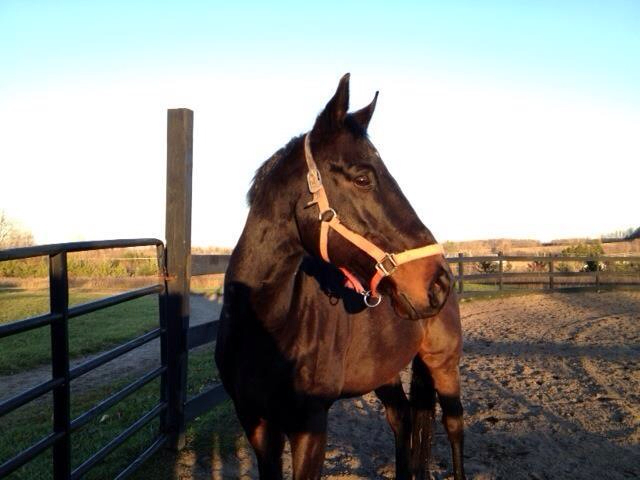
I am in Iowa City, Iowa where tonight I will read poems from my new book at Prairie Lights Books, one of the nation’s premier independent bookstores. I am hereby announcing that my brief reading is dedicated to “Luigi” who is pictured below
I am in Iowa City, Iowa where tonight I will read poems from my new book at Prairie Lights Books, one of the nation's premier independent bookstores. I am hereby announcing that my brief reading is dedicated to "Luigi" who is pictured below. For my blind readers Luigi is a thoroughbred "off the track" former race horse who entered our lives when my wife and I moved to Syracuse a year and a half ago. My wife rides Luigi and I feed him apples. Why dedicate a poetry reading to a horse? Because he has soul, he's a talker, and he has the kindest eyes of any animal I know. Sounds like poetry to me. And here is James Wright's amazing poem "A Blessing" because its one of the best poems I know:
"A Blessing"
Just off the highway to Rochester, Minnesota,
Twilight bounds softly forth on the grass.
And the eyes of those two Indian ponies
Darken with kindness.
They have come gladly out of the willows
To welcome my friend and me.
We step over the barbed wire into the pasture
Where they have been grazing all day, alone.
They ripple tensely, they can hardly contain their happiness
That we have come.
They bow shyly as wet swans. They love each other.
There is no loneliness like theirs.
At home once more,
They begin munching the young tufts of spring in the darkness.
I would like to hold the slenderer one in my arms,
For she has walked over to me
And nuzzled my left hand.
She is black and white,
Her mane falls wild on her forehead,
And the light breeze moves me to caress her long ear
That is delicate as the skin over a girl’s wrist.
Suddenly I realize
That if I stepped out of my body I would break
Into blossom.
–James Wright
Blindness, Babies, and Today's News
There’s an article in today’s New York Times (see link below) about a consortium of universities that failed to tell parents of severely premature babies that the use of heightened oxygen levels in incubation can cause blindness and other serious effects. Perhaps the most astonishing thing about this is that the blinding eye disease associated with oxygen in incubators has been widely known in medical circles since the late 1950’s. Accordingly, leaving this information off of consent forms for parents appears both incomprehensible and perhaps intentional.
Retinopathy of prematurity is the blinding eye disease that I have. I was born three months early in 1955, just before ophthalmologists at Johns Hopkins announced the link between oxygen and blindness in premature infants.
This story does contain more than a whiff of scandal.
Hey, Is That A Service Dog You Got There, Sonny?
When you have a service dog you have to be alert at all times for the crazies–I mean there are some really strange pilgrims on American streets. And boy, they love you when you’re blind. The dog, without meaning to, invites them in. Once in Minneapolis, checking into the Hilton, I met two really drunk college girls who professed to love my dog. They were stinko, blotto, plum loco, almost staggering. “Hey, your dog’s beautiful,” the first one said. “Yeah she’s really beautiful,” said the second. “Hey,” said the first, “You wanna touch my face?” “Yeah,” said the second, “You wanna touch me too?” “Oh your dog is so beautiful!” said the first one. “Oh yeah,” said the second. I backed away, half tripping over my suitcase. All I wanted was to check in. “No,” I said, “I don’t touch faces.” “Well what’s wrong with our faces?” said number one, her voice darkening. “Yeah, what’s wrong?” said number two. “Nothing’s wrong,” I said. “Now go away.” And then security appeared, for this was the Hilton, which is the tasteful lady of commercial hotels, and the face girls became belligerent, claiming that I lured them with the dog. Security said, brightly, “they got dogs outside.” And they went away, shouting, “You coulda touched us!” And this of course is legion, this incident, for every revolving door shoots another nut into the street. There was the lady in the Pittsburgh airport who told me how beautiful my dog was, then added that all her dogs were poisoned by malevolent strangers. Then she asked if my dog could have a treat. Really. This is often how it is.
On Conferences and The Body
My heart’s newfound fluttering in my chest, I sit in the auditorium, half circles of cushioned seats facing a stage. A conference: illness, narrative, disability, medicine. I think about my body in pain. My body in pain listens to presentations on the body in pain.
Question: Sontag taught us illness doesn’t mean anything; illness is just illness. But aren’t we creatures who make meaning? Who relish stories, plot development, denouement? Who desire happy endings. Or barring happiness, desire at least a sense of an ending.
Here’s a happy ending: my body failed, continues to fail. And I am learning to live with it. There is no overcoming. It is no use wishing for something else.
Question: There is no overcoming?
Answer: Sometimes you can’t neatly tie together a narrative.
My heart flutters: a whoosh of blood relapsing when my mitral valve doesn’t close tightly. “Insignificant,” according to the cardiologist. My “new normal.” I feel it constantly. Behind my breasts in pain.
“What else to say?” Theodore Roethke asks.
A presenter distinguishes between illness—what she calls “transitory” and “needing to be fixed”—and disability— an “aspect of enduring identity.”
Question: What if illness is chronic? What if disability is not tied to identity?
Question: Does it matter what stories we tell? What changes when we change our stories?
Another presenter says every day we feel well is contingent. I like that word, contingent. Meaning: “of uncertain occurrence, befall, something happening by chance.” Contingent, my body’s pain, my heart’s fluttering.
Answer: Roethke: “We end in joy.”
“Life is amazing,” Valerie Harper says. She is dying faster than many of us. “Live it to the fullest. Stay as long as you can.”
I sit in an auditorium, listen to presentations on illness, medicine, narrative, disability.
Answer: Life and death. The heart flutters. Pain and no pain: contingent. There is no overcoming. Stay as long as you can.
Thanks for the shout out by Bellemeade Books:
http://bellemeadebooks.blogspot.com/2013/04/national-poetry-month-stephen-kuusisto.html
Homage to Bill Peace and All Chair Users
My friend and academic colleague Bill Peace has written a blog post about a very ugly incident he experienced last night. Essentially, he was prevented from getting into his car by a woman who parked illegally next to the disability parking space. He had to wait around in the dark for her to return so he could get in his car. Worse however was the woman’s disdain for his evident distress, for she took her time to say, “You people are so bitter,” and “I will pray for your rotten soul”–all because he dared to evince his dismay at her behavior. Bill is a talented and brilliant man who has a lifetime of disability advocacy behind him. Imagine how a newly paralyzed veteran, someone who still doesn’t have a sense of self-advocacy, would experience this. Bill can at least write about the evil harridan. I too have met her kind. Bill, I’m performing ancient Finnish magic on her right now. She will wake up tomorrow as a dingle berry on a reindeer’s posterior.
Who are the Blind?
No one really represents the “blind” just as no one speaks for all cab drivers in the United States. There might be good reasons for a national taxi union but even if you could launch it in the face of the Teamsters’ and the 14th amendment, you’d have trouble getting word out to real cabbies, even in the age of Twitter.
The “blind” are just as complex and busy as any other group. Like cab drivers they’re everywhere–indeed the “blind” hail from every ethnic, racial, and social group. You can’t get the “blind” to agree about anything. I happen to like this fact.
There are blind people who believe the only dignified way to walk is with a tall white cane in hand. I believe that’s their right. There are blind people who feel that working with a guide dog is the best way to travel. I belong to that group. A guide dog is trained in a procedure called “intelligent disobedience” which means if you make a bad street crossing decision, the dog will prevent you from walking into a car.
Some of the “cane people” are really quite militant in their disdain for the dog people, and vice versa. This dispute has always reminded me of Jonathan Swift’s description of the nation in “Gulliver’s Travels” that was still fighting a 100 year civil war over the issue “which end of the egg do you crack–the big or the small?”
In New York City cabbies are divided according to their origins and shared languages. They have their own networks and publications. I suspect they fight among themselves. That’s how it is when the commercial stakes are high and the resources are small.
The problem with fights between rival blindness factions is that their disputes can do great harm to individuals who already have a hard time managing their lives. Roughly 70% of the blind remain unemployed in the US, a number that reflects larger unemployment figures for all people with disabilities. One would thing blindness organizations would work together to affirm every avenue of success for blind people trying to get ahead. But such was not the case in Iowa when a young woman with a guide dog tried to take a computer class and was told by the “cane people” that her dog wasn’t welcome in class. Here is my original blog post about this from 2009:
Blind Woman and Guide Dog Suffer Setback in Iowa That is Incomprehensible
If you’re looking for a story that’s so far fetched it makes Edgar Poe’s Cask of Amontillado seem like a plot from Leave It to Beaver then you can read the following story at The Des Moines Register. Some days I need a crazy story for the sheer giggling asphyxia of the thing and there’s no help for it: I just have to read about the raw, dark, nay, even pre-historic antics of people who I had quietly supposed were our civilized neighbors. I make this mistake about civilization rather often so there’s no dearth of outlandish stories in circulation but this one is surprising for its evident extremism about blindness by an agency funded by the state of Iowa that’s supposed to help blind people–and that’s just the opening fork’s worth of apalling meat. The larger mouthful is that state money was spent to fight The Americans with Disabilities Act in a time when every nickel of public aid is desperately needed to help people but I digress. I’m having a problem with my oxygen. This story is just too disgraceful for my customary sensibilities.
Here is a brief excerpt from the Des Moines Register’s article that’s linked above:
Woman’s Bid To Take Dog To Classes Rejected
(Des Moines Register)
February 20, 2008
DES MOINES, IOWA– [Excerpt] “Stephanie Dohmen’s six-year fight to take a guide dog to training classes at the Iowa Department for the Blind suffered a setback Thursday in Polk County District Court.
Jurors rejected the Des Moines woman’s discrimination lawsuit and sided with a department policy that bans the use of visual aids, including seeing-eye dogs, in the program.
Dohmen and her dog, Lilly, were caught in a decades-old argument that has divided blind Americans into distinct camps: those who prefer guide dogs and those who consider the animals a poor substitute for learning to function with only a directional cane.
Supporters of the state program who testified at Dohmen’s trial praised the verdict and defended the ban on guide dogs.”
Reader’s note: the excerpt above was provided by Dave Reynolds who produces the disability rights information site called Inclusion Daily Express.
Now back to my own bosky musings, eh?
If you are from a foreign country and you’re not aware of the matter there is indeed a group of blind advocates who believe that using a white cane as a means of navigating sidewalks and streets is a superior method of mobility than traveling with a professionally trained guide dog. Several of these cane only people work at the Iowa Department for the Blind.
One wonders if there’s a department within the Iowa Department for the Blind that’s in charge of humiliation and impoverishment, but I digress. Sometimes I can’t help it. Preternatural and projective intolerance does this to me every time.
The real issue is that the Iowa Department of the Blind is influenced in its delivery of services by a group of blind people who are members of the National Federation of the Blind which is headquartered in Baltimore, Maryland. The Iowa folks believe there’s only one way to be blind or visually impaired even though specialists in orientation and mobility training for blind people do not generally agree with their positions. I won’t go into this matter at great length but for the sake of analogy this is like imagining a program for wheelchair users that insists no one can have a power chair–you can only use a manual chair and it has to be of a certain specific type of manual chair sanctioned by a committee of manual chair exceptionalists. Any other form of wheelchair is forbidden and not only that, but if you deign to use one of those other mobility devices you are not a “real” mobility impaired person.
Of course the analogy above doesn’t pass the sniff test. And what if we expanded the argument? Let’s say the Iowa Department of Transportation issued a decision that you can only have a driver’s license in Iowa if you drive a Yugo. Remember the Yugo? Surely there’s a Yugo collector’s group. I’ll even wager there are enough of these cars from the former Yugoslavia to match the population of Iowa. That’s a pretty good guess I think.
The whole miserable story of the Iowa Department of the Blind has to do with the prevailing and controlling idea that people who are blind or who are “legally blind” must adhere to the NFB influenced model of blindness which means that you need to wear a blindfold if you have any residual vision in order to take one of their talking software classes. The idea that a guide dog is some kind of visual aid that needs to be checked at the door is so crazy you can hardly give it credence save that in these United States you will never run out of easily confused people who can serve on local juries. Apparently the Polk county jury was confused by the testimony of a guide dog user at the Iowa Department of the Blind who cheerfully announced that he always leaves his dog at the door.
The fact is that demanding such a position of a guide dog user is illegal. Period. And the additional galling fact in this case is that state dollars were spent on this offensive discrimination in a time when people need all the help they can get.
Jeez. If they let Stephanie’s dog into the computer lab it might cheat.
Why am I bringing this back up today? Because the story remains offensive, incomprehensible, and damaging. Because the National Federation of the Blind puts out press releases about their legal work on behalf of the blind (many of which I’ve reprinted on this blog) but they still have a dark and shameful incident in their social archive for which, as far as I know, they’ve never apologized.
I tend to remember these things.
 Planet of the Blind