The MacDowell Colony: Stephen Kuusisto's Current Home Away from Home

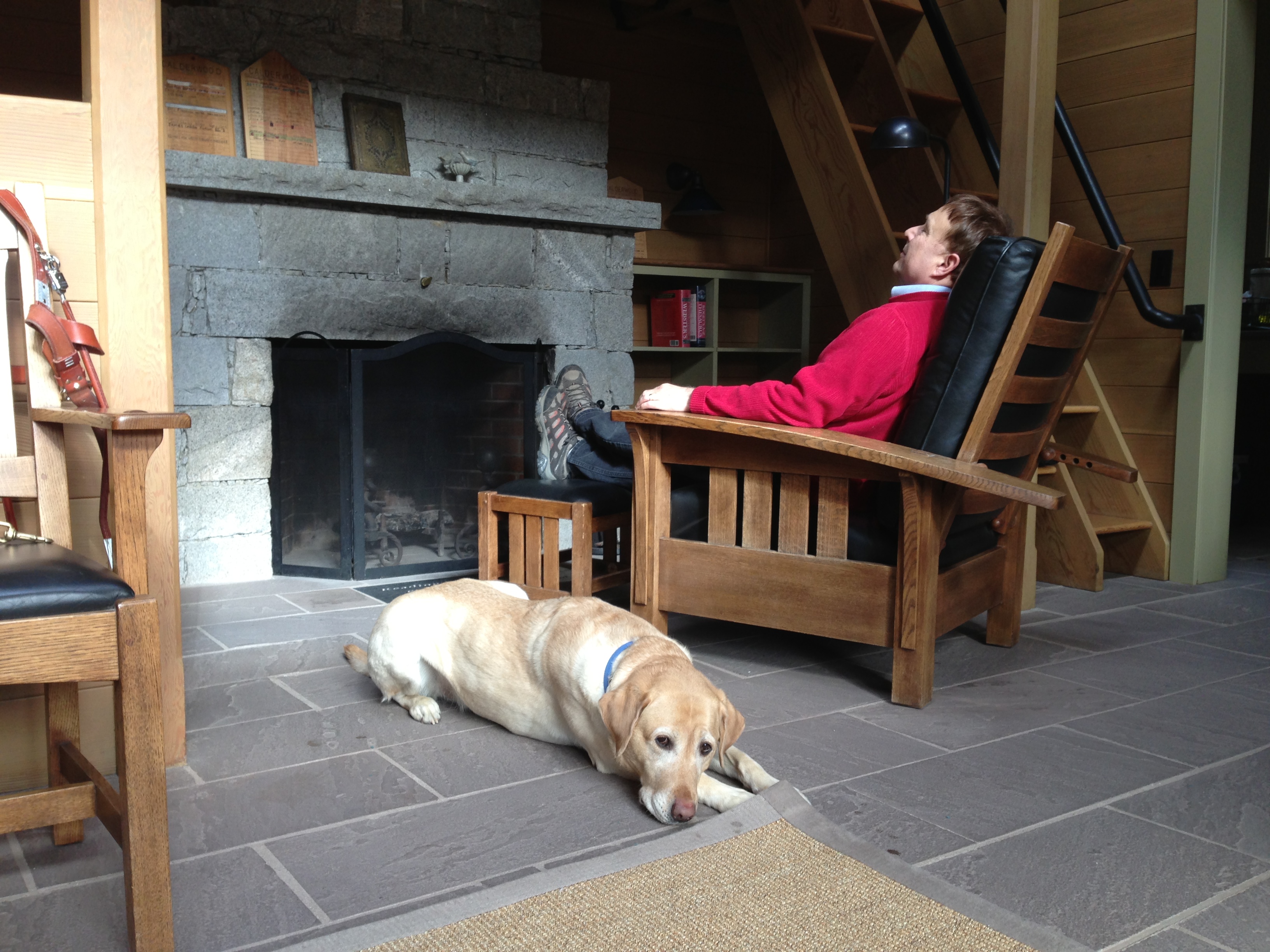
Any writer/artist lucky enough to stay at The MacDowell Colony is indeed very lucky.  Here, Steve Kuusisto and his guide dog, Nira, can do their best thinking.  Nira’s job is to provide inspiration as Steve works on his next book, tentatively titled “What a Dog Can Do”.

Steve Kuusisto and guide dog, Nira

Photo and post submitted by @ConnieKuusisto: Steve, in red sweater, is sitting in a Stickley chair in front of the fireplace in the cabin he’s staying in. His yellow Labrador guide dog, Nira, is lying on the floor by his side.

Disabilities as Ways of Knowing: A Series of Creative Writing Conversations: Part II


The Disability Experience and Poetic Verse


Reading by Poets Jim Ferris, Laurie Clements Lambeth, and Stephen Kuusisto


March 28, 2013

Reading 7:00 to 8:00 pm at Watson Theater

Reception and book signing from 8:00 to 9:00 pm at Light Work

SU Campus


Jim Ferris, Laurie Clements Lambeth and Stephen Kuusisto will be reading from a selection of their poetry, followed by a reception and book signing, for all members of the S.U. community. While this event is geared specifically to raise and support awareness among undergraduates, everyone is welcomed to participate in this exciting set of opportunities. This event will feature works from Beauty is a Verb: The New Poetry of Disability(Cinco Puntos Press) and launch Letters to Borges (Copper Canyon Press), where “best-selling memoirist Stephen Kuusisto uses the themes of travel, place, religion, music, art, and loneliness to explore the relationship between seeing, blindness, and being. In poems addressed to Jorge Luis Borges—another poet who lived with blindness—Kuusisto leverages seeing as negative capability, creating intimacy with deep imagination and uncommon perceptions” (from http://www.stephenkuusisto.com).


American Sign Language (ASL) interpretation will be provided during both the reading and the reception/book signing. Communication Access Realtime Translation (CART) will be provided during the reading.


If you require accommodations or need information on parking for this event, please contact Radell Roberts at 443-4424 or rrober02@syr.edu.


This event is made possible through the Co-Curricular Departmental Initiatives program within the Division of Student Affairs, and cosponsorship by the Disability Cultural Center, the Renée Crown University Honors Program, the Center on Human Policy, Disability Studies, the Burton Blatt Institute, the Dept. of Women’s and Gender Studies, the Lesbian, Gay, Bisexual, Transgender Resource Center, the Office of Multicultural Affairs, the Slutzker Center for International Services, the Creative Writing Program, the Disability Law and Policy Program, the Disability Student Union, the Beyond Compliance Coordinating Committee, and the Disability Law Society.


As aspects of variance and diversity, disability cultures and identities enrich the tapestry of life on and off the SU campus.

Disability Prejudice Alive And Well In The U.S.


(Al Jazeera)

January 30, 2013

SEATTLE, WASHINGTON– [Excerpt provided by Inclusion Daily Express] Often referred to as “the world’s largest minority”, persons with disabilities are accustomed to facing barriers to their participating in almost every aspect of society.

“In the case of disability, we’ve had to spend all our time and energy determining who is a member of the club, rather than if they are being discriminated against,” Joelle Brouner, Executive Director of the Washington State Rehabilitation Council told Al Jazeera.

Brouner, who experiences a major physical disability herself, works to see that a greater number of people with disabilities enter the workforce and progress in their careers.

But, like so many people with disabilities, sometimes just getting to work can pose as great a challenge. Smiling, she asked: “How do I figure out how to build a life when I have to figure out how to ride a bus?”

“In 2004, I went to New York City and there were very few wheelchair accessible cabs, and I couldn’t use the subway. ‘We don’t want more of you in the world’ is the message some of this sends to people with disabilities.”

Entire article:

Human Rights for US Disabled?

http://www.aljazeera.com/news/americas/2013/01/201312717417999561.html

The 20-Year-Old Self

By Andrea Scarpino


Lately, I’ve been thinking about my younger self, who she was, what she would say about where I am in my life these days.


She liked to think of herself as radical, that younger me. Radically vegetarian—sometimes vegan, aspiring always to veganhood—radically political, radically bodied. She found and formed new identities with each trip to the library, took as many college classes as she could to expand her knowledge, spoke often in class, visited her professor’s office hours regularly. She was passionate, full of energy and idealistic beliefs, full of desire to live her life fully. She had thousands of dreams, imagined thousands of possibilities, careers, places to live and visit. She laughed so loudly people turned to stare.


But she also believed in perfection, that maintaining a 4.0 GPA was incredibly important, that making the world a better place was only possible if she fought racism and sexism and classism and homophobia perfectly. If she never made mistakes. If she held others to the same standards to which she held herself. She thought in black and white, never shades of gray.


And she was constantly anxious, nervous. She was sick from stress, barely sleeping, quizzing herself with stacks of flashcards while she ate breakfast, walked to work. She was judgmental, lecturing her father in restaurants about his food choices, lecturing her step-mother about racism, lecturing strangers in the supermarket about their religious beliefs. In her mind, there was right and there was wrong; there was nothing in-between.


She was lovely in many ways, that younger version of me, although she never quite believed she was saying or doing or being the right thing. But she was also rigid, inflexible, unwilling to seriously dialogue with people who didn’t agree with her beliefs. Sometimes she belittled in order to prove her point.


And I feel, lately, like it’s important to remember the negatives of that younger self, not just to idealize her energy, conviction, all the truths she knew beyond a shadow of a doubt. Because the older I become, the more complicated everything seems, the more I understand the world in overlapping systems, constellations of choices with constellations of consequences desired and unintended. And sometimes I worry my younger self would have nothing but disdain for the current me. After all, I buy most of my clothes new instead of used, I drive three hours to get my hair cut, I didn’t volunteer a single minute for the last election, sometimes I wear make-up, sometimes I smile at sexist jokes instead of screaming.


When I remember only my idealistic younger self, I’m overcome with anxiety that she would think I’ve sold myself short. As a student told me recently, “Complexity is just something 30-year-olds tell themselves to make them feel better about selling out.” I laughed. And walked away. Because lately, I’m trying to be gentle with myself, the choices I’ve made, continue to make, the paths I’m choosing in a world of complexity. I’m trying to be gentle with others, too. Understand their choices, see them from many angles and possibilities. I’m trying to maintain my younger self’s enthusiasm, laughter, passionate beliefs, while moving forward with less judgment, more kindness, less right-or-wrong thinking.

Elegy


We are still here where cartoon pigs sell car insurance

And travelers comb the suburbs ringing doorbells for Christ.

Anselm, my father used to laugh, said the American Finns

should have stayed home.

Once I found a set of dentures–uppers and lowers on a road.

This cash and carry country is a slap on the back kind of place.

I’m told that light is a climb and going up one steps right out.


Ableism at the Hockey Rink

Craig Wyshynski whose online moniker is “Puck Daddy” apparently thinks that the recent ableist display by a minor league hockey coach (who imitated a shambling blind man, using a hockey stick for a cane) was “hilarious.”

I think it’s amazing how many people believe lampooning the blind is perfectly acceptable. One remembers the Saturday Night Live skits making fun of former New York Governor Paterson.

Shame on Wyshynski. Grow up “Puck Daddy”. Or don’t. But don’t pretend blind people are stupid cartoon characters Dude!

Farewell Anselm Hollo


News has reached me this morning of the death of Anselm Hollo the incomparably original and probative Finnish-American writer and translator. If sadness is custom, losing a poet is its shadow. No elegy captures shadows. Auden perhaps came closest, observing at the death of Yeats how the poet becomes his admirers. How heavy the poet’s cloak feels. I know I’m grieving with thousands of poets and readers who loved Anselm Hollo’s works and days.

I first saw Anselm in an upstate New York supermarket in 1972. I was 17, almost totally blind, anorexic, shy as hell, and just discovering poetry by way of Stephen Berg and Robert Mezey’s anthology “Naked Poetry”.

I knew who Anselm was, knew he was teaching at the local college.

There he was, walking the canned goods aisle at “Loblaw’s Grocery” with a knee length leather coat, a dizzying mane of “late Beatles” hair, giving off the dissociational fixedness of a man in multiple worlds.

I have carried this particular poet’s books with me now for over thirty years. His poems, translations and prose have been keen influences on my growth as a poet and writer. It would be easy to say my admiration for Anselm’s work is tied to my own Finnish heritage, but that’s not the case. In fact Anselm was a cultural refugee from Finland. One may imagine (as Robert Creeley did, mistakenly) that Finland is filled with outré jazzy transnational shamans, but it isn’t so. Hollo found his voice in the United States when, as a high school exchange student in Iowa in the 1950’s he heard Bill Haley and the Comets. Thereafter he found his way to cities and towns where poetry was creating new communities. In fact when I think of Anselm I always think of gatherings of poets. Yes he was Finnish but in the way of Victor Turner’s “liminal” figure, the man or woman who leaves the ritual circle of the customary culture, who travels widely, who sends back news from unknown terrain.

His translations of poems by Paavo Haavikko and Pentti Saarikoski inspired me to undertake a Fulbright year in Helsinki in 1981-82.

In my memoir Planet of the Blind I describe the dark and provincial quality of my research year in Finland. Poets wouldn’t meet with me. Scholars at the university thought contemporary poetry was beneath contemplation. Maybe things are better now as much has changed–Finland is more international both in cultural and business terms today. But whatever the case I discovered there were not tons of statically alive, multi-cultural, extroverted Anselm Hollo-like Finns walking the Esplanade in Helsinki. It was a place of sharpened introverts. Years later when Bob Creeley also ventured to Finland on a Fulbright the same discoveries befell him. He later described his year in Finland as remarkably lonely. We both found out that Anselm was a Finn in much the way John Lennon was English. Anselm Hollo is an international poet with a Finnish caraway seed under his tongue.

Hollo was the anti-laureate as Robert Archambeau wrote. I have always liked anti poesis Liked it the first time I saw it in person there among the cans of creamed corn in Geneva, New York when I was 17, weighed 102 pounds, and didn’t know how to live.

I will close with one of Anselm’s love poems, this one dedicated to Jane Daleymple, his second wife:


wind gusts changes sky from blue to white

above carpet of crabapples under the tree

flickers flicker through air


tremendous lightning strike two nights ago

gave me the flesh of the hen for half a second

then water poured from the sky


— no I’m not turning into a “nature poet”

but the little green house you built for me

does make me notice a few more things in the universe

to add to my “Notes on the Possibilities and Attractions of Existence”

and I never imagined I could be so unjealous

of my loved one’s art

even when it takes her away from me

for many evenings and mornings and nights inbetween

but o I make myself a joy of it

to see her again


“the flesh of the hen” — “la chair de poule” — goose pimples

“make myself a joy of it” — “se faire une joie de” — to look forward with pleasure
 

Sterilization Survivors Testify As Virginia Considers Compensating Eugenics Victims


(News & Advance)

January 29, 2013

RICHMOND, VIRGINIA– [Excerpt provided by Inclusion Daily Express] Lewis Reynolds, 85, rose slowly to his feet Monday to tell a House of Delegates subcommittee about being sterilized at the age of 13 at the Central Virginia Training Center.

The 65 people in the room fell silent as Reynolds, of Lynchburg, told the lawmakers he still loves his country despite being deprived of offspring who might have helped him cope with his advancing years.

“I’m Sergeant Reynolds, United States Marine Corps,” he said to eight members of a House Appropriations subcommittee.

“I served in Korea and Vietnam for y’all’s freedom. I couldn’t have no family,” he said, because of the misguided science of eugenics, endorsed by Virginia law from 1924 to 1979, and practiced by sterilizing about 7,500 people in its mental-health institutions.

The subcommittee was considering a bill to establish a state fund to provide $50,000 to surviving victims of the eugenics practice. Five of the victims attended the subcommittee meeting.

Entire article:

Sterilized Lynchburg residents visit House panel, which delays action

http://tinyurl.com/ide0129132a

Related:

Bill Would Compensate Virginia’s Forced Sterilization Victims (WAMU)

http://tinyurl.com/ide0129132b

Virginia’s Eugenics Legacy (Inclusion Daily Express Archives)

http://www.inclusiondaily.com/news/advocacy/vaeugenics.htm


Harkin: How One Iowa Senator Secured Civil Rights For Americans With Disabilities


(Think Progress)

January 29, 2013

WASHINGTON, DC– [Excerpt provided by Inclusion Daily Express] This past weekend, Sen. Tom Harkin (D-IA) announced he will not seek re-election in 2014, bringing an almost 40 year career in Congress to a close. But as Harkin steps aside, his legacy — particularly his work to champion increased protections for Americans living with disabilities — remains.

Twenty two years ago, President George H.W. Bush signed the Americans with Disabilities Act (ADA) and the Individuals with Disabilities Education Act (IDEA) into law. Either law would have been considered landmark civil rights legislation on its own merits — taken together, they represented nothing short of a legislative revolution for disabled and special needs Americans. And those bills were made possible by Harkin, who authored and shepherded them to overwhelming bipartisan approval.

Every handicapped spot in a parking lot, each mechanical wheelchair ramp on a public transport vehicle, and any company that employs qualified Americans with a disability, is only made possible because of the ADA. The law’s provisions — which include protections ranging from anti-workplace discrimination, to public transport and public facility accommodations, to telecommunications support for the visually and hearing impaired — have given millions of Americans the means to pursue independent livelihoods.

As one disabled American put it, “I have traveled 18,000 miles between Los Angeles and Bakersfield in an externship, and without the ADA and the Department of Transportation’s provisions, I would not have managed to remain independent and commute.”

According to one study, the percentage of disabled Americans citing public transport accommodations as a barrier to their commute dropped from 49 percent to 31 percent between 1989 and 2004.

Entire article:

How One Iowa Senator Secured Civil Rights For Americans Living With Disabilities

http://tinyurl.com/ide0129131a

Related:

Sen. Tom Harkin (D-Iowa) to retire (Washington Post)

http://tinyurl.com/ide0129131b