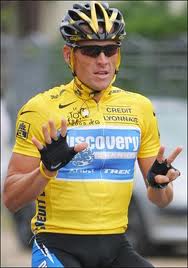
Wrestling with Armstrong

By Andrea Scarpino


Lance Armstrong


Seven Tour de France titles stripped. That’s the recent recommendation by the US Anti-Doping Agency in light of a plethora of doping accusations made against Lance Armstrong. 


I’m profoundly ambivalent. I want Armstrong to be clean with an irrationality that says more about my desire for athletic heroes than my interest in cycling. But I also think our cultural obsession with unfair advantages is a bit misguided. Remember Oscar Pistorius—some claim his carbon legs give him an unfair advantage even though they mean he has less musculature and must start each race slower than athletes with flesh and bone legs. 


We also allow all athletes to consume caffeine, which is a known performance-enhancing drug. And athletes with more money almost universally fare better. The more they can spend on coaches, trainers, massage therapists, sports psychologists, on technology that assesses every muscle’s twitch, on nutrition and nutritional supplements, on traveling to train in high altitudes, etc. etc., the better they perform. So caffeine and money are clear performance-enhancers—and are totally legal. The lines demarcating “unfair advantage,” in my mind at least, are drawn in a series of grays. Easily smudged. Not easily defended. 


And there’s something about Armstrong. His name, for one—how could you name a child “Lance Armstrong” and not expect him to become a superhero? His overcoming of testicular cancer. The way he has shifted his athletic career to cancer research and support. He may be a cheater. But I respect so much of what he’s accomplished—and that makes me want so badly to believe he was clean. Or at least, I want to believe he didn’t dope any more than any other first-rate cyclist. 


My friend Kevin, who knows much more about cycling than I do, wrote me, “If he is stripped, they will have to go pretty deep to award the win to a “clean” rider. I think some years you’re out of the top ten to find someone who hasn’t been implicated.” In other words, cycling is rife with doping. And if we believe Armstrong was doping, then we probably have to believe everyone of his caliber was also doping. 


And if everyone was doping and Armstrong still won, doesn’t that still make him the best rider? Such is the case with the high-tech half-body swimsuits used by many swimmers in the 2008 Olympics. Although those suits are now banned as providing unfair advantage, the swimmers who medaled while wearing them still get to keep their medals. I understand they weren’t illegal then, and maybe that’s the sticking point. But if everyone wore them, and three swimmers still performed better than everyone else in the pool. . . then what? Then aren’t those three swimmers still the best in the pool? 


I’m struggling through my thinking here, not sure—still, again—why I want so badly for Armstrong’s Tour de France success to remain. As I said, I don’t think the lines between “fair” and “unfair” are very well drawn, are very easily defensible—and often have more to do with knee-jerk reactions than actual science. But there’s something else simmering below the surface: a desire, maybe, to believe that a human can accomplish seemingly un-human feats without the help of specially concocted drugs. Isn’t that why we make heroes, because they’re better and stronger and braver examples of the human species? Because they reflect back to us the fullest extent of human potential? To leap tall buildings in a single bound! Wouldn’t we all like to make that leap? 


Brief Treatise on Morning

I wake to the sound of an electric fan and lie in bed with my eyes closed imagining, like the poet Lars Gustafsson, the silence in the world before Bach. Mornings can begin this way. The day is empty. There is room for the mind’s play. There is no place just now for capitalism. The mind is a question asked of another question. And just as I decide I don’t want to get out of bed the dogs come because their bellies are empty. 

Micro Memoir 32


Alright. A repeated fury has me by the toe. You see, the wind from dawn’s hourglass opened my eyes and I wasn’t ready. Now I want to tear the wreaths off my neighbor’s doors but it isn’t Christmas. 


There are so many unknown forces in the genes. Today I am a rabid king. Beware lest I appear on your doorstep. As Pablo Neruda once said: “Please, I beg a sage to tell me, where may I live in peace?” 


Micro Memoir 52


A friend lost his eyes once. He was washing them, prosthetic plastic eyeballs and he dropped them and they rolled away–two eyes moving in different directions. And my friend was frozen in place for he was in a nameless moment, one for which there are no intonations or gestures. The eyes were rolling like an infinite number of mistakes. He could hear them, oblong, blue, stuffed with algebra. 

Micro Memoir 62

Micro Memoir 62


I bought an umbrella from a street vendor. The sky was clear. The weather report called for many days of sun. Sometimes you need a prop for the dark, unconscious side of life. I bought the thing for my dead mother. And then she was there with me on 8th St. And the crowd around us formed a dense black ant pile and the confusion all about was indescribable.

Looking To November, Disability Advocates Call For Accessible Polling Places

(WNYC)
August 28, 2012

NEW YORK, NEW YORK– [Excerpt provided by Inclusion Daily Express] A Federal Court Judge will hear testimony Monday about how to make city polling sites more accessible for people who use wheelchairs or have vision impairments.

Earlier this month, U.S. District Judge Deborah Batts ruled there were pervasive barriers at sites — from inadequate signage to locked entrance doors — for people with disabilities.

The suit was filed two years ago, alleging the Board of Elections violated the Americans with Disabilities Act.

Denise McQuade, who uses a wheelchair, faced several obstacles when she tried to vote in 2010 because her polling place in Bay Ridge was inaccessible.

“The door was hard to get through in a wheelchair and then I immediately faced a steep ramp that was more for deliveries than wheelchairs because it was on an incline and it was impossible to go up or down it by myself,” she said.

It wasn’t the first time McQuade had problems trying to vote.

Entire article:
Looking to November, Disability Advocates Call for Accessible Polling Places

http://tinyurl.com/ide0828123

Jennifer Bartlett's new chapbook from Albion Books

a message from Brian Teare:
 
dear steadfast friends and associates of albion books and jennifer bartlett —


i’m delighted to announce the publication of the fourth (and final) volume of series four —


by jennifer bartlett
 
 
an essay about writing larry eigner’s biography, disability criticism, new american poetics, and embodiment —
 
printed in an edition of 120 — handbound — letterpressed covers — w/french flaps — recycled papers —
 
$15 — order with paypal through the above link — or send me an email to order by check —
 
barters and trades always welcome !


thank you all again for your support in 2011 and 2012 —
 
and be on the lookout for new chapbooks by frank sherlock, rachel moritz and juliet patterson this winter —
 
 
as ever
 
 
b.