Guide Dog Reveille

When the day opens the dog opens. Opens before you do. Sees the beautiful objects all around the room. Can’t resist waking you. Puts her front paws on your chest. 


Note to self: find out how dogs wake each other in the wild. Maybe they all wake at once. Probably waking human beings is a different order of business than waking the pack. Of course it is.


Oh but the day is open. And because guide dogs are on a schedule, a daily calendar that reflects a working life, they must eat first thing. Then it’s a trip outside, often before daylight, and without regard for the weather. We are awake and outside and its raining and by God the day is good. 


When you’re up, you’re up. And there’s a day of linked occasions opening all around the man and dog.  


Disability and Dark Tourism

Lawrence Downes’ essay “Erasing the Past at the Ghost Hospital” makes for good reading if you’re interested in dark tourism. The Kings Point mental hospital, now in advanced ruins, is proving to be an attractive destination for people who view mental illness through Hollywood lenses–perhaps they see David Caruso with a gas mask as they walk the paths of what was essentially a concentration camp for the mentally ill? In America we like to make things gothic with a small g, rather than see what our most segregationist impulses have always been about. Today the largest mental hospital in the US is the Los Angeles County jail system. Any tourists up for visiting that?


Here's to Charles Lott and His Service Dog Nia

Protesters Demonstrate To Educate After Man Arrested Over Service Dog
(KARK-TV)
August 6, 2012

LITTLE ROCK, ARKANSAS– [Excerpt provided by Inclusion Daily Express] “They have information taken straight from the ADA website,” said Charles Lott because he said, the library violated those rights when they arrested a disabled man with a service dog at the library last week.

“We’re trying to show them that someone was harassed and his basic rights were denied,” said Lott.

On the library’s security footage we first showed you Wednesday, you can see Terry “Grizz” Hayhurst with his service dog, Nia, who is trained in balance assistance as Hayhurst suffers from a spinal cord injury.

Hayhurst said he was asked questions regarding his disability that were not allowed under ADA regulations.

Library officials said he was escorted out and later arrested for not cooperating.

The protest Sunday was to show solidarity for what activists said is an injustice.

Entire article:
Protesters Want More Knowledge Of Disability Discrimination

http://arkansasmatters.com/fulltext?nxd_id=568762
Related: 
Disabled Man Arrested After Debate Over Service Dog at Little Rock Library

http://arkansasmatters.com/fulltext?nxd_id=566602

Aristotle and the Guide Dog

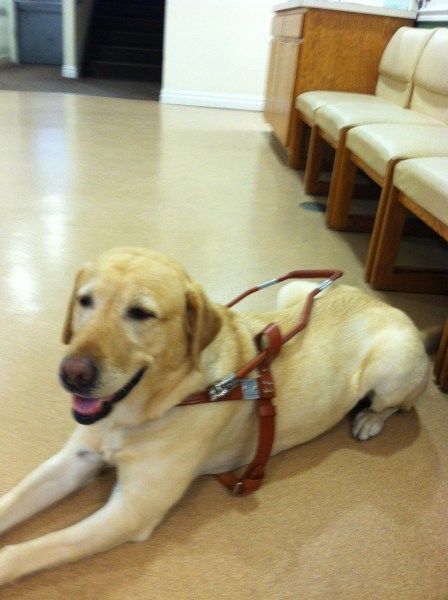
IMG 0317


Photo depicts guide dog Nira, a yellow labrador, sporting a new leather harness at Guiding Eyes for the Blind. She’s smiling. 


Sometimes I think about the world as the ancients did and imagine I can stand in a pond and observe all the chance things nature chooses to reveal. Blindness complicates this but only a little. The aim is to stay open. Watch less television. Live like Aristotle. And soon you find that life with a guide dog raises this art to a higher level–you enter the day on a dog’s terms, walk in Central Park before you are ready for new circumstances. You’re half awake and it’s very early and you find yourself in  conversation with a policeman who admires your dog. It’s also clear he admires you. You’re in the world despite all the obstacles. You’ve trained successfully to be in the world. The policeman doesn’t have to say this. It’s in his voice. He was just walking his beat and he came across a man and dog who together defy the odds. And you have given him something Aristotelian, a minor marvel at sunrise. And he has given you easy, mostly implicit admiration–the way Americans used to do this, the Gary Cooper way. It’s six am and you’ve already thought of philosophy and Lou Gehrig. This is guide dog life. I wouldn’t trade it for anything. 


Blade Runner

By Andrea Scarpino

“I didn’t grow up thinking I had a disability. I grew up thinking I had different shoes,” Oscar Pistorius said in last week’s lead-up to his 400-meter Olympic race. "I just see him as another athlete, another competitor. What's more important is I see him as another person,” said Kirani James, the runner who won the semifinal heat in which Pistorius came last, and the favorite to win the finals. Upon finishing, James embraced Pistorius; they traded numbers from their jerseys.

Pistorius, a Paralympics star, is now the Olympics’ first athlete who is a double-amputee, a man who runs on two carbon limbs. He has been followed by controversy, by international sports officials and armchair sports analysts insisting that his carbon legs give him an unfair advantage. He has fought hard to prove that isn’t the case—and his upright, bouncing exit from the race blocks—when athletes running on skin and bones can exit almost parallel to the ground, reducing wind resistance—should offer some visual proof to the studies that show he has no advantage.

But none of this is what most impresses me. What impresses me: this quote, again from the lead-up to last week’s race: “I’m not expecting to win.”

I’m not expecting to win. This from an athlete who is used to winning, to breaking records and winning gold medals against competitors like him, as well as competitors with one amputation, with no amputations. This from an athlete who likes to win. Pistorius wasn’t fighting to race against able-bodied athletes in the Olympics as a showpiece, the one “disabled athlete” with access to a world audience. He was fighting to race as a competitor—his competition understands that. He wants to win every time he leans into the starting blocks, every time a practice gets hard.

And this is what most impresses me: to know that you won’t win, that being born without fibulae is not insignificant—and to dedicate yourself to running faster than your own previous best. To still run as if you will win. What impresses me: to know that you might fall, that you might cross the finish line in embarrassment, or not at all—and to risk racing anyway. To know that detractors will tell all sorts of stories about your success or lack of success—and to shut them out entirely.

It’s one thing to have Michael Phelps-like confidence, prestige, privilege, to enter each race expecting to end victorious. It’s another to know at least part of the world sees you as a freak or cheater or worse. And to still compete. To still win the respect of your competitors.

Pistorius’ goal was to make the semifinal round in the Olympics. He did. And many of us rooting for him understand this as a gold-medal win in and of itself: an athlete with two carbon legs stealing the world’s attention. But what will stay with me long after the Olympics is Pistorius’ self-reflection—“I’m not expecting to win.” And the speed with which he ran anyway.

Invitation–Support the Anne Sullivan Macy Act and Improve Outcomes for Students with Vision LossInvitation–Support the Anne Sullivan Macy Act and Improve Outcomes for Students with Vision Loss


From our friends at AFB:

Dear Colleague:

Since its enactment more than 35 years ago, Public Law 94-142, now the Individuals with Disabilities Education Act (IDEA), has transformed educational opportunity for all children and youth with disabilities. However, the law does not adequately hold public agencies accountable for vital services and instruction such as braille, orientation and mobility, the provision of low vision devices, and a host of other essential services and instruction needed by students with vision loss to truly receive a free and appropriate public education worthy of their tremendous potential.

The Anne Sullivan Macy Act, comprehensive draft legislation endorsed by the American Council of the Blind (ACB), American Foundation for the Blind (AFB), Association for Education and Rehabilitation of the Blind and Visually Impaired (AER), Council of Schools for the Blind (COSB), Perkins School for the Blind, and VisionServe Alliance, would revolutionize America’s special education system for all students with vision loss, including students who may also have additional, and potentially even more significant, disabilities.

Everyone who cares about the scope and quality of special education for students with vision loss is invited to join in the national effort to work for the legislation’s prompt enactment and/or incorporation into IDEA. While the process for congressional review and reauthorization of IDEA promises to be a long one, advocates should begin now to educate federal policy makers about the critical need for the array of improvements that the Anne Sullivan Macy Act embodies.

You can find the full text of the draft legislation and a petition to sign at:

http://www.AFB.org/MacyAct

An array of supporting explanatory materials can also be found at a joint AFB and Perkins School website at:

http://www.ECCAdvocacy.org

If your school, association, agency, parent network, service organization, or other group can join the growing roster of organizations endorsing the Anne Sullivan Macy Act, we’d love to hear from you! Send an email confirming such endorsement to:

MRichert@afb.net

Named for Helen Kellerís beloved teacher, the Anne Sullivan Macy Act would strengthen the Individuals with Disabilities Education Act (IDEA) and improve results for the more than 100,000 children and youth with vision loss, including those who also have additional disabilities. Key provisions of the legislation include:

∑Ensure that every student with vision loss is properly identified regardless of formal disability category or classification so that all students with vision loss, including those with additional disabilities, are counted and properly served.

∑Expand knowledge about the scope and quality of special education and related services provided to students with vision loss through refined data collection that tracks all students with vision loss, regardless of formal disability category or classification.

∑Expect states to conduct strategic planning (and commit such planning to writing) to guarantee that all students with vision loss within each state receive all specialized instruction and services needed by students with vision loss provided by properly trained personnel.

∑Clarify that proper evaluation of students with vision loss includes evaluation for studentsí needs for instruction in communication and productivity (including braille instruction, and assistive technology proficiency inclusive of low vision devices where appropriate); self-sufficiency and interaction (including orientation and mobility, self-determination, sensory efficiency, socialization, recreation and fitness, and independent living skills); and age appropriate career education. Such instruction and services constitute the Expanded Core Curriculum, the body of services which teachers of students with visual impairments and related professionals are expertly trained to provide.

∑Ramp up U.S. Department of Education responsibilities to monitor and report on statesí compliance with their obligations with respect to instruction and services specifically provided to students with vision loss.

∑Assist parents and educators of students with vision loss through regular and up-to-date written policy guidance from the U.S. Department of Education.

∑Establish a national collaborative organizational resource, the Anne Sullivan Macy Center on Vision Loss and Educational Excellence, to proliferate evidence-based practices in the education of students with vision loss, to keep special educators current with the latest instructional methods, and to supplement state and local educational agency provision of the instruction and services constituting the Expanded Core Curriculum.
 

Confessions of a Man on Fire

When doctors don’t know what you have–you know, “the thing” that bends you low, makes you sweat, causes you to entertain prayer, forces you to jump up and down like a mechanical toy from the 19th century, they call it an “idiopathic” condition. 


Now of course there are different kinds of not knowing when it comes to the body. There’s not knowing and there’s not knowing. I hope this clears things up. 


I have one of the commonest idiopathic ailments and you might have it too: I fucking itch all over. We’re not talking a minor league, Sunday school itch–the kind Huck Finn had when they told him not to scratch in church–that ain’t idiopathic my friend. We know why Huck was itchy. In fact studies have shown that ministers, preachers, priests, rabbis, zen masters, imams, and school teachers can cause itching by doing nothing more than moving their eyes. There’s a scientific term for this. Preachers who make you itch just by looking at you are known as ohptho-idio-paths, which is an elevated way of saying you break out in hives because they really don’t fucking like you.  


There. I’ve dropped two “f bombs” in three paragraphs. But this reflects how serious idiopathic itching is. The doctor doesn’t know why you itch. You just boil all over with purgatorial pins and needles, with no part of your body unaffected. 


You might be allergic to wine. Maybe food. Maybe air pollution. Agribusiness. Laundry detergent. But you live without those things as an experiment, sequentially, sober, starving, hiding in the cellar, stinking so badly the dog won’t come near you and nothing changes. You itch like an electrified sponge. 


In my case the thing that most helps is an over the counter generic drug called loratadine–an antihistamine that’s commercially marketed as Claritin. When I take it the itching is vastly reduced. I stop tearing at my skin. I even get some sleep. 


So why then did I spend last night “not taking it” and playing a game of mind over matter?  Why did I lie on my bed of fire and send brain messages to every part of my straining body?


 The answer?  It’s the Lutheran Olympics. It’s a Scandinavian thing. 


Brain to feet: “C’mon guys, can’t we all just get along?”


Feet to brain: “Captain, the engine room’s on fire and the door’s locked!”


Brain to hands: “Now just stop that! Grow up!”


Hands to brain:  “Help! The tarantulas have escaped! They’re in our mittens!”


Other parts of the body have requested anonymity. 


Please don’t try this. We are, as they say in TV land, trained professionals. 


Grace Under Pressure: Goodbye to the Dog Who Saved My Life


I was traveling in Chicago when Connie called to say that Corky had had a seizure. She’d stumbled in our kitchen and had became disoriented. The message was “not to worry” as a local vet said she was not suffering from something serious. Corky, at 13 was still for all intents in great health, and happy to be at home with Connie who worked at her computer. Corky and Connie had a special bond. I believe it was Corky who led me to Connie in the first place. Corky, my street guardian and matchmaker. My fairy tale dog. 


When I came home from the conference Corky looked fine. She even brought me a shoe, one of her happy domestic eccentricities. Always one shoe. Always pleased with herself. 


Outside winter was turning to spring. It was that funny season when the snow has gone but the world is not yet green. I’ve always thought of this as the moment when winter’s ghosts are preparing to leave the earth. I believe there’s more to the Ides of March than we customarily admit. As green comes to the branches the dead are rising. 


A week later Corky had another seizure, this time in the evening. She was disoriented, walking sideways, her eyes half registering us. We rushed her to a 24 hour veterinary clinic where a kindly young vet examined her and concluded that whatever had happened was minor. Corky looked better, more alert, even wagged her tale. We took her home. 


Later that night she had a massive attack. She emptied her bowels and fell to the floor. My beloved was dying. 


In the morning we took her to our regular vet but she wasn’t in. An assistant told us to leave her and come back. 


We found a breakfast place and drank coffee and began to plunge seriously into worry. Corky was such a remarkable girl, so loyal, so deeply loving, it was next to impossible to imagine life without her. Could she be made better? Oh please! We ate our melancholy breakfasts, Connie and I, while pursuing hope.  


When we went back Corky was lying on a blanket with an I.V. attached to her foreleg. she was panting heavily. We were told that it was a brain tumor and there was nothing they could do. It was time to say goodbye. My stepson Ross stood behind me, radiating both love and strength. 


“Courage,” said Hemingway, “is grace under pressure.” I have never felt especially courageous. But it occurred to me that Corky had spent her life protecting me. More than once she had taken evasive action that had saved my life. She was always looking out for me, concerned and yes, spiritually affirming. My dog. My special angel. I knew that I had to force back my tears. I lay down on the floor beside her, held her, and sang to her our special walking song. And she died in my arms.