Jeremy Bentham, Peter Singer, and Contemporary Disability Advocacy

Are disability lives not worth living? The long history of "abled" voices has said, and continues to say "no"–a "no" that has been complicated by pre-natal testing and divisive political rhetoric about the nature of what a qualified life really is. In 2005 the Terri Schiavo case demonstrated to disability rights activists that when it comes to protecting disability life, conservatives had more empathy and courage than neo-liberal Democrats (with the notable exception of the Rev. Jesse Jackson).

The very idea that a disabled life is not a life at all depends both on the medical appropriation of curative utility (life with illness only possesses value in relation to its amelioration) and simple metaphor (disability understood as a ruined identity, see Erving Goffman). The dichotomies of spoiled identity have a long history on both sides of the Atlantic–eugenics, forced sterilizations, the "ugly laws", institutionalization, and the Nazi "T4" mass murder of adults and children with disabilities. The pattern is one of distillation: disability, (post industrial revolution) is broadly conceived–has been conceived as economically unviable, hence lacking all capacity for the pursuit of happiness in the world of econo-biography.

The darker version of this is the resentment of social welfare (Hitler famously depicted people with disabilities as "useless eaters"). The utilitarian (Benthamite) position (Peter Singer) holds that the greater good of society must trump the needs of a minority in pain–"good" is understood as the potential for achieving pleasure. The Benthamite pleasure principle subborns life to economic life and forgoes the question of what constitutes individual autonomy when imagined outside of industrial labor. In turn it's the right of the majority class, the "duty" of the majority class to debate the probable happiness potential and index of the minority. Many disability rights activists and scholars have pointed out the inevitable connection of Jeremy Bentham's ideas (and Singer's fealty to same) as the foundational principles of Nazism. There is truth to this because eugenics was driven by the principles of Bentham.)

The 21st century extension of disability as a cathexis of the utilitarian body and the medical model of physicality (that abnormality only has value in relation to its likelihood of cure) is now intensified by pre-natal testing. Mr. Singer would counsel parents to abort a fetus if it's future birth would result in a child without arms and legs. In his view that child would have no likelihood of happiness and (more sinister of course) such a child would impede the greater happiness of society. Singer is no scholar of economies of scale or of their pre-history. The idea that a legless man might be a great singer or poet demands an appreciation of proto-industrial village life: the majority history of human kind. But enough of Singer.

A friend wrote me recently. She's a young writer and a new mother of a little girl with a disability. She wrote because she's experienced the insensitivity of her academic colleagues and friends who have opined that they couldn't imagine raising a child with an intellectual or developmental disability. My friend has been shocked by the thuggish candor of these remarks. And by turn of the imaginative poverty of the conceptualization of a challenged life as no life at all. This is the marriage of utilitarian philosophy (absorbed through capitalism's ubiquitous social rhetoric) and the medical model of disability which holds that physical difference without the prospect of cure is not worth enduring. We are living in creepy and reactionary times. And though I've been a life long liberal, I applauded the efforts of former Florida governor Jeb Bush to save the unimaginable life of Terri Schiavo. I've never felt any ambiguity about that. Perhaps my lifetime of nearly incomprehensible difficulty to live and stand among the able bodied has given me a strange capacity for steepened joy. Not an easy joy. Not a hot rod, drive your car fast joy, It's the joy of living beautifully in the solitudes of challenge–something your average doctor or utilitarian philosopher can't imagine because they don't understand the vitality of pain.
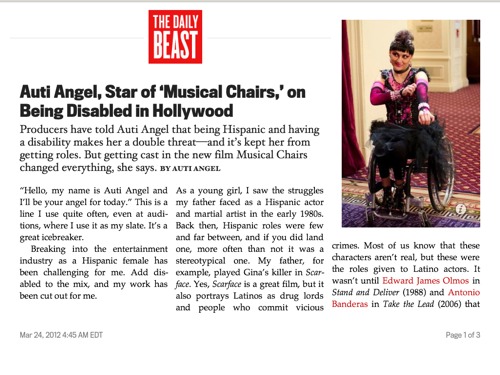
Article: Auti Angel, Star of ‘Musical Chairs,’ on Being Disabled in Hollywood

Auti Angel, Star of ‘Musical Chairs,’ on Being Disabled in Hollywood

(Sent from Flipboard)

Stephen Kuusisto 

Director

The Renee Crown University Honors Program 

University Professor

Syracuse University

The War on Disabled Children and the Wrongful Birth Industry

Amy Julia Becker: Why Do Some See My Daughter’s Life As Wrongful?

(Huffington Post)
March 21, 2012

NEW YORK, NEW YORK– [Excerpt provided by Inclusion Daily Express]Over the course of the past five years, I’ve read news reports of a series of “wrongful birth” lawsuits in which parents won millions of dollars for the ongoing care of their children. In each case, the parents claimed they would have had an abortion if they had known ahead of time about their child’s disabilities.

There was Ana Mejia of Florida who was awarded $4.5 million after her son Bryan was born with no arms and one leg. And Ran Zhuang, of Boston, who received $7 million to care for her daughter Annie. Most recently, Ariel and Deborah Levy have made the news due to their successful lawsuit against Legacy Health Systems. Jurors awarded the Levys $3 million because, in spite of extensive prenatal tests, they did not learn during Deborah’s pregnancy that their daughter has Down syndrome.

As the mother of a child with Down syndrome, I could write an essay in which I criticize Ariel and Deborah Levy or question their devotion as parents or express sadness or outrage over their decision. But I can’t see what good that essay would do. We live in a culture where disability is on the one hand celebrated as a mark of human diversity (think of Becky on Glee) and even, in some cases, genius (think of Stephen Hawking or the movie My Left Foot).

We also live in a culture where disability is viewed as an obstacle to be overcome through prenatal testing. In Denmark, for instance, free prenatal screening has led to such a decline in births of babies with Down syndrome that the Danish government predicts they will cease altogether by 2030. In the United States, fifty percent of babies with Down syndrome are aborted, and that number may well increase in light of recent advances in prenatal testing. Both Legacy Health Systems and the Levys themselves participated in a system that assumes life with a disability like Down syndrome is a life not worth living.

Ironically, for the thousands of babies born with Down syndrome each year, life is pretty good. And it seems to me that telling the story of that good life is the best response to these stories of wrongful births.

Entire article:
Why Do Some See My Daughter’s Life As Wrongful?

http://tinyurl.com/ide03211202a
Related:
Oregon’s “Wrongful Birth” Case (Disability Rights Oregon)

http://www.droregon.org/the-dro-blog/oregons-wrongful-birth-case
Living with Down Syndrome (Oregon Public Broadcasting)
http://www.opb.org/thinkoutloud/shows/living-down-syndrome/
Amy Julia Becker’s website
http://www.amyjuliabecker.com

Peter Singer and the "Ashley Treatment"

Now that the redoubtable philosopher Peter Singer has weighed in on the Ashley Treatment, one must ask the question: "When is it admissable to skip the first rule of medicine?" Singer's defense of the procedure in which a mentally impaired child was subjected to invasive surgery and hormone therapy in order to keep her small, in the name of her parents' convenience, relies on the notion that critics, who claim the treatment is "unnatural" are simply missing the point–nothing medical is natural and no one should imagine that utilitarian thinking is in any way reducible to matters of nature. This is what one expects from a Benthamite: an easy shrug, a simple moue of weariness, for after all, disability is itself a tabula rasa for medicine, a field of experimentation, and not much more. On the matter of what constitutes "harm"–the concerns of medical ethicists that removing a girl's breast buds and uterus and subjecting her to hormone treatments for the rest of her life–that's tossed aside by Mr. Singer. The first rule of medicine is conditional in Singer's world. What's interesting is Singer's weak conception of human health–his position is subborned by his unacknowledged metaphorization of disability as a pejorative and hence, inconvenient circumstance. Utilitarianism indeed. That I do not care for Singer's position is of course no surprise. That I think his intellectual acumen is fading is worth saying. His capacity for ethical assessment is fading, and it wasn't particularly muscular even twenty years ago.  

LeDerick Horne Tonight on PBS

·         LeDerick Horne
Tonight the PBS NewsHour will feature a piece on learning disabilities / preventing high school dropouts. I was interviewed and an article about my story is featured on the NewsHour's Blog. Please tune in to PBS tonight and let me know what you think.


Poetry from a 'Neurologically Impaired' Mind | The Rundown News Blog | PBS NewsHour | PBS


Essay: Don't Give Up

When you walk with a guide dog there’s a story every moment. In Manhattan a cab driver tells me of his daughter who is deaf and how they came to the United States because people with disabilities have dignity here. My dog is a sign, not merely of visual impairment or the practicalities of motion, but of a sustaining human enterprise. I have unanticipated and soulful conversations with strangers. These occur with tremendous frequency. I might be weary but then it happens, I’m talking with a stranger who hasn’t given up on living. 


The First Guide Dog Trainer in the World, Potsdam Germany, 1918

What did he have to know, that first guide dog trainer? He had to know a thing or two about the blind, not just dogs. He had to know blindness is like an ocean span. When it comes suddenly it’s the division between a man and his country, a woman and her nation. He had to know that it steals books, maps, stairways, street signs, faces. Had to know that blindness is made up of a thousand worries, hundreds of misapprehensions. That it splits a person into subjective parts–there’s no longer any illusion that you’re master of the street–you’re a drifting boat, almost helpless but not quite. He had to know exactly how the blind use language–that nouns matter more when you can’t see. That nouns are images, that they blossom inside your head. Oh and he had to know that unclouded time is the reality when you can’t see anymore, that time is harder and that it’s a field of study that requires mastery. Yes it takes longer to get places when you walk. 

Yes he had to know about cars and horses and new patterns of post world war traffic. Streets were like the wild west–no right of way laws were enforced and in any case, laws were local and obscure. Even sighted people could die when crossing roads. By the end of the first world war pedestrian life was forever changed by the inventions of Mr. Daimler, Mr. Benz and Henry Ford. Imagine the loss and absence of the world that blindness represents to sighted people. The first guide dog trainer had to look beyond the complications caused by motor cars and the abstract fear of blindness that so often suffuses the public’s view of vision loss. The first guide dog trainer had to believe that blind people belong in public, that they needed to go places, that their disability was not insurmountable. He had to believe in mobility, conjecture and memory. Had to believe that blind people still knew the world and could solve problems. This is where the guide dog begins. A guide dog is not an accommodation for walking–it is a team mate borne of consciousness and instict, the dog is a co-investigator and problem solver. He had to see that. And he had to know that because he’d walked in other fields, assisted by the glow and love of a dog. He had to know this because it was the legacy of his own boyhood. 


Mental Health Advocates Sue Pennsylvania

Pennsylvania Advocates Sue Governor, Claiming Budget Cuts Would Violate State Law
(Pittsburgh Post-Gazette)
March 16, 2012
HARRISBURG, PENNSYLVANIA– [Excerpt from Inclusion Daily Express] Advocates for people with mental illness and intellectual disabilities filed a lawsuit on Wednesday claiming Gov. Tom Corbett and executive agencies violated state law by requesting too little funding for services.
The governor has proposed combining funding for several public welfare programs, including services for mental illness and intellectual disabilities, into block grants for administration by the counties. The suit, filed in the Commonwealth Court of Pennsylvania in Philadelphia, also charges that this blending of funds violates the same law because it does not allocate money specifically for services for mental illness and intellectual disabilities.
The advocacy groups argue the state Mental Health and Intellectual Disability Act of 1966 requires county officials to develop annual plans to make services available to people who need them and the Department of Public Welfare to make grants based on those plans. The lawsuit says the department is only exempted from paying those full amounts to the counties if lawmakers fail to appropriate enough money.
Mark Murphy, CEO of the Disability Rights Network of Pennsylvania, which is representing advocacy groups in the lawsuit, said the budget proposal would cut funding 20 percent for services covered under the law. He said cutting funding for community-based services, like crisis intervention for people with mental illness and employment assistance for people with intellectual disabilities, would lead to increased demand for costlier treatments.
Entire article:
Proposed state cuts in mental health services spur suit
http://tinyurl.com/ide03161201a
Related:
Advocates for disabled sue Pennsylvania Gov. Tom Corbett over budget proposal (Patriot-News)
http://tinyurl.com/ide03161201b
Lawsuit seeks to halt Pa. welfare cuts at the pass (Delaware County Daily Times)
http://tinyurl.com/ide03161201c

Essay: What it Is

I am not a confident geneologist. I don’t see brave generals or visionary statesmen in my family’s musty portmanteau. My paternal grandfather was a minister, strict, Finnish Lutheran, with a homeland in the sky. My great grandfather, I don’t know. I tell myself this does not matter, that we’re dust. I don’t need a grand, familial narrative. I try to live without a vain heart. 

This is a splendid thing to do. But here’s a cautionary note: without the queen of Sweden in your trouseau you must live with things. Vacant lots. Poor sky. Corrosive rust. Fat stars. 

Live and let live. Lean from the window railings. Talk to strangers. Walk about with the aloof majesty of an idiot. 

Trust in the alien reality of stray dogs.