Disability Rights Advocates Sue New York City For Failing On Disaster Plans


(Thomson Reuter)
September 28, 2011

NEW YORK, NEW YORK– [Excerpt provided by Inclusion Daily Express] Disability-rights advocates on Monday accused New York City of failing to account for the unique needs of its nearly 900,000 disabled residents during disasters like Hurricane Irene and the attacks of Sept. 11, 2001. 

The proposed class-action lawsuit, filed Monday in Manhattan federal court, contended that the city is violating federal and state anti-discrimination laws by failing to make emergency plans, shelters, announcements and transportation fully accessible to individuals with physical disabilities. 

The suit was brought by the Brooklyn Center for Independence of the Disabled, the Center for Independence of the Disabled New York, and Tania Morales, a Brooklyn resident who uses a wheelchair. Morales was one of more than 250,000 New Yorkers asked to evacuate from low-lying areas during Hurricane Irene. 

Morales said she arrived at a designated emergency shelter to find the gates leading to the wheelchair ramp were locked. Volunteers at the shelter tried to track down the keys, but after 10 minutes Morales returned home, saying she was afraid to wait any longer on the sidewalk and had no way to get to another shelter.

Entire article:
NYC disaster plan ignores disabled people: suit

http://tinyurl.com/3d8slhd
Related:
Bloomberg's "Irene Preps" Provoke Federal Discrimination Suit (Public News Service)

http://tinyurl.com/45595pz
Disability groups sue city, claims its emergency planning is subpar (AMNY)
http://tinyurl.com/6j8vp77


National Federation of the Blind Condemns New Amazon Kindle


FOR IMMEDIATE RELEASE


CONTACT:

Chris Danielsen

Director of Public Relations

National Federation of the Blind

(410) 659-9314, extension 2330

(410) 262-1281 (Cell)

cdanielsen@nfb.org


National Federation of the Blind Condemns
 Lack of Access to New Kindle Fire


Baltimore, Maryland (September 29, 2011): The National Federation of the Blind commented today on the release of Amazon’s new Kindle Fire, which cannot be used by people who are blind.


Dr. Marc Maurer, President of the National Federation of the Blind, said: “Blind Americans have repeatedly asked Amazon to include accessibility for the blind in its Kindle product line.  The feasibility of including accessibility in similar products has been demonstrated.  The Department of Education and the Department of Justice have made it clear that Kindle devices cannot be purchased by educational institutions, libraries, and other entities covered by this country’s disability laws unless the devices are fully accessible.  Despite all this, Amazon has released a brand new Kindle device, the Kindle Fire, which cannot be used by people who are blind.  Enough!  We condemn this latest action by Amazon and reiterate that we will not tolerate technological discrimination.  The National Federation of the Blind seeks nothing less than equal access to all technology for blind people.  It is one of the most critical civil rights issues facing blind Americans in the twenty-first century, and we will do everything in our power to see that this right is secured.”


###


About the National Federation of the Blind

With more than 50,000 members, the National Federation of the Blind is the largest and most influential membership organization of blind people in the United States.  The NFB improves blind people’s lives through advocacy, education, research, technology, and programs encouraging independence and self-confidence.  It is the leading force in the blindness field today and the voice of the nation's blind.  In January 2004 the NFB opened the National Federation of the Blind Jernigan Institute, the first research and training center in the United States for the blind led by the blind.


Dyslexia, Neurodiversity, Autism: All Out of the Box

Out of the Box


There's a very interesting article at US News by Meryl Davids Landau which highlights the work of progressive college admissions deans who are seeing the advantages of disability inclusion on their campuses. Here's a taste: 

"Some 45 college admissions deans from across the country gathered at Stanford University this past June to learn about high-achieving dyslexic applicants. Experts shared the latest research, and well-known figures—including California Lt. Gov. Gavin Newsom, financier Charles Schwab, and Delos "Toby" Cosgrove, a heart surgeon and CEO of the Cleveland Clinic—described their experiences coping with the disability.

"Our goal is to help colleges realize that, because of their intelligence, out-of-the-box thinking, and perseverance, these students can add luster" to their schools, says Sally Shaywitz, the Audrey G. Ratner professor in learning development at Yale University who helped organize the event."

From a disability studies perspective this is a hopeful sign. They key phrase that Professor Shaywitz offers is "to help colleges realize"–for surely, as those of us in dis-studies have long known, neuro-atypical students and colleagues have spent their lives outside the box and thereby bring fresh thinking to the classroom and the work environment each and every day. I would add though, that this is not simply true for high achieving students with dyslexia–it also holds for nonspeaking people with autism, blind students, students with profound poly-trauma. The recent special issue of Disability Studies Quarterly devoted to autism and neuro-diversity edited by Ralph and Emily Savarese highlights the remarkable insights and imaginative atypicalities of autists and is critically important reading. I like what Jamie Burke, a college student with autism says as a brief epigraph to the issue:

"I must send forward my bold appreciation for taking the soul of this topic … to be shared among the many and diverse hearts who will attempt a new understanding. It can be very lovely when curious old patterns of comprehension shift to a more connected and true demonstration of the improved focus. My deep thanks, then, for the spirit of change and challenge." 


S.K. 


Come Hear My Friends Phil Flanagan and Hanna Richardson


Hanna and Phil


Greetings friends!

We’ve just returned from a wonderful southern mini-tour

and can’t wait for our next concert at the Westcott

Community Center (corner of Westcott and Euclid in

Syracuse).


Hanna on tenor guitar

Phil on upright bass

Brian Earle on clarinet


So delighted to welcome our friend Brian Earle from Ithaca!

Two sets of classic, swinging American music, guaranteed

to leave you with a song in your heart and a spring in your step.


Next week! Saturday, October 8, 8:00 p.m.

$15 ($12 for WCC members)

$10 for students with ID


Reservations:  315-478-8634  or available at the door


One of our few local gigs this fall!  Hope to see you there.  Come check out Hanna’s beautiful new tenor guitar, custom made by local luthier Tom Fay…


“One of the best chamber-jazz ensembles you’ll ever hear.” – Jazz Lives


Everything 101

President Obama Don Quixote Charging the Windmill


What is the name of the house you build inside you? I don’t mean the rhetorical house–the one you speak of when called upon–I mean the pithy, timbered house of thought. Mine is cautious optimism. I am not better than the man or woman whose inner house is cautious pessimism. This is simply what I have become and neither nature or nurture can explain it. 


I’m in mind of this because I met someone recently who was so pessimistic he gave off a virtual odor. Worse, he tried to take me down.  Generally I think people who don’t know the names of their inner houses are more likely to try dragging you into the parlors of their psyches. Maybe this sounds like fin de siecle psychoanalysis but so be it. Post-modernism and performance theory can’t explain everything. 


Do we have a name for courage, declension of our social variables, consistency of progressivism, a commitment to human rights–all understood as the materials of mental architecture? It appears we do not and the daily news grows worse and worse. But I say the answer is to be “at home” in the time you live in. As the poet Robert Bly says in his poem entitled “Early Morning in Your Room”: “If you had/ a sad childhood, so what? When Robert Burton/Said he was melancholy, he meant he was home.” 


Sadness can be a part of optimism. The very idea is one that contemporary Americans don’t appear to understand and this has consequences. One of them is what has come to be called “neo-liberalism” –a term that stands for rhetorical progressive values that are veneer all the way through. Neo-liberalism also tends to enforce single issue political values. But sadness can be a part of optimism, can’t it?


It matters what you call your house. I thought Barack Obama was right to call out the GOP for accusing him of engaging in class warfare by saying, essentially, “If that’s what they want to call it, then let’s call it that.” Sadness can be a part of optimism. Neo-liberalism probably can’t. The president made his choice. I admire him for that. 


S.K.    


Disability Rights, or Starving the Monster

Thinking About Some Lines By Robert Bly


“A man I knew could never say who he was.

 You know people like that. When he met a monster,

 He’d encourage the monster to talk about eating

 But failed to say that he objected to being prey.”


(“Conversation with a Monster”)


I have had a disability all my life. Every now and then I meet a monster. What’s interesting about these experiences is “the monster” is always a person in conditional authority–a bag man as they say in the Mafia. Once in awhile it’s a chief, but not often. 


If you’re a real veteran of disability advocacy and “self-advocacy” you’ve learned how to say “I object to being eaten” and then, by turns, you make yourself inedible. 


It’s not easy out here in the forest. 


A former president of Hobart and William Smith Colleges once bullied me behind a closed door–he was trying to get rid of me–I was just an adjunct professor. He offered me a job driving a golf cart. I kid you not. He was going to take me out of teaching, and put me in charge of summer sports camps for teenagers. I would essentially hand out towels and he wanted to know if I could manage to drive around campus. I told him I was blind. (He already knew this of course. Monsters usually size up their victims.)


“Don’t tell me about being blind,” he said. “My room mate in college was an Olympic rower and he was blind. You’re obviously not competitive enough.”


The great thing about monsters is that they lack logic. They’re so hungry. As an old Finnish cook book says: “Never pick mushrooms when you are hungry. Always use great care.”


Real men don’t eat quiche. Real disability advocates refuse to be prey. Of monsters there are many. But you can starve them out.


S.K.    


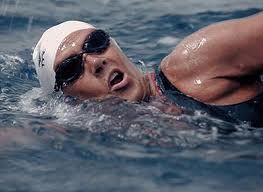
Diana Nyad: The Toughest Athlete in the World

Diana Nyad

By Andrea Scarpino

Twice this summer, Diana Nyad has tried to swim the 103 miles between Cuba and Florida without a cage. In other words, exposed to sharks and jellyfish and Man o’War (although she swam with anti-shark support staff in kayaks). In other words, without riding the draft of a boat pulling a cage. And Nyad is 62 years old. She hasn’t tried to set a record like this in 30 years. 


Twice this summer, Nyad didn’t quite make it to Florida. The first time, she endured 11 hours of asthma attacks before being pulled from the water. The second time, she was stung by a Man o’War and jellyfish, stung so badly her eyes and lips swelled, welts spread across her arms. At one point, her spine went numb. For many hours, she continued swimming through incredible pain—until her medical team advised another sting could be deadly, not just to her, but also to her support team, one of whom had also been badly stung as he tried to help clear her of stinging tentacles. And still, she left the water some 80 miles farther than when she entered it.


Of course, she didn’t finish the swim the way she would have liked to finish it. She would have liked to crawl onto that sand in Florida, to have left one country and emerged on another, having pushed her body harder than it wanted to go. She would have liked to hold another swimming record. I get all that. I get that she’s probably disappointed beyond belief—to have trained so hard, and then have two swims disrupted by unexpected, unplanned events—asthma, sea creature sting.


But even though she didn’t make it to Florida, were her two attempts failures? Is it true that she didn’t succeed? I’m not prone to hippydippy optimism, to trying to look on the bright side of things. But when I think about Nyad—and I’ve been thinking about her constantly since I first learned of her swim early this summer—I think of her courage, her belief in her body’s abilities, her strength. This woman, after all, is at an age when many of us talk about “slowing down,” “taking it easy,” an age when former athletes wistfully recall their glory days. Instead, she is setting nearly impossible goals for herself, she is training for hours a day, she is pushing her body harder than she could in her 20s. She is, as she says, “determining {her} own finish line.”


On her website, Nyad quotes a writer for the Dayton Daily News who says, “The toughest athlete in the world is a 62-year-old woman.” I hear a surprise implicit here on the part of the writer—a 62 year old! And a woman! Why that’s impossible! But that surprise, I think, is true of many of us who picture athletes as young and usually male. Who picture them as able-bodied. Who picture them as model-perfect. Nyad is breaking out of that stereotype, in so many ways. She is challenging us to rethink “athlete”—and more than that, rethink the things we’ve told ourselves we’re capable of doing. Of accomplishing. Rethink our own dreams.


As far as I can tell, that is success. Whether or not she tries this particular swim again, whether or not she ever crosses from Cuba to Florida, whether or not . . . I hope she sees this summer as a success. I hope the rest of us do too. This incredible athlete, doing what the vast majority of us can’t even hope to do, no matter our age or ability—I hope we think about her success and use it to motivate our own.


Poet and essayist Andrea Scarpino is a frequent contributor to POTB. You can visit Andrea Scarpino at:  http://www.andreascarpino.com/

 

Dirty War All the Time Department


Over at NPR there’s a story about General Abdul Razig, who has done America’s on the ground dirty work in Afghanistan. One may well argue that the US never learns–dirty war all the time…


http://www.npr.org/2011/09/26/140751605/rags-to-riches-americas-man-in-kandahar?ft=1&f=1001


“Gen. Abdul Raziq is the acting police chief of Afghanistan's Kandahar province. At just 33, he's a former warlord whom the United States relied upon during its 2010 "surge" operation. But Raziq is also accused of brutal abuses of power, even massacring his rivals, according to a new article in The Atlantic.”


http://www.theatlantic.com/magazine/archive/2011/11/our-man-in-kandahar/8653/ 


Box Me Up

I am in cardboard hell. The moving truck arrived at our house last Tuesday. The movers were terrific. They did a great job. But now my house is filled, room by room with tall and short boxes. Did you know that cardboard boxes are odorous? They breathe and give off the damnedest odors. It’s a sour smell, made all the worse by humidity. Yesterday a friend of mine visited and turned vaguely green. “Oh,” he said. “Boxes! Oh god!” 


Connie and I have moved five times in the past 14 years. We move so much it’s like we’re in the witness protection program. Our latest move to Syracuse promises to be our last. We’re happy with that idea. But we’re shell shocked among our own possessions. We don’t know how to unpack. We move like robots, mechanically picking up small things and puting them down again. God Alighty! I think we need a marching band! A sportscaster: “Look! She’s picked up the soup tureen! She’s put it in the cupboard! What an AMAZING play! Can you believe it?” 


In a nation with so many unemployed people it’s callow to whine about stinking boxes. I know this. But I’m telling you all the same: they stink. This side up. Fragile. Send to basement. They are bad boys! 


Rick Perry Advocates Weird Discipline for Boys with ADD

Boys With ADD Need More Discipline For "Paddleable" Offenses, Wrote Perry In 2008 Book
(Politico)
September 21, 2011

AUSTIN, TEXAS– [Excerpt provided by http:/www.inclusiondaily.com] Between his positions on global warming and the HPV vaccine, Texas Gov. Rick Perry's views on science have been a central focus of his presidential campaign so far. 

They were also on display in his 2008 book, "On My Honor: Why the American Values of the Boy Scouts Are Worth Fighting For." Though the book is ostensibly about Perry's love for the Boy Scouts and the organization's battle with the ACLU, peppered throughout his idealized picture of rural youth are several brushes at science, including his own self-diagnosis of his own childhood troubles and defense of spanking.

"Some young boys — especially those with severe Attention Deficit Disorder (ADD), as I must have had as a boy — have never focused on something for more than a few minutes until they tried to build their first fire on a camp-out or learned to tie a bowline knot with a double half-hitch knot on the opposite end of a thirty-foot rope," Perry wrote.

Later in the book, Perry comes back to the topic, suggesting that the contemporary culture has not so much made scientific advances in identifying illnesses, but rather is making excuses for problems that would have been dealt with more severely in the past.

"We have a drug for every problem and a diagnosis for every psychosis," he wrote. "We don't have children with 'ants in their pants'; we have children with 'attention deficit disorder.' That is not to minimalize such conditions. Lord knows, whether you call it a disorder or a "paddleable offense," I had it as a kid.

Entire article:
In first book, Rick Perry self-diagnosed ADD 

http://www.politico.com/news/stories/0911/63922.html
Related:
ADD: Just An Excuse For Bad Behavior, Perry Suggests (Care2)

http:/