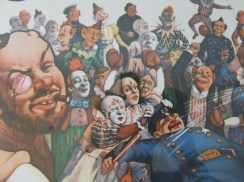
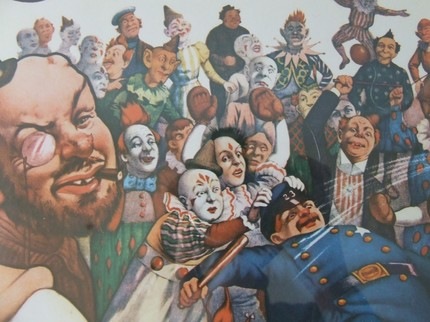
In the hey day of the American circus, back when there was no entertainment beyond what the Ringling Brothers occasionally brought to town, there was the “Army of 50 Clowns” that marched and somersaulted, minced and danced its way into the public square. That army was designed to look like the nation itself: ersatz rich men, hoity toity society ladies, hefty policemen, foreigners, cowboys, and of course, people with large ears.
They had a job to do, those clowns. Their mission was to show the locals the follies of the locals–not with the vainglorious, besmirching, ideologically driven venom of cable television, but with pantomimic acts and sweeping gestures. To put it simply, that army said: “we’re all clowns who discern these clowns” and they might have added, “to think otherwise may be perilous.” (Notice how easily I speak for the clowns? I learned the art in kindergarten, in case you’re wondering.)
It’s of course an irony that the Industrial Revolution destroyed village life, and then, as a mercenary afterthought, asked deracinated people to spend their first flush of disposable income watching sendups of late Victorian street scenes. That’s the story of Charles Dickens novel Hard Times which offered the earnest hope that Christian decency might still survive among homeless acrobats and grotesques. Dickens turns the circus into a wandering morality play. Above that proscenium arch he set the coal burning factories.
When times are unbearable there’s nothing like the Army of 50 Clowns. How I miss them! Today I would like them to march into Iowa City, Iowa. I want to see Mademoiselle Scheel riding her lion straight down Dubuque Street.
**
The clowns are us. Mencken knew it. His essay “On Being American” covers this with all the proper and prosaic vituperative bells and whistles. The clowns are us but they’ve read Thorstein Veblen and a smattering of John Dewey. We liked them when we were our own grandfathers. Those clowns spat on the sidewalks. They appeared to be just as astonished as the bystanders. (Clowns have always understood that you can make aesthetic connections with your audience later–first you have to show off your ticks. “Pull down the curtains, there’s no such thing as behind the scenes life, not anymore.”)
But then you see, the clown who spat, who seemed to be making a point steps on the trousers of the clown in front of him and the trousers fly apart to reveal more trousers. Clowns are clowns.
**
Academics who favor “performance theory” will tell you that a clown is something else. But showing the locals both who they are and who they are not requires little explanation. Pete Mardo, a black man who performed as a white clown didn’t need cultural theory. Or to put it another way, the only theory is Shakespeare’s–the clown holds a mirror up to nature–an Italian mirror to be sure, the one that makes you fat or thin, but a mirror just the same.
If you think a mirror needs a theory, boy do we have a clown for you.
**
The clowns are mostly gone now. Could Pete Mardo put off old age, and ranting time renew, could those old clowns rise up again, we’d drink a can or two…
(Apologies to Yeats.)
The clown wears a coat of fashion, or dresses like a queer old man. He’s green as a boy. He’s iron red. He stretches in slumber in the middle of the street. Stands in the bed, tramples the bed clothes.
The only thing the army of clowns asks is that you laugh at impulsive men.
S.K.
 Planet of the Blind