The Moral Law Within Us


How quickly must the falling angels fall to set the algebra of all that’s human?

Didn’t we know there were no abstractions? Didn’t we always know

Everything sails toward resurrection?

I know as a son of The Enlightenment I should be suspicious

Of the sky. But the angels throw back their long hair

Saying the soul turns simple once more, that it was always simple.

We are better than the proteins that animate us.

We can simplify. We can again say we abjure violence,

That we shall live daily by the golden rule.

“Why not?” the angels say. Those who weep for this world of distances and shadows.

A man is a question asked of another question, the indefinite

The sole body

In which we properly live.

It is spring again. Time to burn the dead winter grass.

And so we ache and plant and turn again to love our neighbors…


S.K.

Electro-shocking Students with Mental Disabilities Brought to Attention of the United Nations


Each morning I read the disability news because Dave Reynolds over at The Inclusion Daily Express does us all a yeoman service by coordinating and distributing vital information about what is happening in disability land. When I opened this morning’s edition I was veritably stunned to read about the inhumane electro-shocking of people with mental disabilities at an institution in Massachusetts.

Take a look at Diana Sweet’s story at The Raw Story for more on this.


S.K. 

Immigration

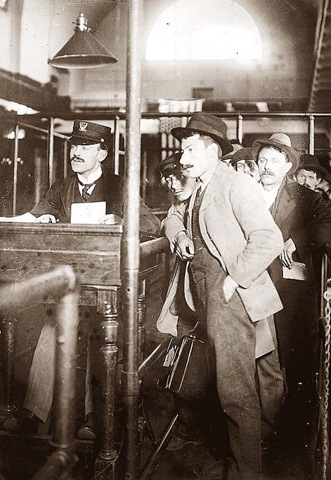
Immigrants-Island-Ellis-002


Andrea Scarpino

Los Angeles


Arizona’s new immigration law has me thinking about my own family, what it means to cross borders and languages and cultures in search of something—a better paying job, a different life, the fulfillment of a promise. My father’s family immigrated to the US from Italy in the 1900’s, and my mother’s family came centuries earlier from England. I don’t really know why either uprooted their lives to try on the United States, but I do know my father suffered from terrible harassment throughout and after World War II because he was Italian, had a clearly recognizable Italian name.

By the time he had me, anti-Italian sentiment had mostly vanished, but he still balked at telling people his heritage. If asked, he would insist he was American. If asked again, he would concede, I’m of Italian extraction. But that was it. He wore American flags on his lapel every day to teach, raised the flag on the Fourth of July, voted in every election. He took being an American seriously—in part because he knew the consequences, how quickly the tide of public sentiment can turn, how quickly he could have found himself targeted for his ethnicity once again, even though he had subsumed the language of his parents to English, even though he spoke proudly of American ideals, bought American cars, wore that lapel pin, even though, even though.

So when I think about immigrating to a new country, a new language, raising children like my father, the man my father became, I feel awe and admiration. How brave you have to be to risk all you know for the shadowy outline of a different life. How much embarrassment you suffer as you struggle through a new language. How much shame you must feel for your “other” status, for your children’s refusal of your “otherness.” How often you must question your decision, wonder if you made the right choice. The risk of immigration, of tearing up all you know for a vast unknown. What a display of hope.

I know there are statistics and arguments on both sides of Arizona’s law, know that many people are passionate about “protecting” the United States from those who were born sometimes only a few miles away. But my family is made up of immigrants, from Italy, from England. And I’m in awe of them. No matter if they moved here legally (and my mother’s family certainly didn’t).

Which brings me to compassion, what happens when a citizenship loses it, when lawmakers lose it. I feel sad for Arizona, for such nearsightedness. But mostly, I feel sad for the people who will be harassed because of this new law, who will feel shame and embarrassment, who will be treated as less than. And I will see my father’s family in their faces.


Andrea Scarpino is the west coast Bureau Chief of POTB. You can visit her at:

www.andreascarpino.com

Of Persistence and Art

Our friend Leslie B. who is an advocate for people with disabilities and a keen admirer of the arts has written a lovely post about the Japanese-American artist  Henry Fukuhara. Take a look at what she has to say about his persistence in the face of so many odds one can scarcely calculate them.


http://www.solutionsinsight.org/community/mod/groups/topicposts.php?topic=2032&group_guid=1984


S.K.

Anecdote of Wars and the Dead From Same


Sometimes you see ice ferns at the windows and they resemble the hands of the dead

Though you don’t say it aloud. You are half a child, half like Strindberg–foolish either way

To imagine the dead want to return. Of course that’s it:

Coming to life, the sheer glide of archaic whirling

Is what the dead would wish. Oh, but not to be us,

Not to be men or women again;

Nor to be children running at dusk

Between the hills and houses.  

I too, mostly blind have a form to see with

And can understand the world I saw.

Birds in the meadow rose like a cloud and vanished.


S.K.

An Essay on Embroidered Birds and Blindness


1.


When I was a boy I lived alone on many days. I’ve written about this elsewhere. I leaned into the water and opened my damaged eyes and watched a turtle move in and out of the boat house. The turtle was building a nest. The turtle’s life was fervent but steady. In my poor eyes she looked like a Rorschach.


2.


When I became quasi-known for writing a memoir about blindness a group called the National Federation of the Blind accused me of demeaning blind people. In the memoir I describe trying to ride a bicycle when I couldn’t see. I did the bicycle thing for several years, largely because my mother insisted that I should. She didn’t want me to be blind. “Don’t be blind,” she said. “You’ll never get anywhere.” My poor mother! Blind people are enormously successful! The problem for the blind and visually impaired is that there are lots of old fashioned social attitudes about blindness. There’s a Victorian quality to the public’s incomprehension about “the blind”–we’re thought to be helpless and virtually unemployable, for indeed how can a blind man find his mouth to eat or locate the bus stop? It is still the case that some 70 per cent of the blind remain unemployed.


3.

I don’t know when I first understood this–I was very young, I know that much. I saw that one can learn by means of reversible luck. (Remember the old days when you could buy a reversible suit?) 

In general terms people think they understand luck. Most think its a visitation, like the appearance of magic in a fairy tale. I can’t say this isn’t true. Certainly I’m not presumptuous enough to speak on behalf of the angels. But with reversible luck I don’t have to. Reversible luck says you’re open to the potential for goodness. And “open” means open: you are aware that the structure you imagined for the day will impede you now; you see that a minor set back is really an advantage.

Reversible luck is what we call “thinking on the run” or “outside the box” –pick your cliche. But its also a sort of mental jujitsu: we instantly change the terms of our problem and in turn achieve an advantage. Being lost works this way. The American poet James Wright once got lost while he was in graduate school and entered the wrong classroom and heard, quite by chance a professor reciting the poems of Georg Trakl. Trakl was one of the great 20th century German language expressionist poets, a poet largely unknown in the U.S. –at least in those days. What James Wright heard changed his life.


4.

The important thing is to remain all your life both able and willing to learn something different. Reversible luck won’t work without this rich, strange, extra-absorptive intelligence. The poet Robert Bly writes: “The beauty that six or seven words can bring/Together makes the whole brain sing.” Do you see that learning something different can derive from a small thing?


5.

Suppose you’re the kind of blind person who believes that the only way to read is by knowing Braille. Let’s be clear. Braille is a good thing. A reader of Braille can access information at his or her fingertips. Braille is the closest thing to the immediacy of sight reading. Yet today, with advancements in ophthalmology, there are more blind people (legally blind) who have usable vision than ever before. They don’t necessarily need Braille to have a literate and successful life.


Or let’s suppose the Braille reader gets carpal tunnel syndrome or has tennis elbow. Isn’t having a talking computer that can read books aloud a good thing? Of course it is. And isn’t having someone read to you–someone who loves poetry–can’t that be a beautiful thing?

My point is that one needs intense flexibility all one’s life, both “with” and “without” a disability–but especially “with” a disability.

The more one can live a life without adhering to static behavior the better. Routine will kill reversible luck. My feeling is that a lot of blind people ruin their chances for serendipity because they’re weighted down by the dark mud of rehabilitation strategies. The white cane people don’t like the guide dog people; the advocates for tactile warning strips on a railway platform are demeaned by those who say that the blind don’t need this kind of help. On and on it goes. The static condition of disability in the U.S. is ingrown, confused and unlucky. In this way blind people give away their power. Did you know the average computer package of assistive technology for the blind pc user costs over $1,000? This is a scandal since every computer should be blind-usable right out of the box. But the blind sign up for this burden, a burden that I believe is a testament to the antipathy of blindness advocacy organizations to work with other groups.


6.

There is no right way to read. A person with autism may use facilitated communication and a special typing device. An elderly blind person may use Braille exclusively. A younger blind person born without hands may use a talking computer. Rules are not persuasive in the world of reversible luck.


There is no right way to read, there is only good reading. If literacy has a value this is it. Those who read well read adventurously. Reading adventurously is like the picture of Jesus standing in his boat, his back to the far shore. He knows he will get there. He doesn’t have to see.


7.


There is no right way to be disabled or to be blind. Even the day itself can lay claims on disability. A person with low vision begins her day reading with large print. By the afternoon she might need JAWS for Windows or a Braille display. 


8.

I suppose I’m writing about reversible luck today for several reasons. Recently I was uninvited to be the keynote speaker at an Iowa organization for rehab specialists serving the blind and visually impaired. These specialists had invited me and I’d agreed to speak for free. Then after months of planning the word came back that I wasn’t needed. I know for a fact that this had everything to do with my public outcry against the Iowa Department of the Blind’s discrimination against a woman with a guide dog. And so you see, we’re back to the issue of reversible luck, or by turn, how to create the conditions that will make such luck possible. The Iowa Department of the Blind didn’t want a woman with a guide dog in a computer class. Imagine. And imagine the group of sub-rosa people who would dis-invite a visually impaired American writer from speaking on their own behalf? Silly! To imagine that my years of research both in Disability Studies and in the history of literacy and the arts might have some bearing on the lives of the blind in Iowa.


9.

There is no right way to read. There is only good reading. And the latter leads to reversible luck. As Robert Bly writes:


“This man  went up to monsters and asked to be

Adopted. I’ve done that often. Reader, are you

Fond of the Jonah story? Say to a monster,

“I may have something for you, but I can’t promise.”


10.


What about the embroidered birds in the title?  Did you know there are people who still believe that embroidery is all the blind can do?


S.K.
Folk Tale

All morning I sweep the porch because this is the season of wind. In Iowa the grass and trees sound like the ocean and if you wake in the night you can think yourself far at sea. Today I am far at sea. I am rubbing my eyes against the magic of this life. I feel so oddly alive I could cry. Who am I? Who am I? The question has to be asked twice.

It occurs to me that I am influenced by the dogs in my life–not as easy friends, co-denizens of the house–but as shapers of my heart. My first guide dog Corky who carried my shoes to my bedside each morning; my beloved Black Labrador Roscoe who had such faith in Connie and I, who loved us because he saw us as being purely actual, not abstract. My present guide dog Nira who has the devotion of love solidified: she is still teaching me things even today.

And the wind works at the house…


S.K.  

Temporizing about Disability and Other Bad Ideas

The latest issue of the White Cane, a magazine published by the Iowa Department for the Blind carries an article about the 20th anniversary of the ADA that proposes the public is “still afraid” of people with disabilities. When I first saw this I was surprised, as I was unaware that the public is afraid of pwds and I wondered if perhaps I’d been asleep in a magic kingdom these past twenty years, somewhat like Rip Van Winkle–how else could I have missed this “fear and loathing” phenomenon? “Ah,” said my inner Bugs Bunny, “it’s not people with disabilities that the public is afraid of, it is difference of all kinds.” And this is how I tend to think of the matter. Disabilities are just as likely to be a source of anxiety to the non-disabled or temporarily abled (the normates, if you will) as sexual orientation or ethnicity. This is hardly news. What is news–alas, old news–is that there are certain groups within the disability community that insist on an almost tribal importance, as if disability is entirely separate from the human condition “writ large”. This concerns me because in my experience, the people with disabilities who are the most successful are those who see no sectarian divide between their conditions of embodiment and an integrated life on main street.

In general terms I think the blindness communities in the U.S. are susceptible to self-imposed segregation. The National Federation of the Blind and the American Council of the Blind, two advocacy organizations that have long been at loggerheads over tiny differences in how to use a white cane or take advantage of civic opportunities continue to schedule their national conferences at precisely the same time and always over the 4th of July weekend. Think about that. By scheduling their conventions at exactly the same time these groups make certain that there can be no crossfertalization of memberships and no real meeting of diverse minds. But wait! There’s more! By having these conventions over the 4th of July the NFB and the ACB ensure that no one from the rest of society is going to walk in.

Tribalism. Ingrown followings. Hostility to differing views about “how” one might successfully live and navigate with blindness. All these things mark the American organized blind advocacy groups. If the White Cane magazine thinks the public is still afraid of blind people, well, you might start imagining a welcoming message and an inclusive agenda for both the blind and the public. If you’ve been reading this blog over the past couple of years you may remember that it was the Iowa Department of the Blind (the publishers of White Cane) that prevented a woman with a guide dog from taking one of their state sponsored assistive technology classes. That story speaks for itself.


S.K.   

Why I Can't Twitter


First I should tell you that I joined Facebook and discovered that I couldn’t handle it. The number of posts and invitations flattened me like a school board meeting. I even made the mistake of putting Facebook on my smart phone thinking this was a means of keeping up, but the poor phone began coughing and wheezing, so great were the number of announcements–the phone sounded like it was getting “the croup” or more precisely, what they used to call “the vapors” and I had to uninstall the Facebook “app” from my BlackBerry. Then, without announcing the matter, I ran away from Facebook. I haven’t been “on” the thing for months. Occasionally I get messages from FB asking me if I’m still among the living. I delete these. I just can’t stay in the game.


A well meaning reader of this blog has suggested that I should “tweet” but I can’t. I try every day to push the words around, make sense, have some poetry, sing some songs, help those whose ambitions and ideas are worthy of what little help I can offer–and I walk my dog, swim, read books. If I can’t handle Facebook how can I handle the tweeting?


I love technology. But it’s got this three headed Cerberus thing. It has more appetites than a man has soul. My guitar is calling me. Its time to strum “The Worried Man Blues” for a while. Time to turn off the machines.   


S.K.