
I too climb in and out of the pit of myself
And have watched so many others do the same

And as a man have crawled on all fours
And have told the overseer to fuck off

And have called the wrong things mystic
And have seen the November mushroom

The “Standalone of Fall”—that silly man
Not giving up—but waiting

In the milk light of the underworld
Which is wholly inside him

So that now after rain, early winter,
Hop-scotching birds,

Avian imperfect, the wild ordinary
Welter of earth, small gasps,

I walk up the pale green avenue—
7th avenue in New York—

End of day, my great guide dog
Working to keep us safe,

Taking us toward
The postulate of arrival,

The grandest of things,
A task accomplished,

Going where we had to go
Mystic one calls it

Whether right or wrong.
Author: stevekuusisto
Poet, Essayist, Blogger, Journalist, Memoirist, Disability Rights Advocate, Public Speaker, Professor, Syracuse University
Wherein Obscurely
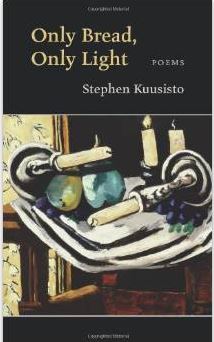
Why this compulsion to write?
Misericordia. Upright
And nursing our wounds.
Surely we’ve inhaled
Some of God.
Tsuris, vespers…
And the candles
Cold as glass…
Soothsayer
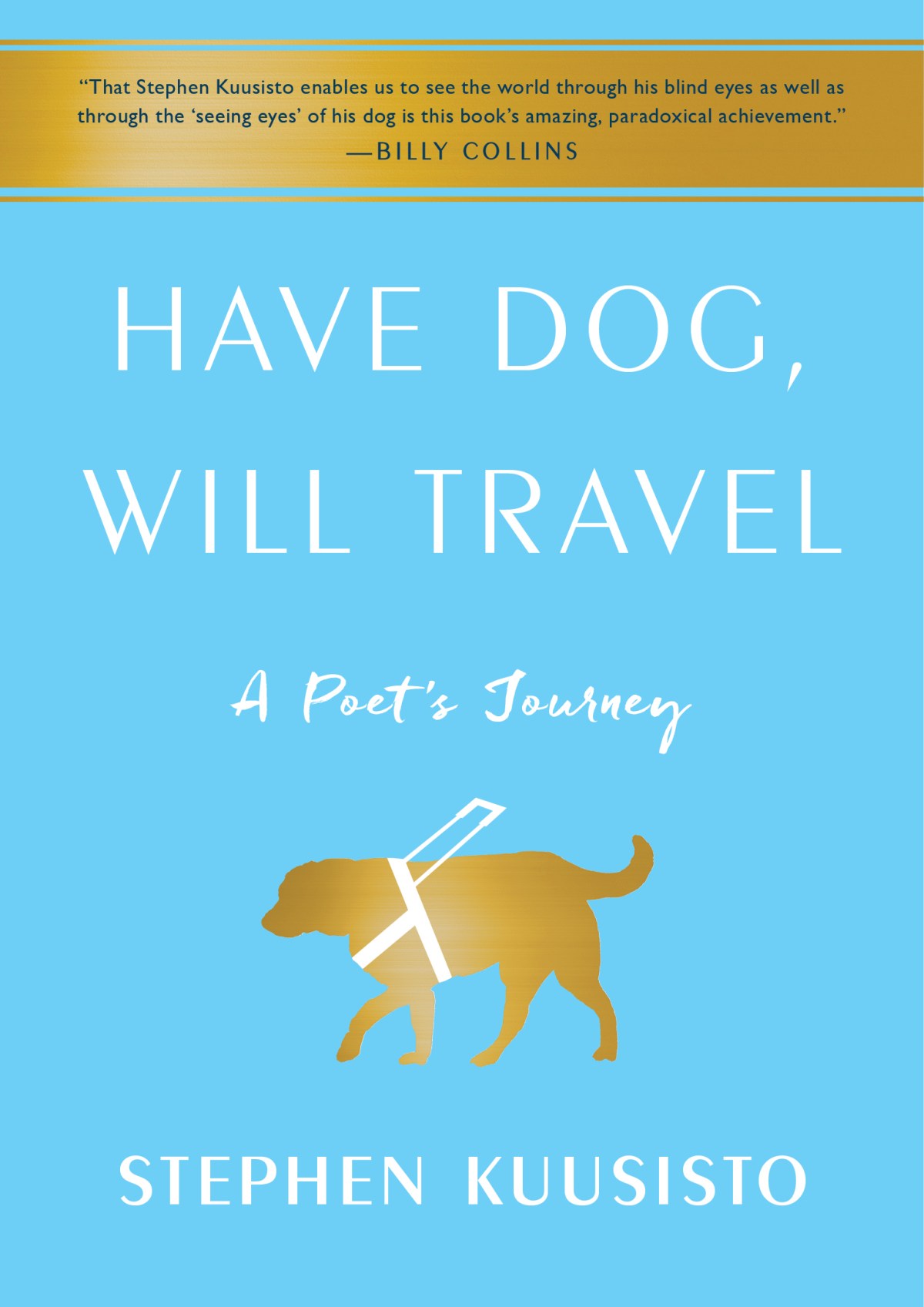
At twenty she came to me
Saying: you will write books
And some people will read them
But you’ll not be happy
Life will become
A muffled clamor
You’ll be foreign
To yourself
Like a man
Who speaks
The glaucous dialects
Of herdsmen
And all I could hear
Was “books”
Authorship—
Not understanding
The loneliness
To come
And the crying out
For trees
To rescue me
“From the Monotonous Sublime, or, on Being a Blind Graduate Student at the Iowa Writer’s Workshop Before the ADA”
“Pity the planet, all joy gone
from this sweet volcanic cone;
peace to our children when they fall
in small war on the heels of small
war – until the end of time
to police the earth, a ghost
orbiting forever lost
in our monotonous sublime.”
― Robert Lowell
Years ago when I was a thick spectacled graduate student at the Iowa Writer’s Workshop I found me-self under the sway of Longinus or Pseudo-Longinus or Dionysus of Halicarnassus or whoever he was, and I swear, all I could think about was ”the sublime” and I underlined this: great thoughts, strong emotions, certain figures of thought and speech, noble diction, and dignified word arrangement…
In those days I thought Wallace Stevens poem “Sunday Morning” was the premier example. Stevens could be simultaneously Nietzschean and pragmatic (there was more of Dewey in Stevens than Santayana) and so grand thoughts were central—how does anyone live without tutelary gods or faith in Popular Mechanics? How do we achieve nobility?
Now also in those days I had a physical problem as all of us generally do. When I decided to attend the University of Iowa I flew to Iowa City three months early and walked the town like a crime scene investigator. I marched in little grids. I moved haltingly up and down dozens of streets. When I thought no one was watching I drew a telescope from my pocket and read the street signs. I hiked in the stifling summer heat and worried about people marking me as deviant. I was “Blind Pew” the untouchable but I wouldn’t let anyone know. By late August I knew enough of Iowa City to travel from my unfurnished apartment to the English-Philosophy Building.
That was the summer I started keeping a journal. In July of 1978 I wrote:
If you love others you can be brave about your challenges. I am, of course, quite cowardly–—I argue with friends, strain relationships, talk too loudly, all because I hate my zig zagging eyeballs…
I’m starting to think about the politics of bravery…Would it kill me to mention in good company how much I can’t see?
Sublimity isn’t merely a great idea like the vatic circles of Proclus or a sensation like Minturno seeing god’s first blue reflected in windows nor is it aspirational (though one ought never never find fault with desire) it’s an aggregate and poignant quality of irony—“Lord Thy sea is so vast and my boat is so small;” it’s the insufficiency of our floral arrangements; our shy and unspoken wish that we too may see Blake’s angels in a willow tree; it’s knowing our inadequacy and our truest principles. In the second stanza of “Sunday Morning” Stevens famously writes:
Divinity must live within herself:
Passions of rain, or moods in falling snow;
Grievings in loneliness, or unsubdued
Elations when the forest blooms; gusty
Emotions on wet roads on autumn nights;
All pleasures and all pains, remembering
The bough of summer and the winter branch.
These are the measures destined for her soul.
Sublimity is responsibility. (Delmore Schwartz) The measures destined for our souls are as near to ancient sacrifice as a modern man or woman can come. John Dewey: “The self is not something ready-made, but something in continuous formation through choice of action.” For Dewey “self” is the imagination; for Stevens imagination substitutes god; both believe in the sublime which is devotion to strong, arranged, and dignified emotions.
It’s better maybe to think of this as a hunger. Dewey again: “Hunger not to have, but to be.”
3.
Even at twenty five and feeling my way through Iowa City I wanted to be all pleasures and all pains remembered. That was a choice of action. And I would admire poets and poems which took this on. In the years to come I’d admire many poets. To admire was something more than merely liking.
I admired Yehuda Amichai:
“Memorial Day for the War Dead”
Memorial day for the war dead. Add now
the grief of all your losses to their grief,
even of a woman that has left you. Mix
sorrow with sorrow, like time-saving history,
which stacks holiday and sacrifice and mourning
on one day for easy, convenient memory.
Oh, sweet world soaked, like bread,
in sweet milk for the terrible toothless God.
“Behind all this some great happiness is hiding.”
No use to weep inside and to scream outside.
Behind all this perhaps some great happiness is hiding.
Memorial day. Bitter salt is dressed up
as a little girl with flowers.
The streets are cordoned off with ropes,
for the marching together of the living and the dead.
Children with a grief not their own march slowly,
like stepping over broken glass.
The flautist’s mouth will stay like that for many days.
A dead soldier swims above little heads
with the swimming movements of the dead,
with the ancient error the dead have
about the place of the living water.
A flag loses contact with reality and flies off.
A shopwindow is decorated with
dresses of beautiful women, in blue and white.
And everything in three languages:
Hebrew, Arabic, and Death.
A great and royal animal is dying
all through the night under the jasmine
tree with a constant stare at the world.
A man whose son died in the war walks in the street
like a woman with a dead embryo in her womb.
“Behind all this some great happiness is hiding.”
The sublime was more than self-disclosure. It was walking grief, chance joy, intimations of ancestors; it was John Keats writing to his brother; it was Emily Dickinson’s toothache; above all it was the dignity of self-recognition.
What did I learn to like? How about Anne Sexton:
“The Truth the Dead Know”
For my Mother, born March 1902, died March 1959
and my Father, born February 1900, died June 1959
Gone, I say and walk from church,
refusing the stiff procession to the grave,
letting the dead ride alone in the hearse.
It is June. I am tired of being brave.
We drive to the Cape. I cultivate
myself where the sun gutters from the sky,
where the sea swings in like an iron gate
and we touch. In another country people die.
My darling, the wind falls in like stones
from the whitehearted water and when we touch
we enter touch entirely. No one’s alone.
Men kill for this, or for as much.
And what of the dead? They lie without shoes
in their stone boats. They are more like stone
than the sea would be if it stopped. They refuse
to be blessed, throat, eye and knucklebone.
The sublime is unsentimental. Sometimes it’s willing to lie. “No one’s alone.” But we have to say so. As I said above the sublime has ironies. The sublime cannot save you. Wallace Stevens would easily agree. It’s a devotional. Who precisely did you and your imagination purport to be? What did I like? I liked Larry Levis:
“Ghazal”
Does exile begin at birth? I lived beside a wide river
For so long I stopped hearing it.
As when a glass shatters during an argument,
And we are secretly thrilled. . . . We wanted it to break.
Always something missing now in the cry of one bird,
Its wings flared against the wood.
Still, everything that is singular has a name:
Stone, song, trembling, waist, & snow. I remember how
My old psychiatrist would pinch his nose between
A thumb & forefinger, look up at me & sigh.
We shouldn’t say the sublime lacks humor. And we certainly shouldn’t say it’s fussy. If everything that’s singular has a name, well, we still have to guess. Even the gods would say guesswork has nobility. If they don’t then we’re not interested in them. Not for long anyway. And to understand the sublime is to be unimpressed by “isms” and to know it early. As for the Levis poem, nothing is worse than a patient who won’t be fooled. The sublime after all is its own brand of health. The sublime is political. What do I like? Adrienne Rich:
Saw you walking barefoot
taking a long look
at the new moon’s eyelid
later spread
sleep-fallen, naked in your dark hair
asleep but not oblivious
of the unslept unsleeping
elsewhere
Tonight I think
no poetry
will serve
Syntax of rendition:
verb pilots the plane
adverb modifies action
verb force-feeds noun
submerges the subject
noun is choking
verb disgraced goes on doing
now diagram the sentence
If poetry is to matter it needs to be unflinching, must have ardor. It should avoid fussiness and self-regard—be properly intentional or desiring of the spirit.
John Dewey again: “The ultimate function of literature is to appreciate the world, sometimes indignantly, sometimes sorrowfully, but best of all to praise when it is luckily possible.”
Praise is the hard part.
When James Wright said he wanted to write the poetry of a grown man he meant it was time to praise what was around him.
What do I love? I love this poem by Sam Hamill:
Just as I wonder
whether it’s going to die,
the orchid blossoms
and I can’t explain why it
moves my heart, why such pleasure
comes from one small bud
on a long spindly stem, one
blood red gold flower
opening at mid-summer,
tiny, perfect in its hour.
Even to a white-
haired craggy poet, it’s
purely erotic,
pistil and stamen, pollen,
dew of the world, a spoonful
of earth, and water.
Erotic because there’s death
at the heart of birth,
drama in those old sunrise
prisms in wet cedar boughs,
deepest mystery
in washing evening dishes
or teasing my wife,
who grows, yes, more beautiful
because one of us will die.
The poems of a grown man or woman are, as Lowell would say, quite possibly “of” our monotonous sublime by which he meant our clinging, daily, necessary fealty to better ideas, wishes, even intuitions. We fight back against the ruinous and sequential daily atrocities of our age, which means our pitiless living. Don’t assume the sublime doesn’t take work.
You can even be tongue and cheek about it if you like. The late Finnish poet Pentti Saarikoski wrote: “I want to be the sort of poet whose songs call the trees and stones forward/whose poems become houses for people…”
(A rough translation.) As James Wright would say: “put that in your pipe and smoke it.” Know what you’re about. Know your demands.
4.
What does any of this have to do with walking around a midwestern university town unable to see? It should be obvious I imagine—not being able to see pales compared to having no language for it. Fortunate then that the sublime is more interested in our honesty than we’ll admit especially when we’re young. (A tip of the hat to Nietzsche. The abyss will stare back.) But the sublime is far more likely to furnish the creative mind if we learn to know ourselves—indifferently, tinged with dramatic irony, seeing ourselves as if we’re simultaneously in a play and also in the audience. What do we know about this self-to-self dichotomy that passes for a man that we didn’t know as the day began? Why is that knowing so critical both to poems and character? James Wright:
“St. Judas”
When I went out to kill myself, I caught
A pack of hoodlums beating up a man.
Running to spare his suffering, I forgot
My name, my number, how my day began,
How soldiers milled around the garden stone
And sang amusing songs; how all that day
Their javelins measured crowds; how I alone
Bargained the proper coins, and slipped away.
Banished from heaven, I found this victim beaten,
Stripped, kneed, and left to cry. Dropping my rope
Aside, I ran, ignored the uniforms:
Then I remembered bread my flesh had eaten,
The kiss that ate my flesh. Flayed without hope,
I held the man for nothing in my arms.
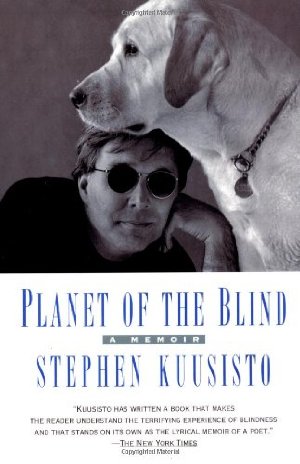
So there is something selfless about sublime engagements. The more powerful and evocative the experience the more we will carry away. We build ourselves with proper words. We learn by standing for things. It is much harder work than simple autobiography. What happened to me is not as interesting as what I understood about what occurred. In my memoir Planet of the Blind I describe how I went running in Iowa, unable to see, and ran straight through a freshly laid patch of sidewalk cement. Surrounded by indignant laborers, one of whom shouted, “are you fucking blind?” I told the truth. “Yes,” I said. “I’m blind and I’m running.” This revelation was so unexpected that one of the men drove me home and told me to get a dog. His uncle was blind. He thought there was a better way of doing it. Back to Dewey: it’s about growth, curiosity, expectation, and hunger to be.
So many early memories are of music…
So many early memories are of music. Caruso in the attic on the old Victrola; a visit to the circus where I couldn’t really see but the calliope was like an insistent relative, an uncle telling you that jumping into deep water was a fine thing. Never trust a calliope. And there was Tchaikovsky on the radio, Swan Lake which is pure heartbreak at any age but at four when I first heard it I drifted away like an airship filled with weeping people. So many memories. Don’t laugh. Wasn’t it Goethe who as a child heard apples muttering in a basket? I heard a voice from a window and there was no one there. One can be both Goethe and John Cage in early childhood.
I think Tchaikovsky’s piano trio in A Minor is the truest expression of early sadness.
**
This morning:
I understand.
Maybe
I’ve another
Few years
With this
Living face.
This morning
My neighbor
Lonely
Returned books
He’d borrowed
Deep last winter.
**
I was alone but not unhappy. That was the thing. Wind up the Victrola, listen to incomprehensible words and musical notes. And sometimes hornets flew past my face. Was it Caruso who kept them away? Whatever the case the hornets never bothered me. The snick of the needle hitting the outermost circumference of the disk. The systolic static from the horn. One more second and the music would start.
**
I know you know.
Skepsis is in the bread.
**
Only the dead feel at home—“My father’s house has many mansions…”
“You have to understand,” the poet said, “life is a rented room, not much more.”
Sometimes I have to laugh
Thinking of piety, all those down payments
For what is essentially free. Death is its own house.
The windows are open, late winter, rain coming, the old curtains billowing.
**
So some music then.
Bring out the guitar
That cries in its own language
Remember, you don’t care for money.
You want children to play in safety.
Let the notes drop of their own accord.
Once in London
Poems came then fast as rain
And Battersea smokestacks
Said they’d make no difference
But the man, the young man
Wrote for himself a boat
Steadfast old Vainamoinen
Sailing to the land of the dead
With yellow fruit
And dark bread
Beetles glistening
In the garden
Tiny windows
Reflecting sunlight
Then talking to himself
In taxicabs
On National Poetry Day
Always now someone
You know, a ghosted one
Without a name
Troubles you
And you throw words back—
Up river, broken window
How thin your wrists are
Didn’t you want
Twilight and discernment
Come closer
Do come
It’s raining in New York
Reading Nietzsche
At twenty
I saw his eagles
Were real
And how little
He loved them
Go ahead
I told myself
Make a vow
Make it respectful
When I remember kindness…
I think of childhood
With its playthings
That is, I understand
How joy promised
Was not kind
For other children
Were not kind
My blindness
Was a compartment
Where I waited
While days unfolded
Joy is to kindness
As a moth to a lamp
And yet goodwill
Survives in the dark
Speaks any language
Or holds quietly
So its not a promise
This affection
For others, strangers
Animals—but
Something better
A surprise
As in nature
When we find
Things are never
Really still
And you feel
Your heart throbbing
Along with the shadow
Inside your shadow
And how it grows
Morning Conditions
A long distance truck crawls through town
In a darkness of its own
And the dropped newspaper
Raises its dead events
And you’re moving
Like all things outside
Birds and stray dogs
But slowly
Like living in a glass lamp
Walking now
In a cold summer
Mushrooms are everywhere
And the neighbors children
Dig with spoons
Down among the roots
Walking in the Rain
Always now someone
You know, the ghosted one
Without a name
Troubles me
And I throw words back—
Up river, broken window
How thin my wrists
My small life
I didn’t know you
Not well enough
Don’t we want
Twilight and discernment
Books that lie open
In memory
Come closer
Do come
It’s raining in New York
At twenty
Reading Nietzsche
I saw how his eagles
Were real
And how little
He liked them
Go ahead
I told myself
Make a vow
I’ll be respectful
Of my imaginaries….
 Planet of the Blind