Personal Responsibility in Health Care: A Disability Model

There’s an interesting post over at D.B.’s Medical Rants blog from a woman whose son has his own blog on personal responsibility where health care is concerned.  The post in question is a poem that argues for a good, simple, clean, heartfelt, humane lifestyle in work and deed–accompanied by walks and swims. And the point of course is that when human beings take care of themselves both physically and spiritually they live longer, have fewer health problems, and who in his or her right mind wouldn’t want this?

I know I want this. I also know thousands of people with disabilities who always take care of themselves to the best of their abilities.   I appreciate the mantra of self -responsibility as a component of the health care debate that’s currently underway in the United States. Yet I also know that a person with a disability who does her or his best to take thought for the quality of life still must work and engage a system of medical care that remains largely inattentive and confounded by disability issues. When doctors and nurses are not on your side it’s much harder to fashion a pro-active and well mannered life of progressive health practices. Let’s be more specific:

A woman who uses a wheelchair and who also has no use of her hands is told by a nurse that her chair won’t fit into the receiving room, so they’ll have to take her medical information out in the corridor of the clinic. This violates confidentiality laws and the patient says so. The nurse walks away. No one comes back. Eventually the woman with the wheelchair just goes home.

The above incident is legion for people with disabilities.

My argument such as it is, is that medical staff must be properly trained to assist those with disabilities who are trying to take care of themselves to actually accomplish the goal.

This is a team effort.


S.K.

Curing Blindness is Within Reach

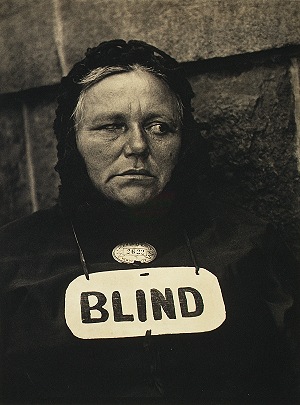
image of holy grail vintage photo of blind woman wearing sign

Yesterday’s article by Pam Belluck in the New York Times entitled “A Burst of Technology: Helping the Blind to See” is worth reading for a host of reasons. Physicians and researchers are within hailing distance of restoring sight to tens of thousands of Americans with the very real possibility that the number might become millions. This story which is altogether remarkable and thrilling is all the more meaningful for the heroism and steadfastness of those who have spent their careers fighting blindness for it is a commonplace in “the field” that research dollars for ending blindness are miniscule when compared to a host of other medical fights. Add to this the thousands of ways people can achieve blindness and you only gain more steepness where the dramatic nature of the story is concerned.

I will dispute Ms. Belluck’s assertion that making the blind see is one of science’s “holy grails” for though the subject captures the hearts and minds of people everywhere the dollars spent to cure blindness are tiny as I’ve already pointed out. I think it could be argued that real dollars right now, in this place and time could lick blindness within the decade and in particular I’m speaking of the genetically caused forms of vision loss: macular degeneration, leber’s congenital amaurosis, retinitis pigmentosa, stargart’s disease, and many others. (Please note that I refuse to capitalize these diseases for I hate them, hate them personally, hope to see them consigned to the history books along with the St. Vitus Dance.)

The subject of curing blindness is of course a complex matter. Ms. Belluck’s article features a new video system linked to a retinal chip that can help some blind people see some things. Believe me, seeing “some things” is a big deal. I’m now seeing “some things” after years of watching mud dry and I can attest that “some things” beat mud every minute. In the business of gaining some vision the old Japanese game of “paper wraps stone” is a useful epistemological analogy: low vision beats no vision; vision itself beats the minimal variants–but how to get there for everyone?

I believe that the greatest promise for the greatest number of people will rest with the genetic research that’s currently underway at places like the University of Iowa’s Carver Family Center for Macular Degeneration and at the University of Pennsylvania and at a host of cooperative facilities around the U.S.. I say this not only because gene therapies are within reach but because there’s a tidal wave of Baby Boomers who are about to go blind en masse. And I can attest that the nation’s rehabilitation agencies cannot handle what’s coming.

Therefore I think more dollars spent now on the race to cure blindness would be the best dollars this nation has spent in recent decades. If we harnessed a tenth of what NASA receives in the service of what Ms. Belluck calls the “holy grail” we would find not only the grail but a means to fill it with joy.


S.K.    

Now That Everyone's a Fascist Let's Talk

Adolph Hitler Nazi Photo

I should point out first thing that I don’t know how to spell Adolf Hitler’s name. In the photo caption above I’ve spelled the old miscreant’s name incorrectly, confusing him with a brand of meat tenderizer widely available in American supermarkets.

Back in 1968 when the American landscape was burning and when police were clubbing war protestors on college campuses everywhere and particularly in Chicago during the Democratic National Convention there was a famous TV exchange between arch conservative commentator William F. Buckley and liberal champion Gore Vidal. Buckley was of the view that war protestors were aiding and abetting the enemy in Viet Nam and Vidal was of the view that the protestors were being prevented from exercising their constitutional rights to assemble and air their grievances.

You can watch in the video as Buckley interrupts Vidal who in turn tells Buckley to shut up. The gloves come off. Vidal calls Buckley a crypto-Nazi and Buckley calls Vidal a pornographer and insinuates that he’s an alcoholic. I remember seeing this on August, 28, 1968. I was a young news hound. Even then I instinctively preferred Mr. Vidal’s position. I saw that if all Americans who exercised their rights to free speech were conceived of being guilty of aiding and abetting the enemy then we were indeed living in a Fascist state. Vidal was correct then and his position is correct today.

But Vidal was not correct when he called Buckley a crypto-Nazi. It would have been more useful to say that his position was patently un-American and leave the matter there.

Nowadays everyone is a Fascist. George W. Bush was compared to Hitler by gazillions of people on the left. Now we see Barack Obama’s image splayed on signs that sport swastikas.   

Ezra Pound said that Fascism would come to America as a corporate marriage between big business and government. I’d say the matter was settled long ago. But I digress…

What if the American character doesn’t like Fascism? That sounds like a good starting point for political agreement–even in severely polarized Washington. 

Since we can all agree that no one wants to be a Fascist let’s imagine giving up the dirty habit. We could have national “Give Up Fascist Principles Day” and you could even go to a Red Cross table and get a little cup of juice and a mini doughnut.

S.K.

Singing the Blues


Ma Rainey Mother of the Blues


By Andrea Scarpino

Los Angeles


Los Angeles is on fire again. Through my thin apartment walls, I heard my neighbors scream and swear at each other. A dear friend of mine has recently been diagnosed with MS. Another had surgery this week and still another had surgery last week. I’m working more than I want to be, making half the pay that I should be making. I don’t feel that my work is appreciated, let alone understood. I’ve argued with friends over whether marriage is an oppressive institution, whether the health care debate is largely about white American racism. I’ve argued with my students. I’ve argued with my mother.

I’m frustrated by my writing, by poetry’s never ending subjective state. I’m frustrated by my hair. I miss my father, my childhood dog. I miss the weeping willow tree outside our home in Michigan, and the way lake water lapped at its roots. I’m tired of bad poetry readings and this country’s bizarre fear of socialism. I’m tired of people who don’t believe in our impending environmental catastrophe. I’m angry that every year, gun-toting Americans buy 30 bullets for every person (even children) who lives here. I guess so they can kill each one of us 30 times.

There are always good things, of course. Yesterday, I ate eggplant caviar and carrot cake. I ran nine miles, the longest I’ve run since I changed my stride to forefoot striking. I bought 12 glow sticks at Target for one dollar and turned off all the lights in my apartment to watch them glow. Today, I may read Proust. I may eat seaweed salad. I may sit quietly and breathe. There are always good things, of course. But right now, I’m tired of the fight.

At the end of “Song of Myself,” Walt Whitman writes, “I stop some where waiting for you.” On days like this when the blues creep into everything I do, I remember that line and it makes me believe everything will be fine after all. Even if the state burns to the ground, even if we never change our health care system, even if I never again get another poetry journal acceptance, even if. . . . There is Old Walt Whitman with his bushy white beard, maybe sitting under a tree, maybe with some apples in his hands to share.


Andrea Scarpino, poet, essayist, community activist, editor, teacher, friend of philosophers and animals lives in Los Angeles and is the West Coast Bureau Chief of POTB. You can visit her at:

www.andreascarpino.com

Disability Ballad

To say I have deserted my post, couldn’t hold it…

All day trucks go by emitting fumes of dollars and social terror,

Who gets health benefits, who does not…

University professor-colleagues with the vaguest of politics…

Early A.M. carried a bird on my finger in the dark yard…

Remember over coffee, Ed Sanders smuggled poem out of jail in his shoe…

Remember on bus, Peacenik cripples frisked because they came home from Viet Nam…

Feeling like a living being…

Remember Allen Ginsberg saying: the world has a beautiful soul…

The nation is unwell. Let us prescribe raging iambics…


S.K. (in office at state U, awaiting students…)

Child Isolated in School without Dignity

I must catch a bus in just a few moments. One wonders about the community of Columbia, Tennessee and about the training of Ms. Tasha Walker. One wonders how these stories keep coming. Shame on Columbia, Tennessee. Shame, shame…


S.K.


Excerpt from The Inclusion Daily Express:

Mom Says Educators Stripped, Locked Up 9-Year-Old Son
(The Daily Herald)
September 22, 2009
COLUMBIA, TENNESSEE– [Excerpt] Maury County judge has issued an emergency injunction against educators at Joseph Brown Elementary School after a developmentally disabled student was allegedly stripped down to his underwear and locked in a seclusion room.

“I don’t want this ever to happen to another child,” said Spring Hill resident Michelle Parks, mother of the 9-year-old boy. “My child’s rights have been stripped from him.”

Parks alleges she was called to the school Tuesday to pick up her son after he had acted out in his special education class taught by Tasha Walker.

After the mother got to the school, Parks said she was led to a door with a small window. When the door was opened she saw her son standing and crying in the middle of the room wearing only his underwear.

She said the first image that came to her mind was a jail cell.

“It’s just nothing that you should be put in,” she said, while fighting back tears. “I guess if he had committed a crime or if he had been locked up in jail, but emotionally it’s not good for a 9-year-old child.”

Entire article:
Mom: School officials stripped, locked up son

http://www.inclusiondaily.com/news/2009/red/0922d.htm

Time and Disability

There is regular time and then there is disability time. Some people have known them both in a single life. Others marry into knowing the difference or they have children and in turn must learn about the matter. However you get there once you’ve felt the distinction you’re never the same.

Regular time is causality or the illusion of causality. The story of a human life can be told in terms of an equation: A, A1, B,C,D, unto E. Where E equals a wise old woman and A is the moment of her birth. A sequence of events produced E. E is summary. We all know this story–art and literature depend upon causality and its proprioceptive incorporation of time. A life well spent is a planned life. An hour is a planned hour. If causality had a saint it would be Benjamin Franklin.

Disability time is without observable connections. For the sake of argument I’ll say that disability time is like Carl Jung’s idea of synchronicity. There’s a chance aspect to events. We call this “coincidence” and yet Jung saw that the ancient Chinese were able to understand how chance events offer meanings to each and every moment of observation. In his famous introduction to the I Ching Jung wrote:


“The manner in which the I Ching tends to look upon reality seems to disfavour our causalistic procedures. The moment under actual observation appears to the ancient Chinese view more of a chance hit than a clearly defined result of causal chain processes. The matter of interest seems to be the configuration formed by chance events in the moment of observation…synchronicity takes the coincidence of events in space and time as meaning something more than mere chance, namely, a peculiar interdependence of objective events among themselves as well as with the subjective (psychic) states of the observer or observers.”

You are here now. You did not plan to arrive here. Nothing you did or did not do has created this instant. What you will “do” with this instant is in turn the process by which meaning will be discovered.

This is disability time. You can’t put it on a calendar. It can’t be scheduled for scrutiny or convenience. It will manifest itself with all its manifold meanings in the chance operations of nature and that’s that. Early to bed, early to rise–nah, it won’t save you. “Kairos” was a winged god whose name meant “Lucky Coincidence” to the Greeks. And the Greeks understood that when Kairos appeared you had better grab ahold of him quickly. This quickness is what makes people with disabilities so successful. For while the blind goddess Fortuna may drag a good person into the underworld without a second’s meditation, lucky coincidence is just as prevalent in the many worlds around us.

This is a short meditation on disability and success.


S.K. 

Stopping for Lunch in Hell

The following comes to us from The Inclusion Daily Express. I think it requires little by way of editorial preface save to say that I wonder what Mr. Fleming was having for lunch?


S.K.


Caregiver Arrested For Lunching While Three Sat In Hot Locked Car
(Frederick News-Post)
September 21, 2009
FREDERICK, MARYLAND– [Excerpt] Frederick police arrested a man on suspicion of leaving three blind and deaf adults locked in a car while he ate at the Mountain View Diner on Sunday.

Officers arrested Brian T. Fleming, 47, of Fairfield, Pa., after they arrived at the diner on West Patrick Street.

Patrons at the diner called police to report three mentally challenged people were left locked in a parked vehicle with the windows almost rolled up and in direct sunlight, police said.

Police said the adults inside the vehicle appeared to be hot and in distress, so they called an ambulance to provide care. Officers were able to open the car door so heat inside could escape.

Entire article:
Caretaker locked 3 blind, deaf adults in car while he ate, police said

http://www.inclusiondaily.com/news/2009/red/0921c.htm

Why Governor Paterson Doesn't Get It

The following excerpted article and associated links come to us from The Inclusion Daily Express. A long time ago and in a valley far far away I wrote an op-ed piece for the New York Times in which I ventured the altogether optimistic view that Governor David Paterson would bring interesting and unique skills to the Governor’s office because of his lifelong personal experience with blindness. When I wrote that essay I was imagining that David Paterson had the kind of blind skills that the most successful blind people possess. I have had the good fortune to meet blind folks who are attorneys, professors, financial analysts, entrepreneurs, artists, administrators in government and industry, in short, people who have what it takes to be fabulously successful just like sighted people who have ambition and brains. 

Unfortunately when I wrote my Times piece I was guilty of projection. I was imagining that David Paterson was a good listener and frankly I also imagined that he had the kind of technology skills that are de rigueur for successful blind professionals. Talking computers, hand held digital note takers, talking pda devices, digital readers and scanners come to mind–the digital age makes it possible for the blind to keep complete track of information and to access it instantly. Yet Governor Paterson relies on a tape recorder and on sighted assistants who remind him what he needs to know. “What’s the difference?” you might ask? “Isn’t information just information, no matter how the Governor receives it?” Well, no. The ability to use cutting edge technology also represents a serious investment in being part of a community of people with disabilities–which talking pc software do I want? How and when do I upgrade that system? What’s the best way for me to make Microsoft Outlook work on my talking pda? How do I find passages in a digital text instantly while I’m talking to an audience? Answering these questions requires knowing other blind people and in turn knowing something about the arc of blindness success–by this I mean the ways and means to success. And by turns this also suggests a belief in community. I think Gov. Paterson has an insular and outdated “blind world” and while this can’t entirely explain why he’s ineffective as a politician it does explain why he’s a poor manager of his time and why he’s intellectually impervious to the civil rights problems that people with disabilities all too often experience. See below. Meantime I’m eating my hat. And for another take on Paterson from a disability perspective take a look at this terrific post over at “Bad Cripple”: http://badcripple.blogspot.com/2009/09/david-paterson-and-price-of-access.html 

S.K.


Governor’s Vetoes Outrage Disability Advocates
(WIVT)
September 18, 2009
ALBANY, NEW YORK– [Excerpt] New Yorkers with disabilities were stunned last night when Governor Paterson vetoed not one, but two critical pieces of civil rights legislation. Both bills were passed overwhelmingly by the state legislature, and would require state law to conform with existing federal requirements under the Americans with Disabilities Act and the Help America Vote Act.

In response, disability advocates are calling on the state legislature to override the Governor’s vetoes and ensure people with disabilities in New York are treated as fairly in New York State as they are under existing federal law.

“By vetoing these bills, the Governor is denying millions of people with disabilities fundamental civil rights,” said Melanie Shaw, executive director of the New York Association on Independent Living.

“We are appalled that that the Governor would veto two civil rights bills passed by a proportion of the Legislature sufficient to override a veto, bills that simply write existing federal rights into state law for clarification and enforcement.”

“It is unconscionable and highly ironic that a governor with a disability has vetoed these bills. We are very disappointed that, by these actions, he has failed to offer the leadership we hoped he would bring to the governor’s office,” said Christine Zachmeyer, NYAIL board member and chair of the New York State Independent Living Council.

Entire article:
Governor’s Vetoes Outrage Disability Advocates

http://www.inclusiondaily.com/news/2009/red/0918d.htm

Funny Without History

Mark Twain


Conventional wisdom says that people are funnier or need humor more when times are dark. This is a great idea and yet like so many ideas it cannot be proved. Theorizing about the comic impulse is like trying to figure out which came first: Moses or monotheism. (I think Moses came first since he saw he had an opportunity to move the theosophical furniture around while everyone else was looking for a decent cup of coffee and a bunch of lost goats.)

When I was a child and living in small town New Hampshire there was a family we knew who had somehow taken it into their heads that they could become acrobats together and land a spot on a famous national TV show. They would all stand on their heads and walk around on their hands. Their act never got anywhere but they looked splendidly alert and sweetly philosophical as they staggered about on their hands, their faces gone beat red, the father of the tribe sputtering orders while trying to maintain his contra-natural position, dimes falling from his pockets. In those days a dime would buy you a gallon of gasoline so losing change for the sake of art was no small matter. This of course isn’t the point. Those people were unintentionally funny and some of us knew it.

Lately as I’ve surveyed American TV comedy–both the sitcoms and the evening standup-variety shows I’ve gotten this odd feeling that the unintentionally funny aspects of comedy are missing. I wish to hell we had something more like Ernie Kovacs. God save us from Conan O’Brien and more of Leno. But now I’m back to monotheism. What happened to those goats? Where did Moses go? He said he was coming back with the coffee. Hey have you noticed that Moses hasn’t been himself lately? He keeps talking to the sun. Really. Just walks in circles and talks to the sun. Yeah, the kids hide in the bushes and watch. They shake the leaves and talk to him. Really.


S.K.