
I know what they did
To your daughters.
Some days I lie in a field
Spreading my arms. Once
Years ago during
A dark winter I tried
In vain to write a poem
In your honor. I was earnest
And the thing turned out
Like a nursery rhyme
But because it was for you
I kept it in a box.
There’s nothing wrong
With innocence
Though I don’t say it
Or I do, but only
In the proper hour
When I’m bowed
By injustice and need
Something like the first flower
I brought home.
I admit I know very little.
Easy. Rain now.
I prefer to think
There’s another life to come.
Author: stevekuusisto
Poet, Essayist, Blogger, Journalist, Memoirist, Disability Rights Advocate, Public Speaker, Professor, Syracuse University
Old Joke
Ghosts
In grass at dusk
Silly he thinks
A cricket animism
And mostly
No one to tell
Which is the punchline—
Talking to himself.
Some of us are just wilderness children…
Some of us are just wilderness children.
**
We have no patterns for relating across our human differences as equals.
—Ibram X. Kendri
**
One has questions of course. It starts when you’re just old enough to despise Jacques Lacan. I don’t give a damn about the mirror as metaphor.
**
In the monastery at Velamo
I took a sauna bath with a monk
Who was one hundred years old
And in the steam his skin
Smelled like strawberries.
“What do you like to eat?” I asked.
“Strawberries,” he said.
**
And so the war doesn’t end
Though they promised the young
It would be so—the dreamlike president
Spoke from a cloud all Jehovah and shit
I’m with you he said we’re all in this he said
But if you looked closely
**
Tree children hiding…
**
It’s like Dante, everyone
Up to his or her neck
In a self loathing stew
And down at the peace and harmony shop
They’re eating butterfly wings…
**
It was good, I saw, to have a secret. Let the other kids with their baseball gloves and bats have at it in the field. I had Pagliacci.
**
I wish to explain myself
I don’t want to talk to others
Where is my home?
Where?
**
How he spends his life
Believing there’s another,
Standing on his own shoulders
Looking out to sea.
*
Ghosts
In grass at dusk
Silly he thinks
A cricket animism
**
Late afternoon
Railway station
I’ve got Salvatore Quasimodo
Inside me
No one can see it
What’s it like to land on a branch…
What’s it like to land on a branch
With bird feet?
What does the branch feel?
**
It was nature
Asked human beings
To speak
And look what we’ve done.
**
I like the ghosts of Victorian children—
I like their slyness of sincerity, “please mister!”
**
No one has the proper telescope for “my” sea.
**
Sure, I want to speak for silence
But I wake in the night
To the sounds of branches—
They say write your own book.
**
I haven’t forgotten about the ghosts of Southwell.
In the morning I need to be alone
So we can talk.
Notebook Nov. 6, 2021
One makes the world while drinking tea
Another—running for his life
No matter—the old soupy mind
Runs cold…this is something
To love
**
Meanwhile
Catbirds drift me
Under yellow leaves
Among birches—
Since wandering blind
Isn’t straight
**
& slow life is the work
We turn to good
So we think
Let us be slow
Let us be very slow
**
Happily sharing our sanity
Is losing a thing together
We didn’t know it
A game we played
We will not meet
I enter the woods
The long day runs away
People I remember
Up late beside a lamp
**
“And here’s where the labor of death comes in: within the philosopher’s self-fashioning project, death is not only an integral part of biography, but it may end up being as important as life itself. Simone Weil, who knew more about these things than most people, was less concerned that she would not find the “meaning of life” than she could miss the meaning of her death: “I have always had the fear of failing, not in my life, but in my death.””
Simone Weil
**
Winter with a Book
Alone with old man teeth, what a thing!
Steam from lake, what a thing!
Drum roll Shostakovich—
Train whistle;
Dog barking far;
Hot tea;
Fireside;
Odysseus sailing….
**
“When spirits come in the forest something happens first. It gets quiet. You get about ten minutes of acute, padded stillness. It’s not like any other kind of stillness, any other kind of quiet, any other kind of atmosphere. This is your moment to run, if you still have the legs underneath you. Otherwise, the assumption is, you’re in.”
Martin Shaw, Small Gods
I write a poem a day sometimes two
I speak to a neighbor’s parakeet
Pull books at random from their shelves
No one is in charge no locksmith
I do not know my maker
My voice is a mystery
This life is a ship board affair—
Radio signals come
Turn eighty degrees left
Reduce speed
At this longitude
I own a notebook
Of mid-ocean static
Simply crossing a room
Mickey Rooney, Disability, and the Good Old Five & Dime
I don’t remember the movie where this occurs and I’m too tired to look it up, but a group of young white teenagers who are impossibly wholesome are down in the dumps when one of them leaps to his feet and says, “I know, let’s put on a show!” I suspect this is a Judy Garland-Mickey Rooney scene but as I say, I’m worn out and frankly “googling” is a pain in the ass when you’re blind and use screen reading software. It takes ten times longer to suss a thing out. “Let’s put on a show,” is what social psychologists are always preaching: become a volunteer, join a church, just get out more.
I suspect even Mickey Rooney would agree it’s hard to feel useful or agreeable if no one wants to put on a show. In today’s version Rooney would leap to his feet, make his suggestion, and everyone would be looking at his or her phone in collective silence.
Here’s the thing. If you’re visibly disabled you’re always putting on a show. You leave your house with your wheel chair or your guide dog and there it is! The play’s the thing. You’re the bit actor in a centuries old play called “A Long Day’s Journey Into Normalcy” and your part is to stand for deviance and abjection even as you manifest a hundred competencies and social dexterities. And of course you’re often the sole proprietor of this production. You work amongst non-disabled people, ride the bus with them, etc. And yes, it’s really true, you’re the off Broadway diversion du jour.
Some days I’m really unable to play the role and prefer to stay at home.
You have to laugh. Poor normals. Addicted to imagined perfections that have already beaded them and which, if allowed to fester in the noggin will lead to ever increasing despair. The normals who will spend their adult lives desperately trying to stave off har loss, neck wattles, acid reflux, widow’s humps, corns, callouses, hangnails, all while hoping to be mistaken for a tv star. At least a cripple is a solid deviant and the advantage is ours. There ain’t no normal everyone’s got hammer toes.
Let’s put on a show.
You’re the guy with a dog riding the old wooden escalators in Macy’s Department Store, while a hundred people stare. “I feel like I have a fried egg glued to my forehead,” I once said to my wife as we were navigating an airport. “You do,” she said. You can count on your spouse. When I think more deeply about this I think in terms of history. I belong to the first generation of public disabled. We’re not in the institutions. The laws of the land welcome us. Of course I’ll be stared at. 100 years from now, when everyone will have wild looking quasi-electronic rubberized appendages attached to their bodies this era will seem like ancient history. I hope for that.
Meanwhile one walks about. You’re clearing the road for others who may follow. I often think about the business of clearing. I’m not just asserting a right to inhabit public space for the disabled but for all my brothers and sisters who are still outsiders.
I took to whispering into my guide dog’s ear: “What’s an outsider?” Perhaps being a pack animal she knew, but she only said: “It’s something in the past.”
Dogs eat grass, just to know what’s in it. They eat the past. A lesson. Get over yourself.
And you do for a minute. You imagine you’ve eaten the grass; the here and now has fallen; you can taste a pure democracy. But the here and now is like rain at the windows, just persistent enough to haul you back from utopia. You’re in the Seven-Eleven again, being stared at by absolutely everyone. “What’s that man doing?” says a child to its mother. “Shush,” says the mother. “No Mommy! What’s that man?” “Shush,” she says, “Or there’s no birthday for you!”
You’re innocent. You are standing beside a rack of Twinkies and Hohos, just trying to figure out where the coffee is located, and now you’re the un-indicted co-conspirator behind the ruination of some kid’s birthday, all because you entered the damn store.
“You’ve entered the damn store” became my personal tag line. My father who served in World War II used to say, “You’re in the Army now, you’re not behind the plough….” His way of saying you’re screwed and just get over it.
In Macy’s I was once followed by a store detective. I was walking just to walk. Working my dog around mannequins and racks of clothing, mostly because it was something to do and it was a good exercise for the dog, and you know, what the hell. Sam Spade was about ten feet behind me wherever I went. What’s an outsider? He’s whatever they say he is. He doesn’t look like the other crayfish. Let’s eat him.
April (Elegy)
As a child I harvested
Black currants with shears
Now I see them again
Scissors, cold among wet leaves
Snow in the branches
The sun with hands
Ready to be born
Always what happens
Is more than we can carry
Someone has to sing so I do
Beside the hole, my father’s grave
Disability and the Compass
In her posthumously published novel “This Real Night” Rebecca West describes the simmering injustices of childhood which she allows are inflicted in the service of a social lie. The narrator portrays herself and her fictional sisters as coming of age, therefore arriving at a place of indeterminate but welcome freedom:
“We were as happy as escaped prisoners, for we had all hated being children. A pretence already existed in those days, and has grown stronger every year since then, that children do not belong to the same species as adults and have different kinds of perception and intelligence, which enable them to live a separate and satisfying life. This seemed to me then, and seems to me now, great nonsense. A child is an adult temporarily enduring conditions which exclude the possibility of happiness. When one is quite little one labours under just such physical and mental disabilities as might be inflicted by some dreadful accident or disease; but while the maimed and paralysed are pitied because they cannot walk and have to be carried about and cannot explain their needs or think clearly, nobody is sorry for babies, though they are always crying aloud their frustration and hurt pride. It is true that every year betters one’s position and gives one more command over oneself, but that only leads to a trap. One has to live in the adult world at a disadvantage, as member of a subject race who has to admit that there is some reason for his subjection. For grown-ups do know more than children, that cannot be denied; but that is not due to any real superiority, they simply know the lie of the land better, for no other reason than that they have lived longer. It is as if a number of people were set down in a desert, and some had compasses and some had not; and those who had compasses treated those who had not as their inferiors, scolding and mocking them with no regard for the injustice of the conditions, and at the same time guiding them, often kindly, to safety. I still believe childhood to be a horrible state of disequilibrium, and I think we four girls were not foolish in feeling a vast relief because we had reached the edge of the desert.”
I’m alert to the ableism in the passage but also interested by its unsentimental analogies. If childhood is its own disabling circumstance it’s because small bodied happiness is unattainable in a world designed by the larger bodies. Notice West’s elegant insertion of compass in the service of withheld compassion. Nothing more perfectly describes disability struggle than the picture of compass-compassion denied. The first is an accommodation, the second is moral philosophy much as Hobbes saw it. That is, compassion is a social choice. Compass, compassion, contract.
Today’s cripples do not admit there is some reason for their subjection but unlike West’s young women we’ve not reached the edge of the desert.
**
I’ve been watching “Breaking Bad” like millions of others and though I’ve been “drawn in” I haven’t been captivated–a distinction reflecting disability and cultural theory as opposed to more ecumenical views regarding embodiment and agency. The latter are, to quote Susan Sontag, matters of lying, as in lying about cancer and then lying about our social circles: “patients are lied to, not just because the disease is (or is thought to be) a death sentence, but because it is felt to be obscene–in the original meaning of that word: ill-omened, abominable, repugnant to the senses.”
From the outset it would be wrong to characterize “Breaking Bad” as simply a cancer narrative but it is nearly so since Walter White’s diagnosis is the incitement premium (as Freud would call it) the idea at the top which gets all that art and anxiety going. Walter is ill and though physicians don’t lie to him, he absorbs all the ill-omened, abominable, and repugnant pathos of his diagnosis. Dark history now and then will grant a man permission to behave as badly as he wishes to. Walter becomes an agent in the original sense of the word: someone or something who produces an effect. He’s cancer-man; unbridled; unhouseled–he eschews salvation; he’s vengeful. He understands class distinctions and the cultural impediments to achieving freedom. He’s a contemporary middle class American, one who is falling from the wheel of fortune; he’s every man in the age of the affordable health care act and shrinking jobs; he’s the pure product of Paul Fussell’s status complex–Fussell who said famously, “Americans are the only people in the world known to me whose status anxiety prompts them to advertise their college and university affiliations in the rear window of their automobiles.” Walter is an embittered status hound. He’s terminally ill. He’s going to produce effects. With his slacker ex-student Jessie Pinkman he’s going to “cook” and make money, beat the clock, provide for his family before the big “C” gets him.
It’s hard to like cancer. But aside from the whack-a-mole portentousness of Walter’s diagnosis, the narrative incitement of “Breaking Bad” has everything to do with dark agency: accordingly the show depends on unabashed ableism. By this I don’t mean simple “discrimination in favor of able bodied people” but what David Mitchell and Sharon Snyder call “narrative prosthesis”–disability as a vehicle employed to reinforce normalcy. Narrative prosthesis deflects the abnormal body by dramatizing its unseemliness and presuming its incompatibility with our better natures. This is “Breaking Bad” in a nutshell.
What makes narrative prosthesis palatable? The answer (as Dickens well knew) is the Tiny Tim effect–the cripple must stand for something larger or more urgent “right now” in culture. You might not ordinarily think of Walter White and Tiny Tim in the same room, and if you were inclined to think of Tiny Tim at all in the context of “Breaking Bad” you would most likely imagine Walter’s son Walter Junior who is portrayed as having mild cerebral palsy. This is a clever prosthetic red herring, a ruse on crutches, for Walter is Tiny Tim in the purest sense: he reflects cultural ideas about illness. Why? Because his diagnosis is inseparable from his latent capacity for dishonesty and cruelty–a matter the show labors to prove throughout its first season as we see him despise friends and former business partners and family members who wish to help him. He’s Ahab with cancer and no health plan and a chemistry degree. He’s a figure for our times: smart, ironic, bitter, a little crazy, shrewd, vengeful, oddly nostalgic for his nuclear family, entirely creepy. But while the show strives to make these qualities digestible its larger Aristotelian template is a simple reduction of ableist ideas about serious illness. Everyone will be made ill by Walter. Everyone is rendered a cripple by Walter from his brother in law the DEA agent to his wife to Jessie Pinkman. And this is the oldest and most repulsive idea about cancer of them all. Cancer as metaphor. Intoxicating. Everyone alive with vices. Even the environment has cancer. The houses. When ableism really works its best magic the city is cancer. As Sontag says: “Before the city was understood as, literally, a cancer causing (carcinogenic) environment, the city was seen as itself a cancer–a place of abnormal, unnatural growth, and extravagant, devouring, armored passions.”
There is one other dichotomy of cancer as metaphor that “Breaking Bad” exemplifies to the hilt. Because cancer functions metaphorically as a reification of capitalism, Walter engages in two kinds of symbolic behavior: before his diagnosis he stands for early capitalism with its sagacity, accounting, and thrift. After his diagnosis he is the embodiment of post-industrial capitalism–expansionist, excessive, speculative, or as Sontag would say he represents “an economy that depends on the irrational indulgence of desire”).
“Breaking Bad” positions cancer as loathsome and fatal and morally contagious. In this way it subverts healthy bodies and disabled ones.
**
Back to the desert, which one hopes to escape, the location of Walter White’s brief hour upon the stage, the nursery of all helplessness where brute adults still own the compasses. That is of course the discovery. Ask any disabled high school student if it’s easy to transition to college and receive appropriate accommodations when in fact the nature of the work you’ll be expected to perform has changed. Ask them if the compass is easy to get when you’ve left childhood only to arrive in a larger barren place.
So the takeaway from West’s novel is that normal teens can expect to leave the desert of childhood disadvantage and enter the garden of compasses and compassions. As a cripple the haunting thing is knowing how few accommodations my people will have when youth has ended. Yes, and how the desert expands.
Morning notes, Oct. 31, 2021
Gist
I slept above the city
And in my dream
Many chasms opened
Expectant faces
Of the dead appeared.
Love was rising from hell
Broken hands, Dante’s missing jaw,
The hoof on an ox…
I rose higher
And dead-love
Was harder to see.
“Ah,” said a voice not my own,
“This is when the soul hears best.”
**
I write poems like a poor farmer digging up stones…
The farmers of Finland shipped granite to America.
The Americans used the Finnish rock for tombstones.
The history of shoveling
Isn’t innocent, nor has it been written.
En route the granite served as ballast in great ships.
**
The gardener cherishes a black flower–
Sad napkin: it is a Lepidopterist’s poem
**
Odysseus’ Horse
Out of Hades he comes, eyes calm
Not cantering
But quick step—
We’d say “command”
If we could
But words fail.
**
They say love goes easily
Toss your hair
Mind your roots
Is it too late
To admit my poverty
With humility?
**
Lines in a notebook, “live for a time, after all…”
**
Even with coming rain
Our dream rain
May you be happy
**
Dear Id: I have just now stepped off the train. I have raised the flag. I am standing in tall weeds.
**
You shouldn’t care about my habits of mind so forgive me. The branches of the yew are fragrant. And small birds I can’t identify are high in its branches.
Getting lost at the carnival involved disregard for authority…a morning notebook…
Getting lost at the carnival involved disregard for authority. I’d gone there with my seedy, antisocial high school pals. In the haunted house ride I leapt from the car and hid behind a Frankenstein’s monster. As I fought to keep upright what with the cables around my feet I saw how capitalism creates fetish-commodified screams with pasteboard and volts.
**
Boston never looked more brilliant: aloof, magisterial and vaguely hostile—which is to say it looked like itself.
**
I have to hurry
Rain in the mind is coming
Windows are open—
A field of flowers
Is waving
This man
Misshapen
Inside the dusk
Is waiting
When he should be running
He’s going to flower into song
**
The old heart
With its black napkin
Waving in my chest
The bus passes the funeral home
Tonight I’m half soul, half body
I must be doing something right
**
“But there is another, deeper reason why even atheist inhabitants of the postmodern world must take account of Milton’s ideas. To return to a point made in the Introduction, our world is ruled by a force that everyone now recognizes as supernatural: money. Having finally abandoned its material manifestations, money appears only in symbolic form and truly exists only within the mind. What we get from Milton is an understanding of that force and, even more vitally, a comprehensive explanation of why the particular, peculiar way in which money behaves today is evil.”
Excerpt From: David Hawkes. “John Milton.” Apple Books.
**
What is a family after all but a stand of trees in an open field?
**
But there’s much more to think about.
Dancing for instance.
**
“In the year 1930, John Maynard Keynes predicted that, by century’s end, technology would have advanced sufficiently that countries like Great Britain or the United States would have achieved a fifteen-hour work week. There’s every reason to believe he was right. In technological terms, we are quite capable of this. And yet it didn’t happen. Instead, technology has been marshaled, if anything, to figure out ways to make us all work more. In order to achieve this, jobs have had to be created that are, effectively, pointless. Huge swathes of people, in Europe and North America in particular, spend their entire working lives performing tasks they secretly believe do not really need to be performed. The moral and spiritual damage that comes from this situation is profound. It is a scar across our collective soul. Yet virtually no one talks about it.”
Excerpt From: “Bullshit Jobs.” Apple Books.
**
Buddha said: “Resolve to be tender with the young, compassionate with the aged, sympathetic with the striving and tolerant with the weak and wrong. Sometime in your life, you will have been all of these.”
**
I once translated a poem from Finnish which contained the lines: “sometimes I see a child/ see in him what I was like/and I want to say I’m sorry.”
**
A friend wrote…
He didn’t sleep
Not even in the dark.
He walked in leaves
Lay down
Beneath the moon
He thought he’d catch a nap
But in America
it was
A bad time
So he gathered straw
For sleeplessness
Made himself
A poet nest
While the wars
Went on and on.
**
    “Such terrible coughing, as if someone was                         breathing live birds.”

                —Paavo Haavikko
**
No one can describe the happiness of others. We’re like dogs barking at hieroglyphs when we talk about emotion.
Christ I spent years studying poetry and I know its all a dream, this business of inter-personal comprehension. I hardly know myself. About my life I recognize only a few bare details.
**
This morning
I shake the green leaves down
For I’ve nowhere to go
Autumn already
**
“The answer clearly isn’t economic: it’s moral and political. The ruling class has figured out that a happy and productive population with free time on their hands is a mortal danger.”
Excerpt From: “Bullshit Jobs.” Apple Books.
**
Poetry isn’t a bullshit job once you inure yourself to building and maintaining your own invisible steamboat.
**
I’m walking home after a night of carousing. I’m 25, heartily youthful, so in love with the world my lips twitch, and in the coming years I’ll often talk to myself.
“You’re horse is beautiful,” I say to a cop, peering upward in rosy air. The horse is very tall and the man is tall and they are far above in emerging light.
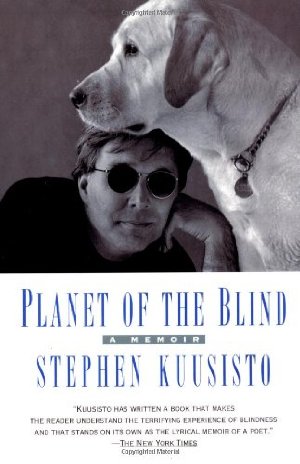
 Planet of the Blind