Now, unknowingly, the king
Eats his own horse
Uncle History remembers…
Times past stay
Like flavors
Memory, a kind of mouth
When eating Majesticus
There’s a hint of pepper
And wormwood
How hungry he is!
Bitter chewing
Unaware
He’s devouring
A creature he loves
And his ride home…
Aunt History Waits for Language

I wish I could tell you
About being me
Says Auntie History
But I’m still waiting
For the language—
The blood soaked
Moist-ugly nouns
Have yet to come
She sees young women
Writing books
And cheers them on
She comes down the mountain
And its spring withal
No one remains
In the old village
The women have vanished
She finds thistles
In a basket
She stands in haze
In a rough meadow
Her heart racing…
Aunt and Uncle History go to the opera…
They know
Aria is a blue word
In the singing
It may rise into red
But it returns to blue
You know
They’ve been to every performance
On earth—Chaliapin
Their favorite
The way he tore at his beard
Under that clock—
And the castrati
They remember
How, in the beginning
They sang only sacred music
Oh how they love
Beautiful torture!
Over the years
They’ve come to see
The best singers
Always have
Such tiny feet…
Uncle History and Sadness
Because he was sad
Uncle History talked to the linden
Just as any orphan would
It was more of a song really…
“See these hands,” he sang
“They are not mine…”
Afterwards he switched the radio
On and off
Like a spy
Sending signals
To the next room
Then he tapped his toe
In the present tense pond
Voila! He’s not unhappy
Sorrow can be monetized
Its a whole new day
When Uncle History sleeps…
When Uncle History sleeps
He doesn’t dream
But half awake
He sees things—
Edgar Poe
On laughing gas—
Anyway, he’s waking up
But he’s not quite back
And he sees feathers
White, lovely feathers
So perfect
Not sinister at all
Not hopeful
No Emily Dickinson
Just feathers
Floating
A sweet fascination
Before words come
And for a moment
No matter what Derrida says
There are only feathers
And no words for feathers
Over coffee
He won’t remember this
Not fully
Something about a single swan
It’s open ended
What happens
He’s strangely sad
Uncle and Auntie History and the Goats
Being history differs from thinking about it
Every morning Uncle and Auntie History
Tend to their goats
(They’re no different
Than Polyphemus
But they don’t live in a cave)
Because they personify the past
You will find them
Wherever books are sold
And they’re in the world’s Braille—
One can read them
On the weathered doors of Venice
Their goats are loyal
In the manner of goats
Which, if you’re thinking
Means our History clan
Resembles them
The bleats of some goats
Sound like human screams…
The lived circumstances of disability are contemporary disruption…
The lived circumstances of disability are now at code red in the United States. From the dismantling of the Department of Education (which has historically supervised ADA compliance in schools—from kindergarten to universities) to denying benefits for people who desperately need Supplemental Social Security the disdain and cruelty are “on” as they used to say on the radio. WE are ON WITH 50,000 WATTS OF rock and roll power!
I spent part of this morning walking around the campus of the University of Iowa where I studied creative writing long ago. Later I came back to teach here. The U of Iowa has always been a disability unfriendly place and now, in Trump 2.0 they’ll be free of any corrective government action. This ain’t just the case in Iowa. As colleges and universities ditch their Diversity Programs, many of them are shoving disability compliance under the bus as well.
I’d be in despair if I wasn’t already in despair. Meanwhile I’m reading “After Disruption: a Future for Cultural Memory” by Trevor Owens. It’s just out from University of Michigan Press. He has many arguments in the book and I won’t highlight all of them—the book is nuanced and shrewd. But one salient contention is that the takeover of our public square, pushed as it is by big tech, is powered by the language of “disruption” which of course reminds one of Elon Musk waving a chain saw while high on Ketamine.
The really interesting thing is that according to Owens the premonitory language of disruption was adopted by Silicon Valley from the academy. I confess to never having thought of this. Disruption in feminist studies or disability studies has always meant the ways in which outlier bodies interfere with normative narratives. This much is true and is still true and will always be true. But by adopting the lingo of disruption the Peter Thiels of the world have been able to push the idea that AI and the erosion of the humanities are excellent things. I urge you to read Owens book. But here’s a quote:
“When Silicon Valley co-opted the vocabulary of disruption, it removed the genuinely radical ideas that had come from feminist critical race theory and shifted them into a blunt fear-inducing instrument. While the rhetoric around disruption often comes with a revolutionary sentiment, at its core, disruptive innovation’s roots are in fear. This rhetoric is about making us afraid and pushing us to believe that Silicon Valley has the secrets to how we address the fear of being made obsolete or being replaced.”
One of the interesting things about ableism is that whatever form it takes it occupies the future perfect. There will be time enough to make things right for the disabled but not today. One may fair say “not today” is the motto of the thing. “Non hodie” in Latin. Picture a flag bearing the image of an indolent house cat. Not today will we question our assumptions about discrimination. BTW: ableists also avoid saying “maybe tomorrow.”
If you require accommodations “Non hodie” is the prevailing reply. What’s so demoralizing is that those who ought to be in the fight for disability inclusion are not interested. How can this be? Well, actually, the matter is simple: “there will be time enough to make things right, but not today.” That this “non hodie” includes administrators and faculty tells you how big a muscle ableism really is. But there’s another issue…
And of course there are gaslighting committees—they have names like “Inclusion and Access for One and All” and they meet privately because its all about “non hodie” and private self-congratulation. The folks on these committees don’t suffer from a lack of accommodations. In general they feel pretty good.
Which gets me back to Owens. Feeling good in today’s universities and in the United States has been replaced by resignation, precarity, and a new form of future perfect. Owens expertly explains this contemporary dread. Your embodied disruption is too disruptive. But it all sounds so good:
“Disrupt. Fail faster. Asking, in almost any meeting, “but will it scale?” Over the last three decades the language of Silicon Valley start-ups and venture capitalists has followed digital technologies into a wide range of industries, cultural-memory institutions included. This vocabulary, which historians of technology Lee Vinsel and Andrew Russell call “innovation-speak,” is now a core part of management cultures across the US and beyond.”
I urge disability activists to read this book.
Uncle History visits an old haunt…
Uncle History visits an old haunt
And thinks, things look OK
People appear contented
New buildings have risen
And by god the restaurants
Are better
There’s a new kind of fun alright
He’s reminded of a Roman snob
Who carried a silver toothpick
He remembers
Potemkin’s village
But that was easy
He remembers
A quote—
“Properly cared for
A Saville suit
Can be handed down
For generations—like gout…”
He can’t recall
Who said it
A boy with a funny hat
Glides past
On an electric scooter
And wearing noise canceling headphones
He remembers Hawthorne:
“Some maladies
Are rich and precious,
And only to be acquired
By the right of inheritance
Or purchased with gold.”
He thinks he knows where the gold
Is coming from
Then he doesn’t
Then he does…
Uncle History makes too much noise…
Uncle History makes too much noise
He’s a noisome man
Clattering over cobblestones
Like a Cossack
Except he has no weapon
And no reins
He does have a fallen apple
He has a torn paperback
About birds
He used to carry the I-Ching
But he lost it
On a bus in Buenos Aries
He loses lots of books
But its alright
Because he doesn’t read them
Like a drunk outside your hotel
He shouts that he knows everything
And when the cops arrive
He convinces them to sing along
Aunt History once read a story…
Aunt History once read a story
About a man who bought a sketch
By a famous artist—then
Erased it
She loves that plot
She too wants to erase things
Loves the idea of art so clean
It’s still in the imagination
Even if the paper
Is soiled
Even if what’s left
Is imperfect—
It’s still suggestive
A dancer’s finger tip
In the upper right hand corner
She thinks how she’d erase that also å
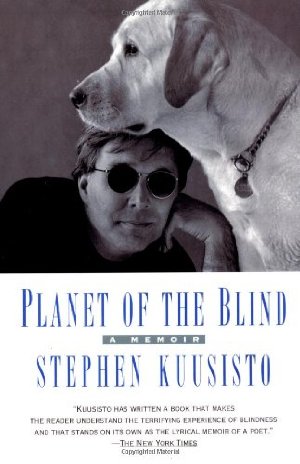
 Planet of the Blind