Disability and the Dyer’s Art

Let’s celebrate what for lack of a better term one might call the optimistic imagination as practiced by wretches. I’m in mind of G.K. Chesterton’s assessment of Dickens, that he was: “delighted at the same moment that he was desperate. The two opposite things existed in him simultaneously, and each in its full strength. His soul was not a mixed colour like grey and purple, caused by no component colour being quite itself. His soul was like a shot silk of black and crimson, a shot silk of misery and joy.”

Yes optimism for the wretch is a dyer’s art but it must be farcical in its hope. (Think Shakespeare’s Bottom.) One must be ridiculous in the boot black factory. (Dickens-Chaplin.) This is the thing, likely a tee shirt slogan: we hope in misery. As for the literary imagination printed ideas are invariably sad even when they propose optimism and no honest writer can ignore it. What did J.P. Morgan’s library smell like in 1902? Short answer? The vapors of sorrow.

A game I play, more often than I should admit, is a dramatic transference for which there may be a name but I’ve never found one. Perhaps there’s something in German. In short, I employ the characters of Shakespeare and Moliere as standard bearers for people I meet and especially for  public figures. The literary term for this is “comparison” but what I’m describing is better than that—“kayfab” is what they call it in professional wrestling, where everyone, both wrestlers and fans collectively pretend a false drama is real. Essentially I live and have always lived since my late teens in Tartuffe and The Taming of the Shrew and at this stage of life there’s no help for it. This is comedy as it’s lived but not necessarily admired. Moliere:

“The comic is the outward and visible form that nature’s bounty has attached to everything unreasonable, so that we should see, and avoid, it. To know the comic we must know the rational, of which it denotes the absence and we must see wherein the rational consists . . . incongruity is the heart of the comic . . . it follows that all lying, disguise, cheating, dissimulation, all outward show different from the reality, all contradiction in fact between actions that proceed from a single source, all this is in essence comic.”

Both Moliere and Shakespeare grew up watching morality plays, fables whose stock characters were invariably named God, Death, Everyman, Good-Deeds, Angel, Knowledge, Beauty, Discretion, and Strength. Because they lived during the first flowering of public literacy they understood the indispensable healthiness of word flipping. Talk about nature’s bounty! Words were no longer merely to be received and absorbed. Can you imagine the joy of a 17th century adolescent forced to watch Everyman or The Second Shepherd’s Play, as he substituted Satan, Life, Neighbor, Sin, Second Rate Demons, Ignorance, Ugliness, Gossip, and Basic Human Weakness for the stock characters of religious drama? Of course you can. Almost no one who’s lived through a high school production of The Man of La Mancha has not done this.

Comic irony is when you recognize the impostors beyond their appearances on stage. The characters in Tartuffe are at every holiday party. They creep through the workplace. Confidence men, hypocrites, exceptionally vain head cases, the credulous, and all who make their living feigning virtue. Ah, nature’s bounty indeed!

By living Moliere I reside in kayfab—I know the world may be better or worse than this adoption, but I can bear my illusions for not to live in Tartuffe would be, at least for me, unsupportable. Comedic representation is healthier than plodding credulity and more philosophical since incongruity is the mainspring for understanding the irrational. If you’re following me, you’ll say my proscenium of custom if it’s all Moliere, all Shakespeare, all the time, is a matter that must by necessity make me unreasonable. I prefer this to any conversation with the human resources crowd or political canvasers or god help me, professors at a conference. I’d gladly sip the milk of custom and spit it in a potted plant than talk to Orgon or Tartuffe. Contradiction isn’t a customary beverage. It’s milk and iodine and it’s healthier for you than any drink Madame Pernelle will offer.

Shakespeare was the first comic writer to dramatize reverse psychology as Petruchio, a wandering nobleman, undertakes the wooing of Kate who’s notoriously short tempered and cruel:

“Say she rail; why, I’ll tell her plain
She sings as sweetly as a nightingale.
Say that she frown; I’ll say she looks as clear
As morning roses newly wash’d with dew.
Say she be mute and will not speak a word;
Then I’ll commend her volubility,
and say she uttereth piercing eloquence.”

We are the ones invited to say she rail; we’re instructed to become as devious as Petruchio. Taken into his confidence we’re delighted by his promissory book of lies.

That’s optimism as comedy. Not as a vehicle for pratfalls or put downs, but discernment and the vanity of hope.

Hope is comedy. The sadness of the world is irrational. This is how I live. I think of Auden’s line: “All we are not stares back at what we are.” If an empowered disability identity is “out” and on the street it’s ironies are inherently complicated by the acculturated language of normalcy. This is both a signature subject for performance theory and disability studies. It is also the seed bed of literary consciousness. Watch out! The crip writers are comics.

Cripples descend to the streets with their horrendous habits and torn tickets…

Have you ever considered the flamboyant machinery of disability? Not the machine of desire like Deleuze, but of insistence. The Dis-machine is about insistency and each of us who’s claimed disability must be rendered robotic by our demands. Not the cyborg of Judith Butler the Dis-machine: it’s a childish contraption, irritatingly repetitive, always whiny and whinnying. So it’s loud, gets attention, and the human soul boils inside it.

**

Wasn’t that enough for you? Didn’t we give you a radio and some Braille playing cards? Oh yes, and didn’t we give you Social Security Disability payments? Isn’t it enough we didn’t tumble you into the sea?

What? You want to be of the earth like your neighbor?

**

Flamboyant: mid 19th century: from French, literally ‘flaming, blazing,’ present participle of flamboyer, from flambe ‘a flame.’

Disability, advocated for, is a repetitive life-long enslavement, stiff, mechanical. Vocalized it becomes hot, a conflagration.

The disabled, considered children by those without disabilities, are, effectively steam engines, wholly constructed; hot to the touch.

**

Now I don’t know you. You, my fellow passenger. We’re flying Iodine Air. The commuter plane is filthy and smells like gym socks. I don’t know a thing about you, Man Across the Aisle—you who imagine because I have a guide dog I can’t tell you’re sizing me up with the face of a reproving minister. Perhaps you don’t like dogs; maybe blindness upsets you. In extremis, I remind you of death, which is wonderfully ironic because I see you as a specialized proto-cadaver. That is, you’re biggest contribution to humanity will come when you’re dead and on a table. I’m on fire alright.

**

Desire’s basic function according to Deleuze and Guattari is to assemble and render itself mechanical.

All disabled are “Le machine hot” and you really shouldn’t touch me.

What is the constructive thing the disabled form?

**

This is the problem: the bio-political conditions of disability are stripped of effectual desiring-production and must, therefore, be voiced relentlessly, like the notes of a calliope.

Meanwhile the journalists trained their lenses on the crippled child who was allowed to meet the great basketball player. Normal people wept and considered the little boy “brave” for wanting to walk in the world.

**

This is the problem: there are no workshops for disablement mastery.

Cripples descend to the streets with their horrendous habits and torn tickets.

The desiring machines of crippledness are fueled by the chrysanthemums of healing.

These are not the true machines.

You see I feel as well as my body tells me I do. I throw flames from my wide mouth.

Books will mean nothing when world burns down…

    --for Naomi Ortiz

Just a local stroll—
Dead fountain, snow, light,
Blind, starting always…

A crippled friend writes
About a gasoline attendant
Who was addicted to meth
How meeting the guy
Intersected
With his own disability

How many times
Have I been in the company
Of drunks and broken wanderers?

**

Traveling blind differs from sighted walking in only one respect: strangers are more likely to approach when you can’t see. They’re generally not malevolent—my sense is they’re lost. Yes it’s ironic they should gravitate to a blind person.

Over the years I’ve come to see this gravitation as something spiritual. I don’t mean it in a churchly sense, but more like Carl Jung’s analysis of UFOs. A blind person going confidently about his or her business means something obscure to hapless wanderers.

**

Once in New York City I was grabbed by a man who dragged me across the street. On the far side he actually bowed and ran away. He never said a thing. My guide dog was as stumped as I was. They didn’t teach us about this at the guide dog school. The man was working something out.

What’s clear is that disability always represents something—its like the mirrored ball in a disco. You may be—no, likely are—minding your own business. You’re pumping gas like Bill was doing, or you’re standing on a corner thinking about tartar sauce, why do they call it “tartar sauce”—did the Tartars actually make sauce—when a man disguised as a man appears. He says he has headaches. He says he lost his job. Says inside his clenched fist he has a ruby that once belonged to Agnes Moorehead. These things happen all the time when you have a disability. There is no such thing as neutral weather. Not if you are a cripple abroad in America.

**

Today they are burning the world
They do it in a kind of reverie
They love their occulted ash
They look forward to the death of all atmospheres…
How can I be a poet
How do I think this mask of tragedy
Will “mean” anything tomorrow?
There will be no books tomorrow
There will be no wind swept crows wings

**

When I was fourteen years old and struggling with vision loss, my mother, who was by then a heavy drinker met me at the door of our house. I was returning from junior high school, hoping desperately to find safety after seven hours of bullying. All I wanted was my own room. I could picture in my mind’s eye my cave with its short wave radio. Nowadays I know the mind’s eye is the work of the soul but I didn’t know it then. I only knew retreat.

My mother clutched a burning sofa cushion. “I don’t know how I did it,” she said. “get out of my way!”

She ran across our suburban lawn with the blazing thing held at arm’s length, and for some reason she wouldn’t drop it. She staggered from place to place until flames singed her hair and then she flung the cushion into a neighbor’s hedge where it extinguished itself but continued smoldering, sending up smoke signals.

As a disabled teen I was learning there were no safe places. We find, by necessity, locations where our souls can retreat, and after practice, we learn to take these guarded, hermetic spaces wherever we go.

Back then my job was to endure by stamina. Be blind, but don’t be blind, be something sort of blind, but not really blind blind. Be some kind of defective sighted person, but not really defective, just moderately less broken. Or whatever.

Blindness became a tortoise like affair. My blind soul held its breath in a shell.

They are burning the world down
I’m still holding my breath
I’m pleading before a mirror and ringing a bell

Reading D.H. Lawrence


I too climb in and out of the pit of myself 
And have watched so many others do the same

And as a man have crawled on all fours 
And have told the overseer to fuck off

And have called the wrong things mystic
And have seen the November mushroom

The “Standalone of Fall”—that silly man
Not giving up—but waiting 

In the milk light of the underworld
Which is wholly inside him

So that now after rain, early winter, 
Hop-scotching birds, 

Avian imperfect, the wild ordinary
Welter of earth, small gasps,

I walk up the pale green avenue—
7th avenue in New York—

End of day, my great guide dog 
Working to keep us safe, 

Taking us toward 
The postulate of arrival, 

The grandest of things, 
A task accomplished, 

Going where we had to go
Mystic one calls it

Whether right or wrong.


Soothsayer

At twenty she came to me
Saying: you will write books
And some people will read them
But you’ll not be happy
Life will become
A muffled clamor
You’ll be foreign
To yourself
Like a man
Who speaks
The glaucous dialects
Of herdsmen
And all I could hear
Was “books”
Authorship—
Not understanding
The loneliness
To come
And the crying out
For trees
To rescue me

“From the Monotonous Sublime, or, on Being a Blind Graduate Student at the Iowa Writer’s Workshop Before the ADA”

“Pity the planet, all joy gone
from this sweet volcanic cone;
peace to our children when they fall
in small war on the heels of small
war – until the end of time
to police the earth, a ghost
orbiting forever lost
in our monotonous sublime.”

― Robert Lowell

Years ago when I was a thick spectacled graduate student at the Iowa Writer’s Workshop I found me-self under the sway of Longinus or Pseudo-Longinus or Dionysus of Halicarnassus or whoever he was, and I swear, all I could think about was ”the sublime” and I underlined this: great thoughts, strong emotions, certain figures of thought and speech, noble diction, and dignified word arrangement…

In those days I thought Wallace Stevens poem “Sunday Morning” was the premier example. Stevens could be simultaneously Nietzschean and pragmatic (there was more of Dewey in Stevens than Santayana) and so grand thoughts were central—how does anyone live without tutelary gods or faith in Popular Mechanics? How do we achieve nobility?

Now also in those days I had a physical problem as all of us generally do. When I decided to attend the University of Iowa I flew to Iowa City three months early and walked the town like a crime scene investigator. I marched in little grids. I moved haltingly up and down dozens of streets. When I thought no one was watching I drew a telescope from my pocket and read the street signs. I hiked in the stifling summer heat and worried about people marking me as deviant. I was “Blind Pew” the untouchable but I wouldn’t let anyone know. By late August I knew enough of Iowa City to travel from my unfurnished apartment to the English-Philosophy Building.

That was the summer I started keeping a journal. In July of 1978 I wrote:

If you love others you can be brave about your challenges. I am, of course, quite cowardly–—I argue with friends, strain relationships, talk too loudly, all because I hate my zig zagging eyeballs…

I’m starting to think about the politics of bravery…Would it kill me to mention in good company how much I can’t see?

Sublimity isn’t merely a great idea like the vatic circles of Proclus or a sensation like Minturno seeing god’s first blue reflected in windows nor is it aspirational (though one ought never never find fault with desire) it’s an aggregate and poignant quality of irony—“Lord Thy sea is so vast and my boat is so small;” it’s the insufficiency of our floral arrangements; our shy and unspoken wish that we too may see Blake’s angels in a willow tree; it’s knowing our inadequacy and our truest principles. In the second stanza of “Sunday Morning” Stevens famously writes:

Divinity must live within herself:
Passions of rain, or moods in falling snow;
Grievings in loneliness, or unsubdued
Elations when the forest blooms; gusty
Emotions on wet roads on autumn nights;
All pleasures and all pains, remembering
The bough of summer and the winter branch.
These are the measures destined for her soul.

Sublimity is responsibility. (Delmore Schwartz) The measures destined for our souls are as near to ancient sacrifice as a modern man or woman can come. John Dewey: “The self is not something ready-made, but something in continuous formation through choice of action.” For Dewey “self” is the imagination; for Stevens imagination substitutes god; both believe in the sublime which is devotion to strong, arranged, and dignified emotions.
It’s better maybe to think of this as a hunger. Dewey again: “Hunger not to have, but to be.”

3.

Even at twenty five and feeling my way through Iowa City I wanted to be all pleasures and all pains remembered. That was a choice of action. And I would admire poets and poems which took this on. In the years to come I’d admire many poets. To admire was something more than merely liking.

I admired Yehuda Amichai:

“Memorial Day for the War Dead”

Memorial day for the war dead. Add now
the grief of all your losses to their grief,
even of a woman that has left you. Mix
sorrow with sorrow, like time-saving history,
which stacks holiday and sacrifice and mourning
on one day for easy, convenient memory.

Oh, sweet world soaked, like bread,
in sweet milk for the terrible toothless God.
“Behind all this some great happiness is hiding.”
No use to weep inside and to scream outside.
Behind all this perhaps some great happiness is hiding.

Memorial day. Bitter salt is dressed up
as a little girl with flowers.
The streets are cordoned off with ropes,
for the marching together of the living and the dead.
Children with a grief not their own march slowly,
like stepping over broken glass.

The flautist’s mouth will stay like that for many days.
A dead soldier swims above little heads
with the swimming movements of the dead,
with the ancient error the dead have
about the place of the living water.

A flag loses contact with reality and flies off.
A shopwindow is decorated with
dresses of beautiful women, in blue and white.
And everything in three languages:
Hebrew, Arabic, and Death.

A great and royal animal is dying
all through the night under the jasmine
tree with a constant stare at the world.

A man whose son died in the war walks in the street
like a woman with a dead embryo in her womb.
“Behind all this some great happiness is hiding.”


The sublime was more than self-disclosure. It was walking grief, chance joy, intimations of ancestors; it was John Keats writing to his brother; it was Emily Dickinson’s toothache; above all it was the dignity of self-recognition.
What did I learn to like? How about Anne Sexton:

“The Truth the Dead Know”

For my Mother, born March 1902, died March 1959
and my Father, born February 1900, died June 1959

Gone, I say and walk from church,
refusing the stiff procession to the grave,
letting the dead ride alone in the hearse.
It is June. I am tired of being brave.

We drive to the Cape. I cultivate
myself where the sun gutters from the sky,
where the sea swings in like an iron gate
and we touch. In another country people die.

My darling, the wind falls in like stones
from the whitehearted water and when we touch
we enter touch entirely. No one’s alone.
Men kill for this, or for as much.

And what of the dead? They lie without shoes
in their stone boats. They are more like stone
than the sea would be if it stopped. They refuse
to be blessed, throat, eye and knucklebone.

The sublime is unsentimental. Sometimes it’s willing to lie. “No one’s alone.” But we have to say so. As I said above the sublime has ironies. The sublime cannot save you. Wallace Stevens would easily agree. It’s a devotional. Who precisely did you and your imagination purport to be? What did I like? I liked Larry Levis:

“Ghazal”

Does exile begin at birth? I lived beside a wide river
For so long I stopped hearing it.

As when a glass shatters during an argument,
And we are secretly thrilled. . . . We wanted it to break.

Always something missing now in the cry of one bird,
Its wings flared against the wood.

Still, everything that is singular has a name:
Stone, song, trembling, waist, & snow. I remember how

My old psychiatrist would pinch his nose between
A thumb & forefinger, look up at me & sigh.

We shouldn’t say the sublime lacks humor. And we certainly shouldn’t say it’s fussy. If everything that’s singular has a name, well, we still have to guess. Even the gods would say guesswork has nobility. If they don’t then we’re not interested in them. Not for long anyway. And to understand the sublime is to be unimpressed by “isms” and to know it early. As for the Levis poem, nothing is worse than a patient who won’t be fooled. The sublime after all is its own brand of health. The sublime is political. What do I like? Adrienne Rich:

Saw you walking barefoot
taking a long look
at the new moon’s eyelid

later spread
sleep-fallen, naked in your dark hair
asleep but not oblivious
of the unslept unsleeping
elsewhere

Tonight I think
no poetry
will serve

Syntax of rendition:

verb pilots the plane
adverb modifies action

verb force-feeds noun
submerges the subject
noun is choking

verb    disgraced    goes on doing

now diagram the sentence


If poetry is to matter it needs to be unflinching, must have ardor. It should avoid fussiness and self-regard—be properly intentional or desiring of the spirit.

John Dewey again: “The ultimate function of literature is to appreciate the world, sometimes indignantly, sometimes sorrowfully, but best of all to praise when it is luckily possible.”

Praise is the hard part.

When James Wright said he wanted to write the poetry of a grown man he meant it was time to praise what was around him.

What do I love? I love this poem by Sam Hamill:

Just as I wonder
whether it’s going to die,
the orchid blossoms

and I can’t explain why it
moves my heart, why such pleasure

comes from one small bud
on a long spindly stem, one
blood red gold flower

opening at mid-summer,
tiny, perfect in its hour.

Even to a white-
haired craggy poet, it’s
purely erotic,

pistil and stamen, pollen,
dew of the world, a spoonful
of earth, and water.

Erotic because there’s death
at the heart of birth,

drama in those old sunrise
prisms in wet cedar boughs,

deepest mystery
in washing evening dishes
or teasing my wife,

who grows, yes, more beautiful
because one of us will die.

The poems of a grown man or woman are, as Lowell would say, quite possibly “of” our monotonous sublime by which he meant our clinging, daily, necessary fealty to better ideas, wishes, even intuitions. We fight back against the ruinous and sequential daily atrocities of our age, which means our pitiless living. Don’t assume the sublime doesn’t take work.
You can even be tongue and cheek about it if you like. The late Finnish poet Pentti Saarikoski wrote: “I want to be the sort of poet whose songs call the trees and stones forward/whose poems become houses for people…”
(A rough translation.) As James Wright would say: “put that in your pipe and smoke it.” Know what you’re about. Know your demands.

4.

What does any of this have to do with walking around a midwestern university town unable to see? It should be obvious I imagine—not being able to see pales compared to having no language for it. Fortunate then that the sublime is more interested in our honesty than we’ll admit especially when we’re young. (A tip of the hat to Nietzsche. The abyss will stare back.) But the sublime is far more likely to furnish the creative mind if we learn to know ourselves—indifferently, tinged with dramatic irony, seeing ourselves as if we’re simultaneously in a play and also in the audience. What do we know about this self-to-self dichotomy that passes for a man that we didn’t know as the day began? Why is that knowing so critical both to poems and character? James Wright:

“St. Judas”

When I went out to kill myself, I caught
A pack of hoodlums beating up a man.
Running to spare his suffering, I forgot
My name, my number, how my day began,
How soldiers milled around the garden stone
And sang amusing songs; how all that day
Their javelins measured crowds; how I alone
Bargained the proper coins, and slipped away.

Banished from heaven, I found this victim beaten,
Stripped, kneed, and left to cry. Dropping my rope
Aside, I ran, ignored the uniforms:
Then I remembered bread my flesh had eaten,
The kiss that ate my flesh. Flayed without hope,
I held the man for nothing in my arms.

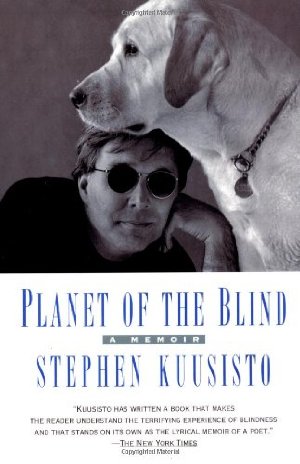
So there is something selfless about sublime engagements. The more powerful and evocative the experience the more we will carry away. We build ourselves with proper words. We learn by standing for things. It is much harder work than simple autobiography. What happened to me is not as interesting as what I understood about what occurred. In my memoir Planet of the Blind I describe how I went running in Iowa, unable to see, and ran straight through a freshly laid patch of sidewalk cement. Surrounded by indignant laborers, one of whom shouted, “are you fucking blind?” I told the truth. “Yes,” I said. “I’m blind and I’m running.” This revelation was so unexpected that one of the men drove me home and told me to get a dog. His uncle was blind. He thought there was a better way of doing it. Back to Dewey: it’s about growth, curiosity, expectation, and hunger to be.
So many early memories are of music…

So many early memories are of music. Caruso in the attic on the old Victrola; a visit to the circus where I couldn’t really see but the calliope was like an insistent relative, an uncle telling you that jumping into deep water was a fine thing. Never trust a calliope. And there was Tchaikovsky on the radio, Swan Lake which is pure heartbreak at any age but at four when I first heard it I drifted away like an airship filled with weeping people. So many memories. Don’t laugh. Wasn’t it Goethe who as a child heard apples muttering in a basket? I heard a voice from a window and there was no one there. One can be both Goethe and John Cage in early childhood.

I think Tchaikovsky’s piano trio in A Minor is the truest expression of early sadness.

**

This morning:

I understand.
Maybe
I’ve another
Few years
With this
Living face.
This morning
My neighbor
Lonely
Returned books
He’d borrowed
Deep last winter.

**

I was alone but not unhappy. That was the thing. Wind up the Victrola, listen to incomprehensible words and musical notes. And sometimes hornets flew past my face. Was it Caruso who kept them away? Whatever the case the hornets never bothered me. The snick of the needle hitting the outermost circumference of the disk. The systolic static from the horn. One more second and the music would start.

**
I know you know.
Skepsis is in the bread.

**
Only the dead feel at home—“My father’s house has many mansions…”
“You have to understand,” the poet said, “life is a rented room, not much more.”
Sometimes I have to laugh
Thinking of piety, all those down payments
For what is essentially free. Death is its own house.
The windows are open, late winter, rain coming, the old curtains billowing.

**

So some music then.
Bring out the guitar
That cries in its own language
Remember, you don’t care for money.
You want children to play in safety.
Let the notes drop of their own accord.

Once in London

Poems came then fast as rain
And Battersea smokestacks
Said they’d make no difference

But the man, the young man
Wrote for himself a boat
Steadfast old Vainamoinen

Sailing to the land of the dead
With yellow fruit
And dark bread

Beetles glistening
In the garden
Tiny windows

Reflecting sunlight
Then talking to himself
In taxicabs

On National Poetry Day

Always now someone
You know, a ghosted one
Without a name
Troubles you
And you throw words back—
Up river, broken window
How thin your wrists are
Didn’t you want
Twilight and discernment
Come closer
Do come
It’s raining in New York
Reading Nietzsche
At twenty
I saw his eagles
Were real
And how little
He loved them
Go ahead
I told myself
Make a vow
Make it respectful