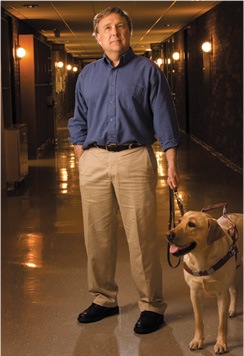
Some years ago when I was working for a famous charitable organization I had the chance to visit with the movie actress Mia Farrow and several of her adoptive children. Mia was giving a new life to some amazing kids who hailed from the far corners of the earth and who also had disabilities. We had some fun together on that morning because I showed the kids how my guide dog “Corky” –a big yellow Labrador retriever, could guide me around obstacles. Soon we were making a long human chain and having Corky guide us all together in a kind of fabulous “conga line”. Some of Mia’s children were blind, others had developmental disabilities. All of us were laughing and following Corky as she made her way around the grounds of the guide dog school.
That memory stays with me because it represents two essential characteristics of living”with” or “without” a disability. Principle One: sometimes it’s crucial to break the rules. Principle Two: We can’t always be healed but we can live well.
Guide dogs are trained to guide only their single human partner. If you’re blind and you allow other blind people to latch onto you for guidance you are putting an unfair burden on the dog. Part of every guide dog’s job is to make evaluations about the combined width of the team. But on that morning with Mia Farrow I saw that Corky could safely give all those kids a lift. The result was a moment of pure momentum and group joy. “Group Joy” is a funny thing. You can’t always count on it. The “rule book” doesn’t have a chapter on this.
Principle Two is harder to think about. We are all hoping to “get well” when we are fighting an illness or a disability. I recently attended a conference on writing and “healing” and heard lots of literary writers talking about how important their creative work was in terms of “healing” from illness. What was fascinating was the way every one of those writers assumed the easy use of “healing” or “being healed” as being analogous to the purpose behind human creativity. This is an old fashioned idea that many otherwise sensible people are still attracted to. Who would want to argue against this idea? Isn’t the goal of every therapeutic encounter to be healed?
Well no, not always. People who have disabilities or who are enduring an intractable illness are often faced with a different challenge, one that defies healing but which requires us to think about being well just the same. As a teacher with a disability who is increasingly researching the ways that culture influences our ideas about “ability” and “disability” I have come to prefer the old metallurgical term “tempering” to “healing” because it suggests that we are getting stronger without denoting a complete physical transformation.
Not every disability can be healed. I learned long ago that being “incurable” and being well are possible. But don’t go looking for this anomaly in the rule book. In effect what you need to do is break the rules that have long been established for how to think of being well. I am for instance the best blind sailor in my family. Never mind that I’m the only blind sailor in my family. I did in fact teach my sighted wife how to dock a boat. There’s no rule book for this.
I should add that I’m not opposed to healing. I believe in curing illness and in eradicating diseases. But I also believe in being tempered by physical difference and that it’s possible to lead a vigorous life. Some ophthalmologists would see me as a patient who represents the failure of their profession. They weren’t taught about how its possible to live well when you can’t see. They don’t know about the human equation that links imaginative direction and the unknown together in joyous motion.
It is interesting to note that the word “disability” didn’t turn up in idiomatic English until the 19th century. The economist Karl Marx used the term to signify people who could not work in the factories. If an economic model of bodily motion is the normative language of physical acceptance in the modern state then it becomes easy to see why the idea that having a disability and living well would be impossible in the mind of the public.
A recent New York Times article highlighted the fact that many of America’s largest companies are now hiring people with disabilities to work from their homes. The internet and assistive software on the pc and the mobile phone make it possible for the disabled to be wonderfully productive workers in today’s economy. What has changed? The rule book has changed. This is why disability studies and the architectural term “universal design” are increasingly linked. I think my guide dog Corky had a good idea: a conga line for all those kids. All of us are going somewhere these days.
S.K.

 Planet of the Blind