It’s like hitting a baseball I think.
Today I strike out.
But the crowd in my head!
They’re throwing batteries and pool balls!
A rotund little fella seated behind the first base dugout cries:
“Send in Lorca!”
And the manager, who represents the violent and powerful dead on the bench
Approaches with his odor of blood.
The uproar of living by day and dreaming by night…

Sometimes Beethoven makes my pulse race
Though I’m paring an apple
And the radio is in the next room
**
Outside, rain, a fox
Nosing stiff winter grass
Meanwhile my teeth are wearing out
**
Brass buttons gleaming in the attic
Dear Ludwig
A succession of immense birds….
Overnight
Apples have appeared on the old tree
Fingernail sized
Though nature keeps a closed book
And fruit cannot be hope.
Last night I dreamt
Of friends long gone–
We were beside a lake
Together in sadness
And someone said “Odysseus.”
Small apples.
Emergent green.
Nostalgia means
Returning home in pain.
Laconia- or the Provincial Opera
1.
When I was five years old I discovered a Victrola in my grandmother’s attic. It was August and the neighborhood kids were playing ball and there I was with a wind up gramophone. Blind child alone at the top of a Victorian house with an ancient record player.
2.
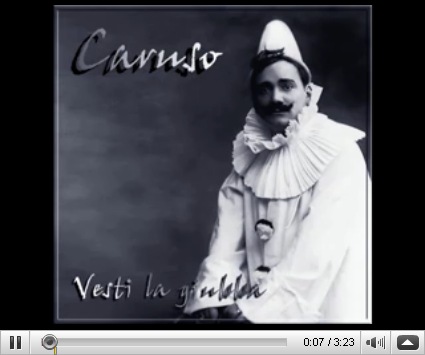
I fell wildly in love with that machine. It worked perfectly and there were dozens of records featuring the great Enrico Caruso. You have to picture me—so small and stunned to hear such a voice under a sloping roof. Even today, sixty years later hearing Caruso pulls me back to that provincial first opera house.
3.
As a boy the poet W. H. Auden loved machines, especially mining equipment, so much so his parents thought he’d grow up to be an engineer. With poets what matters are the engines beneath the skull, those marvels unseen in the outer world. For me it was the Victrola—it signaled a recursive, shadowy inner life.
4.
There were lots of artifacts in that attic. A raccoon coat, a sea captain’s chest, a cracked boudoir mirror, cane chairs eaten through, dusty books, a sewing machine, oddments of all kinds and tools I couldn’t identify. I explored with my hands while the great tenor sang of vengeance or a broken heart.
5.
In my case poetry has always been about forsakenness. The solitude glitters. Rain runs down the window and you press your forehead there. You discover you need nothing.
I still hear the needle hitting the record. That sound of hay scratching hay.
6.
Lawrence wrote: “It’s no good trying to get rid of your own aloneness. You’ve got to stick to it all your life. Only at times, at times, the gap will be filled in. At times! But you have to wait for the times. Accept your own aloneness and stick to it, all your life. And then accept the times when the gap is filled in, when they come. But they’ve got to come. You can’t force them.”
Ah the voice of a tenor singing in the dark in Laconia, New Hampshire, 1960
7.
The times were plain. Some children knew the names of birds. My favorite was the White Throated Sparrow who we called the Peabody Bird. His song could break your heart. The Wood Thrush was also a heart breaker and lying face down in the woods he’d get inside you. He’d get inside us because we were playing dead. This was in the final days before television. We played dead and listened to bird songs.
8.
So a blind kid with a victrola falls in love with a great Italian tenor. I see now it makes sense: a disabled child was transported by a dusty machine that brought back alive a dead man’s voice.
9.
And wasn’t Laconia, New Hampshire the perfect town?
A ruined place.
Factories shuttered.
The disused railway station where they stored dead Coke machines.
10.
New York Times, 8 December 1906:
“The real sensation at the Metropolitan Opera House last night was the appearance as a spectator of Signor Caruso, sans moustache. When the tenor entered the foyer after the first act, accompanied by Signor Scotti, he was not recognized, but when the story spread the foyer quickly filled, with persons eager to see him. Seemingly unmindful of the commotion he had created, he continued to walk up and down the corridor.
“It’s on account of Puccini’s opera, Manon Lescaut,” he explained. “The chevalier is a youth and a mustache would not be congruous.”
The comments in the boxes and foyer were animated.
“Have you seen Caruso?”
“Do you think he looks better than he did?”
“What did he do it for?”
“Can he sing without it?”
The public will be in suspense about the last question until next Wednesday night, when the tenor makes his next appearance.”
11.
Boy 1906!
Upton Sinclair publishes “The Jungle.”
The great San Francisco earthquake which Caruso survives.
Theodore Roosevelt creates national parks.
Harry K. Thaw shoots Stanford White high above Madison Square Garden.
Lon Chaney Jr. is born.
The brand name “Victrola” is introduced by the Victor Talking Machine Company of Camden, NJ.
12.
Enrico Caruso issued approximately 240 records, 78 rpm disks, each recorded while the tenor sang into a paper horn. His recordings became the gold standard for a new, sophisticated popular culture in the years before radio. Until the mid twenties the Victrola was the best selling and most sought after entertainment device around the world.
13.
My grandfather was dead about eight years when I found his record machine. He’d been among the earliest manufacturers of motor cars and motorcycles in the US. So yes the man loved contraptions. I’ve no evidence that he particularly loved opera. But that’s the thing: in 1906 Caruso was “The Beatles.” Everyone had to own his records. One could hear Puccini emanating from the lowliest farmhouse.
14.
And 1960 was the year I thought there was a man inside the window. He was frosted like the glass and more than once I knew he was the one doing the talking.
Then I’d climb to the attic.
The Victrola sang from its great, crackling heart.
And my own heart raced, both running and returning.
The Itch
When doctors don’t know what you have–you know, “the thing” that bends you low, makes you sweat, causes you to entertain prayer, forces you to jump up and down like a mechanical toy from the 19th century, they call it an “idiopathic” condition.
Now of course there are different kinds of not knowing when it comes to the body. There’s not knowing and there’s not knowing. I hope this clears things up.
I have one of the commonest idiopathic ailments and you might have it too: I fucking itch all over. We’re not talking a minor league, Sunday school itch–the kind Huck Finn had when they told him not to scratch in church–that ain’t idiopathic my friend. We know why Huck was itchy. In fact studies have shown that ministers, preachers, priests, rabbis, zen masters, imams, and school teachers can cause itching by doing nothing more than moving their eyes. There’s a scientific term for this. Preachers who make you itch just by looking at you are known as ohptho-idio-paths, which is an elevated way of saying you break out in hives because they really don’t like you.
Meanwhile the doctor doesn’t know why you itch. You just boil all over with purgatorial pins and needles, with no part of your body unaffected.
You might be allergic to wine. Maybe food. Maybe air pollution. Agribusiness. Laundry detergent. But when you live without these things as an experiment, sequentially, sober, starving, hiding in the cellar, stinking so badly the dog won’t come near—nothing changes. You itch like an electrified sponge.
In my case the thing that most helps is an over the counter generic drug called loratadine–an antihistamine that’s commercially marketed as Claritin. When I take it the itching is vastly reduced. I stop tearing at my skin. I even get some sleep.
So why then did I spend last night “not taking it” and playing a game of mind over matter? Why did I lie on my bed of fire and send brain messages to every part of my straining body?
The answer? It’s the Lutheran Olympics. It’s a Scandinavian thing.
Brain to feet: “C’mon guys, can’t we all just get along?”
Feet to brain: “Captain, the engine room’s on fire and the door’s locked!”
Brain to hands: “Now just stop that! Grow up!”
Hands to brain: “Help! The tarantulas have escaped! They’re in our mittens!”
Other parts of the body have requested anonymity.
Please don’t try this. We are, as they say in TV land, trained professionals.
I didn’t want to cry…
I didn’t want to cry. The wide sun was covering my face. Tourists were all about. The day was warm for April. I didn’t want them, the tears, the choked tears of disability exclusion but they came and I leaned against a wall outside Santa Maria delle Grazie, home to “The Last Supper” and wept before strangers. I’d been denied entry to the church by a nun. She’d hissed like a goose and had pointed me away. It was Corky—no dogs in the grotto! Her disdain was cruel and it belonged to the viaticum of ruthlessness and I understood it wasn’t Corky she objected to at all but blindness itself, a pre-Roman atavistic stigma. I heard it. It rose from the back of her throat.
I encouraged my wife Connie to go in and so I swayed and cried alone and hated myself. It wasn’t the spectacle of weeping that disgusted me, it was having to cry and letting a dried up craven, superstitious dingus get the best of me. “Supper Sister” had turned me away from Heaven and she knew it.
I slid down the wall and sat on the pavement. Corky, Labrador, large, affectionate, concerned, pressed against me and I cried all the more. The guide dog was supposed to fix this; to give me freedom; open the world, and to the best of her ability she had. We were in Italy when only three years ago I’d been living a sealed and provincial life in a small town, unsure of how to go places. Corky had done her part.
Godammit! What was wrong with me? The Italians weren’t friendly to guide dogs, and over a span of three days I’d absorbed the evil eye from at least eighteen men and women. So what? Where was my inveterate, subversive streak—though I’d lived much of my childhood and adolescence fearing disability, I’d also been wild enough to say fuck you to teachers and aggregate bullies. Fuck you, I’d said to the high school chemistry teacher who wouldn’t describe what was on the blackboard. Fuck you, I’d said to the college professor who said I shouldn’t be in his class. Fuck you and Fuck you. And Fuck you, Nixon. Jesus! I’d been undone by a nun! A sputum bespattered unfounded wobbly nun!
I laughed then because that’s how it is with tears of discrimination—you get there.
Hints of Thumbnail Purgatory
I was happiest as a child alone in the woods, light suffused, everything quiet. Somewhere far off the town held a parade. I was alone in my green cave, darker than morning, trees donning sorrow hats as the sun faded. And the birds quiet. Hint of a coming rain.
It’s the “hints” that most interest me. Door-mouse scratch; footfalls from a distance; daydreaming on a carpet.
A question arrives from the proverbial interested stranger: “what do you do in your cave of making now you’re a grown man?”
I make things up. Here’s a one act play featuring Aunt and uncle Benevolence. It takes place in the United States. I’m calling it Thumbnail Purgatory:
Purgatory, from purge: “an abrupt or violent removal of a group of people from an organization or place.”
Purgatory, in Roman Catholic doctrine: “a place or state of suffering inhabited by the souls of sinners who are expiating their sins before going to heaven.”
“Well that’s it,” said Aunt Benevolence, “the good times are over. It’s time to send the lame and the halt straight back to the dirty boulevard.”
Uncle Benevolence wasn’t so sure. He scratched his purple wen. “I don’t believe, my dear, that there IS a dirty boulevard anymore. It’s been replaced by a heated, closed to traffic, “promenade” with decent shopping.”
“Well,” said Auntie, “we’re going to have to send them somewhere. Once there’s no Medicaid to speak of, and no health insurance for the knock kneed elders and the scoliatics, etc..”
“Well I hear North Dakota is empty,” Uncle said. “It’s mostly empty, anyway.”
“How will we get them there on the cheap?”
“Everyone knows boxcars are cheap.”
They sat for a time side by side in silence.
“It was easier on the old days to just take care of people,” Auntie said after a little while.
“Yes,” said Uncle, “but they’ve gone Pagan now. You know, Horace and shit. The best days are the first to go.”
“When did they forget Jesus?” Auntie asked.
“In America?” Uncle asked.
“Yeah,” Auntie said, “you know, Christian’s bundle, noblesse oblige, shit, even just a minimal sense of national regard for appearances…”
“It was never a Christian nation,” Uncle said. “And the Devil loves a vacuum.”
Blindness, an Abandoned Stove and Crickets
Blindness, an Abandoned Stove and Crickets
I knew, listening with everything I had that crickets would materialize within me. They were my first talking books. My first Caruso. Later I’d discover Lorca, his line: the little boy went looking for his voice/the king of the crickets had it…
Yes. The cricket king. A little boy with his thick spectacles. The proscenium arch of the old stove among birches.
The Yearning
I went to New York City owing to either a yearning or an itch. Perhaps they’re the same though the former sounds like Romantic poetry and the latter doesn’t. In any event I wanted to go somewhere with my guide dog Caitlyn. In my guide dog using life I’ve been a vigorous walker in cities around the world. It felt like time to get back into the world after a year and a half at home.
There’s a song by Lou Reed which has the refrain: “it takes a bus load of faith to get by.” I’ve always liked Lou’s employment of “faith” which he offers with irony to be sure. A bus load of faith is a crowd’s worth of faith—we’ll get where we need to go without mishap and we’ll manage it because we all have the proper thoughts. That bus stays on the road with our collective magic. Faith is hard work.
I think this is why I like to take off and go places by myself. Or with just my dog for company. I feel the skin of my faith grow tighter. I step into the unfamiliar, alert to the mysteries of being alive and the sheer improbability of having a consciousness. I walk down Fifth Avenue and feel how provisionally alive I am and how lucky. And I often don’t know precisely where I’m going.
Walking around New York I thought of John Donne. It’s a hard life. Call faith what you will. Advance the flight.
My tender age in sorrow did beginne
And still with sicknesses and shame.
Thou didst so punish sinne,
That I became
Most thinne.
With thee
Let me combine,
And feel thy victorie:
For, if I imp my wing on thine,
Affliction shall advance the flight in me.
Dog and Man Return to the City
I decided to come to New York City after 16 months of COVID isolation. I live in Syracuse, New York five hours west by train. I needed a “return to the world” guide dog journey. My current guide is a yellow Labrador named Caitlyn and she too has been stuck at home. We came here: a solo team testing the waters.
It’s hard to relate the precise feelings that lead to my decision but I felt if I didn’t do this I’d never get out of my house. Then there was my concern about Caitlyn’s skills. Would she be rusty after only taking meager walks around my suburban neighborhood for 16 months? Would I be inattentive and therefore not a good guide dog handler? Frankly it seemed safer to stay home.
So I made myself buy a train ticket and then, just to make the city visit a bit more challenging, I bought a reserved seat to see the New York Mets play baseball at their home stadium in Queens. I’d have to take the subway from 42nd Street to Willets Point.
Pre-pandemic I was routinely out and about and these things would be second nature to me. Now they felt daunting and even somewhat frightening. The pull of my couch was fierce.
I was betting the pull of my guide dog would be better than the couch.
**
Checklist so far:
Amtrak: excellent.
Guide dog: relaxed.
Man: drank coffee and read.
Arrival at Moynihan Train Hall: no one to advise me where to go. Wandered about with dog and suitcase. Found myself on the corner of 33rd Street and 8th Avenue. No taxis. Called for an Uber. I was on the wrong side of the building for Uber. The driver drove several blocks out of his way to find me. Score one for human kindness. I felt proud of “us” man and dog. The Madison Square Garden-Penn Station neighborhood is the opposite of my couch. Jackhammers; blaring horns; migraine sunlight; throngs pushing; people colliding like lobsters in a trap. Fabulous! New York! And there we were!
**
The hotel is on East 47th Street and Third Avenue. The room is small and it’s filled with pointy objects. Hilton calls is a “boutique” hotel. It’s a well dressed formerly shabby joint and not much really but heck, the check in peeps were really friendly and they told me something I needed to know: you don’t need a Metrocard to ride the subways anymore! You just point at the turnstile with your iPhone and voila! (Yes. It works.) Soon New York will be as advanced as Helsinki!
**
Caitlyn remembers everything. She stops on a dime at every curb. She looks and guides with precision. On the 7 train to the Bronx she curled up under the seat. (One always worries about what’s under those seats.) Post-Covid the subway smells better.
At the Mets stadium, Citi-Field we had a few kerfuffles. Before you enter the ballpark you’re greeted by a team of frontline handlers who as far as I understand it are the folks who make sure you’ve got your COVID vaccination card and a ticket. The woman who met me said I couldn’ come in with my guide dog. Then she got into a minor argument with another guy who said it wasn’t a problem. Then a Mets ticket taker came up and wanted to know if it was a “real” guide dog. It was kind of shitty. But of course that’s what being back in the world is partly about: being treated like shit if you’re disabled. So I just said, c’mon man, you’re the Mets, act like you’re major league.
Once inside the stadium they couldn’t have been more helpful and kind.
**
So we’d made it to the park. We were in ADA seating behind third base. We were actually doing the big world thing. And there was a crowd and they were happy and people did the “wave” and there was lots of cheering and I had a hotdog and I gave Caitlyn some kibble from my pocket and I shared my bottled water with her and we didn’t care if “we ever get back” as the song goes. If you haven’t been to the Mets ballpark you should go. It’s beautiful.
**
The train back to Manhattan was a snap.
Went to a restaurant adjacent to my hotel and the waiter didn’t want to let us in because he’d apparently never seen a guide dog in his life. The owner appeared and let us in and was solicitous. Yep. Disabled and back in the world.
**
With any luck going home tomorrow will be easy. I’m a little concerned about finding my train.
The usual blind person traveling alone predicament. I remind myself I know the drill. And my dog does too.
 Planet of the Blind