Leaves and Gulls

I can’t tell you how to live or what to do. That’s freedom. Beware those who imagine otherwise.

One should especially be wary of those who would monetize telling you what to do.

**

“I’d like to have dinner with Emily Dickinson,” says a poet. Another says “Walt Whitman,” and so forth. I’ve always wanted to spend an evening with Thomas Paine. How could you not enjoy conversing with this man?

“To argue with a man who has renounced the use and authority of reason, and whose philosophy consists in holding humanity in contempt, is like administering medicine to the dead, or endeavoring to convert an atheist by scripture.”

**

Then there’s Christopher Hitchens:

“If I search my own life for instances of good or fine behavior I am not overwhelmed by an excess of choice.”

**

“… Civil society means that free expression trumps the emotions of anyone to whom free expression might be inconvenient.” (Hitchens also.)

Curses on the left and the right for canceling the inconvenient.

**

I’ve this blog about disability, about poetry, politics, really an exophthalmic notebook and lately I haven’t been writing much. I’m chilled. I’m walking around and absolutely chilled.

**

You see, the church of my childhood asks “what does God demand of you now?” As a boy, a blind kid, the question terrified me. Sometimes I hid in the closet where my parents hung the winter coats in portmanteaus. I pushed into the back.

**

The world wasn’t friendly. God was impatient. And yes it was cold in that closet. My childhood house still stands. I haven’t been there in years. But you see where I’m going—every locale is again that place, potentially, maybe because of an ideo-motor effect, a trance in my backbone, a tip of the head. It doesn’t matter. William James would tell us it’s always cold in there—in vertebrae, among the moth balls.

**

Final aria:

When I was four I ran away from my parents and got happily lost in Helsinki.

I lived on a constantly turning electrostatic wheel of inventions.

I loved Kaivopuisto Park and chased leaves even though I couldn’t see them.

I was high above the Baltic among leaves and gulls.
Disability, Employment and Optimism

I’ve always said it takes depressed people to make optimism. Abraham Lincoln is perhaps the greatest exemplar of this.
One can widen it to include historical moments. The US was coming out of a deep economic collapse when it took on Fascism. If you don’t think fighting Fascism was based on optimism you don’t understand the big “O.”

Disabled as I am I dance with optimism and do it badly. I want the disabled to have jobs and when I talk about it I find all about me faculty and students who say they’re interested in disability but whose engagements are not about real people. They want to “critique” the dominant system which is certainly necessary but they’re not willing to admit cripples need to make a living.

Arguing for disability jobs is seen by many in academic circles as just another form of Neo-liberalism. It’s better to say that disability is created by capitalism and colonialism. Yet we live in a time when technology and design justice should in fact make it possible for old fashioned disability unemployment to come to an end.

Check out my friend John Robinson’s website “Our Ability”. John, who is disabled, is working with AI and corporate allies to build new ways for disabled job seekers to make employment connections. He and I are also working with multiple stake holders to build this effort into a future program engaging disability and entrepreneurship at Syracuse University.

I say this is optimism.

Oscar Wilde wrote in “Lady Windermere’s Fan” “We are all in the gutter, but some of us are looking at the stars.”

Ralph Waldo Emerson wrote: “Write it on your heart that every day is the best day in the year.”

I say the best day is when the disabled are in the world and making an adequate living.

Noam Chomsky: “Optimism is a strategy for making a better future. Because unless you believe that the future can be better, you are unlikely to step up and take responsibility for making it so.”

Moth at a Lamp

Just one. A soul.
Window dark.
Circle of light.
I save her
By flipping the switch.

**

I am of course an inadmissable. Disabled upon arrival at the airline counter, at the cab stand, in the intellectual spaces of universities, on the common streets. All disabled experiences are a kind of Ellis island and there’s no help for it. As the old song goes: I just keep on travelin’ what have I got to lose?”

**

Here. I wish the moth well.

Meanwhile, Back at the Ranch

There’s nothing wrong with a great nation deciding to be a lesser one. But British and American voters need to know what this means. Brexit has ushered in cascading erosions of English provenance in everything from global finance to fishing. Trumpism means lower health standards, poverty, ecological disaster, and a full scale retreat from the 21st century. People who vote for these things should get package labels warning them of the consequences. At present they vote for living in substandard nations as if grievance will protect them from a diminished future.

**

Meanwhile, back at the ranch, did you ever read “Treasure Island?” I’m Blind Pew, the sinister pirate. Yep. I’m creepy and I know secrets.

Once, twenty years ago, a cab driver in New York City refused to take my money because he said I was the victim of dark magic.

That was back when we used paper money in cabs.

I wonder if he’d refuse my voodoo debit card?

Let’s live as if, in addition to grievance, superstition will protect us from diminished futures.

**

Ding Dong.
“Who’s there?”
“Blind Pew!”
“Blind Pew Who?”
“Blind Pew who gonna make you blind too!”

**

How did I get from Brexit and Trump to Blind Pew? It’s a high school English lesson…darkness ye will always have with ye unless you stand up to it.

Liz Cheney is standing up to it.

**

“The key to all secrets is your own brand of flight.”
Line from a notebook.

**

Montaigne catches on your wrist: “My life has been full of terrible misfortunes most of which never happened…”

The wreckage that remains after superstition, that’s another matter. 500,000 Americans died while Trump was telling the nation to ingest Clorox.

**

There will be a day soon when old translations, flawed though they may be, will defy the odds and return to meaning—pages falling at the feet of reckless students, word-scraps carried on the wind. Cicero will get tangled in your hair: “a room without books is like a body without a soul…”

Fairness, Let’s be Fair….

When the National Review writes about “equity” you can be sure they’re not for it. I won’t offer a link to their latest complacent and rebarbative, nay repellent take on the yearning for American fairness. It’s a slick rhetorical trick to convince children ice cream isn’t in their best interests.

Fairness is equity squared and if you’re suspicious of it you’re also troubled by facts of all kinds. Candy and coconuts. Wild flowers beside a road. Or to put it another way the creator made these things but only for you.

To quote Thorstein Veblen: “No one travelling on a business trip would be missed if he failed to arrive.”

So it is with the NR.

Sneering at fairness is an old sport.

Plato: “…it’s better in fact to be guilty of manslaughter than of fraud about what is fair and just.”

Basho, Basho, Then He Flies

Under the ocean where the debris field of Stephen spreads like a comet you’ll find Basho’s words on stones but don’t give up on your own shipwreck–there’s plenty of travel weary skeleton-lingo to go around. “Real poetry, is to lead a beautiful life. To live poetry is better than to write it.”

You see? It’s ok to sink.

**

The Disabled are routinely disparaged; we often must leave the room to repair our wits; we return, wounded but renewed by patience—-for what else can I call it—this belief in personal and collective victory? Sinking is the nautilus, the “Basho.”

**

I am one of those who sorrows. When the sun shines—-neurasthenia
they once called it–if I tell you this you’ll not necessarily
believe me. It’s a guild, something tribal this business of hearing the dead.

My great grandfather
The wheelwright
Hammers
Infant coffins
From stray boards.

Basho writes, rock on rock.

**

I spoke once to the renowned Finnish poet Pentti Saarikoski by telephone. He was ill, dying in fact and receiving no visitors, but he said: “maybe we will meet one day in this mad world.”

I think of him often. I meet him. Yesterday a lonely man, today a teenaged boy walking in rain.

Saarikoski knew his Heraclitus. “Whoever cannot seek the unforeseen sees nothing for the known way is an impasse.”

Let this be our character.

“The most beautiful arrangement is a pile of things poured out at random…”

In this mad world…

Basho. Rain. Unforeseen flight.

Of A Different Kind

“My purpose is to tell of bodies which have been transformed
into shapes of a different kind.”

—Ovid, Metamorphoses

1.

I think about my purpose after a hard couple weeks. Two friends have passed, one a man and the other a dog and I’ve beheld their ashes. Bodies now shapes of a different kind. And I thought of Ovid, that stricken cartoonist, who saw men and women trapped within trees and animals, who knew the cruel gods and goddesses. In other words I cursed my education.

What else can you do?

2.

Foolish to think we have purpose. And equally silly to imagine we don’t. As the poet said: “curses on those who do/and do not take dope.”

Holding my little dog’s ashes last night I reminded myself I’ve a reason to be here. And I’ve no idea what it is.

My friend was what we’ve come to call a “failed Catholic” who, by my lights, was a success as he left a cruel church and practiced lovingkindness all his days. His motto would have been had he shared it: “be good, be kind, get on with it.”

Ovid, who didn’t think creation was kind would not have understood this. But the Sermon on the Mount is, like the Declaration of Independence, a game changer. Dare to be kind, dare to think for yourself. Dare to know love is the purpose.

3.

I repeat this to the ashes.

Elegy For A Little Dog

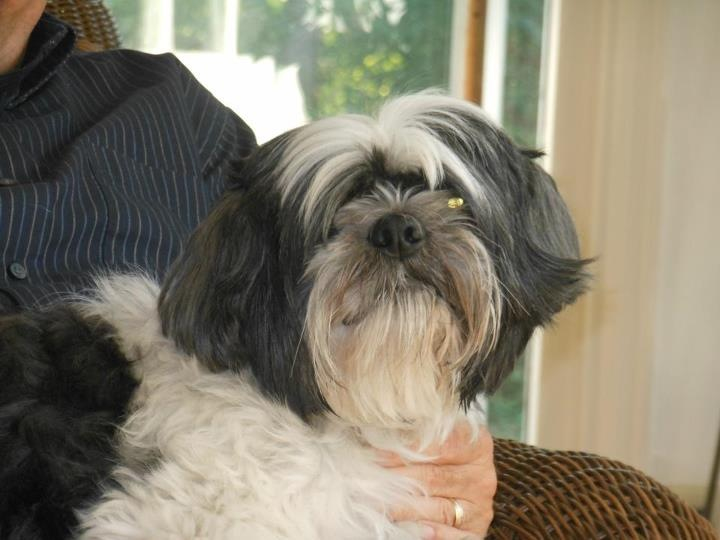
        --Harley, a Lhasa apso

Under the dream eyelids where you live now
I see you beneath birches standing watch
Good traveler with your plumed tail
Head high, your Tibetan smile
(That way you had of hinting
Next joy and next)
I promise we’re still in love
Here between waves
In the stones of the field
O still in love with you
So not forgetting
Your unbounded prance
Which was silly
In the way of those
Who truly live

How to Live, What to Do/ Notebook Entries

I can’t tell you how to live or what to do but literary history is jammed with this expectation, indeed its often the subject of great novels and poems. Who after all is Dorothea in “Middlemarch” but a barometer of sorts—a soul in suspension whose works and days are a struggle for Epicurean good?

Me? I’m a weak fellow. I have for many years tried to be decent. This has meant not worshipping easy satisfactions but learning to use life with an eye toward assisting others. And yes I can’t tell you how it’s going. I don’t have enough vanity to pretend I’m anything much. Still I’d like to be a barometer of sorts like Dorothea.

As the Swedish poet Gunnar Ekelof wrote: “you see your life for what it ought to be,/and ought to have been.”

**

The prose above is vatic and bordering on sanctimony. Here is where I need to pull a handkerchief from my pocket—one of those Harpo Marx hankies that keeps on coming.

**

In the Way of Poets I Was Sad All Day

For each person is a world
Peopled by blind creatures in revolt
As Ekelof said—though
I know a horse without eyes
Who’s gentle and who
I’m certain has a thousand souls.
Of sadness I know so little
Though I just read about
A scientist who makes music
From the strands
Of spider webs
And cold voices
Rise and fall there
And tonight in my absentmindedness
I listen to the wind
Which is a way
Of sensing things
I’ll never hold—
That audible cemetery.
Whenever I say peace I mean something different.

**

When I was young I thought poetry would fix everything. I was a real fool. But I had a saving grace or two. I didn’t think my wounds were significant. I wouldn’t bend your ear about them.
Of sadness and goodness I know so little. But I know this much. I know.