It’s not likely
Aunt History will get her say—
Her bumbling husband
Owns the manor
Just like pere Karamazov
And just like Karamazov
He’s never at home
Which gives her time to think
Lenin’s wife Nadezhda Krupskaya
Was poisoned by Stalin
“Never eat the cake” she whispers
To her cat
In general
Women allied to history
Watch cats
As they wash their paws
Uncle History loves Hans Castorp
Uncle History loves Hans Castorp
The way JFK loved Margaret Macomber
An unlikely comparison—
Hans, a gentle patient
Margaret, a saucy bitch
Fictional eros
Is not refined
Enter Bacchus
One can lie quietly in the reeds
Or screw everything that moves
Uncle believes in lying low
He explores the ceiling of his skull
He likes how decency
Accompanies certain kinds of death
Kennedy knew he’d die young
Its not refined
Slow or fast
Characters die
Big Men Be Victims…
I’ve never been good at organizing. I could screw up a “one car funeral” as my maternal grandmother liked to say. She never said this of me. I was too young. One supposes childhood gives one an inoculation against incompetence. Which gets me to my question: at what age does the incapacity vaccine wear off? The poet Robert Bly argued American adults have the emotional maturity of eleven year olds. He further argued that television and all pop culture is designed to enforce this. If men, and yes, women are eleven forever than the culture has done its job. I find I can’t be persuaded to abandon this view.
Barack Obama was in fact an adult. He was a neighborhood organizer before turning to politics. I think he was the last fully fledged grownup to occupy the White House. Biden was old but his lack of personal irony made him more of a boy than we generally admit. We have had very few adults in the presidency. You can count them on one hand. Eisenhower, Truman, FDR, Lincoln and Washington—the rest have been boy-men despite their accomplishments. Andrew Jackson? Child. Teddy Roosevelt? Child. No one knows what Calvin Coolidge was. Jefferson, for all his intelligence, was peevish.
This is why as democracies get tired the people want a Big Child to lead them. All tyrants are eleven year olds. You know who I’m talking about. Here are some characteristics of fifth graders: Very sensitive to praise and recognition; feelings are easily hurt; Because friends are very important, can be conflicts between adults’ rules and friends’ rules; Caught between being a child and being an adult; Loud behavior may hide their lack of self confidence; Are moody, restless; often feel self-conscious and alienated; lack self esteem; Challenge authority figures; test limits of acceptance…(see: https://www.seedlingmentors.org/developmental-characteristics-of-eleven-to-thirteen-years-old-grades-6-8/)
Bly puts it this way: “The inner boy in a messed-up family may keep on being shamed, invaded, disappointed, and paralyzed for years and years. "I am a victim," he says, over and over; and he is. But that very identification with victimhood keeps the soul house open and available for still more invasions. Most American men today do not have enough awakened or living warriors inside to defend their soul houses. And most people, men or women, do not know what genuine outward or inward warriors would look like, or feel like.”
― Robert Bly, Iron John: A Book About Men
When I see Putin or Trump I see baby men with toy soldiers. And yes, they feel like victims…
Yeats and Ruth Benedict

“Experience, contrary to common belief, is mostly imagination.”
—Ruth Benedict
You can cross the snowy fields and see castles and diamonds because imagination is there. In Scandinavia they call it troll power. You know the world as trolls do. This is why children can’t answer the question “what did you do today?” And its why poets can’t reply honestly when asked “where did you get that idea?”
When imagination rules experience we’re at a loss for words, at least at first. Later we grow up—the editor inside us who’s an adult tells us experience is not of the imagination at all. In general this is what MFA programs do. The study of creative writing is good for the delete button. When Yeats writes of faeries he’s telling us to resist this. In his 1901 essay “Magic” he says:
“I believe in the practice and philosophy of what we have agreed to call magic, in what I must call the evocation of spirits, though I do not know what they are, in the power of creating magical illusions, in the visions of truth in the depths of the mind when the eyes are closed; and I believe in three doctrines, which have, as I think, been handed down from early times, and been the foundations of nearly all magical practices. These doctrines are —
That the borders of our minds are ever shifting, and that many minds can flow into one another, as it were, and create or reveal a single mind, a single energy.
That the borders of our memories are as shifting, and that our memories are a part of one great memory, the memory of Nature herself.
That this great mind and great memory can be evoked by symbols.”
Yeats had a different view of symbols than the Constructivists or Surrealists. He took them quite literally. The poet Kathleen Raine wrote: “For Yeats magic was not so much a kind of poetry as poetry a kind of magic, and the object of both alike was evocation of energies and knowledge from beyond normal consciousness.”
“A kind of magic” begs the question “what kind of magic?” Only Yeats could answer this and he spent his life working to do so. But at its core he believed the magic resided outside the mind. The poet’s job was to translate nascent signals of mystical experience into ordinary language. He loved Newton’s alchemy; Hermes Trismegistus; most of all he loved the story tellers in the Irish countryside—that place and culture vanishing before his eyes. What kind of magic? Preservational. Yes belief is mostly imagination. And the evocation of spirits though we can’t say who they are. This shouldn’t stop poets from trying.
Picking Up Straw
Picking Up Straw
He thought he’d catch a nap
But in America
it was
A bad time
So he gathered straw
For sleeplessness
He made himself
A poet nest
While violence
Went on and on
Standing for Something
Standing for Something
I was in a railway station
And found I wanted to become
Something else
A mythological bush
Or tree perhaps
There in the Milanese crowd
Clutching my slippery suitcase
A man among thousands
One with an ache at the base of his skull
I saw I needed to become Daphne
Ovidian Daphne—formerly
A thing of flesh
And then a flowering thing
“Bring on the metamorphosis,” I thought
“Gods, help me for once!”
An old woman saw I was talking to myself
And she gave me the stink eye
I smiled as if she was a beloved relative
They hate that, the stink eye people
She scurried off bobbing her head like a magpie
“Oh bring on the disambiguation! Come on, Apollo!”
Standing in that middling
And aggressive throng
I knew it would be better
To be a laurel tree:
A laurel with a soul inside it
“Let us,” I said, “become vaguely Rabbincal
About the matter rather than Greco-Roman.”
“My small metempsychosis
My wee soul wandering
Should be reversible like a good garment.”
The Rabbins called this “ibbur”—
The belief that a soul can occupy a body
Temporarily, without passing through life and death
“Alright,” I said. “Right here in this train station
I am a laurel with a soul inside it.”
And though no one noticed
I felt better. Much better
Children Weeping in the Night
In my second memoir “Eavesdropping” (which is really a linked collection of essays) I wrote the following passage:
When the doctor appeared he caught me by surprise. His shoes made no sound at all. He pulled back my sheets without warning and stood and looked down on me in silence.
He addressed himself to people I couldn’t see as I lay in the fetal position and held my breath. This was my first experience of being described for others. The doctor referred to me as “this boy” or “this particular case” and the people behind him took notes. I could hear the pencils moving over paper.
When he was through the doctor departed without a word and his retinue followed in silent obedience. I could hear their voices murmuring in the corridor as they walked to another room.
I remember one other sound from the hospital: children weeping in the night.
If we were to name our age I’d call this the era of “Children Weeping in the Night.” In my case I was just a little boy who’d had eye surgery and had become a specimen in a hospital ward. But we’re now facing a global catastrophe of children starving, children with HIV, children whose lives have been literally torn apart by unspeakable violence, much of it state sanctioned. In the United States where medical insurance and social services have been largely taken away one can hear weeping and weeping.
If only tears were percussive. If only the tears of children and their families could be heard beyond Gaza or the Sudan; beyond Ukraine; beyond inner city Cleveland or the Caribbean. What are tears? In the United States we no longer ask. We don’t have to. We simply pass bills that ensure that hospitals will close down. No hospital, no tears. Let them weep in the back alleys and laundromats. Let them weep where the wealthy don’t have to hear them. And while the weeping grows and grows lets build a golden ballroom.
Uncle History has always loved Kurt Schwitters…
Uncle History has always loved Kurt Schwitters
Who was known as “Stinky” by his friends
For he gathered refuse from the gutter
Roquefort wrappers and such
And from these he made collages
Mandalas of aleatoric beauty
What should History love more?
Even in tidy Vienna
You find false teeth
Lodged at storm drains
Human beings and angels
Throw things away
Which gives Uncle
What is commonly known as
“The giggles…”
When Uncle History employs a shovel…
When Uncle History employs a shovel
There’s a shovel inside
He knows its there
But keeps digging
Earth piles up around him
Alas poor Yorick
He thinks, despite the evidence
That he’s burying men
But its the inner shovel
Does the work—
Spading up ghosts of conscience
People get sick
They get well
They require help
They don’t require help
But you’ll never know
If your shovel is just a shovel
From the hardware store
Uncle History Says…
Uncle History says:
Let’s all run out and buy cheap TVs
So we can watch the world end
They’re going to cancel your favorite show
The one about lakes and dogs
Look at the clarity of the picture
Look at that picture
You better hurry
The store is closing
Pay no attention to the elderly
Who’ve fallen in the parking lot
Ignore the children crying in shopping carts
The cheap tv sale won’t last long
And just think—
Even it you don’t get one
You were in the store
The bloody dark monolith
Of end times
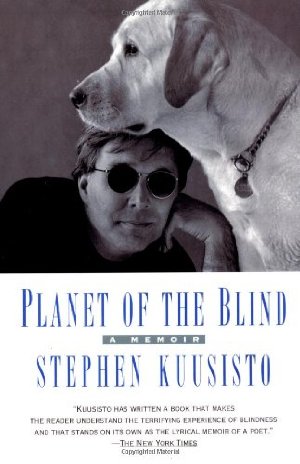
 Planet of the Blind