Goodbye, Goodbye


My friend Andrea Scarpino writes below of the art of father-remembrance, a matter for which we have no true word in English and so I must hyphenate two nouns. The clock goes on with its minutes and small steeping. Tea resolves in the cup. Yet there remain days when, long after one’s father has died, you hear again that singular voice. Listen: your father who you miss laughs and unselfconsciously shares a ribald story or he tells you again about his grandfather who wrote graffiti, not on buildings but in library books. The clock goes on with its tiny minutes. The books are ineffectual. Tea resolves in the cup but I tell you the tea is very sad.

S.K.

Remembering my Father

Los Angeles

by Andrea Scarpino


My father was a child of Italian immigrants, a child of the Great Depression. He first started working when he was nine years old, rolling tobacco into cigars. On payday, he would share some of his earnings with his cousins, buying them (and himself) ice cream sodas. He loved sweets. For much of his life, he was a big man, someone who loved to eat and share food with friends. I remember him making me toast in the morning when I visited him as a child, sending me gingerbread houses whose roofs opened up to a treasure trove of cookies and candies, sending me boxes of chocolate. When I was in college, he packed me special bags of cookies and fruit he bought during his weekly shopping trip. After we had dinner each Saturday night, I returned to my own apartment with a shopping bag full of grapes, anisette cookies, carrot sticks.

He started giving me espresso when I was still a toddler. I remember him feeding me teaspoons from his cup, then laughing at the bitter faces I would make. My father loved to laugh, to exaggerate a good story for effect, to play jokes on friends. He loved to make up stories for me, about little foxes living at the end of his street, giant six foot tall rabbits, the old neighbor lady he insisted lived two doors down who would pierce my ear with a long needle for a dollar. About piranhas living in any body of water in which I wanted to swim.

And yes, he could be a grouch. He was easy to anger, and he let you know when you had made him angry. He held a grudge, he believed the worst in innocent mistakes and accidents, he could exaggerate wrongs committed against him until I wasn’t sure what to believe. But he was also brilliant, always reading, writing grants, fighting for projects he believed in. He worked harder than anyone else I’ve ever met. He knew how to get a job done, to schmooze important people, to turn up at the right time looking the part. He could be hard to live with. He made me cry. And I have missed him every day since he died two years ago.

I’ve read a lot about death and grieving since my father died, and I know some people believe in stages of grief, that after a loved one has died, we should work towards acceptance. I don’t agree. I know that my father is dead, that he isn’t coming back. But I don’t think I’ll ever accept that fact, or accept death as just another part of nature, another part of the earthly condition. Again, I know it is. I know there’s nothing any of us can do to beat death. But acceptance doesn’t seem to be the right word when faced with death or with losing a father. Sadness seems right. And anger. And holes of loss that widen and contract as the day, the moment, the second permits. Remembering seems right. Laughing and loving, even so. Checking in with the dead, even though I don’t believe in an afterlife. Checking in to say hello. I miss you. Two years without you seem like no time at all. Seem like forever.


Andrea Scarpino is the west coast Bureau Chief of POTB.

You can visit her at: www.andreascarpino.com

Higher Education's Studied Indifference to People with Disabilities Reflects the "Rehab Model" Ad Nauseum


There’s a great article over at Getting Hired dot Com about the lawsuit that’s been filed against Arizona State University by several blindness advocacy groups. The issue has to to with ASU’s decision to provide its students with the Kindle Reader as a means of accessing textbooks–and yes, the Kindle is still inaccessible to blind people. I’ll leave aside for the time being the relative technical issues involved in making the Kindle accessible for the talking points are tedious. Trust me, the Kindle can be made to talk without difficulty save for the fact that it needs a more expensive “out of the box” operating system.

ASU adopted the Kindle because it seemed easy. It seemed like a good thing. My general point (such as it is) is that higher education administrators tend to imagine that “someone else” will “take care” of “those people” who have disabilities. American higher education still imagines that the Victorian approach to disability is acceptable–that the disabled are taken care of by people who will read to them in the dark or laboriously turn their books into tape recordings or Braille.

This “rehab” model of Disability is of course the very thing that disability studies has dissected and about which we know a good deal. We know for instance that college administrators who imagine that accessibility is merely an inconvenience and that they can pass along the issue to others are ignoring the ADA and many state laws. But they do so with the built in assurance that the rehab model is acceptable. Someone else will retrofit inaccessible learning environments or physical facilities and assure accessibility for the blind or the wheelchair users or the deaf or what have you. Those “rehab people” will take care of that.

Here at my own university there’s a Victorian rehab assumption in place wherein the administration routinely fails to make restrooms accessible for people with disabilities and they claim any variety of things depending on who you talk to. One fellow tells me that the ADA doesn’t apply to the University of Iowa. Another tells me that they don’t have any money. A third tells me that the university’s philosophy is that “we’ve let you in, what more do you want?” Set against this is the old fashioned rehab model–the administrators I’ve talked to at the U of Iowa believe that disability accommodations are someone else’s issue. So of course nothing gets done. How embarrassing it is that the University of Iowa, the leading public institution in the state that is proudly represented by Senator Tom Harkin, co-author of the Americans with Disabilities Act is indifferent to making its major academic buildings accessible.

The lawsuit against Arizona State reflects the indifference of ASU’s administrators to the contemporary reality that students and staff with disabilities are no longer secondary citizens who can be told to “wait” for access. And yet the indifference of the ASU administrators is widely reflected across the U.S.. I see the same forces at work in my own back yard.


S.K. 

Blind cycling champion to lead UI's Project 3000 RAGBRAI team

University of Iowa News Release

July 17, 2009

Blind cycling champion to lead UI's Project 3000 RAGBRAI team
071709highrezbike
A team of a dozen cyclists — including a blind U.S. Paralympics track
cycling national champion — will pedal across Iowa next week to raise
awareness of and funds for Project 3000, a University of Iowa-based
effort seeking a cure for a rare childhood blinding eye disease.

Team
Project 3000 will ride 442 miles, from Council Bluffs to Burlington, as
part of the Register's Annual Great Bike Ride Across Iowa (RAGBRAI).
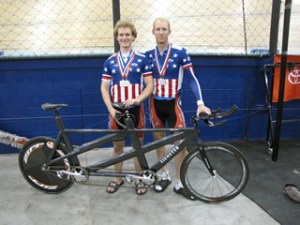
The team's inspirational leader is Clark Rachfal, a U.S. national
medalist in track cycling who has been losing his sight since childhood
and who has Leber congenital amaurosis (LCA), one of the blinding eye
diseases that Project 3000 seeks to cure. Rachfal, whose competitive
cycling activities have been supported by the Verizon Foundation and by
generous colleagues at Verizon, rides a tandem bicycle with a sighted
partner.

The mission of Project 3000 at the UI is to find and
offer genetic testing to the estimated 3,000 Americans with Leber
congenital amaurosis, which causes severe vision loss or blindness and
typically strikes during early childhood.

Genetic testing helps
confirm the diagnosis, discover the genes responsible and lead to
treatments and a cure. UI ophthalmology researchers are committed to
this approach to finding the causes, cures and eventual prevention of
LCA and — through what they learn during Project 3000 — other
blinding eye diseases. Key partners in Project 3000 include Chicago
Cubs star Derrek Lee and Boston Celtics CEO and co-owner Wyc Grousbeck,
both of whom share a desire to find treatments and a cure for LCA.

The
idea to form a RAGBRAI team to support Project 3000 originated with
Paul Rosenthal, a Washington, D.C., attorney who is chair and a
founding member of an advisory board to the UI Carver Family Center for
Macular Degeneration, of which Project 3000 is a part. The center is a
unit of the Department of Ophthalmology and Visual Sciences in the UI
Roy J. and Lucille A. Carver College of Medicine.

"I have had the
privilege over the years of dealing professionally with numerous Iowa
businesses and government officials, and as a result I have developed a
great respect for this wonderful state," said Rosenthal, who manages
the Washington, D.C., office of the law firm Kelley Drye and Warren.
"One of Iowa's, and indeed the nation's, great treasures is the Carver
Family Center for Macular Degeneration at the University of Iowa.
Because I have seen first-hand the enormous talent and dedication of
the center's scientists and staff to their mission to find the causes,
treatments, cures and preventions for inherited eye diseases, it is
only natural for me to want to express my appreciation and gratitude by
riding across the state on RAGBRAI."

As of July 17, Team Project
3000 had raised $35,000 in gifts for the LCA research and treatment
effort. Each team member set up a personal online giving page to
collect gifts from family, friends and colleagues via the University of
Iowa Foundation's Web site, http://www.givetoiowa.org.

Overall,
more than $1.5 million in gifts has been raised through the UI
Foundation for Project 3000 since the project's inception in 2006.

"We
are closing in on effective treatments for LCA, and the support created
through this RAGBRAI cycling team will bring us even closer," said
Edwin Stone, M.D., Ph.D., director of the UI Carver Family Center for
Macular Degeneration and a Howard Hughes Medical Institute
investigator. "Paul Rosenthal's efforts to bring our team together, and
Clark Rachfal's involvement, are both greatly appreciated."

For more information on the Team Project 3000 effort, or to make a gift, visit http://www.uifoundation.org/project3000/. To learn more about Project 3000, visit http://www.project3000.org. Those interested may also follow the team's progress on Twitter at Twitter@Project3000.

The
UI acknowledges the UI Foundation as the preferred channel for private
contributions that benefit all areas of the university.  For more
information about the UI Foundation, visit its web
http://www.project3000.org.

STORY SOURCE: UI Foundation, P.O. Box 4550, Iowa City, Iowa 52244-4550

CONTACTS:
Mitch Beckman, UI Foundation, 319-467-3402, mitch-beckman@uiowa.edu; or
Joseph Schmidt, UI Department of Ophthalmology and Visual Sciences at
UI Hospitals and Clinics, 319-384-8529, joe-schmidt@uiowa.edu

PHOTOS:  A high-resolution of Clark Rachfal and his tandem bike partner, Dave Swanson, is available at:
http://www.uifoundation.org/news/2009/images/jul-ragbrai-hires.jpg

A web-quality image also is available:
http://www.uifoundation.org/news/2009/images/jul-ragbrai.jpg

PHOTO
CUTLINE: U.S. Paralympic national track cycling champion Clark Rachfal
(left), who is blind, and riding partner Dave Swanson, will ride across
Iowa July 19-25 as part of Team Project 3000, which is raising
awareness and funds for a University of Iowa effort to cure Leber
congenital amaurosis, an inherited blinding eye disease.
Veterans Newsflash

We received the following summary from the VA’s Early Bird News Wire:

From today’s VA Early Bird News Summary

Soldier Suicides Down But Many Vets Diagnosed With Mental Health Disorders.   The AP (7/17, Jelinek) reports, “Suicides reported among” US soldiers “have tapered off from extreme highs of early this year amid intense Army efforts to stem the deaths, but officials are not yet ready to say they have turned a corner on the problem.” On Thursday, “Army leadership said…they hope a newly launched mental health study will help identify what is causing the self-inflicted deaths and what programs are best for preventing them. Separately Thursday, other researchers reported that 37 percent of Iraq and Afghanistan veterans seeking care at Veterans Affairs clinics for the first time are being diagnosed with mental health disorders.” That figure is “higher than some other estimates of the conflicts’ toll, and researchers at the San Francisco VA Medical Center said that may be because people still in the military are more reluctant to seek care.”
      The New York Times (7/17, Dao, A10, 1.06M) says the VA study “found that more than one-third of Iraq and Afghanistan war veterans who enrolled in the veterans health system after 2001 received a diagnosis of a mental health problem, most often post-traumatic stress disorder or depression.” The study, which “also found that the number of veterans found to have mental health problems rose steadily the longer they were out” of the service, “joins a growing body of research showing that the prolonged conflicts,

where many troops experience long and repeat deployments, are taking an accumulating psychological toll.”
Bloomberg News (7/17, Olmos) reports, “More than 1.6 million” US soldiers “have served since the war in Afghanistan began in 2001, many of whom have been exposed to prolonged combat and multiple tours of duty, according to the study. In an earlier, smaller study,” VA “researchers found that 25 percent” of US “veterans who sought treatment from 2001 to 2005 suffered from mental health disorders. ‘It’s fair to say that there is a striking rise in numbers’ between the earlier study and the new data published” this week, “said Karen Seal, the principal author” of the later study, which “recommended screening and early intervention programs that would target mental health problems of specific groups of soldiers, such as women and younger men.”
HealthDay (7/17, Reinberg) reports, “More than 40 percent” of the US “soldiers from the Iraq and Afghanistan wars seen at VA hospitals suffer from mental health disorders or psychosocial behavioral problems, a new study shows. Curiously, the researchers” from the San Francisco VAMC “found that most mental health diagnoses were not made in the first year that a veteran entered the VA health-care system, but several years after. This finding supports the recent move to extend VA benefits to five years of free” healthcare, “which allows VA doctors the time to detect and treat more mental illness in returning combat veterans, the researchers noted.” Their “report is published in the July 16 online edition of the American Journal of Public Health.”
      The Newark (NJ) Star-Ledger (7/17, Dinges), which also notes the study, reports that almost “22 percent of the soldiers studied were suffering from post-traumatic stress disorder, or PTSD, researchers said. Another 17 percent were diagnosed with depression, 7 percent had alcohol problems and 3 percent had drug problems.” Veterans advocates “said the new study proves the importance of screening soldiers for mental health problems after they return home.” The Los Angeles Times‘ (7/16, Chong) “Booster Shots” blog also noted this week’s VA study, as did numerous local TV reports in various parts of the country, including WNEP-TV Wilkes-Barre, PA (7/16, 5:24 p.m. ET) and KERO-TV Bakersfield, CA (7/16, 5:23 p.m. PT).
Vets Suffering From PTSD Said To “Need Help In All Areas.” The Washington (DC) Examiner (7/16, Bright) interviewed Kathyrn Mustard, a licensed clinical social worker with the Veterans Affairs Medical Center in Salem, Virginia. Mustard “works in the Inpatient Psychiatric Unit,” where “she helps treat several mental illness forms,” including PTSD, a condition that many “new veterans returning from the Middle East are suffering from.” Mustard told the Examiner that such veterans “need help in all areas,” and it is “hard to gauge the level of ‘success'” in treating them “because I see the most acute patients. However I think the long term counseling tends to deal the best with symptoms from what I’ve seen.”
      The WSPA-TV Greenville, SC (7/16, Coursey) website, meanwhile, said the family of 23-year-old Iraq veteran John David Chapman, who recently committed suicide, “would like to see more programs to help our veterans and for families to recognize the signs of depression.” WSPA added, “If you need help, there are resources available. The Department of Veterans Affairs Vet Center Program operates a system of counseling centers for veterans who have served in combat,” and there is one in Greenville. Just call 864-271-2711 for help.”

Nira's Big Day in Chicago: A Guide Dog's Story

The photo below was taken by my good friend Lorraine Whittington who was Johnny on the Spot when “Guiding Eyes Nira” caught sight of her reflection in “The Bean” which, in case you don’t know is an enormous polished aluminum sculpture in downtown Chicago, Illinois. In the photo you can see Nira, a yellow Labrador retriever catching her own reflection on the curvilinear surface of the bean, and you can see that she’s smiling as if to say: “Who’s that marvelous dog who looks just like me?” Its been said by thousands of writers in thousands of ways that we travel to find ourselves. And why shouldn’t this also be true for a loyal and lovely guide dog? NIra’s trip to Chicago also included a visit to Wrigley Field where she managed to disguise the fact that she’s a Red Sox fan. But she enjoyed the ambient domains surrounding the old ball park. But nothing compared with “the bean” in her estimation.   

The Bean

When I Was Hungry You Fed Me…When There Was a Hurricane I Was Out of Luck


Dave Reynolds over at The Inclusion Daily Express reports on recent findings that people with psychiatric disabilities were discriminated against during the evacuation efforts associated with hurricanes Katrina and Rita. Of particular note is the finding that the mentally ill were simply left out of the planning. Stigma works that way: it starts on the streets and then it prefigures the public’s mind. Urban planners are still the children of the ancient Greeks and Romans–stigma relieves us of having to think about people with psychiatric disabilities or the elderly. The greatest irony in human history is that the man who spoke most ardently against stigmatization was in turn stigmatized on a cross. Here’s an excerpt from Dave’s excellent post:


Report: People With Psychiatric Disabilities Faced Illegal Discrimination After Hurricanes
By Dave Reynolds, Inclusion Daily Express
July 14, 2006
WASHINGTON, DC–People with mental illnesses faced illegal and even deadly discrimination during evacuation, rescue, and relief phases after hurricanes Katrina and Rita hit Gulf Coast states last summer, the National Council on Disability said Friday.

In its report, entitled “The Needs of People with Psychiatric Disabilities During and After Hurricanes Katrina and Rita: Position Paper and Recommendations”, the federal agency concluded that many people with mental illnesses were mistreated, inappropriately institutionalized and incarcerated, or died because the evacuations were mismanaged.

The agency blamed the fact that people with psychiatric disabilities were not included in disaster planning or the relief and recovery efforts, along with the fact that no individual or office was responsible or had the authority to coordinate disaster management efforts for people with mental illnesses. It also said that disaster plans were “shortsighted” and that relief and recovery services were stopped far too early.

The report outlined a number of violations of the rights of evacuees with psychiatric disabilities. Many were banished from shelters and forced to stay outside. Some were sent to nursing homes or state-run psychiatric institutions, “not because they required that level of care, but because there was nowhere else to go”, or because they needed refills of medications that the shelters did not have. In Texas, some who had previously lived in the community were “evacuated” to state hospitals where they remained for many months after the storms were over.

While “special needs” shelters were made available, those tended to cater to the needs of people with physical disabilities and critical illnesses, not people with mental disabilities, it said.

NCD recommended that in the future people with psychiatric disabilities be involved in all phases of disaster planning; that there be a single office or official responsible and accountable for coordinating efforts to help people with disabilities during recovery and relief stages; that the transfer of people from group homes and psychiatric facilities be tracked and their family members be contacted; and that relief efforts continue for at least two years after the catastrophic event is over.

“In the months since the hurricanes devastated the Gulf Coast, media coverage of the hurricane survivors has waned,” wrote NCD chairperson Lex Frieden. “However, for hurricane survivors with psychiatric disabilities, the hurricanes’ destruction resulted in ‘trauma that didn’t last 24 hours, then go away . . . It goes on and on.'”

Related reports:
“The Needs Of People With Psychiatric Disabilities During And After Hurricanes Katrina And Rita: Position Paper And Recommendations” (National Council on Disability)

http://www.ncd.gov/newsroom/publications/2006/peopleneeds.htm
“Saving Lives: Including People with Disabilities In Emergency Planning” April 15, 2005 (National Council on Disability)
http://www.ncd.gov/newsroom/publications/2005/saving_lives.htm

Writing with a Dog Under my Feet


“The sub-cartesian people will drive you nuts

But hooray for those who love their mutts…”

–Ogg of Ancient Schenectady


In the initial position I should admit to being depressed. I have always been depressed. I take medication for it. I work assiduously to overcome the declivities and swells of self-contempt and I ignore the little brother named exhaustion. Some mornings I climb a ladder and climb back down with nothing to show. On occasion I can scarcely leave my house.

The dog under my feet knows all this. She knows my dreams are tuned like the caffeinated mind of Stravinsky. She sees that I am dropping spoons for the music. She gives me good news: no news; nonsense; deferral; not giving a shit…

The best news is the dog’s entire disposition. She accepts you. Doesn’t care that you are merely a botched hominid.

Outside the window in a corn field the gold finches fly up like Orphic birds on Roman tombs. Agricultural dust settles on my neighbor’s glass topped garden tables and wicker chairs.  

I am lonely for my dead mother and father. I may have dreamt about them last night but I can’t remember. I hear my mother telling an irreverent story–she cursed like a longshoreman and didn’t give a rat’s ass for propriety. God how she hated poseurs. She kept a “shit list” and she never forgot who was on it. She was, of course, wildly depressed.

My dog is under my feet. I’m not wearing shoes. I rub her belly and shoulders and her long back. She snores occasionally. The warmth of her body is quick to my feet. Dogs and botched hominids warm one another. Always have.

“Anyone can talk of dying,” I tell my dog. “It’s the measure of tongue and footfall, of boats in darkness.”

My feet and my friend are simply minding their own business.


S.K.