What Did I Know about Disabilities?


This is the question that St. Peter will ask me, though he might not be St. Peter–he might be a Norse God like Odin (who had one eye). The gate keeper to the after life might be nothing more than a child, one who has been granted immortality because she or he, back on earth, was killed by Teddy Roosevelt’s marines who as you may remember massacred whole families in the Philippines under the banner called “the white man’s burden”. One thing’s for sure: the gate keeper asks you what you knew. There’s no book of days. They don’t calculate your “sin to virtue” ratio. And in my case they will ask me about disabilities because not only did I have one but I fought for strangers who also had them–fought poorly, inelegantly, often in discouragement. Anyone who’s an advocate for people with disabilities knows this sense of being always in a long, roller coaster, topsy turvy, fight or flee struggle to express the rights of citizenship and inclusion. And my St. Peter who will be a little girl from the Philippines who was executed in the courtyard of a church will ask me what I knew. You see, getting into the afterlife is about thinking on your feet, just as it was down here.


So what I know about disabilities, rendered on the threshold, is that one must be able to think quickly and often when one’s own dignity or the dignity of others is at stake. “You can’t come in here with the dog,” said a door keeper at Barnes & Noble on 6th avenue in Manhattan. A lovely irony since I’d given a reading in that very store, a reading that had been filmed by NBC’s “Dateline”. “You can’t come in here.” And thinking on my feet I just went in. I let him scrabble after me like a drunken crab. I called loudly to get the manager. Shoppers gaped. It was suddenly nice and hot under the proscenium arch of that flagship bookstore. The manager of course agreed that I could be there but he was rude. I decided that his rudeness had nothing to do with me–that is, I saw that he was universally rude, that he probably had hammertoes or tight underwear. The point is, dear gate keeper, I saw that beyond my inclusion I didn’t need the approval of a suffering man. “That’s how it was down there,” I’ll say to the immortal girl or boy.


“They had poetry down there,” I’ll say. “They worked hard, those with consciences and hearts.” “We gave our lives to seeing what is far off.”


I know that we treat veterans with disabilities poorly or well, depending on where they get their medical care; that we treat the elderly with disabilities with care and concern or with disrespect depending on their wealth; that we treat children with disabilities with courtesy and with proper ambition depending on where they live. I know that there are innumerable colleges and universities in the United States that are failing to meet even the basic requirements for accessibility as outlined by the Americans with Disabilities Act. And so we are still seeing what is far off. We see that we are in a world of suffering. We do our best. We see disability as a central concern in the fight for universal human rights.


“Was that too much to ask?” I will ask.


S.K.
Minneapolis-St. Paul Here I Come


I am heading today to St. Catherine’s University in St. Paul Minnesota where I will be teaching creative writing over the course of this next week. According to my Blackberry “Weather Channel” application it will be sunny in the twin cities; the average “high” will be 70 degrees. There will be birds in the half green trees though my phone doesn’t say so. There will be people at St. Catherine’s who love poetry and literary writing though again my phone doesn’t say it. My phone doesn’t have a poetry “app” and it can’t locate imagination though its the thing you want if you’re looking for a nearby Irish pub. Meanwhile I am packing my spring apparel which looks like my winter apparel because I am a dull man when it comes to appearances. All my cinctured, ruby caftans are inside. On the inside I’m Coco Chanel meets Kandinsky. And this brings us back to creative writing. You see, my inner Coco Kandinsky is not a snob. S(h)e believes that everyone can write. S(h)e also believes that most people don’t have access to good ideas and/or scintillating examples of imaginative writing. S(h)e is not an aesthete though s(h)e could be.


The point is that one may write about anything. Poetry is always with us. It may be a homely thing that gives us the poem. The Swedish poet Lars Gustafsson once saw a house fly while he was riding on a night train. He writes:


Puzzled fly

shut in a night express


still trying to fly

and doing remarkably well


From the south end of the train it arrives at the north

already a far wiser fly


and the train roars all the faster into the night


**


Of course it isn’t enough to say one can find poetry in anything; it is better to say that all conditions, random, slippery, half-formed, minor–all these present the background of our lives. Chance things give us words and words ex nihilo give us clues and clues are lyrics. Does poetry make you better? Probably not. But it makes you a wiser fly on the night express.


S.K.

Scenes from a Writing Conference

Flock of Sheep

By Andrea Scarpino


Los Angeles


The shuttle from the airport filled with writers—What’s your next project? . . . . When I was doing my undergraduate at Stanford . . . . This is my fifth book . . . . Do you know who I’m on a panel with?. . . . I hand out mints, hope that calms the egos, trip. An hour later, hotel after hotel, writers climb over one another to exit the van. Denver air pours in the opened doors, crisp and with a hint of winter.

Book fair: knee high boots, funky tee shirts, suits, two men drinking bottles of beer, a woman with her resume. Here, she says, pushing it to me. I try not to fold it up until she walks away. Postcards, magnets, pens, free issues of literary journals, free chocolates, cheese plate, grapes. Do you write fiction? . . . . Do you like poetry?. . . . Are you interested in an MFA? . . . . The aisles are long and wide but packed. Fluorescent lights. Blue fabric booth dividers. Industrial carpet on the floor.

And in the conference sessions: discussion of craft, poetry readings, readings of fiction, memoir. Discussion of online reading series, research for creative writing degrees. Discussion of modern, contemporary. I study the tattoos of the people sitting around me: tree branches climbing a shoulder blade, stars up and down a calf, a fist in a woman sign, a face in a top hat.

Then Rita Dove. All men are beggars, white or black. And the thudding dirge of his heart. Her shoes are much too fashionable for a writer. Her hair is perfectly done. She is glamour, this poet I’ve long loved. Glamour and sass. When questioned about her subject matter, she fires back, It’s clear he hasn’t read very much of my book.

Hotel lobby cocktail hour. Clinking of ice in glasses, clinking of toasts. Clinking of jokes, pick-up lines. A giggle, a man pulling down the side of his pants to show a stickered tattoo, hurried descriptions of work-not-quite-finished, book tours, grumblings about agents, publishers, prizes almost-won, the selection process. Upstairs, the whirlpool—even as night falls, people in swimsuits sitting in the water, lounging on chairs all around. The whir of exercise equipment. Whir of chatter, gossip, talk.


Andrea Scarpino is the west coast Bureau Chief of POTB. You can visit her at:

www.andreascarpino.com

Talking Half Out Loud

My telephone rang this morning and I heard my aunt’s voice. She was calling to say that one of my dad’s oldest friends had passed away. My aunt was terribly sad. And I was terribly sad. My father died ten years ago. Together we miss him. And his friend’s death feels akin to the old sorrow—though it is a new sorrow. My aunt is a religious woman; I play at religion but have my nautilus chambers of nihilism. Whatever you believe, mortal life is oh so painful and April seems to always be a steep month. My father died on April 21, 2000. His best friend died yesterday. Forget T.S. Eliot. April is no crueler than any other month. But it stirs the heart afresh in these cold regions and tragedies may feel more tragic in such places. I know this much: my garden spade is more useful than prayer, or so it would seem. I think I shall go and plant some flowers even though I have a brown thumb. The salt reserve of my heart is turning over. My heart is very busy.

What should we plant first?


S.K. 

The Lyric Body


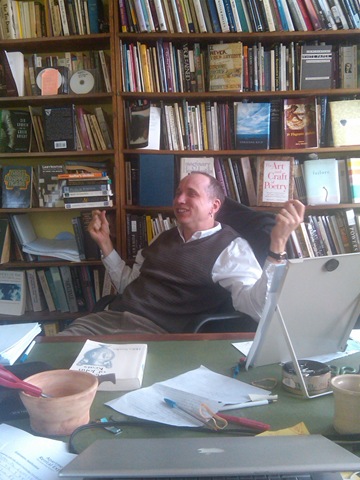
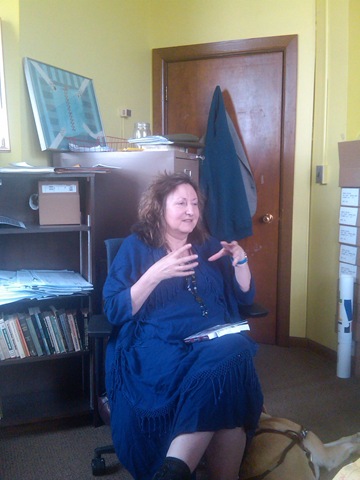
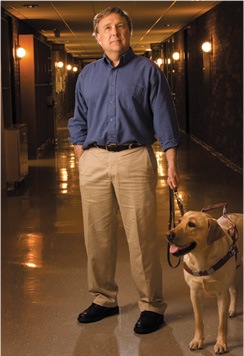
Ralph Savarese at Hobart and William Smith Colleges Susanne Antonetta at Hobart and William Smith Colleges Stephen Kuusisto and Nira   no_access_symbol Seneca Review

Hobart and William Smith Colleges


Since I’m a visually impaired person the images above are arranged without art. In general terms I think this is okay. My life as a writer has been informed by multiple rough hewn inelegancies–a word that Microsoft doesn’t want me to type. I am not cowed. My rough hewn stuff is around my neck and I wear it jauntily since that’s the way to wear it.    


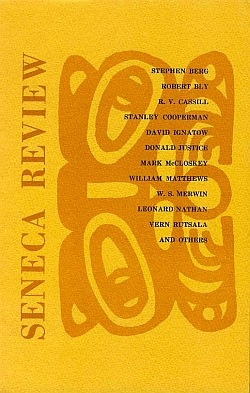
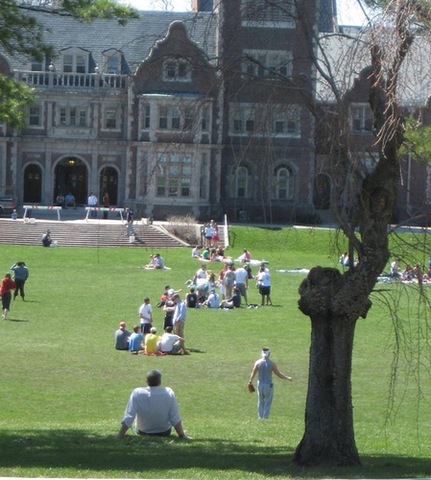
I am home in Iowa City after a trip that took me first to Meramec Community College in St. Louis  where I read poetry and nonfiction and taught a class of terrific students. Then I traveled to Hobart and William Smith Colleges in Geneva, NY for a festival on disabilities and the arts. HWS (as they like to call themselves) has long published Seneca Review a top tier literary journal that was founded some forty years ago by my dear friend Jim Crenner who is now an emeritus professor at the colleges. As the photo above suggests, Geneva, NY is a lovely place in spring. The campus at HWS is among the most beautiful in the nation. More lovely was the fact that we were there to honor April as disability awareness month and to talk about the latest issue of Seneca Review which is devoted to writing about disabilities and/or bodies of difference. I served as a guest editor for the magaizne along with Ralph Savarese (pictured above) and we’ve entitled the issue “The Lyric Body”. Also pictured above is the essayist, memoirist, and poet Susanne Antonetta who also goes by the name of Suzanne Paola. Susanne joined Ralph and yours truly on a panel discussing the power of disability and imagination to shape literary work that exemplifies rich and atypical inventiveness. We also taught a poetry writing class together.


This latest issue of Seneca Review contains extraordinary work from writers as diverse as Gregory Orr, Mark Doty, Adrienne Rich, Jim Ferris, Laurie Clements Lambeth, Rafael Campo, and many more. It’s also a feast for the eye as it contains brilliant artwork by artists with disabilities. Get yourself a copy!


We are off now to walk our beloved dog who has been in many airplanes and fair wondrously patient withal.


S.K.     

April is Child Abuse Awareness Month

By Laura Castle


Each April child abuse awareness activities are encouraged throughout the nation. The first child abuse awareness month was proclaimed in April 1983 by then President Ronald Reagan. Last year President Barack Obama continued this tradition stating that “Every American has a stake in the well-being of our nation’s children” as he proclaimed April 2009 as National Child Abuse Prevention Month.

Our nation’s statistics are revealing: there were 905,000 cases of reported child abuse in 2006. Of these, 794,000 were confirmed by Child Protective Services as being abused or neglected. In the United States children under six years of age are more likely to die from violence and neglect than from accident or illness. Although anything can trigger an attack on a child, the most common triggers are crying during toileting and feeding.

In Florida, last year (2009), 198 children lost their lives to abuse, a shocking increase in the number of deaths in one year. Across the country, the incidence of child abuse was up 20% last year, possibly due to the economic recession. 
Child abuse takes a terrible toll not only on individual lives, but on society as a whole as survivors who have not learned better behaviors fill our prisons. One out of three abused or neglected children will grow up to be an abusive parent. (I love to turn statistics around – two out of three of us will break the cycle of abuse through either non-parenthood or by learning good parenting skills. Hooray- there’s cause for hope!)

Many of us wear a blue ribbon throughout the month of April in honor of those who did not survive child abuse, a tribute begun by a Virginia grandmother in 1983, who tied a blue ribbon to the antenna of her car in honor of her grandson who died from abuse. By wearing a blue ribbon, we bring attention to the prevalence of violence against children and the harm it causes.

Let us all strive to educate the public about child abuse and encourage individuals and communities to work toward providing safe and healthy homes for children. My heartfelt thanks to all of you who took the time to read this!


Laura Castle is a survivor of childhood abuse. She lives in Florida and serves as an advocate for human rights.

On Death and Celebrating


By Andrea Scarpino


Los Angeles


This week, Zac defended his dissertation in Ohio, which means he can now officially call himself a Doctor of Philosophy. The afternoon before he defended, I went with his parents to euthanize their dying cat. And the day after he defended, his mother retired after 19 years at Ohio State.

Zac’s been working toward his Ph.D. for as long as I’ve known him, first getting his Master’s Degree, taking coursework, passing gate-keeping exams, spending the last three years hunkered down with writing and revision. Tuesday, after a two-hour defense, his committee chair shook his hand, congratulated him, signed paperwork, and that was that. No words of praise, no fireworks. Other people on campus went about their lives.

We had dinner with his committee, of course, and lots of drinks, but for a moment as big as passing the last big hurdle on the way to his career, the marking seemed a little insufficient. And so, too, his parents’ cat’s death. Last weekend, her kidneys started to fail and she yowled whenever she was left alone for even a minute or two. But it was an easy, nondescript death. She lay on a warm blanket and the vet gave her one clear shot. Then her body let go. Other people in the vet’s waiting room took no notice of us.

And Karen’s retirement, too. She’s worked most of her life in some capacity, and now, she’s done. She doesn’t have to work again unless she wants to. Her office had a party with a cake and balloons, then we went out to dinner to eat. But how do you really celebrate such a significant thing?

It seems to me that big moments of passing, of celebration, are so important to us that no honoring really seems worthy, no celebration really captures all the work and life that has led to that point. Indeed, maybe if it were possible to capture a sufficient marking, that would indicate the moment wasn’t important enough. When my father died, I remember thinking the news should have taken notice, his funeral should have been packed with thousands of people, something huge and important should have marked his death. But even if the Earth had stopped rotating, I’m not sure that would have felt big or important enough for the loss I felt. This week’s colliding of two milestones and a death seemed apt, somehow, even so. Each event carried a loss of some sort, a change, a moving on to other things. I’m not sure we marked them well enough, sufficiently enough to do them justice, but I’m also not sure we could have, what we would have done differently. I am sure, though, that it was one helluva week.


Andrea Scarpino is the west coast Bureau Chief of POTB. You can visit her at:

www.andreascarpino.com

Spring and All

What do you do with an elephant that has three balls?

You walk him and pitch to the giraffe.


(old barroom joke)


Well it is baseball season again and tomorrow night the Boston Red Sox will take on the New York Yankees at Fenway Park and all the spitting, scratching, secret signs, and improbable feats of gravitational defiance will begin anew. This is a moment for what the poet called the wilful suspension of belief as every fan can believe for a day or two that his or her team will be remarkable. This belief is superimposed against the abstraction that is still the summer to come. The combination of these two fancies is the meaning of hope. I don’t care at all for the talking heads on the sports channels or the radio; don’t believe what I read in the papers about my team’s prospects–I am allowed a great fancy and I take it. Like the elephant in the joke above “I take it” and for a moment I am allowed to go to first base, cheered by nothing more than optimism.


S.K. 

Can You Tell Me What It Means?


Half the people I meet believe the world is ending. The others believe that it has already ended. Now I know and you know that the economy is bad; that superstition reigns worldwide (as it always has, eh?); and that there’s plenty of dire ecological news. But when Americans, glutted, nostalgic, drunk, or sufficiently ill informed to buy a simple toaster are collectively swooning into the apocalypse then one must ask, why are we fighting the fanatics elsewhere who believe the same things? Your average Christian slave to Revelations and the people who blow themselves up in the name of a favored room in the afterlife do not appear substantially different. And yes, of course I’m gilding the Lilly, stuffing the owl, splitting revenant hairs–but I can’t see the end times what with all the bodies blocking the view.

Now I know why people without means, hope, or food would be susceptible to fanaticism. But Americans who have a great nation, a superior ethos, a nonpareil representative government, and plenty of Cheez Wiz (sp?) have little to no reason to throw themselves on the mattress of rapturing. Can the sheer ennui of wealth create this? Were we wrong all these years to say that Rome fell apart owing to lead poisoning? Is it inevitable that societies crash when they are too successful? Maybe. But the end of the world is a bad bet. Wishes and facts are remarkably and respectively incoherent for all who can’t find satisfactions in being alive. 

Being alive of course is a kind of mania. There’s a 19th century picture of Caruso as the murderous clown Canio and though it was taken in an era of studiously posed images it conveys an inspired, stagey madness. You can see a mercurial glow in the man’s eyes; his left hand is upraised and his thumb and ring finger make a strange “v”. He wears the famous Pagliacci costume and oddly enough he appears for all the world like a doctor who has become insane as opposed to a clown.

The photo is the real Caruso.

We know this in much the way we understand truth or deceit while playing cards in a neighborhood cafe. We are people of moods, conceits, tempers, and out-and-out lunacies. Most of us accept our roles devotedly. As Jimi Hendrix said: “You have to go on and be crazy. Craziness is like heaven.”

Of course I don’t mean to romanticize (or downplay) mental illness: far too much literary and academic damage has been done in that arena. And no, this is not a memoir of overcoming depression, nor is it a history of artistic or psychiatric alchemy rehashing again the triumphs of Antonin Artaud or John Clare. It’s possible for men and women with true mental illnesses to find their generous souls in art and just now, in our time we’re learning a great deal about neurodiversity and the magnificence of intellectual disabilities like autism. But this is not a blog post made of the attenuated histories of illness or the compensations of same.

This post is more in the spirit of the rapper Eminem when he says: “The truth is you don’t know what is going to happen tomorrow. Life is a crazy ride, and nothing is guaranteed.”

Or, if you prefer, here’s the famous fast ball pitcher Nolan Ryan: “It helps if the hitter thinks you’re a little crazy.”

I remember my first inkling that an assumed and barmy spirit was a vehicle—really a “getaway car” like something the Chicago mob would have had.

I was on a playground in Durham, New Hampshire. The year was 1960 and I was five years old. I had thick glasses and I was smaller than my classmates. A big kid who I’ll call Rollie came up to me with a handful of dirt which he clearly meant for me to eat.

“You will eat this,” he said.

“It looks good,” I said. “Hey Rollie, have you ever eaten an acorn?”

Rollie held his dirt before him like a little pillow.

“An acorn?” he said.

“Yeah, they’re just like peanuts, really good, that’s why squirrels like them. You want one?”

“Sure,” he said. He held out his other hand and I dropped a neatly shelled acorn into his palm.

“Go on Rollie, its yummy!”

Rollie ate it. Then he turned red, and I mean red, not beet red or fire engine red—he was red as an unkind boy with his mouth swollen shut. Acorns are among the bitterest things on earth. And of course I only knew this because I’d tried one. I was a solitary kid. Spent a lot of time in the woods. Those were the days when a boy could still go to the woods.

Rollie was incapacitated. I don’t think he ever bothered me after that.

I still recall the thrill of my discovery. That a feeling, a simple reaction, a swing tricked out with language could render a nemesis harmless was rousing.

I didn’t do a little dance. Didn’t brag about the matter. But I was on the way.

A lyric life, I will imagine, is one wherein you can access feelings and then, by turn do something productive with them.

The simplest definition of a lyric poem is a poem that expresses the writer’s feelings.

Freud said: “Life as we find it is too hard for us; it entails too much pain, too many disappointments, impossible tasks. We cannot do without palliative remedies.”

One of those palliative remedies is lyric itself. One may think of this as causative intuition, a feeling that trips a switch and makes you sing when you should properly be weeping or running for your life. Again Freud: “Man should not strive to eliminate his complexes, but to get in accord with them; they are legitimately what directs his contact in the world.”

We are getting in accord. We are beside a country road picking edible flowers in the cool of the day. We do not pick edible flowers beside highways because there are pesticides in trafficked areas.

We remove the pistils and stamens before eating.

“Hey Rollie, wherever you are, have you ever eaten Milkweed?”

“Rollie, you can trust me this time. It tastes like green beans.”


Give up on the end times. Let your feelings produce something unforseeable.


S.K.