9-11: Without Words

By Angel Lemke


Geoff Nunberg, a linguist for NPR, noted on Fresh Air the other day that the decade since September 11, 2001 has produced virtually no shift in our everyday lexicon.  There are no September 11 words. 

There are, however, some September 11 phrases.  In his first editor’s column for the journal Narrative after the attacks, Jim Phelan pointed out the one that was, for reasons other than his, the most salient one for me in my own reflections on the day.  On September 11, 2001, “the world changed.” 

Says Phelan in his analysis of the implicit narrative in the phrase:

“[T]o claim that these events changed the entire world is to imply that their significance extends beyond these literal, horrific consequences to some larger, even more pervasive effect.

“That effect, I would suggest, is one about our narrative understanding of the world: “On September 11,2001,what happened at the World Trade Center, the Pentagon, and in the sky over Pennsylvania changed the existing narrative by which we  make sense of the world.” Before September 11, 2001, we had somewhere in our consciousnesses an implicit and relatively stable understanding about the past, present, and future of the world. On the morning of September 11, that understanding was destroyed. Since then we have been trying to replace it with another relatively stable understanding.”

I’ve written elsewhere of the profound feeling of alienation I had from (most of) those around me precisely because I did not feel that the world had changed, because I was grief-stricken to learn that others had not been living with the intense feeling of vulnerability that pervaded my daily life as a young, queer person, as a child who grew up surrounded by generational poverty, raised by people who were struggling with severe mental illness and untreated PTSD.  “You mean the rest of you didn’t know shit could blow up at any moment?”  For me, feeling safe in the world began with an understanding that shit will blow up at any moment, and the hope that we all shared that understanding, that we could, as Dean Spade says, “Be gentle with ourselves and each other,” while being “fierce as we fight oppression.” 

September 11—at first—made me realize that “we” did not share that understanding.  Nope, Jim Phelan, my understanding of the world was not “destroyed”; yours was.

Still, there were moments of hope for me, just after the attacks, like at the end of Phelan’s “world has changed” column, when he reflects on what it would mean to find that new stable understanding he seeks:

“[A]fter September 11,2001,’we’ have been facing a major shift in our previous understandings of past, present, and future, a shift whose outcome is currently far more contested than settled. But emphasizing the diversity of narrators and narratives explaining the world does call attention to the larger challenge of finding a new viable narrative: this narrative must acknowledge rather than erase the multiple explanations of our past, present, and future, and it must find a way to enable the inevitable competition among those explanations to be productive rather than destructive. Only then will the events of September 11 have produced the kind of change the world needs.”


But Nunberg’s piece did not discuss “the world changed.”  Instead, he focused on a different phrase to come out of the days following September 11, 2001; the ubiquitous and instantly mocked formulation, “If we don’t [blank], the terrorists win,” wherein the blank constituted some banal, usually consumerist activity.  He says that, despite our universal understanding of the phrase’s ridiculousness:


“Yet people kept using the phrase. It helped them or their customers square their consciences, as it became clear that in the period that followed this new Pearl Harbor, only a few people would be called on to do the serious sacrificing. For the rest of us, the actual hardship would chiefly extend to having to leave for the airport an hour earlier.”


Having grown up around so many forms of trauma, I know this formulation all too well:  Of course we all know something bad happened, but for chrissake don’t talk about it.  Perhaps that’s why the phrase “the world changed,” escaped Nunberg’s discussion.  We’re still trying to pretend it didn’t.


That’s the legacy of the first decade.  I avoided the memorializing this weekend as much as humanly possible; I did not want to mourn my distance from the “implicit and relatively stable understanding about the past, present, and future of the world” again.  Perhaps by the end of the second, we’ll have moved closer to “acknowledg[ing] rather than eras[ing] the multiple explanations of our past, present, and future.”  Putting words to the experience of trauma doesn’t happen overnight, but I think we can all agree that “Only then will the events of September 11 have produced the kind of change the world needs.”


Angel Lemke is a frequent contributor to POTB.
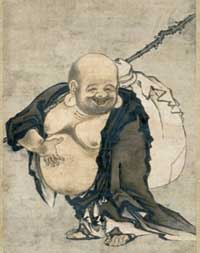
 

Zen Fool at Home

Zen Monk with Knap Sack


There's an interesting article at the NYTimes by James Gorman entitled: "Scientists Hint at Why Laughter Feels So Good" and it begins thusly:

Laughter is regularly promoted as a source of health and well being, but it has been hard to pin down exactly why laughing until it hurts feels so good.

The answer, reports Robin Dunbar, an evolutionary psychologist at Oxford, is not the intellectual pleasure of cerebral humor, but the physical act of laughing. The simple muscular exertions involved in producing the familiar ha, ha, ha, he said, trigger an increase in endorphins, the brain chemicals known for their feel-good effect."

This is why I regulalry laugh at nothing. Here comes a dust bunny! I'm brought to my knees! Here's the sound of water gurgling in the drain. I laugh til I can't stand it and have to put a bag filled with lilac petals and feathers over my head. This calms me just long enough to find the couch. 

But you see it has to be nothing. I don't find the comedians funny. They work too hard. I don't think cruelty is funny. 

Ah but here comes a piece of paper which flew off my desk because there was evaporation from the sea and the wind came next, all the way from Jutland and by God I can't stand it! I'm the happiest man alive! Just here. In an empty room. And the beuaty is, no one can steal it.


SK 


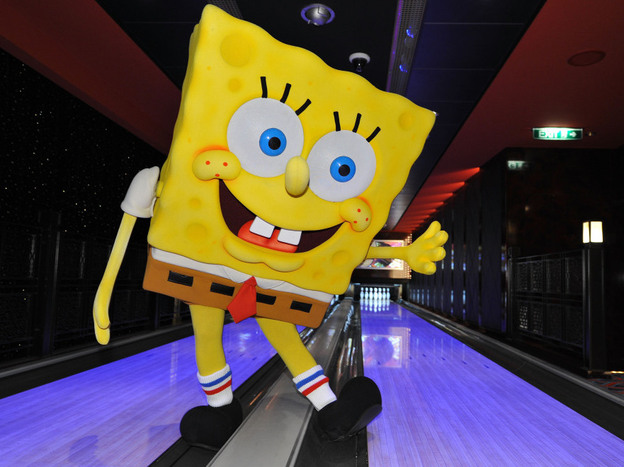
SpongeBob Too Fast For Young Minds

Spongebob1


From NPR: "Children who watched the fast-paced cartoon SpongeBob SquarePants did less well on tests of attention and memory, according to new research. Children who watched a slower PBS show, and children who colored, did better. Other studies have show long-term effects from fast-paced or violent shows."

See full story:

http://www.npr.org/blogs/health/2011/09/12/140401099/spongebob-may-be-too-speedy-for-preschool-brains?ft=1&f=1001


My own take? It's not SpongeBob's "speed" that makes him a deleterious influence on young minds, it is more a matter of narrative. Really. The poor sod is the victim of hopeless writing. SpongeBob is no Bugs Bunny. I knew Bugs Bunny. Bugs was a friend of mine, etc. etc.


One Year Later

Clock Face


Essay by Andrea Scarpino


“Do you know the next person who’s going to die?” Zoe asked. She was seven. We were sitting in a restaurant waiting for our dinner and she had been playing a game on my friend’s phone.


“Who?” I replied.


“Gracie.” Her big sister. Seventeen years old. She had been in and out of hospitals all summer with suicidal thoughts, cutting, alcohol abuse, drugs. I turned in my seat.


“Oh no, Zoe, Gracie’s going to a really good school now that will help her get better.” I tried for words a seven-year-old would understand—words that made more sense than residential treatment center, intense family-centered therapy, medication. I tried, “not a hospital.” I tried “she’ll be taking classes with other girls.”


Zoe shrugged, went back to playing her game.


Less than two months later, her mother called me on the phone. “Gracie’s been in an accident,” she said.


“Is she okay?”


“No. I don’t know.”


Days later, Gracie died.


I’m not a person prone to believe in things like prophecy, that Zoe knew something the rest of us didn’t. Gracie didn’t die of drug overdose or suicide. She was on a treatment center sponsored fieldtrip. The driver of the SUV in which she was a passenger lost control. The SUV rolled over twice. One girl was killed instantly, died while still buckled in her seat. Gracie was thrown through a window, suffered incredible brain damage. No one could have predicted this. Still, the fact remains: in Zoe’s world, Gracie was the next to die.


Maybe someone else would give explanatory power to God, intuition, the unconscious mind. Maybe in another time, we’d point to the underworld, to witchcraft, the infighting of gods. Here’s what I think: Zoe’s grandmother had died of cancer the year before, was in and out of hospitals just like Gracie had been. Zoe visited both of them—different hospitals, of course, different situations. But similar enough for Zoe to associate hospital visits with dying, with death. Here’s what I think: coincidence.


Here’s what I think: no one would want to give Zoe the power to foretell her sister’s death. It was a random accident. But randomness isn’t an idea we tolerate; we want reasons, we want tragedy to make sense. And of course, reasons exist, a trail that can be traced—at least spottily—from Gracie’s birth to her death. Reasons for her experimentation with alcohol and drugs (learning disabilities, self-medicating, depression), reasons for her cutting. Reasons her life felt unmanageable that summer. Reasons the first hospitals didn’t help. Reasons her parents chose the treatment center they did. Reasons the SUV turned over the way it did.


But that trail doesn’t provide comfort. It’s just a list. Here’s what I think: there is no comfort to be found. Not really. Random tragedy just exists. In the world of cliché, Gracie was in the wrong place at the wrong time. When nothing else makes sense, doesn’t that provide just as much explanation? Wrong car, wrong seat in the car.


In a month, it will be the one-year anniversary—what a terrible word—of Gracie’s death. When I saw Zoe this Labor Day weekend, she mentioned that she had thought Gracie was going to die long before she did. “I was expecting it for a year,” she said.


I’m not sure I believe that exactly, but I do believe Zoe was tuned in to Gracie’s struggles that last year of her life, even if not consciously. I do believe she’s also searching for some explanation, for some comfort through explanation. Maybe for Zoe, remembering as prediction her fear about Gracie’s struggles helps put some order onto randomness. Maybe if Zoe expected Gracie to die, then her death doesn’t seem so terrifying.


Here is what I believe: Gracie died in a random tragedy that no one could have predicted. Here is what I believe: in a world of chaos, there is no comfort to be had in that randomness, in that fact. There is no comfort in explanation. The SUV rolled over. Gracie was thrown. And in the broken shards of that accident, the rest of us still stand. Trying to gather the pieces.  


 Andrea Scarpino is a poet and essayist and a frequent contributor to POTB. You can visit her at"

www.andreascarpino.com


Applause for the DREAM

A new student lead organization called DREAM (Disability Rights, Education, Activism and Mentoring) is now up and running. Here's what they say in their explanatory statement:


"DREAM is an organization-in-process, initiated in the hopes of promoting a national (United States-based) disabilities agenda for post-secondary students and their allies and serving as an educational resource and source of support for both individuals and local campus-based groups.  A genuinely cross-disabilities effort, DREAM aims to fully include students with the full range of disabilities–psychiatric, cognitive, developmental, mental, physical, intellectual, sensory, and psychological– explicitly including groups who have been traditionally marginalized or under-represented within the larger Disability Community.  

We advocate for the continued development of disability culture and disability pride as well as related sub-cultures and movements (e.g. autistic culture/pride, mad culture/pride) and strongly value physical, mental and neurodiversity."

You can visit DREAM at: 


http://dreamforpostsecondarystudents.weebly.com/index.html


Disability Conundrum


Each day I must navigate the dynamics of being stared at by strangers while simultaneously requiring the help of the very people who are doing the staring. 

Many people with disabilities have written about this, most notably Rosemarie Garland Thompson who has deftly explored disability performance art as a means of reimagining the social gaze. A spectrum of disability activists, artists and scholars has sought to engage the issue–to in effect replace subjectivity with playful enactments. My wife Connie who has been a guide dog trainer and who has watched me absorb the staring has often imagined wearing a hidden video camera while working a guide dog–posing as a blind person–then capturing them a la Alan Funt, Candid Camera, having caught their stares. I hope she makes the movie. Maybe now that we’re in Syracuse and part of a broad disability community she can finally take that up. Nevertheless I was put in mind of this staring-as-subject-as-activist-performer issue just today when a new acquaintance, a colleague at Syracuse University told me how she admires my apparent ability to carry on in the face of the faces. She has a disability now, one that requires her to use a cane. Her mobility is quite challenged. She shared with me her sense of the stares–how people seem to be looking at her with pity. I think it surprised her when I wrote back and said that I feel this all the time and that I attempt daily to counteract it by wearing a bemused and ironic expression, one that says (as best as I can model it) “I am not what you suppose.” But let’s be clear: wearing an expression is tiring. Being on stage and disarming the hetero-clite pity stare is exhausting. The whole game is easier if you’re quick of wit and love Groucho Marx. I can use language lickety split and it’s a weapon or an anodyne every hour. Staring back takes work. It takes imagination and darned if I can tell if the art will be unnecessary in my lifetime. So today I’m thinking of all my peeps–the disability artists and activists who are staring back and who do it with intelligence and ardor. 


S.K. 


What's That Sound: It's Your Unconscious, Stupid

Yep. You're unconscious is finally starting to act up. It's full. One of its archetypes spoke to me recently:

"After "Guernica" we were feeling stuffed," said Ilpo Aho, a diminutive, elfin Finn who has been speaking for the subconscious since the formation of the continents. "Then came Stalin, Hitler, and Ozzie and Harriet–we were getting hammered I tell you."

Aho says that while everyone is properly worried about global warming they should also be worried about the bloating of the universal unconscious.

"There's no place to stuff the lies anymore," he says. "That means you can lie without guilt. Just look at Michele Bachmann for God's sake! And don't even get me started on Newt Gingrich!"

"Do Democrats also tell guiltless lies?" I asked him.

"They've just discovered they can do it," Aho says, then adds, "Obama will shortly be telling you that smog is perfectly good for you." 

There's a good press release from Brandeis University highlighting their special collection of materials devoted to the history of disability studies. Here's a quote:

"Special Collections Spotlight's latest offering showcases collections from the Walter E. Fernald Developmental Center's Samuel Gridley Howe Library. These collections document the field of disability studies and the history of advocacy from the early 1800s to the recent past.

The collections include several hundred books by scholars and experts in the fields of science, medicine, and disabilities; the papers of Irving Kenneth Zola and of Rosemary and Gunnar Dybwad; and thousands of pamphlets, case studies, and journals on topics ranging from what were then called feeble-mindedness and cretinism to eugenics and crime."

For the full article visit: http://www.brandeis.edu/now/2011/september/disabilities.html