S.K.
S.K.
A secret planet passes through you on your way to the drug store…
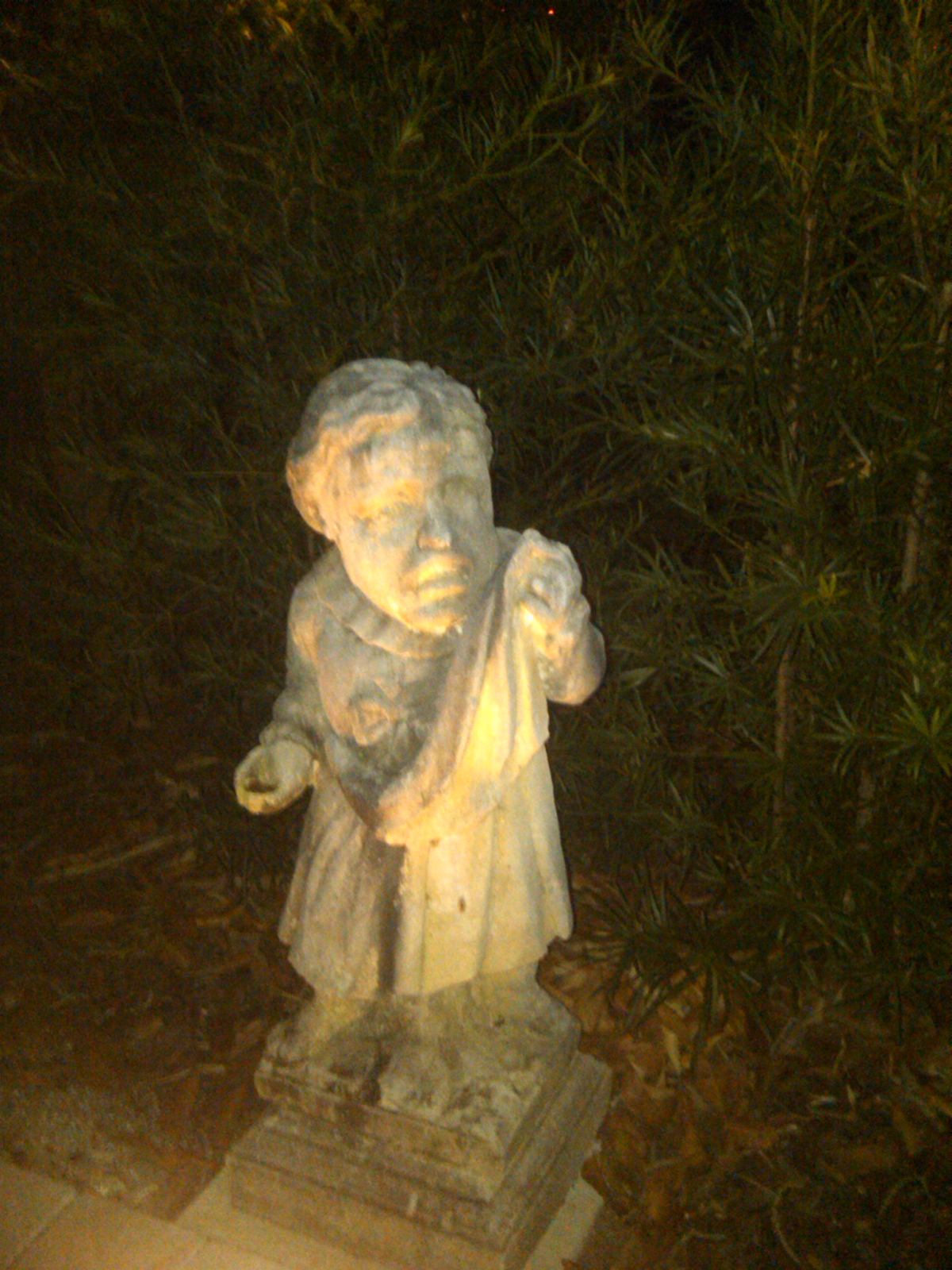
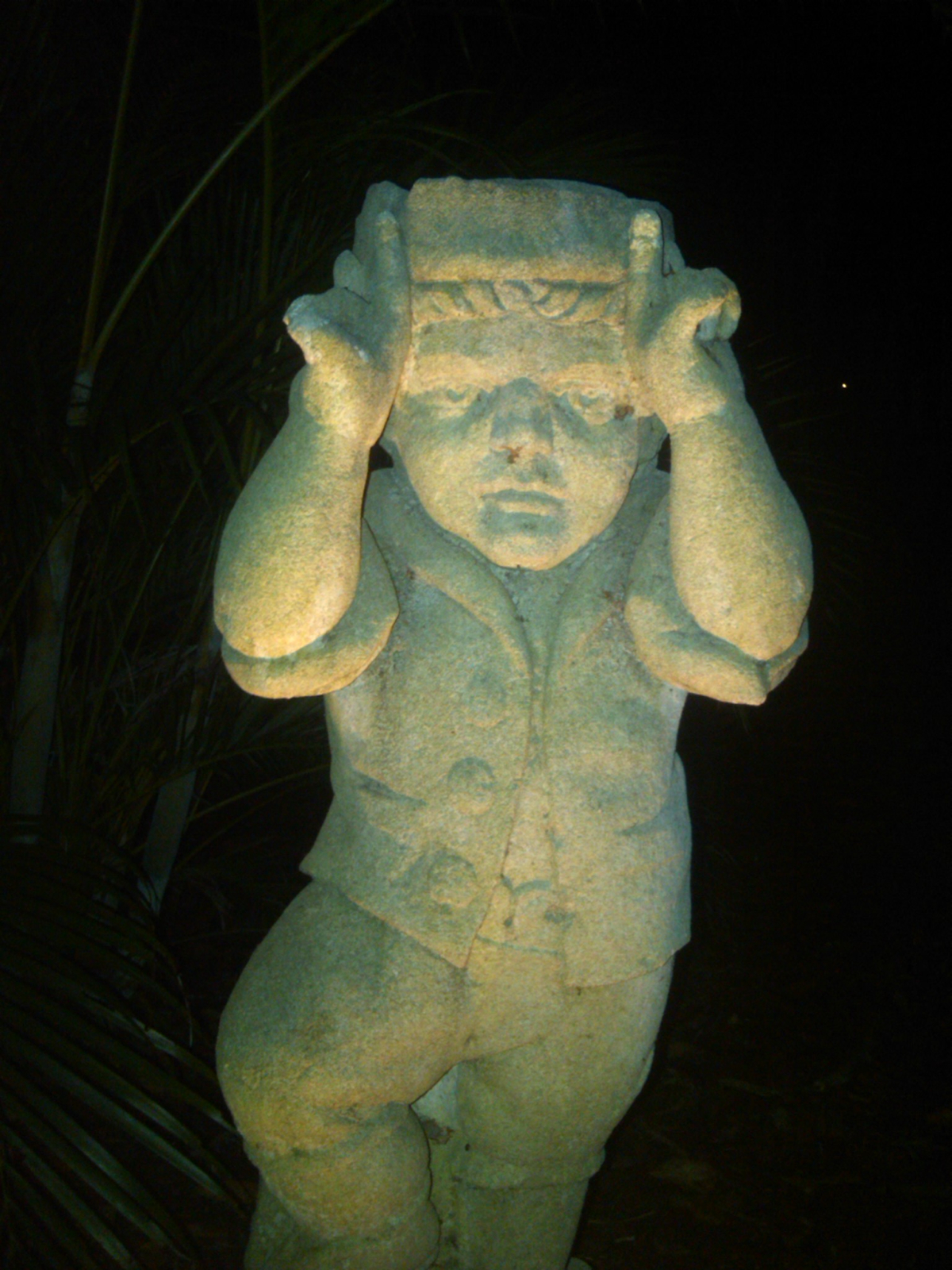
Just a night walk at the Ringling Museum after the public has gone home.

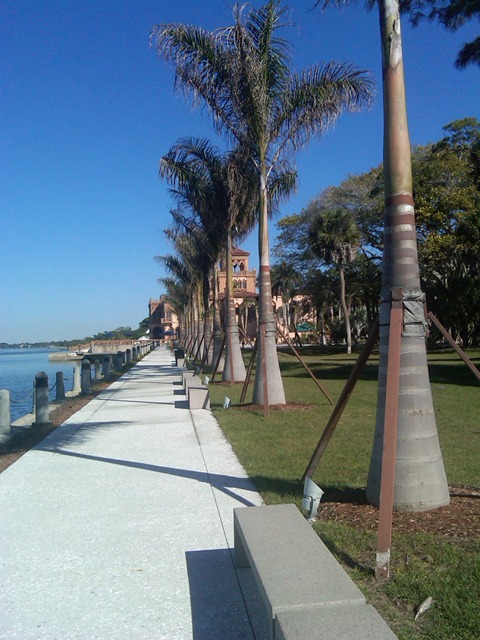
“The day of the sun is like the day of a king. It is a promenade in the morning, a sitting on the throne at noon, a pageant in the evening.”
–Wallace Stevens
“No object is mysterious. The mystery is your eye.”
–Elizabeth Bowen
My own eyes; what an odd thing. Eyes that were always trouble; never in the game; quasi-reliable in youth; little agents of many beauties; never quite understood, like stray dogs; my suspect eyes…
Since the advent of cataracts in my forties I’d been to half a dozen ophthalmologists all of whom had said “leave them alone”.
I’d grown artfully resigned. The art of losing isn’t hard to master. Besides, I was good at adaptive technology, had a talking computer, a fabulous guide dog, a solid career—what craven impulse might it be to imagine seeing in some fashion?
My friend Dr. Edwin Stone was the first to say it. “Could you handle being able to see something?”
Or maybe he said: “Are you emotionally prepared for sight?”
Perhaps he said: “What if you’re not blind anymore?”
I don’t know why I can’t remember his precise words. A good guess is that I was shocked by the temerity of it. It was an audacious thing, and it also had a ring of impertinence. I didn’t like it. I remember that much.
Still Edwin Stone is the kind of physician who would cut off his own hand before discouraging you. Once talking to a boy who’d been diagnosed with an inherited eye disease his young patient asked a question: “Dr. Stone am I going to go blind?”
And Ed said: “Over my dead body.”
It was the subject of eye doctors that had first brought us together. After reading my memoir Planet of the Blind Ed called me up and suggested we meet. He invited me to visit his ophthalmological genetic testing lab in Iowa City. After a tour we sat down and talked about ophthalmologists. He asked me what I thought of the field.
“Well if you talk to blind people a lot,” I said, “they invariably report that their eye doctor was a kind of hopeless person—hopeless in human terms—that is, you know they can’t cure you so they say something like: ‘Sorry but there’s nothing more we can do for you.’ -–and that’s it. Then they push you out the door.”
Ed is one of those individuals who listens with full attention. He’s tall, six feet seven inches and as he nods his upper torso also nods.
“That’s the killer phrase,” he said. “I’m sorry, there’s nothing more we can do for you.”
I nodded.
“And you know what happens next?” he said.
“What?”
“That patient who now is convinced his life is over goes back to the family farm, moves into a shed out back someplace with a mountain of canned beans and disappears, never to return again for ophthalmological care. Those patients vanish from the face of the earth.”
Ed explained that tens of thousands of visually impaired people have dropped off the grid because their eye doctors told them to go away.
“And this is a two-fold problem,” he said. “We might be able to help those people nowadays and they don’t know it. And on top of that, they’re not getting good eye care. Impaired eyes need care too, perhaps more so. And there’s going to come a time quite soon when we can cure certain blinding eye diseases and the people who will most benefit are missing.”
I thought about a blind friend in New York who has grinding headaches but who never goes to the doctor. I thought about a friend with a childhood blinding eye disease, a genetic condition who told me once over dinner that he’d rather go to a proctologist than an eye doctor. “The proctologist has to have manners,” he’d said.
I thought about a woman who’s so angry about her blindness that she can’t hold a job.
And I also thought about the fact that people with disabilities don’t like the medical model of disability, a model that suggests that a person’s validity only derives from being cured. In Planet of the Blind I said “On the planet of the blind no one needs to be cured.” The point is clear: disability is not a subset of medicine; doctor’s can’t define us; nor should they be allowed to do so.
When I’d written that sentence I was certain that I couldn’t be made to see in any significant way. I was also sure that talking about it would be inimical to my hard earned place and the world of disability rights advocates. Wasn’t talking about a cure for my own blindness a tawdry thing?
If people are accorded value only by means of “the cure” then doesn’t this in turn call for a resistance? A militancy?
People with disabilities are all too often viewed by doctors and the general public as “failed patients”. The fallout from this picture is in fact a dreadful thing. Failure isn’t simply medical failure—it becomes a symbolic co-efficient. In this view a person with a disability is more than a medical failure; he or she is redolent with failure; a kind of Typhoid Mary of damaged physicality and even of spirit. How else to explain the fact that some 70 per cent of the disabled remain unemployed?
“Yes,” I thought. “Most assuredly the subject of curing disability is a slippery slope.”
But I made a mental note, saying to myself: “Nevertheless good eye care for the blind and a new generation of mindful, compassionate doctors who can provide it—these are good developments.”
**
After that I shelved the matter. My own eyes weren’t in the running for a cure and I was busy writing a book about traveling blind and hearing the ambient sounds in various landscapes.
One day in Chicago at a conference I tried talking about doctors with two friends who are both disability rights activists and both living with disabilities. “What if we could get beyond the idea that all physicians see people with disabilities merely as defective people in need of cures? And what if we could conceive of cures as simply part of a whole vision of the human being? Whether you’re curable or not, you’re equally valid?” I asked.
I was eating some kind of sushi, something salty and of a doubtful consistency.
My friends were indignant. Talking of progressive physicians was akin to apostasy.
We quickly plunged into a conversation driven by cultural theory. My activist pals, both academics in disability studies had no use for medicine. And worse yet I could see that they thought I was some kind of quisling; a traitor to the collective and aggrieved view that medical practice has sublimated human beings with physical differences into damaged social categories—in their eyes all medicine was Brahmin and suspect.
I fled the sushi restaurant with some jokes about a potential TV series called “Spank the Doctor” and my guide dog and I ran for cover.
Jokes aside I saw that Edwin Stone was right. People with disabilities need better health care and they need to come back to see their doctors. I was wandering Michigan avenue and talking to myself. Doctors need to be educated about the history of disabilities. And while we’re entering the age of “post-molecular” medicine when physicians can pinpoint a single damaged gene as the cause of an eye disease, when the prospect of gene modification therapy is upon us, well, isn’t this the time fo
r a radical reassessment of
what health is? Another way to see this is that we might be able to give someone partial sight and while it may not be the vision of an athlete it would be a delivery system for beauty. Of course I thought of John Keats: Beauty is truth, truth beauty,–that is allYe know on earth, and all ye need to know.”
Ed and I had talked about the fact that many ophthalmologists willfully overlook patients who at best can only be given partial vision. We’d talked about the poetry of seeing things up close.
**
By the age of forty my eyes were done with residual seeing. The cataracts had come to stay. Over a five year period I visited several doctors who told me that operating would be dangerous given the fragility of my retinas. So I lived with the growing cloudiness. By way of analogy I thought of this as ice coming to a pond.
Didn’t I have stamina? I’d always been legally blind. The stone idol of entire blindness could be mine. I imagined carrying it inside my house. A stone idol set before the window.
Obviously getting some vision back was too improbable to be entertained. And maybe the thought was wrong for political reasons?
I remembered Dorothy Thompson’s observation: “Disillusion comes only to the illusioned. One cannot be disillusioned of what one never put faith in.”
Plus I’d seen too many movies and read too much history.
I remembered Rod Serling’s short lived TV series “Night Gallery” with Joan Crawford as the horrid socialite who undergoes an operation to have her sight restored. And of course she was so terrible that the episode functioned as a morality play—her restored vision lasted just a few hours only to fade as the sun came up.
I recalled Mike May’s story in the book “Crashing Through”. May was (and is) a very successful blind executive, inventor, athlete, and business man who had stem cell implantation and surgery, regained some sight and found the entire experience disarming, unpleasant, even a kind of disavowal of his extraordinary success as a person with a visual disability.
Monsters be there.
I thought of a friend who underwent botched eye surgery and who wound up with two plastic eyes. Eyes that he regularly dropped on the floor.
I remembered Oliver Sack’s portrait of a blind man in his book “An Anthropologist on Mars”—it was yet another story of a visually impaired person who found restored sight to be disturbing. Later they made a ghastly movie, “At First Sight” based in part on this story. How I’d hated that film!
Monsters be there.
And once, about fifteen years ago I’d met Sacks’ blind man—we were on a TV show together. Virgil had truly hated being able to see; had found it so confusing he really couldn’t function. Yes, Sacks had written a solid lay person’s account of how the visual areas of the brain may indeed lose the ability to process visual information. Virgil was living proof.
Who would want to be sea sick?
Sitting in the waiting room of the University of Iowa’s Ophthalmology clinic I could imagine Virgil’s experience, bandages off, the room presenting itself as a raw psychedelic infusion; something horrible; faces awry, but permanently so, a Picasso painting thrusting portentously at you; and all the while clutching your head and wanting to throw up. Yes, monsters be there.
In fact it seemed to me there were so many stories of blind people undergoing questionable surgery that the whole matter was a kind of inspirited medical mania.
It’s a Victorian story: the sentimentalized narrative of medicine as one of the gods of progress, a tale so attractive it still floods the tabloid news media with its language of miracles. And nothing so captures the imagination as the headline: “Blind Man Sees Again”.
Virgil’s story reminded me that there are real lives in the balance. Mike May’s experience suggested that medicine can get ahead of what passes for the thing we call quality of life.
But wanting to see is not merely a lifestyle issue. It is a matter of philosophy. At least it was for me. I saw that this wasn’t about being a token of success for the surgeon’s art and that it wasn’t about advertising a kinder, gentler relationship between medicine and people with disabilities. I knew I believed in the latter thing but was less sure of my comfort level with becoming a patient; darkly uncertain of having a symbolic role in a medical narrative of any kind.
Still there I was. The movement inside me was toward light.
I thought of James Merrill’s epic poem “The Changing Light at Sandover”—Merrill whose poetry could capture light on water, a living light, light of our stricken or giddy consciousness itself—whatever that might mean.
I saw that I wanted to weep in the light.
Saw this wasn’t about cultural theories or advertising or social production.
I was thinking these things while sitting in an ordinary waiting room, surrounded by people from all walks of life; some old, others still learning to walk; there were nervous parents, frightened relatives; farmers; people who loved books; and those who desperately needed to keep their sight because they were truck drivers; heavy machinery operators; athletes…
I thought of a prose poem by James Wright entitled “The Secret of Light”, saw how I wanted to live inside that poem. Wright is in Verona in Italy and he begins:
I am sitting contented and alone in a little park near the Palazzo Scaligere in Verona, glimpsing the mists of early autumn as they shift and fade among the pines and city battlements on the hills above the river Adige.
Perhaps I’d never seen mists shifting and fading among pines. But as a kid I could lie down in the midst of trees and see light move from stone to the red floor of the world; watch it take its imperceptible way.
I’d been lucky in my adult years, I could hold entire poems in my head. Wright continues:
The river has recovered from this morning’s rainfall. It is now restoring to its shapely body its own secret light, a color of faintly cloudy green and pearl.
Directly in front of my bench, perhaps thirty yards away from me, there is a startling woman. Her hair is black as the inmost secret of light in a perfectly cut diamond, a perilous black, a secret light that must have been studied for many years before the anxious and disciplined craftsman could achieve the necessary balance between courage and skill to stroke the strange stone and take the one chance he would ever have to bring that secret to light.
Seated in the ophthalmology clinic I knew I was no longer content to read other’s on the splendors and mysteries of light. I felt a wheel, a very delicate one, perhaps a wheel of glass, some trinket for the child of an emperor, felt it turning where memory and desire co-mingle. I saw I could live with an indeterminate success if we went ahead with surgery.
Wright concludes his poem with the lines:
It is all right with me to know that my life is only one life. I feel like the light of the river Adige.
By this time, we are both an open secret.
From The Day of the Sun a memoir in progress by Stephen Kuusisto

Yesterday I blogged about disability and the post-physical body, arguing that conceptions of physical wholeness are rapidly changing in our age of new prostheses and assistive technologies. But the call to action on behalf of wheelchair users below proves just how fragile the well being of people with disabilities is in this time of wholesale budget cutting. I would like to hear each member of Congress stand before a microphone and argue for or against the provision of wheelchairs. Let’s simply refine and focus our attention on one simple thing at a time. I remember once talking to a private contractor whose job was to help the children of the wealthiest Americans find special mental health camps—many of them in the mountains of the far west. Programs with one on one psychiatric counseling and plenty of good food and exercise options. When I asked him if there were grants or insurance benefits that would allow regular troubled kids to get these kinds of opportunities he said, with a notable “sniff”: “Not EVERYONE gets to go to Harvard.”
I want to hear Representatives and Senators, heck, State Governors announce that not everyone gets a wheelchair. If this is the apparent case then it’s time for elected officials to say it out loud. I want to see and hear the video.
S.K.
We at Planet of the Blind have received the following urgent request for solidarity and support on behalf of wheelchair users. Please read this and pass it along.
S.K.

“My name is Andrew Davis. I am sending this e-mail to explain what National Registry of Rehabilitation Technology Suppliers (NRRTS) is trying to accomplish and ask for your involvement as well as members of your organizations who are consumers of Complex Rehab Technology Equipment.
I work with the National Registry of Rehabilitation Technology Suppliers as their Advocacy/Consumer Relations person. I am contacting you to ask for your involvement as well as the members of your organizations that are consumers of Complex Rehabilitation Technology equipment to participate in a National Call-in day to Congress we will be conducting on February 16th to ask Congress vote for upcoming legislation that will create a Separate Benefit Category for Complex Rehab Technology (Quickie wheelchairs, Roho cushions, J-cushions, alternative positioning systems) under Medicare.
AS it stands now, Complex Rehab Equipment is medically coded under Medicare the same as your typical hospital type wheelchair as well as bedside commodes, walkers, etc…Complex Rehab Technology (CRT) products include medically necessary, individually configured devices that require evaluation, configuration, fitting, adjustment or programming whereas, crutches, walkers bedside commodes do not require evaluation before providing it to the consumer/patient. CRT is designed to meet the specific and unique medical , physical, and functional requirements of individuals with complex needs. CRT refers to individually configured manual and power wheelchair systems, adaptive seating and alternative positioning systems and other mobility devices.
Our Goal:
We are asking Congress to create a Separate Benefit Category under Medicare for Complex Rehab Technology. As it stands now, when it comes to medical coding under Medicare, CRT is medically coded the same as lesser quality (hospital type wheelchairs, bedside commodes, walkers, etc.) equipment and Medicare pays for the lesser value equipment which means the suppliers lose funding and could possibly have to lay people off or go out of business all together!
This not only affects the supplier but also the consumer of the CRT. The concern from a consumer point of view is, if the supplier goes out of business or has to lay people off, where does the consumer go to get the equipment they have been using? NRRTS along with National Coalition for Assistive & Rehab Technology (NCART) are trying to make certain that the consumer continues to have access to equipment they need to have the lifestyle they have always had. For example, if I need a Quickie wheelchair but Medicare will only pay for a wheelchair that is of lesser value (and coded the same as the higher end Quickie chair), then it could mean that I am not able to get that wheelchair in my car because it is too heavy to pick up! Therefore I lose my independence! Or, a person who uses a Roho cushion could end up with something of lesser quality therefore it could lead to unnecessary skin break down which means possible skin graft (surgery) which cost more than the cushion and it means the patient/consumer is recovering for a lengthy time. This proposed legislation that we are trying to pass would also eliminate the "In The Home" restriction for CRT products! “
Note: The statutory “in the home” language was originally meant to define durable medical equipment (DME) as devices that were provided outside of a hospital or skilled nursing facility and, therefore, warranted separate reimbursement under Medicare Part B, rather than Part A. However, over time, Medicare has chosen to interpret this language in a way that restricts coverage of mobility devices to only those that are reasonable and necessary in the individual’s home.
“We are asking organizations and its members around the country such as yours to participate in the National Call- in-day to Congress to explain why you feel its important to have Congress vote for a Separate Benefit Category (by the time we participate in the National Call-in to Congress, we will have written legislation that we are taking to Capitol Hill).
You and the members of your organization can go to the following website to get more information and sign up for the National Call-in day to Congress on February 16th. The link below has more information as well as talking points for people who call their Congressman!”
http://www.celaadvocacy.org/ Website includes Finder By Zipcode for your Members of Congress!
Thanks for caring about this!

Four-star Army Gen. Peter Chiarelli — the number two general in the U.S. army — says he is absolutely not offended that Obama adviser Valerie Jarrett mistook him for a waiter at a fancy Washington dinner this week and asked him for a glass of wine.
It could have happened to anybody, Chiarelli tells CNN.
See:

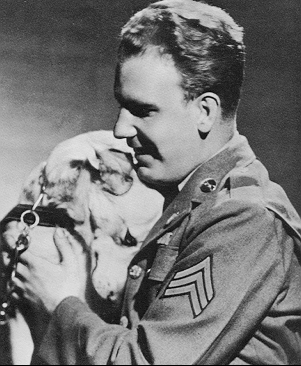
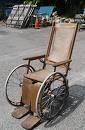
Button Button, Who’s Got the Button?
I once heard an engineer from IBM tell a conference of disability service providers that assistive technology would make disabilities disappear. This was in the late 80’s when the pc was still new and cool (as opposed to tricked out and cool). The engineer had all these examples of how computers could be tailored for people with disabilities. He was swept up in the poetry of his cause. Pointers, sticky keys, speech synthesizers, Braille keyboards—these he said would open the doors to employment and a more receptive culture for PWDs. When it came time for Q & A I ruined the whole thing by asking him what happens if the employer won’t buy the assistive technology? He had no answer for that. He mumbled something about not really understanding the question and beat it off the stage. Of course my point was that disability is a social construction and not a technical problem—that technology fits into the dynamics of disability as a marked category in the assignment of cultural values.
That engineer was a good man. He was longing for the post-physical world. He probably loved that Star Trek episode where the disembodied brain runs the entire space ship from atop a pedestal.

Star Trek image of disembodied brain running the whole show
Of course the image above evokes Bill Clinton’s remark: “If you see a turtle on a fence post you can bet he didn’t get there by accident.”
Post-Physicality and the Millennial Imagination
Longing for the post-physical world is nothing new. The belief in Shamanism is post-physical imagination. In the Finnish Kalevala Steadfast Old Vainamoinen (poet and magician) journeys under the earth in search of magic words. Shamans travel far off in spiritual dimensions, leaving their bodies behind to be guarded by sacred animals. The anthropologist Victor Turner calls such people “liminal figures” because they step over the threshold of the culture and travel to the unknown.

Image of Vainamoinen playing his pike bone harp
In Kalevala Old Vainamoinen solves problems (his boat gets stuck on a rock) by playing a harp made from the jawbone of a fish. As he plays (and sings) the animals of the forest come to listen and finally the disembodied spirits of the sky appear. This is the Orphic imagination. Playing the harp Vainamoinen surpasses mere physicality and configures the mimetic enactment of a post-physical aporia—all contradictions of the body are resolved in reveries of out of the body travel.
This instant from Kalevala represents the poetry of the technical imagination, for Vainamoinen builds and then plays his harp. It is a dream of the body “improved”.
In our time the body-improved is the source of much intellectual and social discord. The pike bone harp is not so easily played. What does the improvement of the body mean? Who is in charge of the improvements? As Gore Vidal once famously remarked: “Politics is knowing who’s paying for your lunch.” Who is paying for the improvements? Who directs them? Do you get a “say” in the direction of your physicality? How do we understand the social construction of the post-physical body?
As Donna Haraway famously writes we are now determinedly living in the post-physical body, a condition she calls cyborgian. Post-industrial human beings are no no longer mere organisms. Logically enough this hybridization is not free of the territories of money and politics:
“By the late twentieth century, our time, a mythic time, we are all chimeras, theorized and fabricated hybrids of machine and organism; in short, we are cyborgs. This cyborg is our ontology; it gives us our politics. The cyborg is a condensed image of both imagination and material reality, the two joined centres structuring any possibility of historical transformation. In the traditions of ‘Western’ science and politics–the tradition of racist, male-dominant capitalism; the tradition of progress; the tradition of the appropriation of nature as resource for the productions of culture; the tradition of reproduction of the self from the reflections of the other – the relation between organism and machine has been a border war. The stakes in the border war have been the territories of production, reproduction, and imagination.” http://www.stanford.edu/dept/HPS/Haraway/CyborgManifesto.html
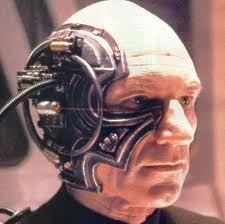
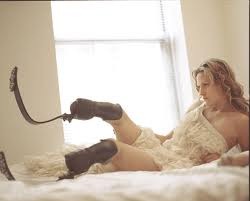
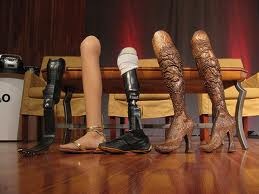
The post-physical body is a confluence of material reality and imagination but it is also co-determined by or within politics. The production of material culture is therefore still a matter of 19th century economics. Accordingly the cyborigian person with a disability is a hostage of sorts. We are, it seems, living in the age of the promissory “improved” body—yet that body is still stuck between the territories of production (politics), reproduction (material expense) and imagination (compulsory normativity).
As of this writing the GOP is endeavoring to take apart the health care programs and social services that provide assistance to children with disabilities, the elderly, and veterans. My argument is that the imagination necessary to develop the post-physical body is at hand and it is simultaneously imperiled by 19th century economics. And that of course is where the word “disability” comes from.
S.K.
|
|
|
Tell Congress: Save NPR and PBS
We’re only a few weeks into the 112th Congress, and Republicans are already attempting to pull the plug on public media. In a budget proposal made public on Wednesday, House Republicans announced plans to zero out all funding for the Corporation for Public Broadcasting (CPB), the nonprofit responsible for funding public media including NPR, PBS, Pacifica and more. If the Republicans are successful, it would be a tremendous blow to the entire public interest media sector. We cannot allow Republicans to destroy public media. Republicans are disingenuously claiming that they need to cut funding for public media because of budgetary constraints. But what they fail to highlight is that national public broadcasting is remarkably cost effective, providing local news and information, free of charge, for millions of viewers while only receiving about .0001% of the federal budget.1 More to the point, it’s nearly impossible to put a price tag on the actual value of public broadcasting. Public media is one of the last bulwarks against the corporate media where the combination of consolidation and profit-motive has long since shifted the focused to infotainment rather than substantive news. In many rural and less affluent communities, broadcasters rely on federal funding to provide the only available high-quality news and public affairs programming. Without public media, corporate media monopolies would increase their already large control of what we see on television, hear on the radio or read in the newspaper. This outcome should deeply worry all of us. The increased accumulation and consolidation of corporate power is a threat to our democracy. And nowhere is this more evident than in our media. At a time when media consolidation is shrinking the number of perspectives we have access to over the airwaves and when newsrooms are shrinking, we need more diversity in our media not less. And we simply cannot afford to lose what public media brings to the table. Conservatives have longed for any opportunity to defund NPR, PBS and other public media. And with Speaker Boehner wielding the gavel, it looks like they may finally get their wish. Thank you for defending public service media. Matt Lockshin, Campaign Manager P.S. It’s been said that NPR receives 98% of its funding from non-government sources. But that’s highly misleading. The government — through the Center for Public Broadcasting — provides a significant source of funding for NPR and NPR member stations.
|
|
|
|
© 2011 CREDO. All rights reserved. Questions? Send us an e-mail or write us at: 101 Market Street, Suite 700, San Francisco, CA 94105. This is a message from CREDO / Working Assets. To change your email address or update your contact info, please visit: http://act.credoaction.com/subscrip/coa.html?id=16482-2810020-F8C13Mx To remove yourself (judith abrams) from this list, please visit our subscription management page at: http://act.credoaction.com/s?i=16482-2810020-F8C13Mx |


 Planet of the Blind