Reverie

–in memory of Muriel Rukeyster


So finally what choice do you have? Break bread with the poor. 

The sturdy paw of want has touched your shoulders. 


Swarms of humans all around–the sun shining 

on everyone, what choice do you have? Walk anywhere,


woods are mild, the eyes of horses, mild, green 

is calm, dreams, windows high in old churches,


world is love. Sun ripples, churns on water. 

Break bread. 


Walk with an empty bridle. 

Walk.


D.J. Savarese, My Friend, Our Ally in Disability Rights

I am a lucky man. Although I bear the emotional scars of a tough childhood—a disability childhood, one with bullying, cruel teachers, lots of loneliness—I have had the startling fortune to meet magnificent people throughout my life. These people are like the shine of fish darting in summer. They come out of black water and the heart no longer feels alone. One of these fish-shine people is D.J. Savarese, the son of my friends Ralph and Emily.

via www.planet-of-the-blind.com

Some days its proper to reblog a good post. If I was a disc jockey, I'd say: "This is going out for D.J.!"

Disability and Political Optimism

I am not optimistic. Or I am. I stagger in my head. I see young poets devoid of activist politics–for poets, read, artists in general. The trees surrounding the arts colony are dying from acid rain but the young writers talk about the fetishization of body parts–self-fetishization. I listen over pork chops, thinking, “you’re so perfect for the 80’s”; thinking, “the universities created you!”; feeling phlegmatic, pinched, tired beneath my shirt. 


Who wouldn’t feel weary? The Associated Writing Programs conference–the big conclave of college and university creative writing faculty and students has almost nothing to do with human rights–don’t expect help in the world struggle from the MFA classes. Neo-liberalism creates and extends a cotton batting, a social insulation borne of anemic performance art. Ideas are better than action. This is the aestheticized anodyne to progressive politics. True political life hurts. Who would choose to hurt when thinking about hurt is so much easier? Let’s historicize hurt. Let’s make hurt as small as a speck in a rat’s retina. 


On Facebook I see artists and university professors advertising sabbaticals, the  imported cheeses they eat, a new outfit, a sled called “Rosebud”–you name it. 


If activist optimism is to survive the issue is still “the streets”–the question is: can you be optimistic in the streets?      


As a writer with a disability I’m optimistic because of the following street wise people, groups, and initiatives, offered here in no special order. These are some of the folk who refresh me, keep the nerve of optimism sufficiently tickled to continue firing:


ADAPT is a national grass-roots community that organizes disability rights activists to engage in nonviolent direct action, including civil disobedience, to assure the civil and human rights of people with disabilities to live in freedom. http://www.adapt.org

Ynestra King (author of Dangerous Intersections: Feminism, Population, and the Environment who wrote about the arrest of wheelchair users protesting the lack of accessible taxi cabs in New York: 


What ensued was an hour’s standoff, as they tried to figure out what to do with us. While they had a small army’s worth of hardware, vehicles and personnel on the scene, as we waited it became apparent that the NYPD did not have a wheelchair-accessible paddy wagon! After a long standoff and more arrivals of higher-ups from the mayor’s staff and the police department — and lots of phone calls to parties unseen — a decision was made to commandeer Access-a-Ride vehicles to take us to jail. (Access-a-Ride is the problematic New York City paratransit service for people with disabilities, often referred to by users as “Acc-stress a Ride.”) To their credit, the regular drivers of the hijacked vehicles told the higher-ups that they “wanted no part of this,” and so supervisors on site for the mayor’s party were forced to step in and operate the lifts and drive us to the police precinct.

Simi Linton: activist, writer, film maker, community organizer, scholar, raconteur. See her video remarks here at the GIMP Project. Her new film Invitation to the Dance, co-produced with Christian Keller 


Bill Peace (also known as “Bad Cripple”): anthropologist, bio-ethicist, disability rights activist, public intellectual, wheel chair athlete, and a cogent contrarian. His blog is a must read if you care about human rights. Read his piece entitled: “Oscar Pistorius, Helen Keller, and the Problem with Role Models”


Anne Finger whose books include Call me Ahab; Elegy for a Disease; Past Due: A Story of Disability, Pregnancy, and Birth. Anne is a writer who never forgets the human rights issues that surround each embodiment. Her essay “Walking to Abbsanta” in the Seneca Review’s issue on the “lyric body” is astonishing–a tribute to Antonio Gramsci. The essay reverberates, troubles, sweats, as the fascist view of the abnormal body remains today and still haunts the public nerve. 


Ralph Savarese who is working on neuro-diversity and the poetics of autism, and who knocks down barriers for non-speaking people nearly every day. 


This is such a partial list–there are so many more writers and scholars whose daily actions defy the abstracted and isolated world of post-post-neo-liberal containments. But this is a morning’s refreshment. 


The Name


All day it trailed me, though without analogy–the name wasn’t like a wolf or a policeman, more like a pitted stone but even so this was no good. The goal of emptiness was evasive, less of natural fact, less of forest flowers, less of Orion, less. Do you know what I mean? That someone, something might reveal itself. Late in the day the lead weight that makes the clock run dropped without warning, my cold, private Emily Dickinson.

Eating Horses, Riding Horses, and Tossing in the Diphthongs

There’s an interesting piece by David Hart at the UK’s Human Rights Blog called “Eating Horse and Where Our Language Comes From” which, is, perhaps, tonally, a wee bit smug, for humans have always eaten horses and the archaic peoples of the steppes flourished by doing so–a matter that Hart finds amusing–a bit of schadenfreude for those who see the current horse meat scandal as an offense against morality.

I am mistrustful of moral outrage that erupts like sun spots, yet sufficiently sentimental about horses to abhor the news that Romanian abattoirs have been selling equine flesh as beef. The crime is misrepresentation. If eating horse is immoral than eating any animal must be–and I’ll leave that argument to others, see: http://www.bbc.co.uk/ethics/animals/using/eating_1.shtml

On the subject of morality and eating animals I’ve always been most persuaded by the virtue argument: 

People who participate in a system that treats animals cruelly, and that kills animals to provide trivial pleasures to human beings, are behaving selfishly, and not as a virtuous person would.

David Hart isn’t terribly interested in the morality of animal husbandry and our eating habits–he’s more “lit up” by the fact that our ancestors both ate and rode horses at the same time they developed spoken language. You are, it would seem, both what you eat and where you go. Hart references a book by Professor David Anthony, The Horse, the Wheel, and Language, which I intend to read as soon as possible. 

What’s clear is that human beings have eaten horses throughout history, often because horses were better survivors in winter than cattle. Against this one may say, rightly, that human beings will eat anything–tarantulas, worms, even each other. Eating horses may well have kept fragile humans alive in colder ages than our own. Traveling on horseback certainly intensified the need for language. 

Language and cruelty are old sisters, a matter that Hart doesn’t explore. Poets have always known this. Language is not inherently virtuous. If you paint a face on a stone it will not be ethical. And I would say the horse has always been an innocent in this matter. 


Jim Ferris, Laurie Clements Lambeth and Stephen Kuusisto Reading at Syracuse University

Disabilities as Ways of Knowing: A Series of Creative Writing Conversations: Part II

The Disability Experience and Poetic Verse

Reading by Poets Jim Ferris, Laurie Clements Lambeth, and Stephen Kuusisto

March 28, 2013
Reading 7:00 to 8:00 pm at Watson Theater
Reception and book signing from 8:00 to 9:00 pm at Light Work
SU Campus

Jim Ferris, Laurie Clements Lambeth and Stephen Kuusisto will be reading from a selection of their poetry, followed by a reception and book signing, for all members of the S.U. community. While this event is geared specifically to raise and support awareness among undergraduates, everyone is welcomed to participate in this exciting set of opportunities. This event will feature works from Beauty is a Verb: The New Poetry of Disability (Cinco Puntos Press) and launch Letters to Borges (Copper Canyon Press), where “best-selling memoirist Stephen Kuusisto uses the themes of travel, place, religion, music, art, and loneliness to explore the relationship between seeing, blindness, and being. In poems addressed to Jorge Luis Borges—another poet who lived with blindness—Kuusisto leverages seeing as negative capability, creating intimacy with deep imagination and uncommon perceptions” (from http://www.stephenkuusisto.com).

American Sign Language (ASL) interpretation will be provided during both the reading and the reception/book signing. Communication Access Realtime Translation (CART) will be provided during the reading.

If you require accommodations or need information on parking for this event, please contact Radell Roberts at 443-4424 or rrober02@syr.edu.

This event is made possible through the Co-Curricular Departmental Initiatives program within the Division of Student Affairs, and cosponsorship by the Disability Cultural Center, the Renée Crown University Honors Program, the Center on Human Policy, Disability Studies, the Burton Blatt Institute, the Dept. of Women’s and Gender Studies, the Lesbian, Gay, Bisexual, Transgender Resource Center, the Office of Multicultural Affairs, the Slutzker Center for International Services, the Creative Writing Program, the Disability Law and Policy Program, the Disability Student Union, the Beyond Compliance Coordinating Committee, and the Disability Law Society.

As aspects of variance and diversity, disability cultures and identities enrich the tapestry of life on and off the SU campus.

~~~~~~~~~~~~~~~~~~~~~~~~~~~

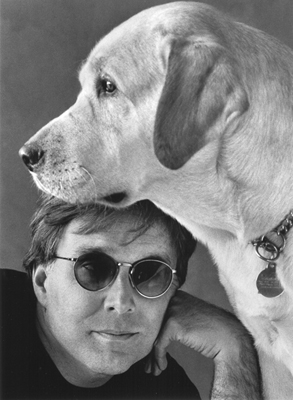
Professor Stephen Kuusisto is the author of Eavesdropping: A Memoir of Blindness and Listening” and the acclaimed memoir Planet of the Blind, a New York Times “Notable Book of the Year”. His second collection of poems from Copper Canyon Press, “Letters to Borges has just been released. Listen to Steve read “Letter to Borges in His Parlor” in this fireside reading via YouTube. He is currently working on a book tentatively titled What a Dog Can Do. Steve speaks widely on diversity, disability, education, and public policy. www.stephenkuusisto.com, www.planet-of-the-blind.com

Nocturne


The rising storm is part of me 

and then foreign–

some kind of language.


I open the door, snow comes, sidelong, hard, 

like thoughts at the end of life.

Do you know? I start to laugh. 


Grandfather died, 

left his house 

filled with dynamite 

and instructions–

tell the police it’s old and unstable.


Inside a man, one vault after another, 

and what with the snow,

you leave things behind. 


Disability Rights are Human Rights

I was intrigued by Michelle K. Wolf’s OpEd on disability rights as civil rights in the Jewish Journal . Her argument reflects a view many of us in the disability rights community hold, namely that the ADA is a civil rights law and not a singular and codified sub-contract to public life. Here is an excerpt from her piece:  

Michelle K. Wolf: Disability Rights Are Civil Rights
(Jewish Journal)
February 15, 2013

LOS ANGELES, CALIFORNIA– [Excerpt provided by Inclusion Daily Express] As a non-profit professional in Los Angeles, I’ve worked at both Jewish and general charities. While it can sometimes be more comfortable for me to work in the Jewish community, I find myself stretching more as a person in the non-Jewish environment, especially during the casual conversations over lunch, when African-American and Latino colleagues on occasion will share painful memories of discrimination.

So, as I am busy promoting and participating as a parent disability advocate with Jewish Disabilities Awareness Month during February, I am also mindful that this is also Black History Month, I am drawn to the parallels of each group, struggling to move out of the margins to claim their rightful place in our society.

When someone makes a snap judgment of your potential ability based solely on your appearance, that hurts. When dreams are taken away from you because of stereotyping and myths, that’s cruel. And when you can’t even receive the same level of education as your peers, it makes it incredibly difficult to ever catch up.

I worry that the families touched by disabilities are spending too much energy pointing fingers and talking amongst ourselves, complaining and wishing we had a more inclusive community. It’s time to take our issue to a new level and actively enlist the support of our extended family, friends and congregants.

Entire article:
Disability Rights Are Civil Rights

http://tinyurl.com/ide0215137

**

I have on this wee blog argued for some time that disability rights are human rights–they are inseparable. A more inclusive community means a community devoted to universal dignity and access. Dignity and access do not mean just ramps for wheelchairs and a welcoming environment for your service dog, it means unqualified reception, a broad understanding that people of difference belong. When the tragic shooting of Trayvon Martin became public news I wrote the following:


March 27, 2012


Hospital, ’58


Something is wrong with the moon, green music, eighth notes, no one can tell what it will be worth–so the boy in the hospital draws it under the blanket, the sliced moon that hums from deep places. And the boy thinks how soon enough the moon will make him transparent. He knows this will happen. This is disability in childhood. And the doctors keep pulling on the boy’s arms, trying to rub out the light. 


My First Day as a Labrador


Early this morning my dog found the tracks of wild turkeys in fresh snow. Vault after vault opened for her. She was standing in the blood and flowers of animal life–so distant from mine, which remains dry. The sun was hardly up. I talked to myself. Spoke dialects of early. Green words. Words to accompany my begging bowl. My dog looked off to the far end of the field. Soft wind. The branches of trees, violent and tender…