When my father sang small birds passed out. The man, as they say, had a tin ear. But his joy was marvelous and the dogs loved his shenanigans. I can still see him now, making the crockery jump.
Month: June 2013
 Posted with Blogsy
Ode to Jarkko Laine, Elegy Also
Here in the mountains where the birds shiver
And across the lake a woman beats a rock
With an oar and clouds rear up like horses
I take pleasure in the absurd life inside us.
I remember you lived on “big ditch road”
A homely name–O home sweet home–
Let’s climb down into the hole of domesticity,
Women and children first, books and dishes,
Maybe a set of knives and a radio.
I want to be a liaison of sorts to the court of things,
A poet’s job, sorting the leftovers,
Making the emptiness sing.
I don’t know how to say goodbye
But I can play my harmonica in the dirty places
Like any man inside a man.
Dog Agogo
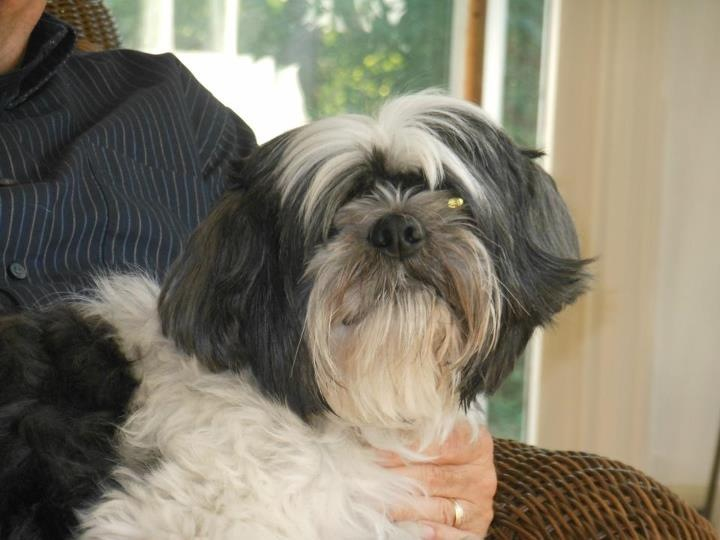
Little dog’s tail is like a spaghetti floor mop, upright and waving as we walk the circle in our neighborhood. Silly guy! Perfect!
The Dog Deal
Little dog and big one pull apart a rubber toy as I write. Later they’ll carry away pieces of the thing hiding them under arm chairs and in closets. Little dog is a rescue guy, part Lhasa Apso and something else though we don’t know what. He resembles a small sheep dog, black and white with long dreadlocks falling in his face. He smiles a lot–that little dog smile that’s both affirming and vaguely naughty.
Big dog is Nira, 2N2206–my guide dog. She’s a Yellow Labrador. Some people call them “golden Labs” but there’s no such thing. She’s the color of excellent French pastry–part honey and half of cream. And she’s big for a girl dog. When I’m out in public strangers think she’s a boy. All my guide dogs have had huge frames and generous heads. Nira’s the possessor of a sweet face and beautiful, kindly chestnut eyes and of course those trademark floppy Lab ears that rise like sails when she’s excited about something. Right now she’s excited about little dog whose name is Harley. She loves Harley because he’s a good sport as she drags him around the tile floor in my finished basement–though its more than dragging, their tug of war is the canine equivalent of Archimedes’ leverage. Nira pulls in such a way that Harley’s feet leave the floor and then she really drags him. And Harley’s legs scramble for purchase to no avail and then he’s momentarily in the air.
Their joy is something from the deep, blue reaches of ancient life. While I struggle with the clouds of my day they are alive in such pure play that I’m envious and reminded of the essential mystery of both joy and friendship. Dogs have friendships and live in the moment. Me? I carry a heavy green book up and down the stairs, worry about tomorrow, fear the unknown. Which of us has the better deal? The dogs of course.
Vonnegut's Eel and Paul Ryan
What will happen when the final final rationalization for coded solipsism is absorbed by the American body politic? If Kurt Vonnegut was here he’d say that giant lamprey eels will eat Indianapolis, but let’s be serious, Mid-American gas and electric has already done that. When people speak in self-serving metaphors about other people’s losses then we have the Paul Ryan plan and the Obama “chained cpi” and other forms of heartlessness tricked out in board room codes. This is not ok. How feeble that protest sounds. But how true it remains. We now talk about letting the poor fend for themselves by suggesting they are a drag on American growth. In fact social programs allow the most vulnerable to participate in the miserable buying and selling that has taken the place of civic life. Stop supporting food stamps, medicaid, medicare, social security disability, WIC, special education, rehabilitation programs for people with disabilities–(its a long list of targets in the coded solipsism industry) then, in turn, you shut down ten thousand shops and drugstores, mini-malls, Walmarts, not to mention of course, putting people in the streets.
In New York the other day I was reminiscing with a friend about the state of Grand Central Station in the 1970’s when the place was run down and filled with homeless people. Remember? That’s the Ryan plan. Forget Vonnegut’s eel.
I just felt like writing these words. They remind me that I’m not a heartless man.
Riding to the Airport, New York City
Hold on Yoko, Yoko hold on its gonna be alright,
You’re gonna make the flight…
On my way to JFK in NYC, find myself thinking of John Lennon. Now I understand him as a survivor of childhood abuse, probably with PTSD. And look how humane he was able to become. The heart chakras are always there, waiting on us, supplanting the toxic. Just give chakras a chance.
How I miss Lennon, who’s voice right now in this age of surveillance would be wise and witty.
How I can’t stand Peter King, who, as folksinger Christine Lavin would say, is “a prisoner of his hairdo.”
Reading Poetry at 30,000 Feet
A little bit of magic isn’t it, poetry, flying.
Ruth Stone writes:
‘In August we carried the old horsehair mattress
To the back porch
And slept with our children in a row.
The wind came up the mountain into the orchard
Telling me something;
Saying something urgent.
I was happy.’
I used to be terrified of flying, would break out sweating as soon as I stepped onto the plane. My fear didn’t stop me from traveling, but it felt like a miracle every time I arrived at my destination safely. I marveled that anyone would choose to work as a pilot or flight attendant: what a crazy suicide.
When I grew tired of being afraid, I started reading books on flight, the inner workings of planes, the job of the pilot, the jobs of the flight crew. I read about the physics of flight, how planes launch themselves into the air, how they stay aloft, how they land. And still, I return to this: magic. I’m no longer afraid of flying, but I still think of it as magic. A little bit of miracle.
‘The green apples fell on the sloping roof
And rattled down.’
And poetry, also: magic. Hard work, yes, hours of dead-ends and deleted lines, stacks of discarded paper to fold into the compost bin. But sometimes, a spark, a something that launches you into the air, that moves you in a new and unexpected direction. Sometimes something magical.
I usually bring silly things to read while flying, magazines or popular novels, things that don’t require too much of my brain so when I lose a page to announcements or a loud seatmate, it doesn’t matter. This trip, I brought back issues of Poetry Magazine. I read Ruth Stone.
‘The wind was shaking me all night long;
Shaking me in my sleep
Like a definition of love,
Saying, this is the moment,
Here, now.’
‘This is the moment,’ I read at 30,000 feet. And ‘I was happy.’ And ‘Here, now.’
Tweezer Man and the Guide Dog
In the “Viand” coffee shop on Madison Avenue in Manhattan a short, wiry little man wearing five tee shirts and intricate shorts with many microscopic pockets (as if he might be a medical examiner with innumerable scalpels) and with industrial headphones–the kind worn by men using jackhammers–and tiny black dress shoes and white socks approaches my guide dog Nira who is lying on the floor behind me.
“Hello, baby,” he says, “Did you give up your life for daddy so he’ll be safe?”
He pets her. She ignores him. “Do you keep daddy safe?” he says to her, ignoring me.
I debate the matter. Should I say something or punt? With my residual vision I see the man looks eerily like Adolf Eichmann. He has thinning black hair and creepy dark horn rimmed glasses. How many dumb conversations have I had with strangers because of my guide dogs? Too many. I say: “She didn’t give up anything to be a guide dog. She has tons of play time and gets to go everywhere.”
He looks at me then, says: “I hate people. I just hate them.”
Then he’s out the door with his shorts full of tweezers.
Mr. Cellophane and Disability
I was born in the year of the iron lung. In another year the number of breathing machines would start to decrease. I went to school in the age of “no people with disabilities allowed” and learned a great deal about shame. And now I’m shiny and sticky! Imagine! (With thanks to the ghost of Frank O’Hara).
About shame: there’s an invisible playing field for the thing. Erving Goffman wrote well about the politics of ruined identity, but he was silent on the matter of its gridiron. The politics of space requires people with disabilities to play by their own rules.
From a Notebook
When you’re splitting in two like John Berryman, remember there’s a third person, call him whatever you like–he’s the comic ironist you need for the long haul. Animals like him.
At the exhibit of Soviet underwear, the brassieres have wires, like farm tools. No further comment necessary.
I lived in Iowa for a time. I know several pig jokes. It’s easy in the Midwest to fall into a rut.
Once in New York City I heard a man drop his end of a plate glass window. It sounded like Stockhausen’s gramophone.
When I was six years old I was selected to care for the classroom’s hamster over Thanksgiving vacation. But the first night home my cat ate it. My first lesson in art: “Don’t worry,” my mother said, “We’ll go to the pet store and get another one–no one will ever know.” She was right.
 Planet of the Blind