A Book for President Obama

There were lots of jokes about the George W. Bush Presidential Library’s holdings when the opening ceremonies occurred. Why not? “W” is likely the least interesting man in the world: “I don’t always read books, but when I do, I read The Klingon Hamlet. Stay incoherent my friends.”

With the exception of Thomas Jefferson there is little evidence books play a large role in the shaping of America’s presidents, though FDR had a considerable library and Lincoln knew his Shakespeare. JFK liked Ian Fleming. Jimmy Carter disastrously read Christopher Lasch. Reagan loved Whittaker Chambers. When our presidents sit down to read, the servings should be tasted first by a loyal and brave servant. (On the matter of brave White House servants, there’s the story of Rutherford B. Hayes who, fearing the newly installed electricity, had a butler flip the switch.) Hayes liked American biographies, so he knew how to delegate.

Now we have the curious case of Barack Obama who, in the matter of human rights appears more of a Quisling than the public may have supposed. Still, according to AbeBooks.com, Obama is a serious reader:

In May 2008, he was photographed carrying Fareed Zakaria’s The Post-American World as he walked across the tarmac at an airport in Bozeman, Montana. The book outlines America’s declining influence in international politics – was he formulating policies for dealing with rising powers like China, India and Brazil?

In October 2008, the New York Times asked Obama to provide a list of books and writers that were significant to him. Here goes – Ralph Waldo Emerson, Thomas Jefferson, Mark Twain, Abraham Lincoln, James Baldwin, W. E. B. DuBois’ Souls of Black Folk, Martin Luther King’s Letter From Birmingham Jail, Toni Morrison’s Song of Solomon, Graham Greene’s The Power and the Glory and The Quiet American, Doris Lessing’s The Golden Notebook, Alexander Solzhenitsyn’s Cancer Ward, John Steinbeck’s In Dubious Battle, Robert Caro’s Power Broker, Studs Terkel’s Working, Adam Smith’s Wealth of Nations and Theory of Moral Sentiments, and also Robert Penn Warren’s All the King’s Men – a novel about a corrupt Southern governor (Rod Blagojevich anyone?). And then there were his theology and philosophy influences – Friedrich Nietzsche, Reinhold Niebuhr and Paul Tillich.


That’s heady stuff for a man who’s now presiding over the NSA’s warrantless wiretapping of American citizens, who believes in his authority to execute his own citizens on foreign soil without trial, and who has reneged on his promise to close the criminal enterprise we have come to call “Guantanamo”.

Of course what a man says he reads and what sits on his bedside table makes for interesting speculation. Nixon said his favorite book was “War and Peace” but aside from the likelihood he skipped some chapters, I suspect Nixon’s favorite book was “The Castle of Otranto”. (“He was persuaded he could know no happiness but in the society of one with whom he could for ever indulge the melancholy that had taken possession of his soul.”)

I reckon the books Obama says he reads are in fact precisely what he reads. It benefits no man or woman to sneer at the list of books above. But in a time when press freedom, personal privacy, and the right to a fair and speedy trial are all under siege, one wishes the President would take up Milton’s Areopagitica:

And though all the windes of doctrin were let loose to play upon the earth, so Truth be in the field, we do injuriously, by licencing and prohibiting to misdoubt her strength. Let her and Falshood grapple; who ever knew Truth put to the wors, in a free and open encounter.


Ode to John Ashbery


A man without music–cumulonimbus,

Opens in daylight. A job is a job. Everything else

Is of or pertaining to the dead (which

Has much of irony, little of melody)

But he sells it. Light and form

Sell almost anything

Though its not fashionable to say so,

Even in the arts.

I wish for allotropic precision but

Get Impressionism at least

Most days which is one of the

Tributaries of poetry.

A poem is grazing on the graves

We care about–


Explaining American Exceptionalism to People with Disabilities in Uzbekistan

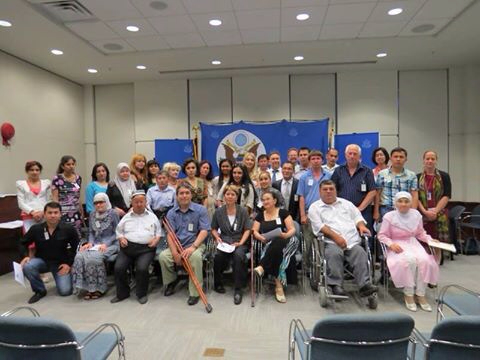
Photo: American writers Christopher Merrill. Ann Hood, Chinelo Okparanta, and Stephen Kuusisto, posing with disability rights advocates from Tashkent, Uzbekistan at the United States Embassy.

Last December when the United States Senate failed to ratify the UN treaty on disability rights I said to a friend: "only people who do not travel abroad or who do not have any friends or family members with disabilities could be so cruel." As I recall, I also said that "cruel" is related to "crude" by way of its French origins–the etymology highlights the worst aspects of American "exceptionalism". Opponents of the treaty (all of them on the far right) argued that ratifying a treaty affirming disability rights around the world would compromise American independence–a position so absurd and willfully ingrown one might conceivably treat it with penicillin.

The GOP's opposition to a treaty that calls for human rights for people with disabilities worldwide was hard to stomach for most decent citizens. USA Today wrote:

"This week, when the Senate rejected a United Nations treaty banning discrimination against the disabled, the vote received relatively little attention. And why would it? The United States already has laws that prevent such bias. They've made curb cuts and wheelchair ramps common sights across America.

But the Senate's failure to ratify the U.N. Convention on the Rights of Persons with Disabilities was nevertheless remarkable — for what it said about the state of domestic politics. Despite GOP efforts to recalibrate after last month's election losses, the treaty vote reflected the continuing influence of a fringe that gets frantic about anything involving the United Nations."

What scares the right more than an African-American president? The specter of "black helicopters" –some kind of international government takeover of the United States by forces too dreadful to name but that didn't stop Senator Jim Inhofe (R) Oklahoma:

“I do oppose the CRPD because I think it does impinge upon our sovereignty. Unelected bureaucratic bodies would implement the treaty and pass so-called recommendations that would be forced upon the United Nations and the U.S. … This would especially affect those parents who home-school their children. … The unelected foreign bureaucrats, not parents, would decide what is in the best interests of the disabled child, even in the home.”

In addition to the canard that affirming disability rights around the world would prevent Americans from home schooling their children (perhaps the most fatuous argument they mustered) opponents also claimed that children with congenital disabilities might be euthanized by sinister UN forces which of course do not exist–but they might you see?

After the treaty ratification failed CNN wrote rather sensibly:

"There is a broader and more disheartening message that the world hears from Washington on this year's International Human Rights Day: The United States is losing its moral voice on human rights because it is not leading by example."

**

The passages above offer the background. As an American who has a disability and who teaches disability studies, I am counting on Senator Harry Reid's promise to bring the UN treaty's ratification back to the Senate floor this year. But the word "cruelty" won't go away. I find myself thinking of blind children in North Africa who are believed to be demotic and are denied education; of people without basic prostheses or job training in every part of the world. Certainly I think of my own experiences with international travel. In Italy I was denied entry to a historic site with my guide dog. I was even denied entry to the hotel restaurant. In short, I might have rights abroad, but then again, I might not. The world wide violations of disability rights are not imaginary like the silly prospect that the UN will prevent you from home schooling your disabled child. Shame on Rick Santorum who pushed that dishonest argument for all it was worth. In the end it was worth 38 votes in the Senate, just enough to derail a treaty that promised hope to vulnerable people–the most vulnerable people in the world.

Enter Tashkent: in May I was afforded the opportunity to travel as a cultural ambassador under the auspices of a program sponsored by the US State Department and the International Writing Program at the University of Iowa. Picture, if you will, four American writers speaking to Uzbek disability rights advocates about literature and self-affirmation (among other things). Chris Merrill (who directs the U of Iowa's International Writing Program) is a poet and journalist who has written a good deal about the effects of war, and he spoke about how writing clarifies our understanding of human experience. Ann Hood is a widely read and honored American novelist who has written about the death of her daughter and how to find a path after grief. Chinelo Okparanta is a recent graduate of the Iowa Writers' Workshop and the author of a brand new collection of short stories due out this fall–stories that draw on her experience as an immigrant to the US from Nigeria. Together we spoke about the abiding and peculiar nature of America–that almost everyone comes from someplace else, that we tend as a nation of readers and writers to value stories that exemplify the struggle for human rights. I spoke about my experiences as a blind person–how I struggled with my identity, fought for an education, and described what it was like to live my childhood and early adult years before the passage of the Americans with Disabilities Act. This is when the question came. A man who uses a wheelchair asked how it was possible–how it was at all conceivable–for the US to refuse to sign the UN treaty on disability rights.

I told the truth–the truth with a wishful forecast. I said that the broad majority of Americans is unhappy with the Senate's failure to ratify the treaty. I said that even people who presently have no direct connection with disability were horrified by the Senate vote. I pointed out that Senator Reid has vowed to bring the treaty vote back this coming year. And I said it would pass. A blind guy can dream can't he?

But the question persisted–someone else asked again "how was it possible for the treaty to fail?" (128 countries have signed the treaty, even China has signed it.)

Explaining there's an extremist fringe in Washington that doesn't like the United Nations is, to say the least, an unenviable task. At best all you can do is explain the embarrassment of exceptionalism, which, in turn, is a high minded way of saying the US has abandoned moral leadership–an abandonment the world can ill afford, whether you have a disability or not.


Dear President Obama

I watched today as you defended domestic spying on average Americans, imagining that enemies of the United States can only be identified by the broadest possible invasion of domestic privacy. You tried to assuage the public’s emerging outrage (misapplied and outdated as it may be) by arguing domestic surveillance has oversight–a matter that is scarcely credible given the secrecy of the FISA court–and that the NSA’s monitoring of phone calls involves no listening to actual conversations. You sir missed the larger point, a matter I know you know given the quality of your education. Secret courts, secret surveillance, the power to arrest citizens and hold them in indefinite detention without a right to a speedy trial, the argument that you sir, possess the authority to kill American citizens at will–these dynamics, taken together, are the definition of tyranny. You did not campaign on these things but you have adopted them as a matter of “realpolitik” and have shown insufficient will to fight them. This will be your legacy. I see it now. You sir, are no Jack Kennedy. Enemies we shall always have with us, but freedoms are entirely ours to cherish and protect.   

First Home Solo with Guide Dog, Part Three

When I was in college I read a book about Egyptian temples which argued the holy architecture of the ancients was designed to be the machinery of astrology. A temple could explain the past and the future by magnifying the present. I loved that idea, loved the mythic notion that the very furniture of a room can reveal mysteries. There I was, walking late at night with Corky and feeling smiles of glee from dark houses and twinkling automobiles. What was happening to me? An old severance was breaking apart. I was becoming my blindness with the help of a dog girl.


I was racing across the watery plain of my blindness under a sky that suddenly felt like a luminous home. This was Corky’s doing. Whole parts of my psyche were cracking open.  I was certain I’d read something about this back in the college library–maybe it was Carl Jung–I was both bright and tranquil and Corky was shaking her harness and she sounded a bit like a reindeer from Lapland and I was splitting the currents of the strange night streets. My dog girl. My vasty dog! 


First Home Solo with Guide Dog, Part Two


In the coming months and years I would have this experience over and over. Corky brought poetry back into my life–but in the way of dogs, asking me to stop, or leading me places I might not have imagined going. Simple places and elegant ones. I saw right away she was drawing me into the quest for life itself. Only later would I see how dogs reveal experience for its own sake, revealing life freed of ideas about life, which is of course life itself. In the park we walked through mounds of dried leaves and I thought of an immense body lying stretched out–the body of blindness rising. I was walking with the moon and dog and new emotions. 


Digital Rights, Amicus Brief filed by AHEAD


June 3, 2013


The Association on Higher Education And Disability (AHEAD), joined by:


  • Marilyn J. Bartlett, Ph.D, J.D.,
  • The Center for Applied Special Technology (CAST),
  • The Center for Law and Education (CLE),
  • Melissa Chafee,
  • The Council of Parent Attorneys and Advocates (COPAA),
  • Disability Rights Advocates (DRA),
  • Everyone Reading, Inc.,
  • Everyone Reading, Illinois,
  • Eye to Eye, Inc.,
  • The International Dyslexia Association (IDA) and
  • The Society for Disability Studies (SDS)


filed an Amicus Brief supporting the Intervenor Defendants-Appellees National Federation of the Blind, et al.  in the appeal of  the Authors Guild, Inc. v. HathiTrust currently before the Second Circuit. 


The comprehensive digitization like that being done by the HathiTrust Digital Library (HDL) would provide desperately needed access to printed materials in the collections of college and university libraries, collections that remain for the most part inaccessible to students and scholars with print disabilities. Thus, amici urge the Court to affirm the district court’s ruling (the lower court court’s opinion can be found athttp://www.hathitrust.org/authors_guild_lawsuit_information).


The brief puts forward two principle arguments:


  1.  that students with Disabilities are entitled to equal access to all aspects of education, including library collection; and
  2. that copyright law and expanding federal disability rights protections complement each other in the form of the Chafee Amendment and the Fair Use Doctrine. 


Please read our Brief by visiting www.ahead.org and selecting the first link on the homepage under “News and Notes,”Authors Guild v HathiTrust –  Amicus Brief.


First Home Solo Walk with Guide Dog, Remembered After Some Years

My first night alone with Corky. Full moon. We walked in the late March cold and the ground was frozen. As she sniffed at the frozen earth I pressed my face against an oak tree in the park. The bark was rough and alive and I realized it had been years since I’d put my eyes against something so simple and true. What a dog can do, I saw, is give you back the joy of what the poet Robert Bly calls lightfooted empty places.  


Memoir, Where Art Thou?

Yesterday I wrote on Facebook that real literary memoir is less concerned with the self–with habits of irony and metallurgical self-awareness, and more interested in the lives of readers. I believe this is absolutely true and if you’re sufficiently awake you’ll say: “But doesn’t that mean there are very few real memoirs?” And I, should you say such a thing, shall agree. There are very few real memoirs. 

Agnes DeMille famously said that when modern dance doesn’t work it becomes “narcisstic jiggling” and this transfers to a lot of what often passes for memoir writing. When I use the phrase “literary memoir” I mean literary consciousness which necessarily is a matter of self-transcendence. That most writers undertaking memoir writing don’t achieve this isn’t surprising–most poets don’t achieve it either, and certainly the world is full of execrable novels. But the memoir is especially vulnerable to DeMille’s jiggling because, like a tree with something sick inside, a singular life, no matter how artfully expressed, isn’t enough to make a tall thing. As Mark Twain would put it, you need to feel when reading that you’ve met these people before, “met them on the river.” We don’t care about your sad childhood, your sense of injustice, or the brave way you overcame your eating problem–we want to see the sweet, unbidden, living faces of people who haunt us when we’re half awake. The opening of Winesburg Ohio should come to mind here.  

As you can imagine I like very few memoirs. Even famous ones. But here are a few I appreciate:

Speak, Memory, Vladimir Nabokov

The Liars‘ Club, Mary Karr

The Woman Warrior, Maxine Hong Kingston

Homage to Catalonia, George Orwell

The Year of Magical Thinking, Joan Didion

Waist High in the World, Nancy Mairs


**


“They f*** you up your mum and dad…” But they are more interesting than that. If you can’t say more about them, you’re not writing memoir. Your just jiggling on the couch.