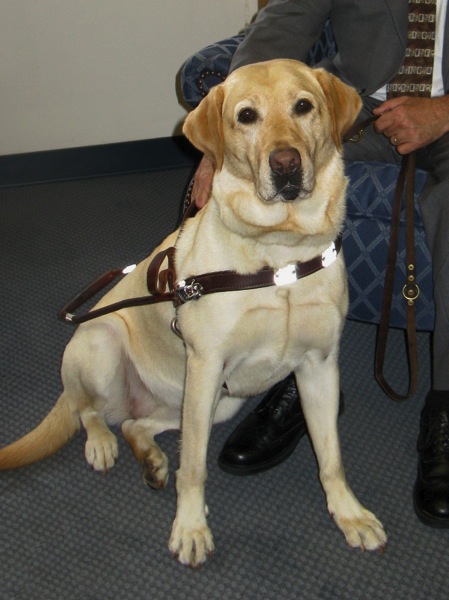
“A Guide Dog’s Tale”


 IMG 0073


New Yorkers love dogs and you always see them, otherwise grounded men and women, cooing, emitting coloratura snippets to leashed Havanese and Yorkies and walking sideways. I enjoy them–canines and partners–for their barmy incapacities. I follow with my guide dog Nira, my $45,000 pal, my yellow Lab trained for traffic and wonder where these people and dogs should live? 


Ahead of us a man with a miniature poodle scolds it for being alive. “You shouldn’t do that, you know,” he says dropping the question mark–and though I can’t see what the dog has done I know it wasn’t a matter of conscience. I don’t have time to think however because Nira has stopped. There’s a problem.  Our path isn’t clear. We’ve hit a construction site with jackhammers. The noise precludes speaking. We stand in threatening air. We can’t ask strangers where in the hell we are. The blind have to ask passersby lots of things–what street is this? Are we near a subway? Can you help me find a cab? You can’t be shy. Meanwhile Nira isn’t fazed by construction and backs up, turns, deftly finds the detour and follows corrugated boards until we’re back on the sidewalk. She’s a pro.


That’s the thing about Manhattan–its dog owners and dogs are amateurs. The poor things are like stilt walkers on day one, hurtling all rickety up sixth avenue, headed for the park. If Nira could talk she’d say how sad it is, tens of thousands of half-decorticated dogs dizzied without purpose. “Dogs,” she’d say, “are meant to have purpose beyond enduring moist speech, all lovey-dovey–”does Snookems want to go walky? Kiss kiss.”” 


And so we decide, guide dog and man to relate the abjections of New York dogs, recording what we’ve heard. This isn’t hard as the dog owners of New York City are verbally expulsive and prove Kierkegaard’s assertion that “people demand freedom of speech as a compensation for the freedom of thought which they seldom use.” For instance the woman on Amsterdam Avenue near 81st Street who was dragging her Pomeranian. “You’ve had enough,” she said. “You’ve had enough and enough is enough!” Nira was wearing her harness, all business, guiding me. We stopped. Nira sat. 


I asked the woman what she meant. I said: “Excuse me, but is there something on the ground that your dog was eating?” 


“What?” she said. 


“Eating,” I said. “Was your dog eating something?” 


“Oh no,” she said, “We’ve had enough of staring at nothing! This stupid Pomeranian just stares at nothing. I’ve had enough of nothing!” 


I nodded. I inherited this trait from my father, a Finn. I thought of Wallace Stevens famous poem “The Snowman”–”the nothing that is not there/and the nothing that is.”  We were having Amsterdam Avenue metaphysics. I thought how if I had world enough and time I could tell the woman what dogs see, tell her that the Pomeranian is really a Cubist of colors and movements with a much wider visual field than humans and that its entirely possible the street is dazzling the dog who has hit the brakes out of instinct. But I was a coward, fearing a conversation that would become a bolus, a chewy lump of bread you can never swallow. She went away, dragging her rust colored and vaguely frightened dog and I felt remorse as if I could have saved the poor creature with instructions for her owner–”Take it from a blind guy, you can’t stare at nothing.” “Your dog is having an allergic reaction to motion. Talk to her, a little cajoling and reassurance would be good for both of you, yes?” “Personally, I get by on cajoling and reassurance Lady.” This is no joke. 


Successful guide dog work depends on cajoling. Or if not quite cajoling, elaborate praise. You’re taught to say “Good dog!” with musical sincerity and to say it throughout the working day. You say it when your dog stops at a curb. When she stops at the stairs. Or when she passes around a dropped bicycle or ignores a fallen pizza slice. “Good Dog!” You say it as if you’re learning Swedish–putting some musicality into it. Working dogs love praise. And you give praise all day. Perhaps a hundred times during a 24 hour period. She absorbs the rolling nightmare of trains and skateboarders and staggering drunks and buses running red lights and you sing to her in cartoon Swedish, “Good Girl!” In turn this reassurance flows backwards, fills you. You’re a competent blind guy sailing through crowded streets or down the tunnels of Grand Central Station. This competency has everything to do with letting your dog be a dog; “follow your dog” they say at the guide dog school–she knows what she’s seeing, knows what to do. Your job is to know where you want to go. Hers is to get your there. We get by on mutual instruction and tandem praise. When Nira is good I’m good. And vice versa. 


In Central Park we met a German Shepherd dragging its man to a dog run. Because I could see just a tiny bit I understood the man was too thin for his dog–he was in danger of getting hurt. The guy was skating and the dog surged like a locomotive and it panted like a locomotive and the man cried: “Dolly, Dolly! You’re gonna break my sandwich!” The sandwich was the least of the man’s problems. He raced by, crying against fortune, his sandwich, the volition of Miss Dolly, his shoes slapping pavement. I decided to sit and listen to the dog run people and give Nira a biscuit or two. Right away a woman asked if I wanted to let Nira run. I said no. “We’re just stopping for a second,” I said. 


“Well you ought to let her run, poor thing, she gives up her life for you.” she said.


“Yes,” I said, “we live in a Boolean equation, where my life is X and hers is X minus 2.” 


“What does that mean?” said the woman. 


“It means,” I said, “our lives are running down in equal measure. Why hell, we’ll probably die at the same time. We’re all giving up our lives in algebraic co-efficients.”      

“You’re pulling my leg,” said the woman. I shrugged. I asked her what her dog’s name was. 


“His name is Jasper,” she said. 


“Let me guess,” I said, “he’s a Dalmatian.”


“How’d you know?” she asked.


“Because Jasper is generally spotty.” I said.


“Tell me,” I asked, “what does Jasper do for you?”


“He doesn’t have to do anything,” she said. “He’s free to be a real dog.”


“I see,” I said. “So a working dog like Nira isn’t real in your view?”


“That’s right,” she said, “your dog is a slave.”


Then there was pandemonium. Jasper evidently swiped a nanny’s iPhone and was running in cursive and onlookers shouted as he chewed it, the dog eluding middle aged men in suits and loafers. Jasper was unfettered and alive and the incitement for a fight–the nanny and Mrs. Jasper got straight into it–who was going to pay for the phone? Not Mrs. Jasper. Her dog was a free spirit. Nanny, you see, should have kept her phone in her purse. Nanny disagreed but made the mistake–the big mistake of characterizing Jasper’s “freedom” as “uncontrolled” –a charge that Mrs. Jasper equated with apostasy, for Jasper, like all untrained dogs, stands for “the Id” and you’re a pretty sorry specimen if you don’t understand it. You shouldn’t bring your super-ego to the dog run. Its the wild west. Etcetera. Nira and I got out of there. 


We walked east toward Fifth Avenue. Wasn’t it Auden who said the roses really want to grow? “Dogs,” I thought, “really want to work.” And working dogs get plenty of play time. In Nira’s case she swims, plays tug of war with a Shih Tzu named Harley, inveigles everyone she meets for belly rubs, and gets to go everywhere I go–none of that dolorous waiting around the dark apartment for hours on end that marks Jasper’s life. No wonder the poor sonofabitch steals iPhones–he’s pure Id–he’d eat the daylight if he could. And that’s the thing about Mrs. Jasper: she exemplifies the cosseted, ingrown anthropomorphism of New York City’s dog owners, a thing beyond “love me, love my dog” for the impulse, the relieving projection of straightened circumstances onto animals      is darker, tangled up in the blankets of capitalist misery and so in turn your silly dog gets to be a wolf. Or like the Pomeranian, just an ambient stuffed toy. 


Paralympic Pimples

There’s a prevaricating article in this morning’s New York Times about Victoria Arlen a Paralympic swimmer who has been ruled ineligible for competition because its possible her disability may improve. What’s missing from the piece and the concurrent debate with officialdom is that disability is not a medical condition (though diagnoses play a role) but rather a series of constructed obstacles. I am blind but with the proper accommodations I’m capable of achieving many goals. Ms. Arlen is currently severely impaired and capable of swimming in the Paralympic competitions, save for the odd shilly-shallying from medical experts who say she might conceivably improve–that her disability is therefore not permanent. Well forgive me for barking! Life isn’t permanent. Able-bodied-ness isn’t permanent. My blindness may not be permanent. What with the remarkable research with stem cells my friend L may discover her multiple sclerosis isn’t permanent.


Using the logic of the Paralympics, able bodied people shouldn’t be allowed to compete in able-bodied sporting contests because their physical conditions are not guaranteed.


Maybe in five years Victoria will be running across Nebraska without a disability. But she’s got a disability today. She will have it tomorrow. Shame on the Paralympics for relying on 19th century ideas both about medicine and disability.


The Scary Milk Man

NewImage


I remember the milk man coming to our door, circa 1960. Blind kid and strange man with white coat. I feared he was a doctor. Blind kid who had been in hospital plenty of times already by the age of 5. “Ding Dong!” Its the doctor. Talk about a melancholy breakfast, eh Larry Rivers? 


This was in mind, as Lance Mannion told me about the butter sculpture at the New York State Fair–many years ago mind you–but his own son, then around five, saw a vast butterized statue of a milk man and, hearing that back in the day such a figure really existed, opined that his father was pulling his leg. Who would dress up like a doctor and deliver milk? 


Perhaps I’m also in mind of this theme–the ersatz doctor–because tomorrow I will be a respondent when my colleague Bill Peace delivers a paper at Columbia University on the notorious Dr. Kevorkian. The nexus of unconscious figurations is fair amazing: man in white coat and driving a funny van pulls up to your house. Old joke from Jay Leno: “Do you suppose when Santa Claus visits Dr. Kevorkian’s house he tries the milk and cookies?” 


Scary ersatz doctors, frightening “faux” bio-ethicists, maybe toss in Ingmar Bergman’s “death” from the Seventh Seal… 


I’m taking a stab against nostalgia. I think its good the milk man is now a mythology in butter. 


Inclusion Now

DPI logoG3ict logo

PRESS RELEASE 

FOR IMMEDIATE RELEASE

Contact: Francesca Cesa Bianchi fcesabianchi@g3ict.org

NEW DATA FROM THE 2013 CRPD ICT ACCESSIBILITY PROGRESS REPORT SHOWS URGENCY FOR THE UNITED NATIONS TO PROMOTE A DISABILITY INCLUSIVE DEVELOPMENT AGENDA
 

Preliminary findings of the third edition of the CRPD Progress Report on ICT Accessibility will be released this week by G3ict – the Global Initiative for Inclusive Information and Communication Technologies, in cooperation with DPI – Disabled People’s International, on the occasion of the General Assembly’s High-Level Meeting on Disability and Development at United Nations Headquarters in New York.  
 

NEW YORK, NY (September 23, 2013)  Underlining the urgency for the United Nations to adopt a post-2015 development agenda inclusive of persons with disabilities, the CRPD 2013 ICT Accessibility Progress Report includes the latest data measuring the degree to which 72 States Parties are implementing the accessibility provisions of the Convention on the Rights of Persons with Disabilities (CRPD). 

The report, developed jointly by the Global Initiative for Inclusive Information and Communication Technologies (G3ict) and Disabled People’s International (DPI), offers disability advocates, governments, civil society and international organizations benchmarks for country laws, policies, and programs pertaining to accessible and assistive Information and Communication Technologies (ICTs). Results cover 65 percent of the world population.                  

While noting some progress in implementing core dispositions of the CRPD, the report documents significant deficits in promoting policies and programs to make essential services accessible to persons with disabilities around the world.  For example:

● 50 percent of countries – compared to 31 percent in 2012 – now have a definition of accessibility which includes ICTs or electronic media in their laws or regulations in compliance with the definition of accessibility in CRPD Article 9, but only 25 percent define, promote and monitor accessibility standards for ICTs.           

● In 2013, about 73 percent of the countries have dispositions to consult persons with disabilities in the development of disability-related policies and programs, but only 12 percent have a systematic mechanism to involve Disabled Persons Organizations (DPOs) working in the field of ICT accessibility for the drafting, designing, implementation, and evaluation of laws/policies.               

● Only 31 percent of the countries have government funds allocated to programs in support of ICT accessibility in both 2012 and 2013, indicating a lack of progress,

● In 2013, only 31 percent of the countries report that they have public procurement policies promoting ICT accessibility, meaning that a majority of countries continue to buy equipment or services which may be inaccessible to persons with disabilities; and           

● In relation to the above, only 35.6 percent of countries in 2012 provided services to the general public, including through the Internet, in accessible and usable formats for persons with disabilities, while 40 percent of countries report providing such services in 2013.   

The accessibility of the information infrastructure, a vital area of ICT accessibility with the greatest impact on the largest population of users, is lagging behind ratifying countries’ general commitments to the CRPD: More than 80 percent of countries in 2013 report no or minimum levels of implementation of policies or programs promoting accessibility in critical areas such as mobile telephony, web sites, fixed telephony, transportation public address systems, television or Automatic Teller Machines (ATMs).

Javed Abidi, Chairperson of Disabled People’s International stated: “Depriving persons with disabilities from equal access to essential ICT-based applications and services violates the core dispositions of Article 9 of the Convention of the Rights of Persons with Disabilities and creates an unsustainable economic and social development gap in our digital age.”        

Table: Accessibility Policies for Specific ICT Technologies, Products and Services by Level of Implementation

Are there any dispositions among Country laws, regulations and government supported programs promoting digital accessibility, the use of ATs or provisions from reasonable accommodations in the following areas of ICT?  No   Minimum   Partial   Substantial   Full 
Copyright Exceptions 84% 7% 6% 3% 0%
ATM or Kiosks 69% 21% 7% 0% 3%
Fixed Line Telephony 65% 14% 13% 6% 1%
Wireless Telephony 65% 18% 9% 4% 4%
Public Building Displays 64% 26% 7% 1% 1%
Digital Talking Books 64% 17% 14% 3% 1%
Transportation Public Address Systems and Services 59% 25% 12% 4% 0%
Websites 54% 29% 10% 7% 0%
Television 29% 51% 15% 4% 0%

A second critical gap, which speaks to the role of persons with disabilities in the implementation of the CRPD, involves the support of DPOs. States Parties’ policies are inconsistent with Article 4 (i) 3 of the CRPD and reflect a lack of respect for the participation of persons with disabilities: About 67 percent do not offer financial support for DPOs and NGOs for their work in developing policies and programs.  Yet, regression analysis across 72 countries data sets reveals that the participation of persons with disabilities is a common denominator among countries with the most successful ICT accessibility implementations.      

A third vital area of information and ICT accessibility related to the CRPD, and which remains low among surveyed countries, involves awareness raising and capacity building for persons with disabilities and key stakeholders. While 53 percent of the countries promote awareness-raising and training programs about the CRPD, a mere 10 percent provide mandatory training programs for future professionals about digital access for persons with disabilities;

This is inconsistent with Article 8 of the Convention and reflects a lack of understanding of the relationship between digital access rights and the capability of countries to engage in capacity building and inclusive development efforts to reflect CRPD dispositions.

Knowing how much progress is actually accomplished by CRPD ratifying countries in ICT accessibility is an essential step for all stakeholders in order to address gaps and opportunities in their own countries. While most countries are generally aware of their basic obligation to implement ICT accessibility, they have not: (1) translated essential CRPD dispositions into actual policies or programs, and (2) included persons with disabilities in the foundational countrywide policy development processes and capacity-building necessary to achieve valued outcomes.  As a result, more than one-fifth of the world’s population may be vulnerable to a digital divide.      

Axel Leblois, President and Executive Director of G3ict said: “This 2013 edition of the CRPD ICT Accessibility Progress Report, which covers two third of the world population, documents critical global gaps in ICT accessibility. Those facts call for the United Nations post-2015 agenda to incorporate ICTs as a critical success factor for the inclusion of persons with disabilities.”

Each of the critical areas of the Convention cited above present opportunities for improvement by ratifying countries, particularly in relation to their capacity for implementation and involvement of persons with disabilities and other stakeholders.  Bridging those vital gaps requires more than Governments work and resources. It requires a long-term partnership between the public sector, industry, DPOs and NGOs.

Overview and Methodology | List of Participating Countries | 2013 Summary Tables

The full report, with detailed data and analysis, will be available as a free download on the G3ict and DPI websites by November 15, 2013.

###

About G3ict

G3ict – the Global Initiative for Inclusive Information and Communication Technologies – is an advocacy initiative launched in December 2006 by the United Nations Global Alliance for ICT and Development, in cooperation with the Secretariat for the Convention on the Rights of Persons with Disabilities at UNDESA. Its mission is to facilitate and support the implementation of the dispositions of the Convention on the Rights of Persons with Disabilities (CRPD) promoting digital accessibility and Assistive Technologies. Participating organizations include industry, academia, the public sector and organizations representing persons with disabilities. G3ict organizes or contributes to awareness-raising and capacity building programs for policy makers in cooperation with international organizations, such as the ITU, ILO, UNESCO, UNITAR, UNESCAP, UN Global Compact and the World Bank. In 2011, G3ict launched the M-Enabling Summit Series to promote accessible mobile phones and services for persons with disabilities in cooperation with the ITU and the FCC (Federal Communications Commission). G3ict produces jointly with ITU the e-Accessibility Policy Toolkit for Persons with Disabilities (www.e-accessibilitytoolkit.org), as well as specialized reports which are widely used around the world by policy makers involved in the implementation of the CRPD. Visit www.g3ict.org   

About DPI

Disabled People’s International (DPI) is a dynamic grassroots global organization headquartered in Canada, with five Regional Development Offices in Africa, Asia, Europe, Latin America and North America and Caribbean, operating in three official languages: English, French and Spanish. Established in 1981 and granted ECOSOC (United Nations Economic and Social Council) status shortly thereafter, DPI has 134 National Assemblies (country organizations) of persons with disabilities worldwide. Since its inception, DPI has collaborated with the United Nations (UN), civil society, governments and disability-related organizations to produce and disseminate information on disability worldwide.  DPI supports persons with disabilities around the world in their efforts to realize their human rights. It does this by promoting the full participation of persons with disabilities in all aspect of their community and by encouraging the equalization of opportunities and thereby, outcomes for persons with disabilities. Visit www.dpi.org


United Nations on the Side of People with Disabilities


From the UN:


23 September 2013 – The rights of persons with disabilities must be directly addressed by the post-2015 development agenda, United Nations officials told world leaders today, urging them to adopt national and international policies that enhance and promote disability-inclusive development.

“Disability is part of the human condition; almost everyone will be temporarily or permanently impaired at some point in life,” Secretary-General Ban Ki-moon said at the General Assembly’s High-level Meeting on Disability and Development.

See full article here.

Guide Dog Bonding

Bonding with a guide dog differs from pet love–though not because of love. All around us we see men and women who love their dogs, and children too. The little girl who lives next door has dressed her Labradoodle in her mother’s clothes–shorts and a blouse. The dog is bounding up and down the lawn–being herself–fully alive–wearing the garments of sad adulthood without reflection or displeasure. And the girl is laughing so hard she has to lie down in the grass. 


Pet love is a form of resilience.  Dogs cheerfully keep us going. “By your leave,” says the dog, “I will be the weight in your clock, steady, standing with and against gravity.” Don’t kid yourself–dogs know how to say these things. And sometimes they just dance around in your mother’s beach clothes. 


Bonding with dogs can be silly. I dislike those cable television dog trainers who pretend for profit that creating a well mannered dog is like going to church. Dog training is really nothing more than a loving game and anyone who says otherwise is out for easy money. 


A loving game. But as I’ve said, guide dog bonding is a different form of love. 


At Guiding Eyes trainer Y shows a young man from the Bronx how to throw a long rope with a rubber pineapple attached. The student in question has never been out of the Bronx. Just think about that. Y is showing him how to play with a dog. 


How do you teach a person to play? Give him a dog and a pineapple attached to a rope.

Y tells Malcolm to pretend he’s fishing. “Just reel your dog in,” she says. Malcolm’s dog is an enormous  yellow Lab named “Herc” as in Hercules, and he’s got the pineapple and he’s running circles around a very large room–growling in a canine version of giggling, his paws scrambling on the tile floor. He’s canine electricity, all juice. “Just reel him in,” Y says again, and Malcolm grabs his end of the rope and puts his back into it. Herc raises his head, surmises the rope’s slack is disappearing, and takes up a lion’s crouch and times the moment of tension perfectly and yanks Malcolm forward–about a yard forward–and suddenly the man is laughing. He’s laughing in a new way. It doesn’t mean he’s never laughed before. It means he’s never laughed with a dog. He’s never laughed with a dog that’s already walked him through traffic with excellent results. He’s never laughed with anyone who he could trust and who also hungered to be silly.


Waxing with the Whales


I was riveted when I read the following this morning:

“From a fetid, foot-long rod of earwax, extracted from the skull of a dead blue whale, scientists have unspooled an in-depth life story of one member of the largest mammals on earth. These waxy diaries could give marine biologists a new way to study the lives of a free-swimming species, and a window into the health of the ocean at large.

"It might be the only life history of any free-ranging animal," Stephen Trumble, a marine biologist at Baylor University, told NBC News.”

You can read the full story here.

I must admit this isn’t news–I mean, leaving aside marine biology, I’ve always known ear wax is really a museum. I’m deaf from wax and devote gobs of time to private, archaeological explorations of wax, my cerumen, my greasy private journal. 

Here’s a tipple from 1982 whispering of the Strindberg Cafe in Helsinki where I spent a wintry day reading Spinoza. Spinoza it turns out is a major cause of ear wax. Oh, and here’s wax from a brief visit to the Greek island of Santorini where I befriended a pelican. I can find everything I need to know about myself from knots of deafness. And I’m a free ranging animal. I’ve left my wax in the Baseball Hall of Fame and the Golden Temple of Kyoto. I once dropped some in Yankee Stadium–the old Yankee Stadium–the one Steinbrenner tore down so he could build the George Mahal. And ear wax in Venice; Tallinn; Berlin; Kingston, Jamaica; Osaka; Los Angeles. Place my orts under a miscrocope and you’ll find I wandered like a good whale, krill seeking, mis-hearing songs. 

Oh my sisterly and brotherly whales! So wild a sea! And stretching over Sado Isle, the Galaxy! (Basho)


Your Dog Reads You with Sufficient Irony to Get the Job Done

My guide dog knows more than I about this moment. I’m trapped in the solo gravitation of my thoughts, seeing the day to come. I’m pondering a business suit–how I have to don it–and wear disagreeable shoes–and then I will pose as an alert grownup all day. 


All moments are elastic and un-cinctured. Dogs know. Just now its tug of war time. And what a relief! My blue, pin-striped suit disappears in the fog of memory and I hold a wet rope and a Labrador drags me three feet across the floor. I growl because that’s what you do when you’re being dragged. There’s joy down here in the lizard brain. We were in danger of forgetting it.


Well, not “we” of course. I was in danger. I was thinking of the future perfect with ablative nuance. My dog was swinging a rope. 


“Before you get too comfy,” she says, “Let’s tear something apart!”


**


Everyone knows dogs bring us joy. I think they’re transmission engines. They push us from customary thinking into liminal space if you let them. You must see in your dog an intelligence equal to your own, though its more selective. Dogs are superbly critical and discerning. People tend to think of them as cartoon-ish “will-o-the-wisp” happy wanderers, drawn by smells, motions and appetites. But dogs read us. I think they read us in a Hebraic way, from right to left and from the back of the book. Dogs think of us as creation mysteries. They scrutinize the delicate motions and little frowns and sidelong glances of their human partners and see that its time once more to rejoice in the garden and the two-leggeds need to be dragged into the light. 


From DREAM: Disability Rights, Education, Activism, and Mentoring Sponsored by the Taishoff Center for Inclusive Higher Education at Syracuse University


Email Update on Issues Related to Disability and Higher Education Week of September 9-13, 2013
 
(Sorry for the delay, we were experiencing some technical difficulties!) 
 
 
Disability and higher education in the news (in no particular order):
 
Related items of possible interest to college students with disabilities:
 
  • NYU has created the NYU Postdoctoral and Transition Program for Academic Diversity Fellowship Program to attract and support promising scholars and educators from different backgrounds, races, ethnic groups, and other diverse groups whose life experience, research experience, and employment background will contribute significantly to academic excellence. For more information, visit: http://www.nyu.edu/life/diversity-nyu/postdoctoral-and-transition/Faq.html 
  • Seeking submissions for an anthology with the working title “Faces of Faith Through Disability.” The final work will focus on discussions that are both interfaith and cross-disability. Please send submissions that are between 750 and 1,500 words. Focus areas can be any aspect of the experience of belonging to a faith community as a person with a disability, or attempting to belong to a faith community. Both positive and negative experiences are welcome. Submissions should be sent to Josie Byzek, MAR, Josiebyzek@gmail.com, by December 15, 2013.

For more information about DREAM or the Taishoff Center, contact:Wendy Harbour (wharbour@syr.edu) Or check out the DREAM website at http://dream.syr.edu To subscribe or unsubscribe to the DREAM email list, send an email torazubal@syr.edu