At the Poetry Conference
He was important to himself in every weather
though he couldn’t remember why—
as there was always Yeats.
Still he was looking rather great
in Banana Republic leather.
At the Poetry Conference
He was important to himself in every weather
though he couldn’t remember why—
as there was always Yeats.
Still he was looking rather great
in Banana Republic leather.
Disability is the orphan of multiculturalism. There. I’ve said it. It’s painful to do so. Painful because my politics are inclusive and I worry daily about other people’s children, children of all colors. Worry about cruelty, joblessness, violence, the prison-industrial-complex; worry about misogyny. I teach against these things. I’ve marched for gay rights. Written against the war. But now at 58, (I’ll be 59 in three weeks) I’ve grown impatient with the able-bodied pure products of America because my people, all 60 plus million of them, who are arguably the largest minority group in this nation—are still ignored by television, radio, newspapers, Hollywood, academic conferences, hotels, airlines, you name it, unless we tell an “overcoming story” in which the reality of disability is ameliorated by a Tiny Tim smile, a miraculous cure, or a two day allowance where a kid with Down Syndrome gets to be on a basket ball team. The reality of disability must always be suborned, deflected, pushed into a closet. Meantime, real disabled people are almost 80% unemployed, their food stamps and disability support services are being cut to pieces, rehabilitation programs are woeful and inadequate, accessibility guarantees required under the ADA are bypassed by a zillion businesses and institutions of higher learning. As the old song goes: “its a hard knock life, for us.”
What’s got me going this morning is that the wrongs in cripple-ville outweigh the rights and it needs to be said. Where are the able bodied progressives? Why are they not on the team? It can’t be because they think disability is “catching” can it? It can’t be some kind of religious suspicion we’re afflicted owing to divine punishment can it? It isn’t embarrassment at being seen with a wheelchair or a white cane is it? Ah, it must be plain old fashioned utilitarian philosophy: the needs of the largest group outweigh those of the minority. It hurts the big group to help the lame and the halt. No, that can’t be it, because disability is the only democratic and universal minority. The larger body politic has disabled friends and relatives. Hmmm. Well, then, it must be that in America if you’re not able bodied you’re imagined to be a slacker, a mooch, a leach.
You’re also probably some kind of faker.
I’m tired of being left out of academic conferences that have no inclusion policy.
I’m tired of visiting colleges and universities where the student disability services are hidden and where the people who run them are without competency in disability as culture—where the website is a bulwark against getting accommodations.
I’m tired of being told I can’t go into a restaurant because I have a guide dog.
Tired of crappy airline service; inaccessible taxis; bulbous headed flat footed department store detectives; police who taser bus passengers with mental illness; the Veterans Administration with its disgraceful rehabilitation services for soldiers; tired of the term “wounded warriors” as though a disability was just a “boo boo” that will go away when we pull off the “ouchless” band aid. Who was the asshole who decided “wounded warrior” was better than disability? Of course!
Wounded Warrior implies “overcoming”—that disability will just go away, that its not a life long issue. The Wounded Warrior Project should have Tiny Tim as its logo. Sorry. But a disability is permanent, its not a wound, and its going to get worse with age.
Yes, disability is the orphan of multiculturalism. Its not sexy enough for able bodied progressives despite our efforts to dress fashionably in some circles, to vamp our ramps.
You see, we’re just food stamp people with canes and wheels. Unless we smile like we’re being electrified and sing the sun will come out tomorrow.
Why are there no sections on disability at Huffington Post or the Nation?
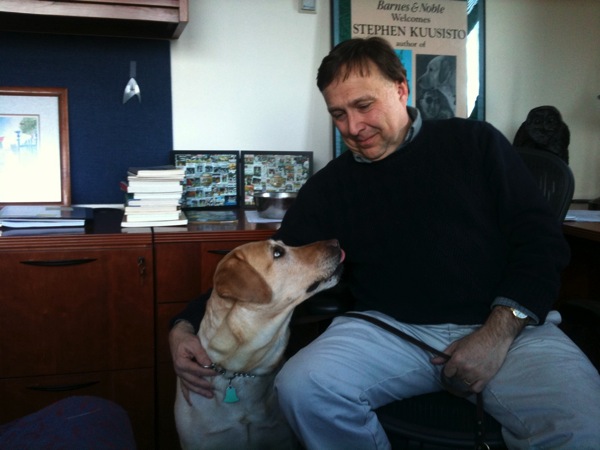
Photo of Stephen Kuusisto and his guide dog Nira, a yellow Labrador, in Kuusisto’s office at Syracuse University.
“At Twenty we find our friends for ourselves, but it takes Heaven/To find us one when we are Fifty-seven.”
—W.H. Auden
Heaven-Friend-Dog, you are vexing, for I love you in all seasons and you love me back, and all without irritable reaching and bad memories.
You’re not my therapist. I’m not your master. A guide dog and man are an occurrence. We’re a walking “happening” whether going forward or astray.
You’re vexing because a soiled man-mind needs problems, thinks irritations are consciousness and you, Heaven-Dog, know otherwise.
When we’re Fifty-seven and set “right” by doggish clarity its like being corrected by a child: “No, Daddy, that’s not what you said!”
My dog knows the better “me”—the one who lives outside the shaming culture.
That’s a friend.
Outside the shaming culture.
With Heaven-Friend-Dog I’m one of Victor Turner’s liminal figures—the Laplander who sails clear out of the fire lit circle and vanishes into the unknown. Shaman, vatic runner, knife in the air, twin invisibles riding Pegasus… Whatever we are, we’re not customary able bodied upright American walkers. Which means our motion is transgressive. We’re the very fast, and very wrong thing on the sidewalk.
But outside shaming culture we’re the right thing. And the hypnogogic sidewalk can go fuck itself.
Sidewalk with its ordinary sleep walking 9-5 walking dead. People shlepping along with their backpacks filled with computers and sad lunches…We race by, heading up a mountain of birds. It’s so good to not be you, sidewalk friend. I’m so profoundly glad to not be you.
Outside the shaming culture we don’t care about our physical difference, don’t care about Dickens and his disability sadnesses, don’t give a monkey wrench about the Brooks Brothers’ guy who sees us and thinks we’re the saddest things on earth, a blind guy and dog. It doesn’t dawn on Mr. Gray Flannel that we’ve just passed him on Pine Street in Seattle; that we’re walking three times faster; that we’re laughing.
We’re laughing, because I can laugh for my dog.
That’s a friend.
Yesterday I was driven across the length of Chicago’s O’Hare airport in an electric cart. My guide dog Nira sat beside the driver, smiling, enjoying the view. Old and young people pointed as we rode past—delighted at the vision of a big yellow Labrador who was in turn delighting. It was a Mardis Gras moment. I felt like throwing beads at the crowds like the firemen in New Orleans.
Most of my airport experiences are rotten, many have been humiliating. But yesterday was good. People were happy to share space with me and Nira on our flights. Airline personnel were cheerful. When I arrived home in Syracuse and was waiting for my wife Connie to pick us up, two young women who worked for Delta wanted to give Nira a biscuit.
Chances are good if you have a disability you’ve had a lot of lousy days while traveling. But once in awhile you’re treated like a citizen. You get home without the usual dignity scouring miseries that accompany public attitudes about physical difference.
So it was a good day. But there will be tomorrow. And the tomorrow after that. One has to cope on a regular basis with the inherent self-privilege of able-bodied people—whether they’re university professors or airline personnel—the moue of unhappiness, the frown, the overt expression of inconvenience, worn on the face without irony or shame, all because you’ve insisted on being treated like a citizen. It’s a hard knock life, indeed.
“And what does it mean when the monster is us?” asks our panel’s event description.
The Oxford English Dictionary: monster meaning, “a mythical creature which is part animal and part human. . . any imaginary creature that is large, ugly, and frightening . . . a disfigured person . . . misshapen being . . . an individual with a gross congenital malformation. . . an ugly or deformed person, animal, or thing.”
Rosemarie Garland-Thomson writes, “The historical figure of the monster, as well, invokes disability, often to serve racism and sexism. . . . As departures from the normatively human, monsters were seen as category violations or grotesque hybrids.”
I am a “category violation,” a “disfigured person”—born with bilateral talipes equinovarus—better known as two club feet—that were surgically corrected when I was an infant. Born with Beta Thalassemia, a hemoglobin abnormality. Then later, chronic pain. For 25 years, I have experienced some form of chronic pain, whether related to the Reflex Sympathetic Dystrophy Syndrome I developed as a 10-year-old, or to the seemingly hormonal constellation of pain issues that began with menstruation: migraine, debilitating mastalgia, uterine fibroids, endometriosis. But even though pain has been a constant presence in my life, as have physical therapists, endocrinologists, hematologists, pain specialists of all kinds, I only began to write poetry about pain in the last year and a half, after a week’s stay at the renowned Mayo Clinic led me to understand there was no cure, there would likely never be relief. I would have to find ways to live with pain, not cure it. I would have to grow comfortable with my monsterhood.
Elaine Scarry writes in her influential book The Body in Pain, “Thus pain comes unsharably into our midst as at once that which cannot be denied and that which cannot be confirmed.” Later, she describes “how inaccessible the reality of physical pain is to anyone not immediately experiencing it.” This unsharability and inaccessibility of pain is also discussed by Megan O’Rourke in her essay “What’s Wrong with Me?” which details her struggle with an autoimmune illness. O’Rourke writes, “One of the hardest things about being chronically ill is that most people find what you’re going through incomprehensible—if they believe you are going through it.”
Let’s linger there: “if they believe you are going through it.”
One of the complicating factors of my kind of monsterhood is its invisibility. “But you don’t look disabled!” people tell me. “But you’re such a happy person!” Both are true statements.
Unless you see the scars running up and down each of my heels, unless you see me lying awake at night, unable to sleep from pain, unless you see me on the phone with nurses, pleading with doctors to do something, anything, to stop the pain, crying in the car on the way home.
Susan Sontag writes in her influential essay, “Illness as Metaphor,” “For purposes of invective, diseases are of only two types: the painful but curable, and the possibly fatal.” Chronic pain is neither; it exists in a murky middle ground that discomforts physicians, patients, and society alike: the person with chronic pain will not be cured, and will not die (at least not from pain). And her pain isn’t even diagnostically verifiable.
As Tobin Siebers writes in “Disability in Theory: From Social Constructionism to the New Realism of the Body,” “The greatest stake in disability studies at the present moment is to find ways to represent pain . . . There are only a few images of pain acceptable on the current scene, and none of them is realistic from the standpoint of people who suffer pain daily.” Even in a field like Disability Studies that should be attuned to issues like chronic pain, there is a dearth of creative and scholarly discussion of the pain experience. Bodies like mine—monsters who can “pass” as healthy, who can hide their monsterhood at least some of the time, monster bodies like werewolves who seem “normal” but transform unpredictably from “normalcy” into sites of unbearable pain—remain invisible.
And what does it mean when the monster is us?
Disability Studies has taught us the social construction of disability, feminism and critical race theory have taught us the social construction of bodies. We construct “normalcy” and monsterhood. We decide what bodies to celebrate, what bodies to denigrate. Garland-Thomson writes, “Disability reveals the essential dynamism of identity. . . . it undermines our fantasies of stable, enduring identities in ways that may illuminate the fluidity of all identity.” Identity is fluid. The body is fluid. Disability and ability are fluid.
Early in the 18th Century, the definition of monster shifted to denote, “an extraordinarily attractive thing . . . an amazing event or occurrence. . . a prodigy, a marvel. . . a remarkably successful person or thing.”
Examples from the Oxford English Dictionary:
1931 New Yorker. Daddy, what’s a Second Monster Week?
1968 Rolling Stone. Of course, man, she’s a monster. She’s like the best
of that type of singer.
A year and a half ago, I began to write my pain experience because the Mayo Clinic doctors—some of the best in the country—told me pain was my future. There is no cure. Indeed, there is not even a diagnosis. I began to read: Paul Monette, Audre Lorde. Body as a site of loss. Body as scarred. I wrote to try to make sense of my monsterhood, what it would mean to live the rest of my life in pain. With good days, with good months. With bad days. With month after month of pain. I wrote to try to communicate the incommunicable, the unshareable and untranslatable body in pain.
I read Peggy Munson’s Pathogenesis:
“I should have walked on cobblestones that day. While I could still take walks.
I try to sing when the perpetual is good.”
The monster body as misshapen, disfigured, ugly, only partly human.
The monster body as attractive. Remarkably successful. Prodigy. Maybe even sacred.
There are many risks associated with admitting monsterhood when you can pass as “normal.” But in the past year and half, writing my monster body in all its gruesome details, all the nights I couldn’t sleep, all the time I spent in doctor’s waiting rooms, something began to grow in me. Not acceptance—I still will work to be pain-free. I still dream of a life without pain. But maybe a truce. With my body’s many disfigurements. My body’s many successes. bell hooks writes, “Only in fully knowing the wound could I discover ways to attend it.” The monster I am writing towards, the wound I am learning to know, growing towards: a vision of myself as: “Of course, man, she’s a monster. She’s like the best.”
I walk with a stick and a dog, down river, up, no one can tell me how its done. A few understand
and sing as I pass—the songs are fine—but there are turns in a stream where songs fall apart, they’re only melody.
When I was a boy a stove abandoned and filled with crickets was opera—blind kid, twilight blues, the moon coming on blues, and so my first lesson. Later Auden would refine it: “the roses really want to grow”.
Crickets sing a house—find homes—say something.
Oh but the walking blues, songs to poems, walking with a stick and dog.
Michael Cuddihy: Each time breath draws through me,/ I know it’s older than I am.
Basho: The journey itself is my home.
Levertov: I saw/ a leaf: I shall not betray you.
Hsieh Ling-Yun: Joy and sorrow pass, each by each,/ failure at one moment, happy success the next./ But not for me. I have chosen freedom/from the world’s cares. I chose simplicity.
Dog and stick, down river, up, a crescent moon, poems remembered.
Rexroth: Water/ Flows around and over all/ Obstacles, always seeking/ The lowest place./ Equal and/ Opposite, action and reaction,/ An invisible light swarms/ Upward without effort.
Niels Bohr: Everything we call real is made of things that cannot be regarded as real.
Jan Kaplinsi: The sea doesn’t want to make waves./The wind doesn’t want to blow./Everything wants balance, peace,/and seeking peace has no peace./If you understand this, does it/
change something? Can you be peaceful/even where there is no peace?
Sam Hamill: I’d kiss a fish/and love a stone/and marry the winter rain/if I could persuade this battered earth/to let me make it home.
Kuusisto: I’m filled with tangled string. A look contains the history of man. (Auden) Some days I’m grateful I can’t see your faces. Mutual need. Mutual aid. Simple. But even Anarchists are specious. I once introduced myself to Utah Philips, said, in the manner of all young pepole: “Its a thrill to meet another anarchist.” He glared at me. Said nothing. And of course I couldn’t see his face. His anarchy had a small “a”.
Stick and dog…
Sam Hamill: Fish, bird, stone, there’s something/I can’t know, but know the same:/I hear the rain inside me/only to look up/into a bitter sun.
Sam Hamill: There are some to whom a place means nothing,/for whom the lazy zeroes/
a goshawk carves across the sky/are nothing,/for whom a home is something one can buy./
I have long wanted to say,/just once before I die,/I am home.
Sam Hamill: the poem is a mystery, no matter/ how well crafted:/is a made thing/that embodies nature./And like Zen,/the more we discuss it,/the further away..
Muriel Rukeyser:
We tell beginnings: for the flesh and the answer,
or the look, the lake in the eye that knows,
for the despair that flows down in widest rivers,
cloud of home; and also the green tree of grace,
all in the leaf, in the love that gives us ourselves.
The word of nourishment passes through the women,
soldiers and orchards rooted in constellations,
white towers, eyes of children:
saying in time of war What shall we feed?
I cannot say the end.
Nourish beginnings, let us nourish beginnings.
Not all things are blest, but the
seeds of all things are blest.
The blessing is in the seed.
This moment, this seed, this wave of the sea, this look, this instant of love.
Years over wars and an imagining of peace. Or the expiation journey
toward peace which is many wishes flaming together,
fierce pure life, the many-living home.
Love that gives us ourselves, in the world known to all
new techniques for the healing of the wound,
and the unknown world. One life, or the faring stars.
Sam Hamill: Poetry transcends the nation-state. Poetry transcends government. It brings the traditional concept of power to its knees. I have always believed poetry to be an eternal conversation in which the ancient poets remain contemporary, a conversation inviting us into other languages and cultures even as poetry transcends language and culture, returning us again and again to primal rhythms and sounds.
Robert Bly:
Our veins are open to shadow, and our fingertips
Porous to murder. It’s only the inattention
Of the prosecutors that lets us go to lunch.
Reading my old letters I notice a secret will.
It’s as if another person had planned my life.
Even in the dark, someone is hitching the horses.
That doesn’t mean I have done things well.
I have found so many ways to disgrace
Myself, and throw a dark cloth over my head.
Why is it our fault if we fall into desire?
The eel poking his head from his undersea cave
Entices the tiny soul falling out of Heaven.
So many invisible angels work to keep
Us from drowning; so many hands
reach Down to pull the swimmer from the water.
Even though the District Attorney keeps me
Well in mind, grace allows me sometimes
To slip into the Alhambra by night.
Kuusisto:
Life in Wartime
There are bodies that stay home and keep living.
Wisteria and Queen Anne’s lace
But women and children, too.
And countless men at gasoline stations.
Schoolteachers who resemble candles,
Boys with metabolisms geared to the future,
Musicians trying for moon effects.
The sky, which cannot expire, readies itself with clouds
Or a perfect blue
Or halos or the amoebic shapes
Of things to come.
The railway weeds are filled with water.
How do living things carry particles
Of sacrifice? Why are gods talking in the corn?
Enough to feel the future underfoot.
Someone is crying three houses down.
Many are gone or are going.
Paulo Freire:
Dominated and exploited in the capitalist system, the lower classes need—at the same time that they engage in the process of forming an intellectual discipline—to create a social, civic, and political discipline, which is absolutely essential to the democracy that goes beyond the pure bourgeois and liberal democracy and that, finally, seeks to conquer the injustice and the irresponsibility of capitalism.
Sam Hamill:
Do your homework. Stand for something. Define what you stand for and live for it and be willing to die by it. It’s the same advice I give a new poet, or for that matter, an old poet. Or a young Buddhist.
Sam Hamill:
You know, poetry’s job is to make us feel good. Poetry exists to allow us to express our innermost feelings. There isn’t one role for poetry in society. There are many roles for poetry. I wrote a poem to seduce my wife. I wrote a poem when I asked her to marry me. Poetry got me laid. Poetry got me married. I wrote a number of poems about Kah Tai lagoon, when Safeway was building that huge, ugly store down there where I used to love to watch the birds nest. That political poem, or environmental poem, was unsuccessful because Safeway built there anyway. And yet the poem has something to say today, as it did then. And I speak here only of my own poems. The agenda for every poet has to be different because most of us write from direct human experience in the world.
Auden:
Can poets (can men in television)
Be saved? It is not easy
To believe in unknowable justice…
Sam Hamill:
Black Marsh Eclogue
Although it is midsummer, the great blue heron
holds darkest winter in his hunched shoulders,
those blue-turning-gray clouds
rising over him like a storm from the Pacific.
He stands in the black marsh
more monument than bird, a wizened prophet
returned from a vanished mythology.
He watches the hearts of things
and does not move or speak. But when
at last he flies, his great wings
cover the darkening sky, and slowly,
as though praying, he lifts, almost motionless,
as he pushes the world away.
There are turns in a stream where songs fall apart, they’re only melody. But poetry pushes the world outward, then pulls it inward, with blue-turning-gray clouds.
Kuusisto:
I’m walking in a yielding air beside my dog, do you understand?
There are no faded hopes beside her, do you understand?
She doesn’t care about my eyes.
She doesn’t care about the heroes on TV.
She lives without protective lies.
Look at us, we’re walking through pitch darkness.
Sam Hamill:
Poetry is one of the ten thousand paths to the Buddha; through poetry (as various as that word may be), we may find self-realization and do away with the “I-and-thou” and competitive mind-set that makes war possible (as well as poetry contests) and we come into a world of only “we,” we-are-oneness” in our struggle in this sentient interdependent world. To value life requires valuing the cosmos that makes life possible. How can we actually learn what love is without learning to fully love this earth on which we stand? —The very dirt and stone of it. We must protect it from capitalism just as we must protect those who suffer most from organized oppression. We must love and resist and rebel.
I go to the well, its dry. What’s the question?
Didn’t I know it would be so?
Maybe the well is a problem
of form and content?
The horses do not share this view.
Vidal and I went to Wichita, Kansas where I was to speak at a conference about blindness. We were met in baggage claim by a blind driver—a first for me—he was legally blind but wore telescopic glasses. I’ll call him “George”. George was very cheerful about his accommodation, adding as he got behind the wheel: “I don’t have a wide field” which he went on to explain meant that sometimes he bumped other cars. “But don’t worry, we’re in Wichita,” he said. Sure enough, pulling out into traffic he bumped a stationary car. “Wichita,” he said, without stopping.
I didn’t have the heart to tell him I’ve a lifelong terror of automobiles. It stems from my mother’s driving when I was a child. She was a menace behind the wheel and if you’re a blind kid who only sees shapes and colors, well, the dread is magnified. My mother could hit parked cars and moving cars with equal facility. George rolled over a curb or something—I couldn’t tell what it was. “Wichita,” he said. This was the first time I gave Vidal my fullest mental attention. We’d been working together for about a month. He was good in traffic. But now I needed a soul mate.
First I apologized to him: “Vidal if we ever get out of this I swear I’ll make it up to you.” “Dog Almighty, I do believe in a positive existence, I do.” Vidal turned and licked my hand. He seemed to understand.
Confession is a human thing—dogs don’t need it. That’s part of their charm. I understood it in Wichita.
Vidal walks me around a birdcage that’s inexplicably sitting on a sidewalk. The bird is gone. Then he walks me around a tricycle. The child has gone. The world is sophisticated in its chance mechanisms. The heart beats faster. At any moment we might be gone. One has to think these things. Beyond the tricycle we stop because someone has left a bundle of tied newspapers on the sidewalk. Obviously the paper boy has suffered a cruel fate. Vidal walks us around the obstacle. Walks without dire signals. I’m superstitious and he’s an engineer, watching the world’s building blocks. One of many great features of the guide dog: his pace.
I walk with a stick and a dog, down river, up, no one can tell me how its done. A few understand
and sing as I pass—the songs are fine—but there are turns in a stream where songs fall apart, they’re only melody.
When I was a boy a stove abandoned and filled with crickets was opera—blind kid, twilight blues, the moon coming on blues, and so my first lesson. Later Auden would refine it: “the roses really want to grow”.
Crickets sing a house—find homes—say something.
Oh but the walking blues, songs to poems, walking with a stick and dog…
 Planet of the Blind