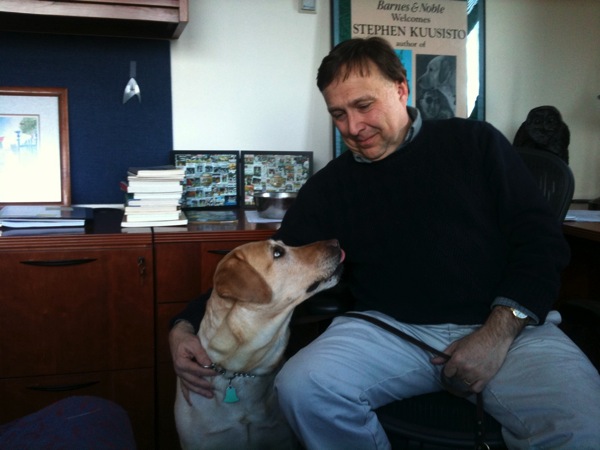
Walking in Snow with My Guide Dog

IMG 0048


We know not everything is equal. We suffer from this. 


Nira and walk in every kind of weather and I talk. 


She listens.


Nira, does everyone need a service dog? 


No one runs aground with a good dog. 


Not everything is equal. They think the disabled are only fit for some stony, savage country.


I tell Nira about the time I visited a sheltered workshop for the blind in New Orleans. The blind employees were kept in a dark room where they stitched decals and flags for the military.


Nira, the subtlety of normal life hides the cruelty of marginal experience. 


Could we wear a sandwich board that says something like this? 


Nira, we should take this idea under advisement. 


Nira, we are introduced to goodness every day. We ain’t frightened. 


She wags her tail. 


She sees the pastel colored world through her optic nerves. Dogs see more than black and white. A dog’s vision is something like Monet’s garden. 


Dogs live always on the verge of happenings that are made of motion, smell, color, and sound. What artists the dogs are. 


Human beings make vague inquiries; dogs plunge into the besieged world. 


Nira, how much beauty can you carry?


The Cost of Poetry-Life

All morning I’ve been thinking about the cost of poetry. You might think this is a foolish thing, like thinking about the price of sunlight, something fanciful. I agree. Then again I don’t. I’ve now lived for poetry for over 40 years. I gave up early success, lived in other peoples’ homes, even wrote in my parents’ basement. I probably won’t have enough money for retirement. I joke some days that I will likely die while teaching a class, and the students won’t notice. But right now I’m alive in the dreamy whereto, ignorant of fate. I prefer this place. I’ve always liked these lines by Sara Teasdale who is now largely forgotten:


Spend all you have for loveliness,

Buy it and never count the cost;

For one white singing hour of peace

Count many a year of strife well lost,

And for a breath of ecstacy

Give all you have been, or could be.


**


One way to think of poetry is to see it as ingenuity. Nowadays engineers and business leaders talk a lot about ingenuity. One may define it as taking what you know and extending that knowledge. Give all you have been, or could be. As a praxis, a Horatian chestnut, one can scarcely find anything better than this advice. But what I really like about Teasdale’s stanza is her wisdom about exchange (the poem’s title is “Barter”).

Strife is behind you. Count it as an ingredient in ecstasy. Then raise the ante, the emotional ante as the poet Marvin Bell would call it. Imagine what’s before you, the abstract future air, imagine it as a field, a place of reception, karma if you will, where you may submit what you’ve been and what you may still become. Submit in terms of alchemy—your thoughts have provenance and abiding possibilities, grand ones. You know…


**


The buying and selling, the storms of desire, regrets, the busted wings of toys and choices…The bride becomes a victim, the victim becomes a ghost. The dear house of fortune falls into disrepair and then ruin. The cost of love is steep and the cool shade of the tomb beckons. Who can muster love for this danse macabre? Ah, for one white singing hour of peace. What a line! 


**


My one good eye hurts. I can’t read. Its barely one pm and I need to lie down. Blindness has its damasks, poetry has its corresponding and shining stem ware. I raise a tall, thin glass to strife well lost and a breath of ecstasy. 


Canine Dance

I’m wrapped in a yielding air beside my dog, do you understand? 

There are no faded hopes beside a dog, do you understand?

I know the bird’s fever when I’m with with my dog, see?

I am determined, pushed by beauties, and I put behind me the green past, the sad old places. 

With a dog means affection and gravitas and walking in rain, do you see?

Do you see I’m different? We’re different? We’re the play within the play.

My dog doesn’t care about my eyes. 

Doesn’t care about the maniac heroes on TV.

She has no conception of protective lies.

Do you understand? 

Look at us, we’re walking through pitch darkness. 


One Day (A Micro Disability Memoir)


He sees at last infirmity is a trick.

something achieved with string,


a game played best on the floor—

puzzle, wish, fear, and ache


are what a magician is for. 

Its raining as always 


but he has a stick

and he waves it at the orient wind. 


**


“Well, the lamb must face the lion,” he says, entering the halls of medicine. Sometimes he thinks of doctors as howler monkeys. Sometimes he sees them as fish swimming in schools. “Doctors,” he thinks, “think their job is to defeat grief, poor dears.” They think a crippled man or woman can only be (at best) a victim reconciled. He wonders what Doc X was like as a child.


Little House on the Psyche: A Self Interview

I don’t know precisely what’s happening inside me. Old English words have been disturbed like leaves in a lake. Feorhbold, the OE word for “body” has floated up. Feor (as the unconscious knows) is a foreboding. Foreboding (as the unconscious knows) is knowing what’s going to happen to your body. Your body and mine. Feorhbold is also related to feorhus—a little house of fear. 


Inside my left knee are the sad nights of youth, railway arches, dark skies. My left eye (the “good one”) holds residual pennies from foreign trips, the ones I shoved into the back of my sock drawer. There are Old English words for these vestiges of psyche. 


Now of course there are countable fears and uncountable fears. One must be exact with the dictionary. 


**


Walking my guide dog this morning we were passed by a woman driving a big SUV. She waved at us. She knows I can’t see. But she waved. I like that. “But how do you know she waved?” My feorhbold told me. 


**


My demands are multiple. I want honesty from poetry. That’s because people in the village square often can’t muster it.


I want compassion in my nation’s discourse. What kind of fool am I? I’m the one with uncountable fears. 


I want intellect that parts the cause from the effect. I’m tired of the balloon animal class of historians. 


I’m tired of sorcerers.


**


Last night in the little house of fear I lay awake listening to branches scraping the eaves. 


Dog Man and Mutual Aid

“If you’re going to live with a dog” he thought, “then you have to decide what kind of person you want to be.” 


Dog-man was learning essential secrets about himself—what he began calling love’s way of living


He had sufficient irony to understand this sounded like the equivalent of loud kissing. 


He decided he didn’t care. 


He was flying when love’s way of living first came to him. It was a domestic flight from New York to Chicago, the plane one of those “regional jets” with an overcrowded cabin and a prevalent odor that reminded him of gym socks.


The plane hit some turbulence and dropped. A woman beside him, a stranger, screamed and grabbed his arm and shouted “Oh my God, Oh my God!” 


Then Corky, big dog that she was, sat up and put her head in the woman’s lap and then the plane was smooth and the woman began crying and Corky washed her tears and several passengers, seeing this, applauded.


“I have to unlearn much that I was taught,” he thought then. “Much.”


For Doug Biklen and Sari Biklen, Two Groundbreaking Advocates of Inclusive Education

Retirement


—For Doug and Sari


In the bad old days it was bad in another way:

Children climbed ladders in the dark

At a priest’s word, or sat 


When they were told, maybe one book 

went around 

Bunyon—What God says is best,


is best, though all the men in the world 

are against it.”  In the bad old days

no one breathed without permission.


A girl who couldn’t speak

and a boy gone blind

read nothing—their lives blanched


by the hands of clocks—

Who’d take the time?

Only the brave, averse 


to the middle,

a mean average 

would dare to teach.


One sees 

how bold that was—

calling for tomorrow 


when there were defeats 

to remember.

Stirring this very night


freed from final ends 

we once called school

are all the little “yeses”. 


The Daily Blind

“No world wears as well as it should,” said Auden, who was thinking of art and culture. But daily life doesn’t hold up either—especially if you have a disability. The things you hear from strangers are hackneyed and tedious—“Why don’t you look where you’re going if you’re blind?” or “How does the dog know when its time for you to go to the bathroom?” The frontiers of personhood are assaulted daily. On the 4 train in New York a woman once asked me if I knew she was a goddess. “Yes,” I said, “you’re Hera.” “That’s right,” she said. “How did you know?” “My dog told me,” I said. This satisfied her. 


Blindness and Irony: Self Interview January 10, 2014

If you have a disability you know a lot about abjection. You also know irony. You say things like: “Well if Jesus could cure a blind man, why didn’t he just get rid of blindness?” “What’s a self-respecting man-god good for after all?”


Contrarian irony was unlocked in me quite early. I’m inordinately suspicious of cant. (For my blind readers that’s “cant” with a c and not with a k–though I have my suspicions about him as well.) 


Disability, Pottery, and the Shattering Classes

My friend Bill Peace is fond of the phrase: “I’m not impressed.” Bill is an anthropologist so he knows when you’re less adept at pottery than your neighbors. For example: my immediate neighbor (who I’ll call Erasmus) can’t spin a pot to save his life–whereas my thrice removed neighbor can turn out a pot that would make Josiah Wedgwood weep.


The thing about being or not being impressed is the choice we make about saying so. Especially when we’re outsiders. You can bet Margaret Mead didn’t tell the Arapesh their pots were laughable. 


But what do we do when the pots are laughable? When we have disabilities and the constructed world is mediocre? How you say it–how you “tell it” is a complicated business.  


Look: they’ve plowed snow into the disability parking space. Look: they’re hosting a conference without disability accommodations. Look: there are not alternative methods for reading the handouts in a meeting. No sign language interpreters. 


The pots are laughable. 


Some days it seems to me that while disability culture has been progressing by leaps and bounds, the mainstream has been under a spell—delusional iron age magic—and so we have neighborhoods of potters and whatever might be the opposite of potters, shatterers I guess. 


I live in this reality. Its not disposable, like the disappointment following a loss by my favorite baseball team. The shatterers are all around the disabled.  


**


Shatterer number one, former boxer Evander Holyfield:


“Boxer Evander Holyfield, who is currently on the U.K.’s Celebrity Big Brother, is in hot water for remarks he made on the program comparing homosexuality to a disability, saying both can be treated by a doctor. All together now: Ughhh.

Holyfield made the remarks on Sunday when reality star Luisa Zissman asked him if there were any gay boxers, according to TMZ. He responded that homosexuality is something doctors can fix.”That ain’t normal!” he says. “The Bible lets you know what’s wrong and what’s right.” He continued his “handicap” analogy: “If you were born, and your leg was turned this way, what do you do? Go to the doctor and get it fixed…The only thing I’m trying to tell you is you know how handicapped people, you can’t say because they’re born that way you can’t move that…Yes, it is a choice.””


Full story here


Shatterer number two, the story of Joe Schultz:


“An Army veteran in Waco is trying to figure out who scammed him out of tens of thousands of dollars in back-paid disability benefits.

Now his fellow veterans are doing what they can to make sure he’s not left out in the cold.

“I’m disappointed and hurt,” says 66-year old disabled veteran Joe Schultz.”


Full story here.


And number three, the story of Marie-Patricia Hoarau, a wheelchair user who was booted off an airline flight. Read here


Shatterers all…