Persistence of Vision: Colleen Woolpert at the Felton Gallery in Syracuse

Yesterday I read some poems and prose at an installation of artist Colleen Woolpert’s works that explores blindness and imagination.  As I’ve often said (so routinely I sound like a public transportation tape loop—“do not lean against the doors; mind the gap”)  no two people who are blind experience vision loss in the same way. Indeed I’ve a favorite comparison: blind people are as essentially “unalike” as the cab drivers of New York City. Nothing about vision loss is ripe for agreement unless one considers the public’s failure to understand the subject. While generalizations are risky, it’s safe to say most able bodied citizens think blind people experience the world like Shakespeare’s Ariel, imprisoned within a tree. In my memoir Planet of the Blind I addressed this straight away in chapter one:

“Blindness is often perceived by the sighted as an either/or condition: one sees or does not see. But often a blind person experiences a series of veils: I stare at the world through smeared and broken windowpanes. Ahead of me the shapes and colors suggest the sails of Tristan’s ship or an elephant’s ear floating in air, though in reality it is a middle-aged man in a London Fog raincoat that billows behind him in the April wind. He is like the great dead Greeks in Homer’s descriptions of the underworld. In the heliographic distortions of sunlight or dusk, everyone I meet is crossing Charon’s river. People shimmer like beehives.”

Excerpt From: Stephen Kuusisto. “Planet of the Blind.” iBooks. https://itun.es/us/SqYjO.l 
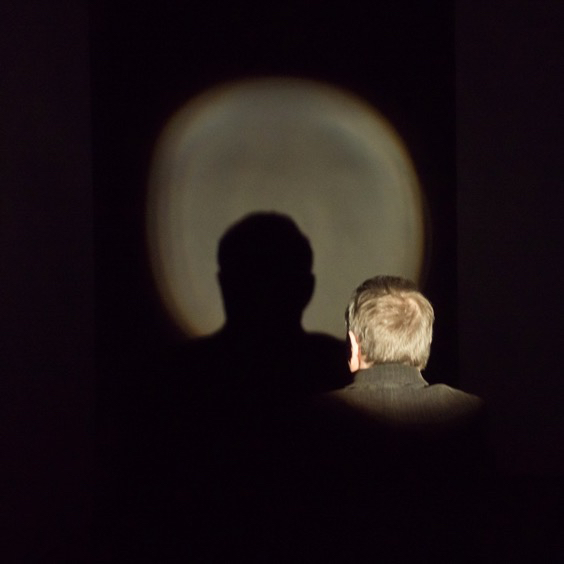


In Woolpert’s excellent installation viewers can see what they do not see, even as they’re presented with the visual ironies of self-hood. The photo above is of me staring into a projected oval of light thereby making my own silhouette. Have you ever seen yourself on the moon? The blind invariably do. Has the moon made you lonely? As the poet Federico Garcia Lorca said, when we see the moon, we feel “the heart is a little island in the infinite.” In this way all are like the blind. Perhaps you knew it. But I doubt you’d have known it if you thought the blind lived trapped inside trees. Would Ariel have known the moon? She may have recalled it. But unlike the true blind she couldn’t sit before it. A blind girl knows the moon and the moon knows her. Now I’m digressing. I’d really like to see a book about the disabled and the moon. Note: when Galilleo first saw a lunar valley it appeared like a hand. What did it say in sign language? I wrote a poem about this for my deaf pal Brenda Brueggemann:

Kansas: Deaf Girl Watching the Moon

–for Brenda Brueggemann

One night there are valleys,

Say around eleven,

When the moon is wide

As a brother’s grin.

The field is black as shadow:

Soybeans sleep in loops

Of darkness,

Their leaves curled.

The valleys of the moon,

As unalike as pitted stones

Or walls or men

Or water or dreams—

Unalike as pages in a book.
When he saw them,
The valleys like hands,
Valleys like the bones of hands,
Galileo rushed into the street
Hoping for someone to tell.

He had no field.

He could not talk with his hands.”

Excerpt From: Stephen Kuusisto. “Letters to Borges.” iBooks. https://itun.es/us/2eNPH.l

Woolpert’s exhibit is called “Persistence of Vision” which is absolutely right. All the blind I know have persistent vision or visions. They are not precisely your visions. In what way is this circumstance anything other than the phenomenology of art?
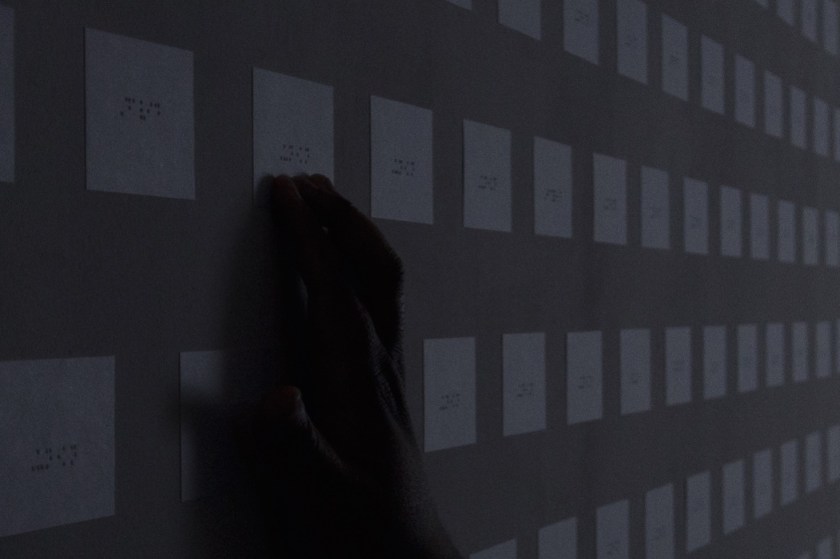
Above is a wall of Brailled note cards, each bearing the first name of a blind citizen of Syracuse. Run your fingers along the wall. The field is black as shadow. The pages are as unlike as any book’s leaves. Let your mind wander. Try to imagine how liberating Braille was when it was introduced? Did you know that before the Englightenment people thought the blind couldn’t read. Diderot was the first great intellectual benefarctor of the blind.

Above, I’m reading poetry beside a projected video of a lovely blind woman’s face. What’s behind those lovely eyes? What’s behind your own?

The exhibit runs through April 14 at Onondaga Community College’s Felton Gallery. Link here.


Analogy, Melancholy, and Neo-Platonic Beans

The inestimable Jacques Barzun wrote: the book, like the bicycle, is a perfect form which may be true but Jacques was guilty of comma spicing as a book and a bicycle are both perfect forms and not reducible to analogy. 

Bill Clinton said (infamously) “it depends on what the meaning of the word “is” is. We know what Clinton meant but we’re not as certain of Barzun. If a book, like a bicycle “is” a perfect form than we’re invited to be Platonic but vaguely so because Plato would not have acknowledged Barzun’s “is”. According to Plato common objects are inferior and mutable but each thing replicates perfect and immutable Forms. So there’s a book “form” in the hands of the Gods and a bicycle form but no analogy. 

We are of course living in an age of analogy which is a beautiful thing. For poets it means sneaking back into the garden and eating a second apple and a third, even a fourth. Stuffed, they can write like Wallace Stevens in “Thirteen Ways of Looking at a Blackbird”: “a man and a woman/are one./A man and a woman and a blackbird/are one.” Now we must ask is this sentiment beautiful because it is true or untrue? If it’s beautiful it’s because we can say it. When we’re reckless with analogy we make claims on eternity as Lord Byron tells us in Don Juan

What is the end of Fame? ’tis but to fill

   A certain portion of uncertain paper:

Some liken it to climbing up a hill,

   Whose summit, like all hills’, is lost in vapour;

For this men write, speak, preach, and heroes kill,

   And bards burn what they call their ‘midnight taper,’

To have, when the original is dust,

A name, a wretched picture, and worse bust.

**

Byron gets it right: after the 18th century analogy is the end of fame. Analogy “is” the striving. 
Byron also gets it right: this is beautiful until it isn’t. 

**

In his essay “Effects of Analogy” Wallace Stevens spilled the neo-Platonic beans:

Another mode of analogy is to be found in the per- 

sonality of the poet. But this mode is no more limited to 

the poet than the mode of metaphor is so limited. This 

mode proposes for study the poet’s sense of the world 

as the source of poetry. The corporeal world exists as 

the common denominator of the incorporeal worlds of its 

inhabitants. If there are people who live only in the 

corporeal world, enjoying the wind and the weather and 

supplying standards of normality, there are other people 

who are not so sure of the wind and the weather and 

who supply standards of abnormality. It is the poet’s 

sense of the world that is the poet’s world The corporeal 

world, the familiar world of the commonplace, in short, 

our world, is one sense of the analogy that develops be- 

tween our world and the world of the poet The poet’s 

sense of the world is the other sense. It is the analogy 

between these two senses that concerns us. 

**

Analogy is a beautiful thing but it’s untrue as all men and women are untrue. It also requires bravery—the recognition there are no perfect forms. Everyone gets to invent his or her own incorporeality. This is what’s meant by the world of the poet. 

For Stevens the corporeal world is Byron’s “uncertain paper”. 

A book and a bicycle are one/gods ride them singularly or in teams…

Analogy is in the driver’s seat. This is a melancholy world. 

Rousseau's Dog

Jean Jacques Rousseau had a dog named Sultan who accompanied him to England when his life was threatened in France. Poor broken Rousseau with his malformed urinary tract, cloying hypochondria and hot paranoia–also poor in cash, resolutely poor in friendships. Sometimes we think we understand him–we, the descendant cripples–those who spent fortnights alone in childhood and more than once. We who occupied our attentions with flowers and seeds. Rousseau had the triple whammy: his mother died when he was very young, then his father ran away. He was forced to learn the baleful adolescent art of beseeching strangers for protection and love. He was easily tricked into churches and bedrooms. And he was easily discarded. The cripples understand this.

No wonder he discarded neo-classicism for what others would call the romantic. No wonder Shelley and Byron adored him–passions of betrayal and resolution always feel the most authentic. Rousseau's enemies substituted “savage” for “authentic” and prided themselves for calling him “uppity” which is of course what is generally done to passionate cripples. Small wonder Rousseau took up the matter of social consent among the governed.

Sultan lead him into the English countryside where he seldom encountered another soul. I love knowing this. A dog can stir and extend solitary human concentration which is the reward of stigma, but you must understand it in a canine manner–pay attention to what's here and here; not yesterday; never tomorrow; and yes, a dog looks the other way when you take from your pocket a handful of French seeds and push them into British soil.


The Trees of My Childhood

And so you think differently in the mornings. The bird takes your wings, flies to the birch tree. “Don’t write prose,” says the bed of moss. Jesus, you don’t even know what prose is. On your hands and knees you know the lady’s slipper, an orchid, purple as a royal hat. 

Once, years ago, in a job interview (with people I didn’t like) when asked, “what’s the next thing you’re working on?” I said: “A biography of the trees in Karstula, my grandfather’s village.” That did the trick, the lights went out in their eyes. Boy do I know my trees. Know what occurs deep below their roots. 

When you’re asked about ambition—in literary terms—well, it’s always a trick question. 

D.H. Lawrence: 

“All people dream, but not equally. Those who dream by night in the dusty recesses of their mind, wake in the
morning to find that it was vanity. But the dreamers of the day are dangerous people, For they dream their dreams with open eyes, And make them come true.” 

Now lately I’ve made a few things come true. 

I translated a micro lyric from Finnish. A dirge. A lovesick flash blues:

sad evening
when the city becomes silent
we will no longer meet

had we some others

we would be happier

Had we some others—nights are precarious. Tonight love. Tonight no love. And see how the city is indifferent.

The trees wish to help but they’re overpowered by sermonizing architectures. 

Didn’t you know it! Even as a child you knew! Stay away from the buildings! 

With trees, among them, never forgetting them, life becomes slow and strong like Mahler’s Fifth. He, by the way, loved the morning.  

The bird takes your wings, flies to the birch. In turn she gives you a tinge of color. 

In the middle of everything, broken glass of their feathers, and the solid streets of the committed trees.

Early, I saw I didn’t know much. A boyhood with trees is just that way. 

All the trees past and present, know some secrets about my strained heart. 


Elegy for Corky, My First Guide Dog

The Chilean poet Pablo Neruda wrote: “How many weeks are in a day/and how many years in a month?” I think for a moment Neruda was a dog.

Last night I dreamt of Corky. She’s long gone, but never gone. Maybe her years went by in a month. Maybe a month is forever.

In the dream Corky was pulling me back from a bus running the curb in New York. She did it in life. She does it over and over in death.

There are weeks in the days—survivals within survivals. Corky taught me over time when we live we live again twice. The unassuming person who nearly died lives and a new person is born who appreciates the fleeting abundance of his own breath. I did not know this when I first met her. I did not know there were years in a month when she entered my life.

And how am I different because I know this now? This is an artistic question. Neruda was a dog. I was a dog. I was a dog for the teeming years we had together. I saw the yellow sky of morning through a dog’s eyes. I stepped off an airplane in Albuquerque, New Mexico and smelled the prairie dogs and the local flags of destiny. You smell everything. And when you don’t you’re invited to imagine you do. How many weeks are in a day? How many imaginations are in a week?

With Corky I was never late for school.


Disability and the Light Before Us

This is not evangelical light; it’s not Manichean. Let’s say its both waves and particles and leave it at that. We’re certain of the waves and particles. And we know diurnal life gets you out of bed. 
Oh but if you have a disability can you trust the light? Does it illuminate? Does it beckon or rob you of your last shred of dignity? 

When I was in college a professor who became my friend recommended I read Ralph Ellison’s magnificent novel “Invisible Man”and that incomparable book gave me language for something I already understood implicitly: light ain’t necessarily your pal. The narrator declares: 

“I am an invisible man. No, I am not a spook like those who haunted Edgar Allen Poe; nor am I one of those Hollywood-movie ectoplasms. I am a man of substance, of flesh and bone, fiber and liquids–and I might even be said to possess a mind. I am invisible, understand, simply because people refuse to see me. Like the bodiless heads you see sometimes in circus sideshows, it is as though I have been surrounded by mirrors of hard, distorting glass. When they approach me they see only my surroundings, themselves, or figments of their imagination–indeed, everything and anything except me.”

Light will not illuminate a man of color and worse, it makes him impossible to see. Like a member of the French underground, he’s retreated to a covert under the city where he strings lightbulbs in his solitude, illuminating his lonely, isolated guerilla existence. 

Like Ellison’s narrator the disabled are also invisible—people refuse to see them; they’re surrounded by mirrors of distorting glass so that when they are seen they appear even more ruined. But mostly, and this is the main point, they’re not seen for who they are and are therefore entirely missing from the light.

So walking about as a cripple you are forced to think about this. In what way, under what circumstances will light be transformed? This is one of the hardest questions of all.

One morning when I was a relatively new guide dog user, still learning I could trust my canine pal in traffic, I had an experience of light that I couldn’t have foreseen. I was walking with my yellow Labrador “Corky” in Manhattan. I saw how the world bent toward us, Corky and me—how a softening of what had been hard in my spirit corresponded exactly to something outside. It wasn’t just that I felt better with a dog. It wasn’t my new optimism about going places (though surely these were potent within me) it was a receptiveness in the very air. The day before us was not just open but welcoming. Sunlight loved us. 

We were walking up Fifth Avenue. Our walking was loose but also fast. Corky was having her usual fun locating the bodies of pedestrians, seeing how to work around them without breaking our stride. And daylight was so hospitable, well, a tumbling happened inside me. It felt like an old lock was opening, some knit up place was giving way. I was untroubled. That was it. And then I was joyous. We were better than just a man or just a dog. Better than a contraption or contrivance. The light outside us and the light inside had met. We stopped. On the steps of a church I said to Corky: “I think we’re the light, my dear.” 

After this when people asked the name of my dog I’d say “Meister Eckhart”. It was my little joke about joy and spirit. If we were, to borrow writer Caroline Knapp’s wonderful term, a “pack of two” we were a pack of two with “chi”—“And how,” I said to Corky,” do we explain this without sounding trippy?” The answer of course was just keep walking.


Professing in the Dark Times

I teach at a university that has lately been in the news for the wrong reasons. Unfortunately I’m in no way unique when making this statement: faculty from Syracuse to Oklahoma, from Chapel Hill to Harvard are now working under the overarching impression of widespread chicanery and deceit in higher education. In a troubled era it’s hard to get the word out that faculty across the nation are by and large rather extraordinary citizens. Of course this is also true of cab drivers—the majority are great. But therein lies the problem. A controlling image of disagreeable aspect has overtaken the public’s perception about academia.

Campus problems are genuine. From sexual assaults to racism to scandals involving academic fraud and sports programs, we’ve seen countless instances of criminality and wrongdoing. Worse are the attendant failures of admission. We’ve heard variants of “we had no idea this was going on” from all too many administrative quarters at too many schools for credulity to stand.

No one can excuse the apparent cavalier exceptionalism of the ivory tower and I applaud New York Senator Kirsten Gillibrand’s support of the Campus Accountability and Safety Act. While laws don’t necessarily provide solutions, CASA will make it much harder for colleges to sweep instances of sexual assault under the rug. But here is something the public should know: many colleges are key players in the effort to establish safe campuses and are playing a vital role in assuring transparency. Chances are good you won’t know this from the headlines.

I have a sign on my office door that says “safe space” and this means more to me than my graduate degree. I was a disabled kid in the fifties and sixties who was routinely bullied and often assaulted. If you’re lucky and have the right support network, you’ll grow up understanding the past and know it’s not the prologue to your future. As a faculty member with a disability I have the right and expectation that my diversity is accepted, understood, and even celebrated on occasion. And this is where I must return to my opening assertion: the faculty with whom I work (or who I’ve had the fortune to meet around the world) are remarkable people. This is not Pollyanna-ism or an optimism bias on my part. Day by day I encounter scholars and advisors who are deeply committed to equal opportunity, fairness, and human rights. It is a shame this needs to be said.

“Safe space” means more than just my office or the office of a colleague. It means the whole university. It means together we pledge to live up to standards of excellence both in the classroom and without. The American professoriate does not have a motto but if it did I think it would be: “we want everyone to succeed”. This means every single student who enrolls. While recent news reports from the halls of learning haven’t been very good, name another place in our civic square where there’s so much desire from so many corners to see that public space is   triumphant space.

I walk everywhere in the company of a guide dog. As a result, because people like dogs, I have frequent casual conversations. On a normal day at Syracuse University I talk with Iraq and Afghanistan war veterans, Latina people, people of color, foreign students, disabled folks, trans-gender students, very old men, and yes, people who are likely hurting inside. But here on “the hill” as we call our quadrangle, we strive, all of us together, to be better than we were yesterday or better than we were this morning. If you think this doesn’t bear repeating you’re probably in search of bad news.

While many argue the traditional college campus will or should become a thing of the past, I disagree. Only by meeting and sharing our experiences, often in casual conversation, do we see how alike we are and how much strength and wisdom we can share. Perhaps some day online courses can deliver this unanticipated news but I doubt it. “Safe space” is real space. I know of no faculty who would easily disagree.


Disability and the Porcupine

I am all for the porcupines. I know them. They are unfamiliar to some, but not to me. At night the porcupines used to climb onto the rocking chairs on the porch at my grandfather’s farm. I think you would too, if you were a barbed and largely misunderstood creature. Those rocking chairs felt good. After years I see those rockers were an accommodation. Freed from their customary fight or flee panic they could glide for a time. Did I mention it was night? Wouldn’t you want to rock at night if you were covered in quills? I say the rocking chair was really invented for the porcupines. And all should have them.

Now here’s the problem: we define accommodations rather narrowly. We say only certain cripples should have them. We wrangle, gnash our teeth, argue, tear the delicate damask curtains, take the matter to court. The porcupine teaches us a thing or two. She says: from each according to his ability to each according to his need. She says a rocking porcupine keeps away the raccoons. She says you should never underestimate the potential contributions of others.

Last night a porcupine said to me in a dream: “admit that you’re married.” “What if you’re single?” I said. “No one is single,” she said, “for you’re like the turtle, carrying your house on your back. You have a horse because you can’t walk fast. You have ink so you can persuade strangers. You have nose drops, eye glasses, shoes, deodorant—all sorts of improvements. And you “husband” these things. You take them for granted. You’re in a bad marriage with your hundred adaptations. You have forgotten you’re not perfect. You’re not even adequate.”

The porcupine teaches us that all humanity needs accommodations. Don’t pretend they’re just for disabled people. 

Rock on, my pointy friends, rock on. 
 

Disability and the Porcupine

I am all for the porcupines. I know them. They are unfamiliar to some, but not to me. At night the porcupines used to climb onto the rocking chairs on the porch at my grandfather’s farm. I think you would too, if you were a barbed and largely misunderstood creature. Those rocking chairs felt good. After years I see those rockers were an accommodation. Freed from their customary fight or flee panic they could glide for a time. Did I mention it was night? Wouldn’t you want to rock at night if you were covered in quills? I say the rocking chair was really invented for the porcupines. And all should have them.

Now here’s the problem: we define accommodations rather narrowly. We say only certain cripples should have them. We wrangle, gnash our teeth, argue, tear the delicate damask curtains, take the matter to court. The porcupine teaches us a thing or two. She says: from each according to his ability to each according to his need. She says a rocking porcupine keeps away the raccoons. She says you should never underestimate the potential contributions of others.

Last night a porcupine said to me in a dream: “admit that you’re married.” “What if you’re single?” I said. “No one is single,” she said, “for you’re like the turtle, carrying your house on your back. You have a horse because you can’t walk fast. You have ink so you can persuade strangers. You have nose drops, eye glasses, shoes, deodorant—all sorts of improvements. And you “husband” these things. You take them for granted. You’re in a bad marriage with your hundred adaptations. You have forgotten you’re not perfect. You’re not even adequate.”

The porcupine teaches us that all humanity needs accommodations. Don’t pretend they’re just for disabled people. 

Rock on, my pointy friends, rock on. 
 

Dear Mr. Blank

Dear ________,

I am taking the liberty of writing as it’s commonly supposed you stand for something, though what that thing may be is increasingly difficult to reckon. I won’t digress: you stood for human rights when your campaign was new. Moreover you said you and you alone represented change we could believe in. I admit I was slow to understand the wit (yours) as you did exactly what you promised: a representation of change isn’t change and so of course when nothing has changed you’re essentially off the hook. Remember how giddy we were? No? We were happy as kids on a stolen sugar high.

You sir have evolved an ugly human rights record. I voted for you twice sir. The first time was hope, the second, fear. Go to the UN and say we’ve made mistakes: drones; Guantanamo; spying on innocent people; stealing hope around the globe; ignoring a global refugee crisis the likes of which humankind has never seen before. Go on. You can’t run again. It will cost you nothing.