Thomas Mann, Illness as Metaphor, and Political Lingo

In Thomas Mann’s novel “The Magic Mountain” whenever his characters grow passionate they turn pink. Its a story about tuberculosis. But of course it’s about TB the way “The Grapes of Wrath” is about automobiles—the world is collapsing and the sanitarium is the mise en scene, the place where people ride out the proleptic storm—its on the way and will become “the war to end all wars” but it hasn’t happened yet. Mann’s characters are already dead—though of course they know it conditionally since they believe they’re merely fighting a disease. Mann wants us to see they are the lucky ones—they’re allowed to wrestle with conscience and soul just before the planet dies.

I’ve never been a true fan of the book because I distrust illness as metaphor but I’m in mind of “The Magic Mountain” these days for a number of reasons. Foremost among them is the floridness of our politicians who live in the magic sanitarium of DC and Wall Street and shout endlessly about ISIL as a cancer as President Obama did during his final State of the Union address—though he merely plucked the phrase from the ambient air. The rhetoric of foreigners as being or bearing a disease is everyplace. John Kerry has called ISIS a “cancer that must be stamped out.” Why not call them a group of hateful extremists?

Calling our enemies a cancer accomplishes three goals: it advantages the fear of every individual, as all people fear cancer in our time, just as they once feared tuberculosis, (Susan Sontag) By cancerizing your enemy you inculcate a wild terror in your listeners. Once the public is afraid they’ll do anything to stamp out the soulless, vicious enemy. Calling them extremists doesn’t accomplish this. After all the world is filled with extremists. But the Cancer-Muslims, they’re a demotic metaphor, easily grasped. Finally, metaphorizing them as illness makes it easy to carpet bomb them, as I believe Ted Cruz recently suggested we should do.

In “The Magic Mountain” the patients (who Mann is at pains to remind us are citizens) are aware that they’ve been reduced to helplessness by their doctors. “Joachim” who wants to be a soldier imagines the science behind his diagnosis may be fraudulent:

Yes, the good, the patient, the upright Joachim, so affected to discipline and the service, had been attacked by fits of rebellion, he even questioned the authority of the “Gaffky scale”: the method employed in the laboratory – the lab, as one called it – to ascertain the degree of a patient’s infection. Whether only a few isolated bacilli, or a whole host of them, were found in the sputum analysed, determined his “Gaffky number,” upon which everything depended. It infallibly reflected the chances of recovery with which the patient had to reckon; the number of months or years he must still remain could with ease be deduced from it, beginning with the six months that Hofrat Behrens called a “week-end,” and ending with the “life sentence,” which, taken literally, often enough meant very little indeed. Joachim, then, inveighed against the Gaffky scale, openly giving notice that he questioned its authority – or perhaps not quite openly, he did not say so to the authorities, but expressed his views to his cousin, and even in the dining-room. “I’m fed up with it, I won’t be made a fool of any longer,” he said, the blood mounting to his bronzed face. “Two weeks ago I had Gaffky two, a mere nothing, my prospects were the best. And to-day I am regularly infested – number nine, if you please. No talk of getting away. How the devil can a man know where he is?”

Would that we might have a few rebellious patients in our ruling classes.
More About Being Blind in the Seven-Eleven…

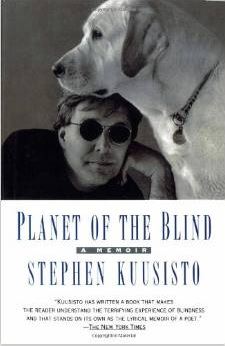
Like it or not, even with your beloved dog beside you you’re still an outsider in most public spaces. Moreover, you’re “the show” and there’s no help for it. You’re the guy riding the old wooden escalators in Macy’s Department Store, while a hundred people stare. “I feel like I have a fried egg glued to my forehead,” I once said to my wife as we were navigating an airport. “You do,” she said. You can count on your spouse. When I think more deeply about this I think in terms of history. I belong to the first generation of public disabled. We’re not in the institutions. The laws of the land welcome us. Of course I’ll be stared at. 100 years from now, when everyone will have wild looking quasi-electronic rubberized appendages attached to their bodies this era will seem like ancient history. I hope for that.

Meanwhile one walks about. And you know you’re a symbolic father or mother. A political symbol if you will. In a way, every space you enter is a frontier. You’re clearing the road for others who may follow. I often think about the business of clearing. I’m not just asserting a right to inhabit public space for the disabled but for all my brothers and sisters who are still outsiders.

I took to whispering into my guide dog’s ear: “What’s an outsider?” Perhaps being a pack animal she knew, but she only said: “It’s something in the past.”

Dogs eat grass, just to know what’s in it. They eat the past. A lesson. Get over yourself.

And you do for a minute. You imagine you’ve eaten the grass; the hear and now has fallen; you can taste a pure democracy. But the hear and now is like rain at the windows, just persistent enough to haul you back from utopia. You’re in the Seven-Eleven again, being stared at by absolutely everyone. “What’s that man doing?” says a child to its mother. “Shush,” says the mother. “No Mommy! What’s that man?” “Shush,” she says, “Or there’s no birthday for you!”

You’re innocent. You are standing beside a rack of Twinkies and Hohos, just trying to figure out where the coffee is located, and now your a fucking un-indicted co-conspirator behind the ruination of some kid’s birthday, all because you entered the damn store.

“You’ve entered the damn store” became a personal tag line. My father who served in World War II used to say, “You’re in the Army now, you’re not behind the plough….” His way of saying you’re screwed and just get over it.

In Macy’s I was  followed once by a store detective. I was walking merely to walk. Working my dog around mannequins and racks of clothing, mostly because it was something to do and it was a good exercise for the dog, and you know, what the hell. Sam Spade was about ten feet behind me wherever I went. What’s an outsider? He’s whatever they say he is. He doesn’t look like the other crayfish. Let’s eat him.

Blind in the Seven-Eleven

People see the blind and think “there’s a defective human.” Getting a guide dog doesn’t change this. One night in a Seven-Eleven in Westchester County I met a cashier who was terrified by my presence—I was “othered”—given the silent treatment the second I walked in. My black friends know the scene, it’s the Old West saloon, swinging doors clattering, all eyes on the suspect newcomer, interloper, desperado, cheat…and you’re “it”; you’re the ruinous banished sonofabitch, back from his Roman ostracism, home from the marshes, returned from the dead, stinking of grave clothes, flashing a fishy slick evil eye right beside the chewing gum God Almighty, even smiling, therefore super dangerous and how jokey it is since you were feeling so good, the evening was going nicely, you were out to buy some condoms, you were getting lucky and now you’re a shrunk nefarious freak under fluorescents, a horny homunculus, a walking voodoo doll. I waved at him, the counter man, for he was there alright, that colossus of late night six packs and last minute milk and since he wasn’t going to acknowledge me I said: “Hey, where are the rubbers?” (You can feel the horror of silent men…I think he backed up a foot or so, his ass contacted the cigarette rack, I heard the clatter.) He said nothing. I said, “you know…condoms…no glove no love…don’t be silly wrap you willy…don’t be a fool wrap your tool… don’t be a ding-dong cover you shling- shlong…” He raised his arms as if it was a stick up. “They are here, behind me,” he said. “Here.” “Aha,” I said. “Can you describe them?” “Oh no,” he said. “Oh no! Can’t describe!” “Yes you can,” I said. “Read the labels.” And he read them then, “lubricant, ribbed, latex, flavored…”  His shame was almost heartbreaking—almost, but never quite.


The Conditions

Old love, like deer eating the tips of winter branches, the poor things still hungry at night. Old love my necklace, my familiar, what do you want? Can’t you tell I’m the acrid pulp of the oak—even insects avoid me. Please go. There must be many who will throw their arms around you. I’m an old man in a bathrobe, productive, alone at his northern window, with a few books for company. Love, don’t return, unless you’re the ghost of my dog…


Why I Blog. “You don’t get paid for it, do you?”

Do you remember receiving letters? They came in envelopes. Sometimes your fingers could feel despair through the paper—a strange packet with loopy scrawls. I’d published a book and  the odd envelopes arrived like dolls with cramped little faces—things you’d have to spend time with certainly. Back then, twenty five years or so, I needed help with those letters and asked friends to read them to me. And so the voice of an acquaintance read lines roughly like these:

Dear Mr. Kuusisto. I’m going blind and I don’t want to live. The days have been hard and they’re getting so much harder. I have no idea how to stay in the world. 

Or:

Dear Sir: I currently reside in prison. I was put here by a blind judge. He was a total bastard. Not all blind people are good. Thank you for reminding me there are some good ones…

When my sister was little she used to pop the heads off her dolls and carry those heads around with her, mostly by putting them in her pockets. I carried my own doll heads having written a book.

I knew there was this thing, the ether of literacy, a place where others read me and felt they might enter. Think of this as blogging with a stylus and sun dial. The internet is the ether for better or worse. Everyone knows about the “worse” of course. The better is small, carried in our pockets, occasionally brought into the light for examination. The doll heads. (When I first heard of the band “Talking Heads” I thought of my sister who used to hold up her Barbie skulls and have them speak.)

**

While reading Peter Gay’s Enlightenment, Volume 1 the following passage intrigued me. Gay is referring to his lifelong fascination with the Scottish philosopher David Hume, and in turn, the work of Stuart Hampshire:

“I was delighted to read Stuart Hampshire’s brief appraisal of Hume, “Hume’s Place in Philosophy,” in David Hume: A Symposium, 1–10, which accords precisely with my own estimate—an estimate I have arrived at after years of close and affectionate concern with Hume’s work. Hume, writes Hampshire, “defined one consistent, and within its own terms, irrefutable, attitude to politics, to the problems of society, to religion; an attitude which is supremely confident and clear, that of the perfect secular mind, which can accept, and submit itself to, the natural order, the facts of human nature, without anxiety, and therefore without a demand for ultimate solutions, for a guarantee that justice is somehow built into the nature of things. This philosophical attitude, because it is consistent and sincere, has its fitting style: that of irony …” (pp. 9–10). The demands and the possibilities of modern paganism have rarely been stated better than this.”

Excerpt From: Peter Gay. “Enlightenment Volume 1.” iBooks. https://itun.es/us/vuGqN.l

I’m fascinated by this wee passage. Gay’s admiration for Hume frames everything. Notice that he’s a delighted scholar! (Are scholars nowadays allowed to express their delight?)

Peter Gay is also an affectionate intellect. Adoration, devotion, and caring are critical to the life of the mind. (Have scholars forgotten this at their peril? One may well think so.)

What does Gay like so much? He likes an appraisal of Hume. Gay’s delight is doing the talking, and then, voila, he brings forward a paratactic delight—a tandem pleasure, Hampshire’s elegance, which is also in the service of Hume. Hume, who isn’t speaking. Here in a cloister of estimation are two scholars whose respective lives were devoted to ideas celebrating the nobility of a third. And the third is their father.

Notice the use of “attitude”. Talk about nuance! From the Latin for “fit” it was originally the proper word for placement, especially of figures in paintings. Later it became synonymous with stance. And once it entered the world of ideas it became the template for self-awareness. Attitude is valuable only insofar as it has the manners of irony.

I know of no better description of the contrarian intellectual. No anxiety, just the facts. So let’s say there is no God. Let’s say justice isn’t built into nature. What then? Why we get to build a confident and clear pagan democracy.

David Hume:

“Epicurus’s old questions are still unanswered: Is he (God) willing to prevent evil, but not able? then he is impotent. Is he able, but not willing? then he is malevolent. Is he both able and willing? then whence evil?”

“In our reasonings concerning matter of fact, there are all imaginable degrees of assurance, from the highest certainty to the lowest species of moral evidence. A wise man, therefore, proportions his belief to the evidence.”

**

These thoughts of a morning.

The pleasures of thought, the marvels of freedom.

College, George Orwell, and the ADA

Working at a college or university when you have a disability is like a waking dream, one straight out of Orwell. Each day you arrive at your office only to find the lock has been changed. You look for assistance but no one knows anything. Someone suggests there’s an empty office down the hall you can use.

The next day you return and the new office is locked. You look for assistance but no one knows anything.

“It was a bright cold day in April, and the clocks were striking thirteen.”

Mostly the administration of your college thinks of the Americans with Disabilities Act as what they like to call “an unfunded mandate” an utterance I often hear as “an unfriended manatee” but that’s just me. You will imagine your own version I’m sure. “Unfounded mandrake”; “unfiended mandible”—all variants are diverting.

In any event, Orwell again: “But if thought corrupts language, language can also corrupt thought.”

There is no such thing as an unfunded mandate. The term has always been “doublethink” which as the master said, means “the power of holding two contradictory beliefs in one’s mind simultaneously, and accepting both of them.”

No building or sidewalk is unfunded. Period. And thinking of civil rights as a mandate casts equality as a foreign idea—one that’s not our own. It’s a deeply offensive idea. “We’re forced to let these people in…” is its signature.

So yes, if you’re disabled and you study at, or are employed at a college or university there’s a good chance you will often feel like an “unfriended manatee.”

Jokes aside the “unfunded mandate” is a sinister phrase.

“He who controls the past controls the future. He who controls the present controls the past.”

The disabled past is really what the saying holds on its nostalgic tongue. If you can imagine the disabled as not quite belonging you can also plan for a non-inclusive future—all the while controlling the present, by inaction and deferral.

Here’s another Orwellism:

“If you kept the small rules, you could break the big ones.”

Accessibility doesn’t necessarily matter if you’re trained to dismiss it. That training requires you believe inclusion belongs in the future; that it’s time isn’t now, but surely it will come; but not today—today belongs to safeguard the small rules which are easy. Isn’t that the purpose of administration—ease, personal warmth, a nice little office…?

“You must try harder. It is not easy to become sane.”


Of Cripples, Montaigne, and Donald Trump

In his essay “Of Cripples” Montaigne wrote of gullibility, a curious word and I’ll return to it in a moment. Here is the master:

Truth and lies are faced alike; their port, taste, and proceedings are the same, and we look upon them with the same eye. I find that we are not only remiss in defending ourselves from deceit, but that we seek and offer ourselves to be gulled; we love to entangle ourselves in vanity, as a thing conformable to our being.

How I love the phrase “to be gulled”! Gull comes from Middle English “to swallow” or, and this is  more interesting, to pretend to swallow—one imagines its first usage—“he gulled me with the proffered poisoned pill for I swear he’d swallowed it…”  Gull is from “gole” which means throat. Some lies will stick in your gullet.

Truth and lies are faced alike so long as they appear or sound profitable. Gull capitalizes on wish. Desire is conformable with our being—is our being—and Montaigne, like Shakespeare, understood the dread implication of modernity: we’d rather be lied to than question our yearnings.

Montaigne never uses the word cripple in his essay. It appears only in his title—and so implicitly his readers are the cripples, all of them. All pretend to be someone or something they are not— soldiers, prelates, merchants, scholars…everyone is alike in his falseness so long as his vanity is conformable with being.

Cripples were everywhere in Montainge’s time. The blind were still thought to be uneducable and were turned out to beg. While the juridical blinding of criminals had largely ceased in Europe by the 17th century blindness in particular, but crippled-ness generally still carried the symbolism of thievery. Moreover, there were false cripples, a story as old as humanity itself.

“Crippled America” is the title of Donald Trump’s prevaricating book—his prose launcher, a festschrift to deceit. Trump uses the word crippled without irony. He means of course that America is helpless. He’s gulling on every page, challenging the credulous to swallow vanity as a port or taste in conformity with their unhappiness. Perhaps his motto should be “let them eat fake.”

You will find no real cripples in Trump’s book, save for those Montaigne saw, so very long ago.

Disability, Cub Scouts, Performance Theory, Pity Amber, etc.

I talk often with my friend Bill Peace “Bad Cripple” about living through childhood and adolescence before the Americans with Disabilities Act. Bill was a paralyzed kid. I was blind. In those days (the 60’s and 70’s) if you had a disability, you really had to invent yourself. One may argue as performance theorists do that all social life requires invention, or as Richard Schechner said: “Performance’s subject [is] transformation: the startling ability of human beings to create themselves, to change, to become—for worse or better—what they ordinarily are not.”

Disability is no different, save that living one’s most impressionable years in a strictly “normative” culture created tremendous pressures for the disabled. One could say we had to invent ourselves quickly and while our inventions could be good or bad, they were always vitally necessary.

Because my parents could only imagine me living on normative terms they taught me to parade wildly in the streets. In 1962 I joined the Cub Scouts and received a uniform and a flag. I marched without seeing in a small town parade, stepping in time with the older Boy Scouts and their drums. I held the flag straight out in unseeable mist. I was surely living and walking by the world’s terms! Although the Cub Scouts adopted a platform to include boys with disabilities in 1957 the word hadn’t trickled down to our little New Hampshire town. Without irony, the Cub Scouts motto back then was “be square”.

What a phrase, “the world’s terms”—as if the planet might be some wild Olympian god. “I like you now,” says the God. “Now I don’t like you.” This is the capricious difficulty, the dance of rejection and occasional reception all disabled people know. We aim to avoid it. This is inherently a performance of failure.

Ironies proliferate where physical differences are concerned. If you think too much about them you’re impeded, or worse, you’ll stop all momentum. If you don’t think about them you’ll fail to grow. “Who am I?” should always be answered by acknowledging our physical lives as much as say, knowing one’s ancestry. But in 1962 the Boy Scout parade wasn’t the place to learn about dignity and pedigree. There wasn’t a chapter in the scout’s handbook about successful blind people—an acknowledgment of Claude Monet’s lily murals or Horatio Nelson. Who am I? I’m a blind painter, a one eyed admiral. I own this place, this Musee de l’Orangerie in Paris or a 104 gun ship named Victory. As a boy what did I have? I had “Mister McGoo” that doddering cartoon blind man who walked off cliffs. A fool. The inspiration for school yard taunting. I was McGoo. “How many fingers am I holding up?” Never never think about your ruined sight, your faintly cross-eyed little face—think of what a preeminent able bodied person you will become some day.

That’s how it was. But the greatest irony of all was that the 60’s, a decade when the youthful president exhorted everyone to ask what they can do for their country became instead a time of individual vigor.  JFK loved the word “vigor” and even the Cub Scouts got the message. And so children born long before the Americans with Disabilities Act were encouraged to get in the game, by sheer will, with toughness, but not necessarily with self-regard. It was possible back then, as it is today, to be spirited but not to like yourself.

I used to do wild stuff. I ran across the steel railing of a suspension bridge. You think I’m Mr. Fucking Magoo? Watch this! No one else tried it. On the plus side: I didn’t think blindness would lead to my demise. On the down side: I had to be reckless as I dragged a long shadow of self loathing.

Richard Schechner once listed the essential purposes of performance:

• To entertain

• To make something that is beautiful

• To mark or change identity

• To make or foster community

• To heal

• To teach, persuade or convince

• To deal with the sacred and/or the demonic

In the tough years before the ADA these functions were different for kids or adults with disabilities—but especially for kids. To entertain meant walking the bridge. Very few of us knew how to make something that was beautiful though we sure thought about it. To mark or change identity? What was that? The disabled kid was too busy being seasick, blindly walking in the parade. Community? “Healing?”

Teaching, persuading, or convincing was pre-ordained for crippled kids—were were inspirational. We were the ones who knew Tiny Tim personally. We were precious but inexactly and contextually so—poster kids come to mind, “Jerry’s Kids”.  We were frozen in the culture’s pity amber.

As for the sacred and demonic, my sense of the world was always marked by receptive or hostile locations. In an actual church I was “pity boy”.

If the past has been transformed by law and art, and certainly in some ways it has, then we must decide as a society to say it’s so. We are not living in the 60’s anymore. Let’s all say it. Let Bernie Sanders or Hillary say it. Let’s declare all public space is now and henceforward inclusive. Is this any more reckless than running a high railing? Oddly, it often feels the same, at least on the inside.

Reading Bill Peace’s blog yesterday entitled “Cripple Radar and Ableism” I came across the following list of ableist “teachings” or “doings” that still routinely afflict the disabled:

The mother who pulls their kid’s hand in the supermarket and says “watch out for that wheelchair”.

The secondary school that transports every child with a disability via one short bus.

Handicapped seating that is substandard and located in one less than ideal place.

The restaurant cripple table. One table is always used to seat a person using a wheelchair. If occupied I am forced to wait despite the fact other tables are available.

Locked accessible changing rooms in clothing stores.

Anything and everything associated with being deemed “special”.

 Paratransit systems that invariably provide inferior and unreliable service.

Side, rear, or locked entrances to buildings.

Inaccessible poling stations and voting machines.

The framing of disability as “other” is still a dominant social dynamic and in a society that’s increasingly penurious—in an age of non-investment in infrastructure, one senses how the disabled are all too often framed as beseechers, pests if you will, for this is a tight economy we’re running, we can’t afford accessible polling stations or accessible bathrooms. Don’t you understand? We can’t afford you. Lingua franca, taken as metaphor, taken as idiom, taken as prevalence says: “you’ve ruined the meeting.”

I’ve gone many places with Bill Peace. He has his wheelchair, I’ve got my guide dog. We enter a restaurant. There’s always the quick glance of the hostess, that funny sidelong prey animal eyeball roll that says, “we’ve got a problem…two cripples…God! Will they drive away our other customers? Do they have something catching?”

It’s rare when we don’t get this reception.

And so it’s not the 60’s exactly. But oddly, fractiously, maddeningly, we’re still forced to perform like the kids we once were.

How do you like my pity amber?


Ode to Tsuris

Why the compulsion to write? Misieracordia. Stiff words upright nursing wounds. When a word sings surely it inhales some of God. The first word singing was tsuris: gnats, lice, flies, locusts, hail, chummy death moving in next door. That man or woman who invented tsuris is always beside me on a carved, tall, wooden bench where we raise a doubtful hymn.

Write so you can sing what the words sing. The tsuris notes will not be light. In his poem “Memorial Day” Yehuda Amichai wrote:

Memorial day.  Bitter salt is dressed up

as a little girl with flowers.

The streets are cordoned off with ropes,

for the marching together of the living and the dead.

Children with a grief not their own march slowly,

like stepping over broken glass.

The flautist’s mouth will stay like that for many days.

A dead soldier swims above little heads

with the swimming movements of the dead,

with the ancient error the dead have

about the place of the living water.


Tsuris will not grace me with affection. It will not march me to the living water. It will nonetheless fill my throat and keep me upright. It fills my little head with appreciations I can scarcely name.

Notes from a Small, Dark Room

In 1961 my mother built a bomb shelter in the cellar of our house and filled it with canned goods and jars of water. One afternoon I went in there after being abused by a neighbor kid who flat out hated me because the world gave him permission—who after all wanted a disabled child next door? And so it was the bomb shelter for me. I lay on cool cement and whispered stories to no one. That’s how storying unfolded, talking in the dark, breathing the odor of Army blankets. Who loves you, who doesn’t, where’s a lucky window, how high the sun, my lips moving. To this day I talk to myself. My wife sees me, says, “what are you saying?” I shrug. How can I say? I’m reciting fragments the way some boys skip pebbles. It might be someone else’s words. Maybe Ezra Pound: “And the days are not full enough/And the nights are not full enough/And life slips by like a field mouse/Not shaking the grass”… Or sometimes it’s just me: “Trace the veins of a barberry leaf, that’s Braille enough…” Talking in sidelong darknesses of broken manners, when the day is insufficient, the minutes not feeding me… Up river go the words, the lonely words. Oh anything will do. Kropotkin I love you. I have small hands. How the kings of France loved tennis.

Have me you birds. Sit for a time in the Agora thinking of Aristotle’s wrists. I believe he looked at them before he spoke. My favorite bird is the Phoebe. I like Miss Dickinson. I’m fond of the late Finnish poet Pentti Saarikoski. He imagined snakes cleaning his ears. Some poets love the snake properly. I like to spread my ten fingers across my face. “Not only is the Universe stranger than we think, it is stranger than we can think.” (Werner Heisenberg) Don’t give up. Keep moving. Even in a small dark room.