A Letter to Boy Blue


In Helsinki, Finland, during my childhood I first understood people can be crazy. I was a small boy and climbing stairs in the old apartment building near the harbor–holding my dad’s hand, climbing, the steps curved like inside a lighthouse, my blindness talking to my feet. You understand–this is an early memory, 1958 most likely. An old woman approached us coming down from above and seeing me said in blue blood Swedish (for she was a member of Finland’s small Swedish speaking minority): “Tsk, Tsk, barna blind…” Tsk, tisk needs no translation, even to a boy. I was a blind child, and there, on that stairwell, in the curving darkness, I received my brand–was branded. My father ignored her by shrugging and we kept climbing.

“Even a minor event in the life of a child is an event of that child’s world and thus a world event.” The words are Gaston Bachelard’s and I’ve puzzled over them for years. My minor event, the naming of my blindness took place in the Scandinavian winter on a dark stairwell and I absorbed some very unrefined ideas about physical difference and human worth–knew them instantly–but how could this ever be a world event? As I see it after all these years dear blue, there are two ways Bachelard can be right. The first is that the old woman’s contempt becomes a cathected and insupportable incitement, the seed of what Carl Jung would call a “complex” thereby draining my life of self-esteem, maybe even stealing my curiosity. The second is this small, nearly infinitesimal occasion turns me to making things. In both scenarios Bachelard is correct. In both cases a child’s world grows upward and outward and influences many people over a lifetime.

One day I wrote a poem about my boyhood incident.

“No Name For It”

Start with a hyphenated word, something Swedish—

Rus-blind; “blind-drunk”; blinda-flacken; “blind-spot”;

Blind-pipa; “non-entity”, “a type of ghost.”

En blind hona hittar ocksa ett korn;

“The fool’s arrow sometimes hits the mark.”

(That’s what the Swedish matron said

When I was a boy climbing stairs.)

She pointed with a cane:

Tsk tsk,

Barna-blind; “blind-child.”

Her tone mixed piety and reproof—pure Strindberg!

It echoed on the stairs, barna-blind—

“Blind from birth”;

En blind hona hittar…

The blind child’s arrow….

**

Dear Blue: I wasn't really a blind child at all, but one of the ghosts who rang Strindberg’s doorbell. I see this now but only through the poem. Strindberg imagined spirits were ringing his doorbell, saw them in the ambient light at twilit windows–things a blind child would know as facts rather than fancies. So in my private life, I’m a practical joker without doing a thing. I ring the old man’s doorbell with nothing more than a glance. I’ve hidden myself in the bushes. I will leap out when the lights go dark at his windows. I shall invade his solitude by means of the newly invented electric doorbell. I will do all this with nothing more than a glance.

Do you understand, Dear Blue, one night some thirty years ago, I met a drunken man in a bar in Estonia. He was very old. He claimed to have been a childhood prankster who tormented Strindberg. I thought then, and think now, how beautiful and sweetly unclear the facts are. I think how the unconscious works by means of animal faith. We go forward and upward by means of trust and laughter. I’d have tormented the old play write if I’d had a chance. Instead I grew up with a blind child’s arrow, a different trick, for I hit things askance and often produced a slanted music–an effect adagio and almost wrong though the credulous mind embraces it after all. Blue, I like Beethoven’s last string quartets. I like broken windows in abandoned country houses. I like crows on telephone wires and Boolean Algebra and rain in winter. I like whispers. I’ve always liked whispers.

Here’s to the Paradise Under Your Eyelids


My mother fed caramels to the squirrels.

She didn’t like her own mother. She didn’t like people very much. She claimed to like animals.

Strictly speaking this shouldn’t concern you. You have your own troubles. It is likely that you want to clean up the garden, burn the old plantings, maybe talk to your cat about Ezra Pound. Ezra Pound who tried to paint Paradise on the inside of his eyelids.

We are all students of doubtfulness and of its moods.

Unlike my mother I tend to enjoy people. I’ve been known to bake bread and leave it on the doorsteps of near strangers. This is no joke. I bake good bread. I listen to Verdi while working the dough.

Ah but now in middle age I find I’m cut off on the inside. And though I can stand in a room and smile, tell a joke, sing a homemade song, even so, standing before the tall glass of my life, there under that moon I am lonely.


I am in no way singular because of it. The man across the street who is picking the last tomatoes of the summer is lonely. The woman I met this morning who teaches linguistics at the university is lonely. My friends, my wife, all my relatives are quietly alone though we are trained to withhold this even from the psychiatrist or the priest.

The poet William Carlos Williams said in one of his poems “I am lonely. I am best so.” I remember reading those words as a college sophomore and I felt the proper fit in my soul.

Make no mistake every heart is in a condition of static or pure loneliness. This is why Jesus said to his disciples: “My father’s house has many mansions. If it were not so, I would not tell you.”

Of all the lines in the New Testament those are for me, the most comforting. This is according to my soul. My soul, that forlorn intelligence hugging my tissues and bones. My soul that cannot get used to life. That insists on sleeplessness so that together we can work out the geometry of mutual being in our common and threshed hours.

Once I harvested the last sunflowers of autumn because the frost was coming.

I did this with some friends.

We brought half living, stately sunflowers into an old house and we propped them against the hearth. We sang songs and drank wine. Unspoken? Every one of us had Lorca under his or her ribs and we could, it turned out, give our souls a warm room and some fading flowers.

My mother died without knowing this feeling of shy, unasked for communion. I think her story is legion.

John Donne writes in one of his elegies:

“Xerxes’ strange Lydian love, the platane tree,
Was loved for age, none being so large as she ;
Or else because, being young, nature did bless
Her youth with age’s glory, barrenness.”


Surely the aim of living is to craft a fruitful spirit.

**

Not long ago I discovered a boy jumping on discarded bedsprings on a Chicago sidewalk. He was making a stripped down music from solitude and trash. It was the song of a woodcutter’s axe in the empty woods. He saw me listening. He sensed an audience. He threw everything he had into making rare music with ruined steel coils and shoes. He was releasing invisible spirits into the morning air of Wabash. Avenue.

At first I thought his effect was obscene. The bed springs sounded like the furtive, metallic groans of forgotten trysts. I thought of a bordello in the Wild West. I laughed at the salty bravado of the performance. Then I saw flashes of light. The broken springs flashed like the undersides of leaves. His bed springs were tuned in harmony with the sky and the local trees.

I saw sparks—heard 16th notes; 8th notes; the found music and electrolysis of dance…

He was dancing at the epicenter of first light—that overcast sun that always hangs in the mornings above Lake Michigan.

Then he was in an island of trees. Low notes came suddenly: the notes signified a bent path. The way forward was harder for some reason. The dance had taken a darker turn. I could tell this was now a steep narrative. Somehow he’d figured out how to make the springs sound like a tuba. Then he made the metal groan like a cello.


**

I remembered that as a boy in Naples, Enrico Caruso sang in the streets. When he made a little money he would eat a blood orange sorbet outside the café Risorgimento. They called this dessert the “frozen sunset” –a dish of scarlet juice and ice, misted with lemon.

I like to imagine the scene: the boy and future tenor singing love songs to the fiancée of a very rotund man from Caserta. “Only a boy can carry my heart,” said the fat man to his beloved. “Boys are still sweet as the baby Jesus!” Then I picture him clapping his hands the way impresarios do: a fleshy sound of exaggeration.

And surely the girl was embarrassed. This was a street urchin, a boy in a dirty shirt. A child hired to sing love songs! This thing was a joke! But there on the via Carraciola in the din of carts and boats and street hustlers the boy sang Bellini’s Ma rendi pur contento his black eyes shining with joy and concentration so that passersby stood still. Two men, twin brothers from Rome stopped eating their sugared almonds. There in the heat of the day in that unforeseen place was a prodigy. What could surpass the unassuming purity of such a child’s voice?

The boy performed as if the edge of his heart was catching flame.

The fat man from Caserta was delighted and bobbed his head like a pheasant, then strutted, ruffled his feathers. His fiancée tipped her head in wonder, her features softening, a portrait reversing to a sketch. Her enormous hat with its absurd ribbons could not hide the smile.

Then the boy sang Bella Nice, che d’amore, his hands stretched out, palms up, without irony. Could anything be this sweet again? Vin santo and peaches? Cloves in the boiled sugar?

The boy Caruso and the hot Neapolitan day were working together, visioning ice, ice on the fat lip of a hungry lover.

**

The kid on the bedsprings spoke with his feet, said: there’s no iridescent glow of escape beyond the dancing and you got to hear it for yourself.


This is the secret of growing old profitably in spirit. We can do this.


We Were Young Once

We were young once. We watched the stars canvas first thoughts. Kid stuff. Clean. Knock knock. Who’s there? Gerard Manley Hopkins. Taught us the serious worship of joy. Here comes the bird whose wingspan opens like pages in wind. I was trying to read poems to a girl in a meadow. We were young once. This was only seconds ago. Finland. A meadow fit for life after life after life. Ate a handful of cloudberries. Swam naked in ice cold water under moon. Kid stuff. Laughed for no reason. Everything, prelude to thought. And sometimes, early, remarkable things. Walking home in Helsinki around dawn, met a policeman on a horse. “Nice horse,” I said, and he climbed down and told me all about her, and I could see he was a country boy.

We were young. Knock knock. Who’s there? Pablo Neruda.

Micro-Memoir: I Want to Be My Dog

I don’t want to be a celebrity. I just want to be my dog. Ipse dixit.

When we hug dogs and smell their fur we’re fully realized. Then we drift back into reason and dogs see we’ve gone to a far room. Empathy matters then. Dogs know we’ve entered a fearful place in a crystal palace of abstractions. They touch our knees. They live only in amazement.


I don’t know as much about amazement as I should. D.H. Lawrence wrote:

They call all experience of the sensed mystic, when the experience

is considered. 

So an apple becomes mystic when I taste in it 

the summer and the snows, the wild welter of earth

and the insistence of the sun. 

I understand a dog’s amazement in our company is indeed mystic but only insofar as we consider it.

I walked up the pale green avenue—7th avenue in New York—end of day, my great guide dog working to keep us safe, working us toward the postulate of arrival, the grandest of things, a task accomplished, going where we had to go.

I was grieving for my father who had died only a month before. Grief is impossible to maintain so we engage it in small gasps. I saw my father was on an aerial bridge, high in the fading light, the span without end. My father had nowhere to go. And outside a monolithic computer store I began weeping. And my guide dog stopped, turned, saw me stricken, rose up on her hind legs and gently washed my face. I, who could not reason clearly, was being guided in more than one way. My father’s bridge vanished. I heard his laughter. “Beauty,” says the dog, “is very strong.”

We have to let the dogs in. Consider what they know.


Micro-memoir: Blindness in Early Youth

Walk and listen.

I follow a creek.

Blackbirds rattle and click in a dead elm.

In the trees I find a pile of discarded birch logs.

I listen as mud wasps fly in and out of their nest.

They sound like old people in a dispute. Buzzing in their different pitches.

They sound like the old Finns in my grandmother’s church.

Sober. Hard at work. Talking beneath their breath. Working while others are napping. A

little resentful.

Some are fast as b’b’s from a gun. Some are sluggish.

I follow the creek and wade through shallow pools among cat

tails.

Bullfrogs talk like the gods of mud.

**

“He’s spending too much time alone,” my Aunt Muriel says in her shrill voice. She has

two voices. One is scarcely audible, her lips moving a catacomb voice as my mother calls it.

The other is like a cry across a public square.

“He’s going to grow up weird!” Muriel shouts.

They are below me in the kitchen. I can hear them through a heat register.

“For Chrissakes Muriel he’s blind!” my mother shouts. “The kid can’t play baseball!”

Get to Know Yourself, Friend

Here comes Hallelujah, the bum. He’s my neighbor. I give him yesterday’s newspapers and he reads them under a tree. Or he takes them away to secret places. He is my neighbor. He could be disabled or homeless; he could be neither of these things. He is American. I would like it if more Presidential candidates looked like him. The man may well have a job. I don’t presume. He’s Old Hallelujah and he’s free. I’ve long admired him because he doesn’t have a TV. He does like the public library. He’s one of the toughs alright.

When my sister was a teenager and in the days when you could still make prank phone calls she used to call strangers and announce that she was from the “Get to Know Yourself Club” and with amazing skill she’d get people to look at their hands. She would get folks to look at their palm lines. She was never cruel. She’d tell perfect strangers how to recognize their own beauty and then she’d hang up. Like Old Hallelujah she was free.

There’s an old Zen adage: “If you want to get across the river, get across.”

Be free. Just decide. It helps if you spend time in the public library and watch zero TV.

Thomas Jefferson wrote: “Nothing can stop the man with the right mental attitude from achieving his goal; nothing on earth can help the man with the wrong mental attitude.”

Get across.

Years ago I decided to learn how to walk in strange places. It wasn’t an easy thing to do.

My blindness made it hard to imagine “taking on New York” for instance.

I got my first guide dog, a yellow Lab named Corky.

We took our first solo walk in Manhattan.

We walked up Park Avenue and entered the Waldorf Astoria Hotel. The doorman bade us welcome. He displayed gladness. My “no longer being afraid” meant I could hear notes of optimism.

“Welcome to the Waldorf, Sir,” said the doorman, adding, “what a sharp dog!”

“Thank you,” I said.

I remembered to say good dog.

We swayed together side by side on the red carpet.

“Corky,” I said. “Oh Corky!”

We stood in the foyer.

There was a general fragrance of lilies.

“We can come to places like this; we can find our way; we’re New Yorkers!” i said, though not loudly.

The rug was soft as a cloud.

There was something august and funereal about the odors of furniture wax and flowers and the odd hush of the place. And as I would do so many times over the coming years I got down on one knee and hugged my dog.

Men and women passed us, headed for the Park Avenue exit.

“Wow,” said a woman, seeing us.

I heard the smile in her voice.

I heard an elevator open.

I remembered that during World War II a train platform was constructed under the Waldorf for President Franklin D. Roosevelt. He could exit the train in privacy—the Secret Service would raise him from his wheel chair and help him into an open sedan. The car would be lifted via the elevator to street level.

I thought of FDR and all the stage work required to conceal his disability from voters.  I’d already come far with Corky. I was fully visible with blindness and more pleased about it than I’d have thought possible.

Get across.

Get across.

And don’t forget: zero TV.

Walt Whitman’s Live-Oak and the Origins of the US Navy

Last night, late, while reading a book about the origins of the United States Navy I learned that 18th century frigates were often built from the wood of Live-Oak trees. I thought right away of Walt Whitman’s famous poem “I Saw in Louisiana a Live-Oak Growing”. Like many readers I first encountered Whitman’s poem in a college class on American literature. I was a blind kid struggling with words and half in the closet about my disability and piercingly lonely. The poem reached deep inside me.

Whitman’s poem is only partly about loneliness—it’s also concerned with art, joy, the uses of solitude, and the ineffable transcendental utility of isolation. It’s shiningly homo-erotic and to my mind it’s one of the most beautiful poems in the English language:

I saw in Louisiana a live-oak growing,

All alone stood it and the moss hung down from the branches,

Without any companion it grew there uttering joyous leaves of dark green,

And its look, rude, unbending, lusty, made me think of myself,

But I wonder’d how it could utter joyous leaves standing alone there without its friend near, for I knew I could not,

And I broke off a twig with a certain number of leaves upon it, and twined around it a little moss,

And brought it away, and I have placed it in sight in my room,

It is not needed to remind me as of my own dear friends,

(For I believe lately I think of little else than of them,)

Yet it remains to me a curious token, it makes me think of manly love;

For all that, and though the live-oak glistens there in Louisiana solitary in a wide flat space,

Uttering joyous leaves all its life without a friend a lover near,

I know very well I could not.

**

My Live-Oak (for we possess things via the arts—and by “possess” I mean enfold, “sweeten” into our minds) has always been the one above—uttering joyous leaves in a rare space; rude, unbending, lusty, glistening. Strong in isolation. Whitman makes it the tree of life. And so it is.

Strange then, to read the following in Ian W. Toll’s Six Frigates: The Epic History of the Founding of the U.S. Navy:

Not long after Europeans settled in North America, shipwrights recognized the potential of the live oak as a building material. Its extraordinary tensile strength and its resistance to both salt air and rot made it ideal for the key load-bearing sections of a ship’s frame. In the joints formed between the trunks and limbs could be found angled pieces that served perfectly for the “short timbers”—the knees and futtocks on which so much of the ship’s structural integrity and longevity depended. Carpenters prized its uniformity of substance, its straightness of fiber, its smooth consistency, its fine grains. Properly seasoned, it was said to have a life span five times that of white oak. But the shipyard workers also dreaded the extra work it took to cut, shape, and manipulate live oak, and they rolled their eyes whenever a new load of raw timber sections was brought into the yard. A nail driven into it was nearly impossible to extract. Axes bounced off it and saws moved back and forth across it again and again, making little or no discernible progress. Nothing took the sharpness out of a ship carpenter’s tools as quickly as well-seasoned live oak. 

In Philadelphia, Fox was busy producing the “moulds” which the cutting parties would use to match the size and shape of the timbers to the dimensions of the frigates. Molds were life-sized, three-dimensional models of each unique timber section, constructed of light wooden battens. The dimensions of each piece, taken from the original plan, were chalked onto the smooth, dark, painted floorboards of a “moulding loft,” typically the second floor of a large warehouse. The dimensions were then taken off the floor, the battens cut and carefully numbered, and the entire package shipped unassembled to the forest. The cutting parties assembled the molds and used them to measure and cut the logs.

Obtaining the timber for the frigates would prove far more difficult, expensive, and time-consuming than anyone might have expected. Several hundred live oak trees were needed for each of the six ships. Because of the great size of Humphreys’s model, the frame pieces could only be cut from the largest and oldest trees. To find the specified timber, the cutting parties would have to journey into the most remote and inhospitable part of the live oak’s range—the uninhabited coastal islands of Georgia.

(Excerpt From: Ian W. Toll. “Six Frigates: The Epic History of the Founding of the U.S. Navy.” iBooks. https://itun.es/us/vSNqx.l)

**

Rude, unbending, lusty, glistening, strong in isolation.

I believe Whitman knew about the war ships.

I choose to believe.

The Live-Oak then, a homo-erotic sword into ploughshare, released from war.

I’m sure you’ll understand that I couldn’t sleep after that.


A Dog Named Harmony

I got the call this afternoon from Lisa at Guiding Eyes for the Blind that starting next Monday (August 10) I’ll be united with my fourth guide dog, a yellow Labrador female named “Harmony”.

Timing is everything whether you’re talking of comedy or the calendar. I’ll have ten days to work with Miss Harmony before the start of a new semester at Syracuse University where I both teach and direct the Honors Program for outstanding undergraduates. Ten days are before me when I must study hard to understand the ways of my new canine companion. We say all the time that everyone is different. This is true of guide dogs. Each has his or her unique personality and though they come already trained, it’s the job of a blind handler to relearn dog handling techniques (for some things inevitably change in the land of dog training) and to learn what the new dog knows and expects. The training is a team activity. In my case, though I’m a veteran dog handler, I have lots of new things to learn. “Be curious every day,” I tell my students. “Be open,” I tell them. Well now it’s my turn. With Harmony and trainer Lisa I’ll be practicing what I preach.

My friends and colleagues will see me walking with Harmony and Lisa on the campus at SU. On day one, which will likely be next Tuesday, anyone chancing to see us will see me with a dog in harness and a young woman walking behind. I will be relearning how to be a good dog handler. Harmony’s life and my own will depend on this.

Timing is everything. I’ve just completed a new book (a memoir) recounting what it was like to discover freedom with a guide dog for the first time. In the next few weeks I will be revising the book for the last time before it goes into production at Simon & Schuster. As I’m preparing to revise the manuscript I’ll be walking richly in the open, with more than a little vulnerability, and with lots of trust.

Miss Harmony is coming. My current guide “Nira” will retire as our beloved house pet. Nira is sneaking up on 10. She’s more than a little tired. She loves me deeply as I love her. Now we will have to separate as hourly companions. I know this will be a bit hard for her, and it won’t be that easy for me.

Harmony will have her different ways. A different gait. She will be faster than Nira who has inevitably slowed. I expect Harmony and I will soon be moving fast.

And so for the sake of Nira and Harmony I’ll endeavor to be the best student I can be.

In the new memoir I describe meeting my first guide dog Corky for the first time:

She was brilliant and silly. I couldn’t believe my fortune. Back in our room Corky licked my eyes. She wanted me to invite her on the bed. I told her to remember the rules. Dogs on the floor, people on the beds. The trainers had been clear about guide dog etiquette and I was going to follow the regimen. Guide dogs aren’t encouraged to climb on the furniture. “You stay on the floor,” I said, and she nibbled my nose again as if to say, “I’ll wear you down brother.” I saw in our first moments we were having the manifold dance of relationship—we were joyous and communicating. I talked in a running wave. She bounced, literally bounced, cocked her head, backed up, ran in circles, and came back. All the while I kept talking. “Oh let’s go any place we choose,” I said, feeling I was on the verge of tears. 

Our first hours unfolded. We began the lifelong art of learning to read each other.  

Oh let’s go any place we choose, Harmony. I’m ready.


Disability and Eye Rolling in the Great Big Academy

Its a truism perhaps but having a disability possesses significance because of its permanence. Your blindness or paralysis or autism isn’t going away anytime soon and though it might someday (especially if you believe marketing from the cure industry) holding your breath is both risible and injurious. Keep breathing. You’ll feel better. If you keep breathing you’re at least guaranteed to feel something.

I work at a big university where I’m a senior faculty member and an administrator. Students and staff who experience disability problems often seek me out because they’re having trouble with transportation, parking, information technology, bathroom access, you name it. One side effect of being a disability advocate is that you often earn unjustified eye rolling from non-disabled colleagues. “Here comes Kuusisto again, saying we’re not up to snuff with accommodations.” I know this is true, though of course I don’t know precisely what’s being said about me. “Here he comes again!”

Non-disabled people don’t really understand that disability means permanence. Its not like a week on crutches or pregnancy. Crutches and pregnancy are situational and while they’re entirely inconvenient, they’ll go away. The permanence of disability means, among other things, that barriers to access are a daily feature of life and the eye rolling and obstructive bureaucracy is routine. When you throw away your crutches your difficulties with architecture and bathroom stalls come to an end. When you’re blind with a guide dog and the restroom doesn’t have accessible facilities the impactful disregard for human variability never comes to an end. For wheel chair users the malfunctioning automatic doors and badly constructed ramps (or the absence of ramps) never comes to an end. For deaf people the absence of sign language interpreters or CART never comes to an end. Around it goes.

The eye rolling would be easier for me if I had a misanthropic streak. But the truth is, I like people. I like them quite a lot. I went into teaching because I enjoy young people and admire my elders—or many of them. (If you teach in higher ed long enough you’re likely to meet Professor Polonius or Dr. Fraud, and you slowly learn not to share your cucumber sandwiches with them.) Still, sharing books and probative ideas is a critical aspect of what I do for a living and its made easier because I like human kind.

Historically, people with disabilities in the United States entered public schools on the coat tails of the landmark Supreme Court decision Brown vs. Board of Education. By desegregating schools the Court opened the doors of public education for the blind, the deaf, and people with learning disabilities. I am a first generation “mainstreamed” disabled citizen whose education was made possible by that momentous civil rights victory.  As a result the schoolroom has been the life-long instrument of my citizenship.

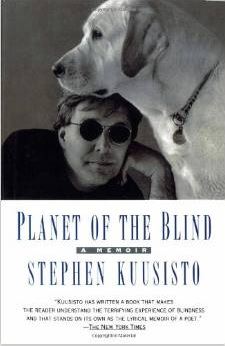
In my memoir Planet of the Blind I describe learning to read with the help of an African-American teacher who put in the extra time to make certain I achieved literacy. She pushed me into writing. Therefore in my own teaching I challenge my students to write with firm control of content and form. In a paper assignment I may ask students to explore the formal elements in Auden’s elegy to Yeats because the exercise will help them see how the lyric component of the poem is central to its political and psychological contents.

Creative writers and theorists who have concerned themselves with the experiences of historically marginalized people influence my teaching. I aim to show students how inherited figurative language may itself become an obstacle for the writer or at least for his or her imagined characters. Raymond Carver’s story “Cathedral” comes to mind as a teaching tool. In Carver’s story the miserable working-class “sighted” narrator guides a blind man’s hand across an oversized sheet of paper in a sympathetic effort to show the sightless man what a cathedral looks like.

I am engaged by what the critic Lennard Davis has called “the construction of normalcy” in the area of Disability Studies. “Normalcy” can be understood as an economic construct of 19th century industrialization. In this kind of analysis no one is normal enough for the factory and no citizen is taught the language of self-identity. In a course on the contemporary memoir I demonstrate for students how Nancy Mairs (who has multiple sclerosis) argues with our culture’s assumptions about the role of women and the value of the disabled. Additionally I strive to show students how a memoirist’s concerns are informed by Feminist Theory, Queer Theory, and African-American Theory and Literature. The memoir is a synthesis of statements about identity whether the writer is Dorothy Allison, John Hockenberry, Paul Monette, James Baldwin, or William Styron—all are engaged in the progressive art of expanding the social parameters of belonging in America, even as they must address the ironic difficulty of that very enterprise.

As a poet and writer of creative nonfiction I hope to demonstrate how imaginative writing transforms the received and static forms of personal language and plot. In turn I aim to show students how to find new and releasing autobiographical material. The art of memoir resides in talking back, but hopefully the memoir or poem or personal essay will become an alchemical romance both for the reader and the writer. I find that I spend a great deal of time “listening” to students both in the classroom and in conferences. Of course in a very literal sense I sometimes need students to read aloud for me a revision of a text. “That’s odd,” I’ll say, “can you hear how you’re saying that?” Ironically blindness often allows me to focus a student’s attention on the emerging or instinctual subject of a poem or essay. At such moments my hearing conceives just beyond a student’s rising music the possibilities for a better line, or a newer theme that still remains to be explored. I try to show my students that where imaginative language is concerned one must cultivate a passionate curiosity about the word—a curiosity that only further writing and “revisioning” will satisfy. I hope I can help them hear their better voices.

The problem for those of us with disabilities is that the permanence of physical or neurological difference is unbridgeable and the built environments that occlude or obstruct our progress are still omnipresent. The Americans with Disabilities Act told us boldly to come into the village square or the agora. We’re here. We like our colleagues. We want them to like us. We feel sad about the eye rolling. The good news? Eye rolling can be a temporary condition.

Essay: You Can’t Please Everybody

Essay: You Can’t Please Everybody

I care what people think of me, but I do not always care. A proverb might be attached: sings to the wind, sings to stillness. Something like that. A student put me in mind of this, asking me how I keep myself buoyant (my words) in a world of endless disappointments (my words) and I said that in my experience those who do not like you would never have liked you, and so what chance do you have? You simply make the music that is your life. I’m always making analogies, not only because that’s what writers do, but because for over a hundred years the thinking of our thinking classes has been infused with metaphor, whether you’re a poet or not. So religion is about ideas of god, science is about wish, far more than scientists will allow, and art is what you make of it. And that’s a fancy way of saying you can’t please everybody.

It is a sobering moment when you first realize that the educated in the US are afflicted by self-loathing and self-doubt to the same degree as your butcher. Talk subsumes surprise all too often, and a grey formalism mixed with gall settles in. You see it in university professors but also in bureaucrats and business people–a vague, unspoken sense that wisdom is not enough in a life. It’s as if the nervous self-awareness of adolescence has become permanent for millions of people; growth has stopped; and so the millions live in thrall to sad confirmations. You can ask why this should be the case and according to the province of theory you’re in, you will get different answers depending on whether you’re reading Osupensky or Marx or Alan Watts. What matters is that one is surrounded by idio-pathic zombies, which is of course why zombie games are so popular on mobile devices.

And so I don’t care what people think of me–I’m a person with an evident disability living in a civilization that sentimentalizes disabilities. The blind man who climbs a mountain can dine out forever giving talks about inspiration–talks that tell millions who live in thrall to sad confirmations that their lives could be bigger if only they dared live bigger. I have a general disdain for these sorts of talks, and in truth would rather have a colonoscopy without anesthetic than listen to the treacle that far too many celebrities with disabilities willingly toss at conferences and conventions. Inspirational speaking is always missing the point–that life is life, and lived with better ideas it’s a better business. Life is not cavalier emulation. It’s something else. It’s perhaps nothing more than a flaunted non-sophistication that finds honest satisfactions. And it’s about inviting your neighbors in, after you’ve swept the house. If you’re going to emulate someone, emulate the teacher who read a book all weekend.

Meantime, I don’t care if I’m not liked. Oh I grieve over it a bit. But what I want isn’t personal. I’m not indifferent to the peculiarities of the world, the one we’ve made. I’m angry that Lockheed Martin can advertise weapons of mass destruction on my television. I’m angry that young people are being told their votes don’t matter; that people of color in my country are being prevented from voting because they don’t have driver’s licenses; I’m wildly angry that my nation has killed a million citizens of Iraq for nothing more than a bullying neo-conservative idea that we could export democracy at gun point. I’m angry that the old damage of American imperialism is so poorly understood by my neighbors, many of whom honestly believe that muslims hate America because we’re Christian–failing to realize that our foreign policy has undermined the dignity of human life in a large part of the world for a generation and that human beings have a good grasp of what has been happening to them. I wake up angry. I go to bed angry. And in the meantime I walk about.

I live in the communion of words with my firm shoulder blades and half groomed head and I read as much as I can about liberty and I say what I must.

If you have a disability you see almost daily how many have learned the language of shoulder shrugging. If you work at a university you see professors who shrug–they’re my pet peeve–the ones who don’t want the students with disabilities in their classes. And the administrators who make it hard for faculty and staff with disabilities to do their jobs–I can’t stand their shrugging. The latter especially as it’s loaded with double talk.

So to that student who asked: I think of the static from the remorseless sun and keep shining.