Dog and Notebook, They Never Let You Down

Australian man button holes me, explains collective unconscious in airport. 

Once on subway in New York I saw a man talking angrily to God. 

As poet Charles Simic would say, “he had dark ages on his brain.”

Easy to be confused by strangers and even friends. Easy to want bubble bath.

Trust notebook. It will never let you down. 

When young, ate an onion like an apple, just to impress girl friend.

Old now, cleans ashes from fireplace, impresses no one.

How it goes. Time stretches him, but he’s only elastic in noggin. 

Sometimes notebook’s pages get stuck together.

Dog owns all the money. Yellow canine money. Lucky, dog spends it with you. 

Walked around the down on luck neighborhoods of Ithaca, New York. 

Shabby houses looked like places where people were either sleeping or sick. 

Old frame structures no longer loved. 

But my dog and I—we were some kind of two headed flying fish. 

Happiness was in the facing wind. 

Poets Ken Weisner and Andrea Scarpino in Syracuse

Y Areas of Focus Blue all bold

A Reading by Poets
KEN WEISNER
and ANDREA SCARPINO

 
WEDNESDAY, 3/25, 7:00 PM
Free and open to the public 

Ken Weisner lives in Santa Cruz and teaches writing at De Anza Community College in Cupertino where he edits Red Wheelbarrow. His most recent collection of poems is Anything on Earth (2010, Hummingbird Press). His work has been featured on Sam Hamill’s “Poets Against the War” website and on The Writer’s Almanac (2010).

Andrea Scarpino is the author of the chapbook The Grove Behind (Finishing Line Press) and the poetry collection Once, Then (Red Hen Press). She contributes weekly to the blog Planet of the Blind. This reading is presented by the Syracuse University Honors Program.

This reading presented by the Honors Program at Syracuse University.

The YMCA’s Downtown Writers Center

340 Montgomery St.
Syracuse, NY 13202

High School Days

When I was in high school an average week went like this:

Skip gym class, go to local college, read Voltaire–but not Candide, instead, his Philosophical Dictionary–liking especially:

“A big library has this in it of good, that it dismays those who look at it. Two hundred thousand volumes discourage a man tempted to print; but unfortunately he at once says to himself: “People do not read all those books, and they may read mine.” He compares himself to a drop of water who complains of being lost in the ocean and ignored: a genius had pity on it; he caused it to be swallowed by an oyster; it became the most beautiful pearl in the Orient…”

2. Skip gym class, go to draft board, show blind letter from doctor. Declare to hedge hog corporal blind people might conceivably work in tunnels. Corporal tells him to go screw himself.

3. Skip gym class, drink stolen bottle of champagne. Take nap in abandoned bath tub in woods.

4. Skip gym class, go to local college, read Ed Sanders, liking especially “Poems From Jail”.

5. Skip entire school day. Stay sober but still take nap in abandoned bath tub.

Ah Wordsworth:

“Though nothing can bring back the hour

Of splendor in the grass, of glory in the flower;

We will grieve not, rather find

Strength in what remains behind;

In the primal sympathy

Which having been must ever be…”

Starbucks and the “Racing Together” Dilemma

When Trayvon Martin was murdered (and I’ve no compunction saying so) I published a blog post saying race and disability are linked by stigmatizing architectures. I wrote from an outlier’s position as I’m a blind man whose presence in public is nearly always conditional. One thing my friends of color and my pals with disabilities (and yes, sometimes they’re the same) know is that nowadays there are more gated spaces in the US than ever. Some places have patrolled fences while others offer no signs of implicit exception. All outliers understand that when you transgress—when you expect to enter closed spaces you’ll be sized up. I said:

As a person who travels everywhere accompanied by a guide dog I know something about the architectures and the cultural languages of “the gate” –doormen, security officers, functionaries of all kinds have sized me up in the new “quasi public” spaces that constitute our contemporary town square. I too have been observed, followed, pointed at, and ultimately told I don’t belong by people who are ill informed and marginally empowered. Like Trayvon I am seldom in the right place. Where precisely would that place be? Would it be back in the institution for the blind, circa 1900? Would it be staying at home always?

Tippy-toe-racist-ableist-architecture isn’t new. Slavery was always architecture. And the “ugly laws” kept cripples off the streets of America for a century. Yes, we’re living in a time of vicious retrenchment. Enter Starbucks.

By now almost everyone knows the CEO of Starbucks, Howard D.Schultz  launched a campaign called “Racing Together”—baristas were instructed to write the phrase on every coffee cup sold. Starbucks’ aim was to start a national conversation about race. I’m saying the motive was good but I’m also scratching my head, for Mr. Schultz must have imagined his franchises are genuine 18th century coffee houses where informed citizens gather regularly to exchange ideas and conduct solemn conversations. I love the notion. I enjoy picturing Samuel Johnson seated across from me, slumped in a leather chair, hoisting his mocha latte, and cheerily dissecting our manners.

I fear Mr. Schultz had a good idea but oddly, inexplicably, misunderstood what the average Starbucks essentially is. Note: I’m not claiming his coffee shops are gated spaces (though some may be) nor am I saying conversations about tricky subjects shouldn’t happen—for I believe our nation is woefully indisposed to the art of engagement. In fact I care so much about conversing I even wrote a book about it called Do Not Interrupt: A Playful Take on the Art of Conversation.

No. I think Mr. Schultz forgot that for over sixty years, Americans have been schooled by Madison Avenue to think they deserve a break today. Although the slogan was originally coined for MacDonalds, it stands for the advertized appeal of every commercial space. The slogan was also accompanied by the claim: “at MacDonalds it’s clean.” The subtexts are variable but one thing’s for sure: you shouldn’t feel guilt when spending money on junk food (you deserve it) and you have every right to expect the place where this food is sold offers “time out” from your daily troubles. All franchise businesses in the United States sell these presumptions.

In fact, so trouble free are these franchises imagined to be, their managers often run afoul of the Americans with Disabilities Act. There are frequent stories about people with service dogs, mothers with crippled children, deaf people trying to sign—all experiencing discrimination in fast food venues.

Some gated communities are entirely created by the advertising industrial complex. (How can the Hamburglar cheer up the tots when there’s a motorized wheelchair user at the next table?)

Where would the right place be for coffee and conversation about outliers when long ago we sold the vision that fast food restaurants are fully sanitized for our protection?


Disability and Slow Thought

It was Hugh Trevor-Roper, writing of Gibbon who observed: “We all tend to simplify, perhaps to dramatise, our mental development. In retrospect, the slow processes of the mind are disguised, sometimes even obliterated, by the dramatic moment of discovery, or conversion. St Augustine’s tolle lege, Newton’s apple … intellectual history is full of such episodes which immortalise, though they may not explain, crucial stages in the transformation of thought.”

We talk in disability circles of the “overcoming” narrative– those memoirs and made for TV films where the “aha” moment is both the summit of long striving and a monument to the agonies of an exemplary cripple’s stamina or faith. “Inspiration porn” we call it. What’s most unfortunate is the misleading impression such stories convey. Real disability is not subject to conversion. Nor is it apprehended in a flash.


If inspiration porn is bad (and trust me it is) so is theory porn. “Culture has completed its work when everything is a sign” wrote William Gass–a troubled irony certainly–culture endeavors to narrow the signifiers–or failing that, to build recognizable maps with lines you can follow. Theory porn accentuates oppositional rhetorics in order to suggest or extol the preferred status of outlier bodies. Critical disability studies creates its own overcoming narrative by arguing disability or crippled-ness are active verbs until we are “disabling” or “cripping” neo-liberalism, compulsory hetero-normativity, or gym toned bodies. Yes, theory porn has its problems. Once at a conference I heard one theorist of disability attack another because the latter was devoted to physical fitness, and presumably insufficiently infirm to hold a position on the subject of disability. If the outlier body is theorized it best be sufficient unto its marginalization.

One must dare to be slow as the wheel chair on ice. Simplifying or dramatizing bodies is not much different from the overcoming narrative. Theory does quite often superimpose its own Aristotelian template over the broken body. It’s a very very slow business this altogether inexplainable body.

Persistence of Vision: Colleen Woolpert at the Felton Gallery in Syracuse

Yesterday I read some poems and prose at an installation of artist Colleen Woolpert’s works that explores blindness and imagination.  As I’ve often said (so routinely I sound like a public transportation tape loop—“do not lean against the doors; mind the gap”)  no two people who are blind experience vision loss in the same way. Indeed I’ve a favorite comparison: blind people are as essentially “unalike” as the cab drivers of New York City. Nothing about vision loss is ripe for agreement unless one considers the public’s failure to understand the subject. While generalizations are risky, it’s safe to say most able bodied citizens think blind people experience the world like Shakespeare’s Ariel, imprisoned within a tree. In my memoir Planet of the Blind I addressed this straight away in chapter one:

“Blindness is often perceived by the sighted as an either/or condition: one sees or does not see. But often a blind person experiences a series of veils: I stare at the world through smeared and broken windowpanes. Ahead of me the shapes and colors suggest the sails of Tristan’s ship or an elephant’s ear floating in air, though in reality it is a middle-aged man in a London Fog raincoat that billows behind him in the April wind. He is like the great dead Greeks in Homer’s descriptions of the underworld. In the heliographic distortions of sunlight or dusk, everyone I meet is crossing Charon’s river. People shimmer like beehives.”

Excerpt From: Stephen Kuusisto. “Planet of the Blind.” iBooks. https://itun.es/us/SqYjO.l 


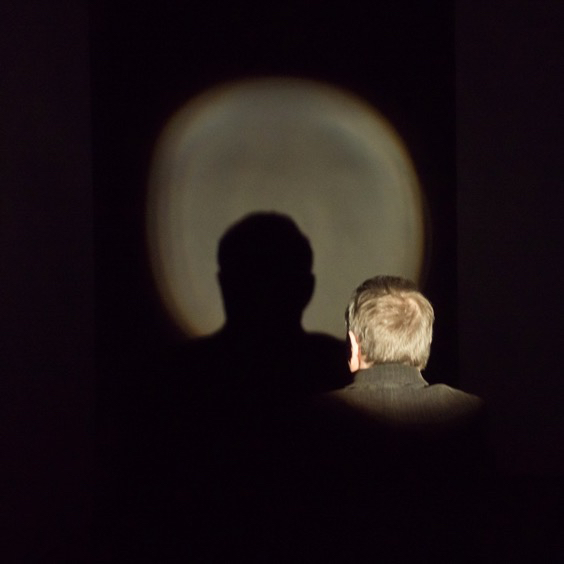
In Woolpert’s excellent installation viewers can see what they do not see, even as they’re presented with the visual ironies of self-hood. The photo above is of me staring into a projected oval of light thereby making my own silhouette. Have you ever seen yourself on the moon? The blind invariably do. Has the moon made you lonely? As the poet Federico Garcia Lorca said, when we see the moon, we feel “the heart is a little island in the infinite.” In this way all are like the blind. Perhaps you knew it. But I doubt you’d have known it if you thought the blind lived trapped inside trees. Would Ariel have known the moon? She may have recalled it. But unlike the true blind she couldn’t sit before it. A blind girl knows the moon and the moon knows her. Now I’m digressing. I’d really like to see a book about the disabled and the moon. Note: when Galilleo first saw a lunar valley it appeared like a hand. What did it say in sign language? I wrote a poem about this for my deaf pal Brenda Brueggemann:

Kansas: Deaf Girl Watching the Moon

–for Brenda Brueggemann

One night there are valleys,

Say around eleven,

When the moon is wide

As a brother’s grin.

The field is black as shadow:

Soybeans sleep in loops

Of darkness,

Their leaves curled.

The valleys of the moon,

As unalike as pitted stones

Or walls or men

Or water or dreams—

Unalike as pages in a book.
When he saw them,
The valleys like hands,
Valleys like the bones of hands,
Galileo rushed into the street
Hoping for someone to tell.

He had no field.

He could not talk with his hands.”

Excerpt From: Stephen Kuusisto. “Letters to Borges.” iBooks. https://itun.es/us/2eNPH.l

Woolpert’s exhibit is called “Persistence of Vision” which is absolutely right. All the blind I know have persistent vision or visions. They are not precisely your visions. In what way is this circumstance anything other than the phenomenology of art?

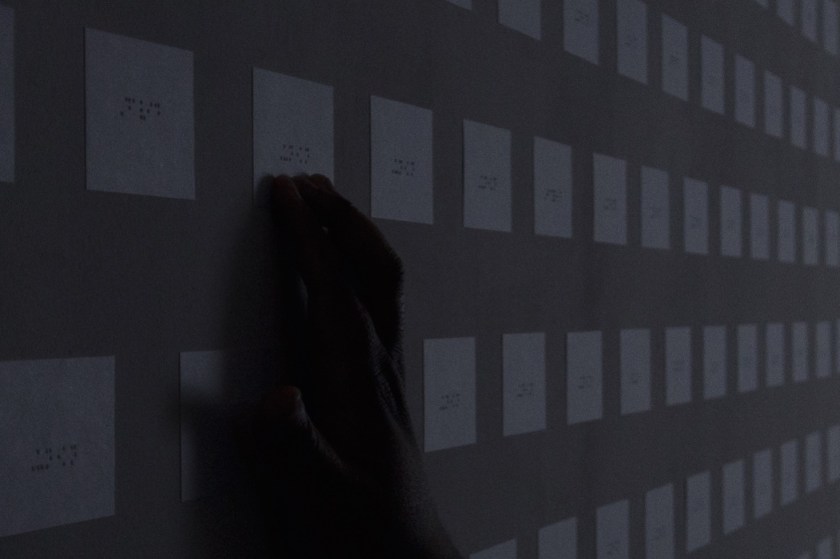
Above is a wall of Brailled note cards, each bearing the first name of a blind citizen of Syracuse. Run your fingers along the wall. The field is black as shadow. The pages are as unlike as any book’s leaves. Let your mind wander. Try to imagine how liberating Braille was when it was introduced? Did you know that before the Englightenment people thought the blind couldn’t read. Diderot was the first great intellectual benefarctor of the blind.

Above, I’m reading poetry beside a projected video of a lovely blind woman’s face. What’s behind those lovely eyes? What’s behind your own?

The exhibit runs through April 14 at Onondaga Community College’s Felton Gallery. Link here.


Analogy, Melancholy, and Neo-Platonic Beans

The inestimable Jacques Barzun wrote: the book, like the bicycle, is a perfect form which may be true but Jacques was guilty of comma spicing as a book and a bicycle are both perfect forms and not reducible to analogy. 

Bill Clinton said (infamously) “it depends on what the meaning of the word “is” is. We know what Clinton meant but we’re not as certain of Barzun. If a book, like a bicycle “is” a perfect form than we’re invited to be Platonic but vaguely so because Plato would not have acknowledged Barzun’s “is”. According to Plato common objects are inferior and mutable but each thing replicates perfect and immutable Forms. So there’s a book “form” in the hands of the Gods and a bicycle form but no analogy. 

We are of course living in an age of analogy which is a beautiful thing. For poets it means sneaking back into the garden and eating a second apple and a third, even a fourth. Stuffed, they can write like Wallace Stevens in “Thirteen Ways of Looking at a Blackbird”: “a man and a woman/are one./A man and a woman and a blackbird/are one.” Now we must ask is this sentiment beautiful because it is true or untrue? If it’s beautiful it’s because we can say it. When we’re reckless with analogy we make claims on eternity as Lord Byron tells us in Don Juan

What is the end of Fame? ’tis but to fill

   A certain portion of uncertain paper:

Some liken it to climbing up a hill,

   Whose summit, like all hills’, is lost in vapour;

For this men write, speak, preach, and heroes kill,

   And bards burn what they call their ‘midnight taper,’

To have, when the original is dust,

A name, a wretched picture, and worse bust.

**

Byron gets it right: after the 18th century analogy is the end of fame. Analogy “is” the striving. 
Byron also gets it right: this is beautiful until it isn’t. 

**

In his essay “Effects of Analogy” Wallace Stevens spilled the neo-Platonic beans:

Another mode of analogy is to be found in the per- 

sonality of the poet. But this mode is no more limited to 

the poet than the mode of metaphor is so limited. This 

mode proposes for study the poet’s sense of the world 

as the source of poetry. The corporeal world exists as 

the common denominator of the incorporeal worlds of its 

inhabitants. If there are people who live only in the 

corporeal world, enjoying the wind and the weather and 

supplying standards of normality, there are other people 

who are not so sure of the wind and the weather and 

who supply standards of abnormality. It is the poet’s 

sense of the world that is the poet’s world The corporeal 

world, the familiar world of the commonplace, in short, 

our world, is one sense of the analogy that develops be- 

tween our world and the world of the poet The poet’s 

sense of the world is the other sense. It is the analogy 

between these two senses that concerns us. 

**

Analogy is a beautiful thing but it’s untrue as all men and women are untrue. It also requires bravery—the recognition there are no perfect forms. Everyone gets to invent his or her own incorporeality. This is what’s meant by the world of the poet. 

For Stevens the corporeal world is Byron’s “uncertain paper”. 

A book and a bicycle are one/gods ride them singularly or in teams…

Analogy is in the driver’s seat. This is a melancholy world. 

Rousseau's Dog

Jean Jacques Rousseau had a dog named Sultan who accompanied him to England when his life was threatened in France. Poor broken Rousseau with his malformed urinary tract, cloying hypochondria and hot paranoia–also poor in cash, resolutely poor in friendships. Sometimes we think we understand him–we, the descendant cripples–those who spent fortnights alone in childhood and more than once. We who occupied our attentions with flowers and seeds. Rousseau had the triple whammy: his mother died when he was very young, then his father ran away. He was forced to learn the baleful adolescent art of beseeching strangers for protection and love. He was easily tricked into churches and bedrooms. And he was easily discarded. The cripples understand this.

No wonder he discarded neo-classicism for what others would call the romantic. No wonder Shelley and Byron adored him–passions of betrayal and resolution always feel the most authentic. Rousseau's enemies substituted “savage” for “authentic” and prided themselves for calling him “uppity” which is of course what is generally done to passionate cripples. Small wonder Rousseau took up the matter of social consent among the governed.

Sultan lead him into the English countryside where he seldom encountered another soul. I love knowing this. A dog can stir and extend solitary human concentration which is the reward of stigma, but you must understand it in a canine manner–pay attention to what's here and here; not yesterday; never tomorrow; and yes, a dog looks the other way when you take from your pocket a handful of French seeds and push them into British soil.


The Trees of My Childhood

And so you think differently in the mornings. The bird takes your wings, flies to the birch tree. “Don’t write prose,” says the bed of moss. Jesus, you don’t even know what prose is. On your hands and knees you know the lady’s slipper, an orchid, purple as a royal hat. 

Once, years ago, in a job interview (with people I didn’t like) when asked, “what’s the next thing you’re working on?” I said: “A biography of the trees in Karstula, my grandfather’s village.” That did the trick, the lights went out in their eyes. Boy do I know my trees. Know what occurs deep below their roots. 

When you’re asked about ambition—in literary terms—well, it’s always a trick question. 

D.H. Lawrence: 

“All people dream, but not equally. Those who dream by night in the dusty recesses of their mind, wake in the
morning to find that it was vanity. But the dreamers of the day are dangerous people, For they dream their dreams with open eyes, And make them come true.” 

Now lately I’ve made a few things come true. 

I translated a micro lyric from Finnish. A dirge. A lovesick flash blues:

sad evening
when the city becomes silent
we will no longer meet

had we some others

we would be happier

Had we some others—nights are precarious. Tonight love. Tonight no love. And see how the city is indifferent.

The trees wish to help but they’re overpowered by sermonizing architectures. 

Didn’t you know it! Even as a child you knew! Stay away from the buildings! 

With trees, among them, never forgetting them, life becomes slow and strong like Mahler’s Fifth. He, by the way, loved the morning.  

The bird takes your wings, flies to the birch. In turn she gives you a tinge of color. 

In the middle of everything, broken glass of their feathers, and the solid streets of the committed trees.

Early, I saw I didn’t know much. A boyhood with trees is just that way. 

All the trees past and present, know some secrets about my strained heart.