The Guide Dog Who Ate Chicago, or Austria

Steve and Vidal


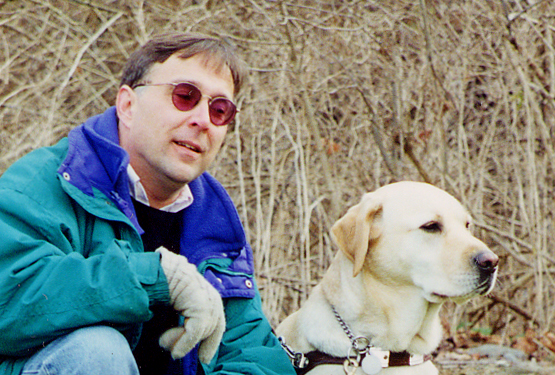
Photo of Stephen Kuusisto and his second guide dog “Vidal” 


I joke about Vidal, saying things like, “well he’s got a “complex”. “Back when he was a wolf he never knew when his next meal was coming.” In Graz, Austria he eats a bird’s wing while I sit up late under the moon in a garden with poets. The poets drink beer. Vidal snacks on raven feathers. For once he doesn’t cough them up. Does a dog who eats feathers fly in his sleep? Is he self medicating? What reckless medicines does he require and for what conditions?


The term for strange canine eating is “pica” and no one knows what causes it. Some say its a quest for missing nutrients. Others argue its just a form of attention seeking. With Vidal I sense its neither of these things—he’s the owner, the possessor really, of a very fast mind. He’s bored and the world is filed with wild promises. 


I come to see his eating as pure curiosity. What’s inside the rose? 


In Vidal’s view, both shade and silence are edible. 


The fact is, he’s really smart. 


Of course he is. But in his case something’s systematically deranged about the thing. I keep saying he’s good in traffic. He’s exceptional. Walking in downtown Graz he figures out how bike paths work—sees they’re potentially lethal—and moreover, sees I don’t understand them. 

He pushes his body against my legs, prevents me from colliding with a cyclist who flaps like a banner. 


Then, as I praise him, he eats some eggshells. 


Lacrimae rerum—or Disability 101


Always the doctor leaning close, saying you’re alive. You raise your hands, open your eyes. The doctor is shabby. He’s asymmetrical like a Roman Emperor. There’s something wrong with the doctor. And even though you’re the monster—hence, proprioceptive, fast, clear, you know you’ll never get the doc to admit his shortcomings.

Dog-man and RandomThinking

The Dog-man is different from the man he used to be. He knows we can only love the things we can conceive. He loves the moon, wind, old friends met by chance. He forgets his enemies though their smell reminds him to be cautious when necessary. You can count on the nose.  


Another way to say it: dogs don’t worry about the sensible soul. 


Boxing and the Body

By Andrea Scarpino


My coach played the video: speed work on the heavy bag. My uppercuts looked good: my balance good, legs strong, chin down. 


Then my hooks. I started to laugh. What was I doing, slapping my arms limply at the bag like that? Distracting my opponent with how ridiculous I looked? 


Next day, another round of speed work. My coach told me to step closer to the bag, to put my weight into it. I thought about the video. And something clicked: hook after hook, the bag made a deep and satisfying sound. I punched harder than I’ve ever punched anything. I heard my coach cheer. I heard Zac cheer. My hands in my boxing gloves were light and solid and free from fear. 


And that may be the key: fearful. Fearless. 


I have lived so much of my life in fear. Fear of physical pain (it always returns eventually). Fear of losing people I love (I have, I will). Fear of never being smart enough (for what?) or good enough (for what?) or the best in something (what?).  In college, I wore my glasses to bed because I was afraid of not being able to see if someone broke in. For years, I slept with a knife under my mattress. 


Doing mitt work one night in the ring, my coach said I was “flinch-y.” Hitting her red mitts, I could feel my eyes flinch, I could feel my body flinch. I just couldn’t stop it from happening. And I couldn’t name fear’s object: I knew she wouldn’t hit me back with her mitts. I knew we were only training. She kept telling me to hit harder. I kept flinching. 


But that moment with the hooks, I felt no fear. I punched and punched and I heard the sound of my body hitting the bag and I heard cheering and I felt no fear. Body in action. Body in the moment. 


“Very few of us live with perfectly intact bodies,” one of my mentors says. 


I’m writing a book-length poem about the body in pain. My body in pain, the bodies of others in pain: football players, Frida Kahlo, young cancer patients. I’m writing a book-length poem about the ash tree: ashes to ash tree. I’m writing a book-length poem about how medicine failed me. Continues to fail me. 


“We write what we need to understand,” another mentor says. 


That night with the hooks—maybe it only lasted 20 seconds, but for those seconds, I understood my body. It did what I wanted it to do. I didn’t feel pain or fear. I didn’t flinch.

In Memory: Maxine Kumin

By Andrea Scarpino


My very first writing conference. I was a terrified graduate student attending session after session of writers whose work I had never read, who were smarter and better informed, who seemed to know all there was to know about publishing and craft and how to break a line. I was jostled in long hotel hallways as I tried to find the right conference rooms. I was jostled waiting for slow elevators, for bathroom stalls, for coffee. I remember feeling almost nothing but overwhelmed. 


And then, Maxine Kumin. A small, stuffy, crowded room packed with people, mostly women, and too few chairs. I sat on the floor with dozens of others—that horrible hotel carpeting. I remember she read from Inside the Halo and Beyond. I remember she looked impossibly old, even then, impossibly fragile, her body stiff from the surgeries and recovery she had endured. 


I sat in awe. 


When she finished, we all stood to applaud, and a line quickly formed in front of the table where she stood. Some people asked her to sign their books, but I hadn’t thought to bring any. Some people asked her smart-sounding poetry questions, but I couldn’t find anything smart to say. I felt completely empty. 


Finally, I reached the front of the line. She stood, impossibly small. And I started to cry. 


“Your work has meant so much to me,” I said, the only words that came. 


She smiled and said “Thank you.” And I walked away. 


My moment with Maxine Kumin and all I could do was cry. But isn’t that what the very best writers do to us? Take away our words. Take away our breath. 


When I texted a friend that Kumin had died, my phone’s autocorrect changed “Kumin” to “luminosity.” As in, “the intrinsic brightness of a celestial object.” As in, “bright or shining, especially in the dark.” 


An outrageously appropriate autocorrect—because that’s what Kumin’s work does for me, sheds light, reminds me to pay attention, stay present in this world, stay present with this world’s beauty, this world’s awfulness. Her work is daring and quiet, bold, full of light and loss. Her work says things I didn’t always know poetry was allowed to say. Her work makes me feel safe that such brilliance exists in the world. 


More poetry books are published every year than any one of us could read. But voices like Kumin’s? Like her contemporary, Adrienne Rich? Books that speak unspeakable truths? That dare? That are narrative and lyrical, mired in the personal and the political, that are brave and brave and brave? 


“How are you taking her death?” my friend texted back. 


“I somehow thought she would live forever,” I replied. 


“Yeah. I know what you mean.”

Guide Dog Two Takes in the Theater


Sometimes we see things with a critical eye—an effect takes place—we see through the wrong end of a telescope and though everything’s small, things are clear. “That’s who you are,” you say. “Yes, that’s who you really are.” 


I had one of those revelatory experiences with dog number two. Vidal was under my feet in the Archbold Theater in Syracuse. We were in the front row. The stage was inches away and accordingly we were just five feet from Sam Waterston. Sam was appearing as James Tyrone in “A Long Day’s Journey Into Night” which meant he was playing the role of an unhappy man and as far as I could see he was doing a fine job it it when Vidal let out a groan. It was not a standard harumph—the sound a dog makes when turning itself. It was a note of misery—and loud enough to be heard throughout the theater. I leaned forward and whispered in his ear, stroked his face. Above me Waterston was lamenting Tyrone’s life—a life spent in the service of a single role—the life of a second rate actor. Tyrone was filled with regrets. Vidal groaned louder. It was a crude sound; an athletic noise. I rubbed his face with my foot. People stirred in their seats. I knew Sam Waterston couldn’t see the dog. He was working hard, emoting, as groans were rising around him. I slumped as low as I could manage. From above I heard: “It was a great mistake, my being born a man, I would have been much more successful as a seagull or a fish. As it is, I will always be a stranger who never feels at home, who does not really want and is not really wanted, who can never belong, who must be a little in love with death!” From below came another dog groan. a noise like a ship coming apart.  


From above I heard: ““Be always drunken. Nothing else matters: that is the only question. If you would not feel the horrible burden of Time weighing on your shoulders and crushing you to the earth, be drunken continually.Drunken with what? With wine, with poetry, or with virtue, as you will. But be drunken.And if sometimes, on the stairs of a palace, or on the green side of a ditch, or in the dreary solitude of your own room, you should awaken and the drunkenness be half or wholly slipped away from you, ask of the wind, or of the wave, or of the star, or of the bird, or of the clock, or whatever flies, or sighs, or rocks, or sings, or speaks, ask what hour it is; and the wind, wave, star, bird, clock, will answer you: ‘It is the hour to be drunken! Be drunken, if you would not be martyred slaves of Time; be drunken continually! With wine, with poetry, or with virtue, as you will.”


“Oh God,” said the dog. “Oh God Oh God Oh Lord!” I leaned close to him. Whispered in his ear. I said: “C’mon boy, you can get through this. Its just Eugene O’Neil.” And we did survive though Vidal moaned like O’Neil’s fog horn and I wanted to stand up and shout out: “Its not me, Sam, its this dog! He’s doing some kind of martyr thing!” 


As soon as the lights came up I fled with my friends Dave and Adrianne and it was at their home the next morning I learned what ailed Vidal for as we stood in the grassy yard he excreted a long, black gym sock—a whole garment—and I could only surmise what agony he’d endured lying under a theater seat while O’Neil’s sad men talked on and on about their meaningless lives in fog. 


And I, a veteran guide dog handler knew I’d a different creature before me. Dog number one would only carry the socks. Vidal was a devouring kind. 


The God of Starvation

America is consecrating the war void. This is accomplished by kicking the old and inform and the very young straight to the ditch. We have a new farm bill! The Democrats assisted the GOP in cutting food stamps to the bone. There is no “back up method” to assure the poor will eat. The war void wins. And it wins when we no longer talk of human life, save to say its inconvenient. The war void wins. 


The war void isn’t really a void of course. It has flesh and blood. But its not yours or mine.  


“Cuts to the nation’s food stamp program hit 48 million Americans this week, including more than 9 million elderly and disabled people.”


See full story here.


Thinking of Verlaine

Thinking of Verlaine


Its raining in my heart and I feel like crying

But I resist owing to a head cold 

and a general richness—

because this is sorrow

not some boyhood thing

and the rain sends me to you: 

“Il pleure dans mon coeur 

Comme il pleut sur la ville.” 

You see? It rains

where my neighbors thin windows  

were left ajar, and they can’t hear a thing. 


Giving Up on Wallace Stevens

I love Auden for many reasons—most principally because he understood Caliban was the best interlocutor for Shakespeare. That’s wisdom. I prefer it to beauty, though, like Caliban, I won’t vote beauty off the island. 


Poems rise and fall with whispered confidences. If you sit beside that ocean for long you’ll lose affection for some voices. I’m nowhere as fond of Wallace Stevens as I was in my twenties. For you it will be someone else. The enduring voices are brave. Auden; Dickinson; Whitman; Langston Hughes; Rexroth; yes, Williams. Muriel Rukeyser. James Wright. Neruda. So many brave ones. 


By forty I found I didn’t like Stevens whose poetry seemed like a rococo picture frame but without figures of candor. The houses are haunted by nightgowns but I didn’t care anymore. But I like these lines by Robert Bly:


“Why is it our fault if we fall into desire?

The eel poking his head from his undersea cave

Entices the tiny soul falling out of Heaven.

So many invisible angels work to keep

Us from drowning; so many hands

reach Down to pull the swimmer from the water.

Even though the District Attorney keeps me

Well in mind, grace allows me sometimes

To slip into the Alhambra by night.”


Excerpt From: Robert Bly. “The Night Abraham Called to the Stars.” iBooks. https://itun.es/us/T4QFv.l


You see, I don’t mind obscurity, but I need a heart as its conductor. 


The Price of Disability Inclusion, and the Fight for Same

“All societies are rational and irrational at the same time. They are perforce rational in their mechanisms, their cogs and wheels, their connecting systems, and even by the place they assign to the irrational. Yet all this presuposes codes or axioms which are not the products of chance, but which are not intrinsically rational either.”

(Deleuze, Gilles. “Capitalism: A Very Special Delirium” in Chaosophy. Ed.. Autonomedia/Semiotexte. Ed. Sylvere Lothringer. 1995.)


This is how it is with disability—the connecting systems of culture (which are concerned with the assignment of meaning) imagine physical difference can be assigned a rational position or location. The asylum and the disability resource center at You Name It University are alike because they separate physical difference from the body normal. For college faculty (many of whom have no authentic civil rights position beyond saying the word “diversity”) disability is a cut off category, because that’s what they’ve believed since elementary school. In this way they are perfectly rational. Power relations have taught them compulsory able-bodied-ness. But the problem for the advocate, the activist, the person with a disability (who presumes entrance to the academy or associated academic venues—conferences, lectures, etc.) is that his or her presence is assigned the status of irrationality. 


If you say you want accommodations—computer aided real time captioning; sign language interpreters, braille, accessible websites, ADA compliant restrooms—just to name the basics—you are assigned the status of irrationality. This dual status—rational segregation and the irrational claim for civil rights makes disability citizenship almost impossible to attain. 


Its a ragged self that survives. Its one that refuses to stop insisting on full inclusion and not mingy half granted and grudging accommodations. I’ve been saying things like this on this blog for 7 years but now I’m going a step further: I’m not excusing casual hand gestures from academics or conference organizers—the old “well we just forgot” moue of false sympathy—“So sorry friend. Yes, once again we don’t have accessible stuff. We’re good people. You should like us anyway.” I can no longer afford to forgive the easy assignment of physical difference to categories of complication or inconvenience. 

In this way I feel like James Baldwin. I’m not playing along anymore. I’ll call my culture what it is. As Baldwin said: “The paradox of education is precisely this – that as one begins to become conscious one begins to examine the society in which he is being educated.”


Ah Baldwin. I need you today. He said: “The price one pays for pursuing any profession, or calling, is an intimate knowledge of its ugly side.” I belong to a generation of writers and academics who came of age before the Americans with Disabilities Act. As a high school student, a college student, a graduate student I endured horrific commentaries from teachers and professors. The dominant trope in American education is speed. Every syllabus is a race. The blind guy with glasses thick as padlocks needed more time to read. He wasn’t supposed to be there. In graduate school at the U of Iowa a famous literature professor named Sherman Paul said I shouldn’t be in his class if I had trouble with my eyes. Against this kind of power-leverage the disabled should demonstrate an all forgiving, all understanding, good nature. 


Baldwin again: “No people come into possession of a culture without having paid a heavy price for it.” But you see, my generation of “cripples” has paid a heavy price. I’ve paid many times over. This is why I’m not going to forgive inaccessible conferences, university events, programs, and the like. Its not 1978 anymore. 


Baldwin: “The world is before you and you need not take it or leave it as it was when you came in.” 


Well I know what the world was like when I came in. I ain’t leavin’ it the same. 


Here’s the deal. You get called “uppity” as Baldwin well knew. If you’re a cripple you’re a “malcontent” or you have a bad attitude. 


And one more Baldwin quote: “Pessimists are the people who have no hope for themselves or for others. Pessimists are also people who think the human race is beneath their notice, that they’re better than other human beings.”


I think this is the problem with the overt or casual disregard for disability rights—both are ableism and both rely on pessimism.