Come Back to the Five and Dime Dear Spinoza

Spinoza wanted to free God from mysticism. My friend X wants to free his wheelchair from superstition. The symbolic mind is the island we can’t escape. Ernst Cassirer mumbled into his spetzel that we’re creatures of figuration. I bang my spoon. “Yes, Ernst, but the disabled are tarred and feathered by capitalism.” “Ernst, all disabled people are malformed according to capital accumulation. The only way out involves sentimentality. Tiny Tim. Inspiration porn.”


Ableism was happy, augmenting his practice, curing people with euthanasia. “Hello, hello? Cassirer, are you still there?”


Disability Theory and Nostalgia

Some people have a penchant for nostalgia but I’m not one of them. I don’t think the past was better—any effort to frame the past is fraught with a hundred anxieties. Today is motionless, snagged in the dendrites of one or more sadnesses. Let’s return to yesteryear with a lollipop. I’ve been damaged by my education. Its a global education. A friend says, “It was better in the 1950’s” and I say, “Not if you were black, a woman, a person with a disability, a citizen ofGuatemala. Perhaps my dendrites are impaired, but they haven’t gone blank. 


Nostalgia is almost impossible for people with disabilities. “Oh for the good old days of the iron lung!” “The asylum was grand, especially the little cookies.” My childhood played out before the Americans with Disabilities Act and it was a horror show. I still harbor rancor for a famous professor at the University of Iowa who said if I was blind I shouldn’t be in his class. The year was 1984. When I went to the chair of the English department to complain I was told I was a “whiner”. You can see why I distrust nostalgia. 


But nostalgia isn’t always about the past. It can become a projective prologue, a kind of “reaction formation” as Freud would say. We project our conscious and unconscious motives not on people but on the future. We do it through the agency of cultural theory and activism and in the best sense we hope the future will be affected by our work, our troubling work. We want to break down ableism, hetero-normativity, all the isms. But often we fail to understand our visions  are utopian, Arcadian, and just as precariously balanced upon our anxieties as common nostalgia. 


This doesn’t mean activism and probative cultural scholarship is unnecessary. Far from it. It’s more vital now than at any time in history  since  we must assert human rights in an age when the split between the developing world and the post-industrial world is mediated by everything from transhumanism to cyborgian fantasy.     


That disability scholarship and activism are important is unquestionable. What I’m arguing is that what we may imagine as “the future perfect” is flawed if we’re guilty of visioning narrow or singular fantasies.


There is a split in Disability Studies between post-normativity (which is vital if we’re to imagine a human future) and life on the street (where “the disabled” are losing benefits, going homeless, and committing suicide.) 


This split as I’m calling it has a good deal to do with projective nostalgia. We ought to critique this. We should know the names of our own privileges. 


In Memory of Anselm Hollo


I went once into the labyrinth of a Helsinki library—no plan—and found a hundred books by your father. Old philosopher he was, though not “always” “old” but still, I bet he was “old” so you had to be fast and odd. 


You got yourself some wristwatch utopias right away. 


And a red piano.


**


I met a ghost in Helsinki. I was young enough to be surprised, old enough to worry. 


I was walking with Tim, our mutual friend. 


We stopped at a toy store. Six year old Pablo went inside to see the insect kites. 


It was April. There was weak afternoon sun, the sun you get in the far north. 


We lit cigarettes, I remember, and talked about poetry—Tim said something and I said something, and then I said—“I see!” And poof! There beside us was an extremely old man. 


He was agitated. His skin was thin as paper. He had a wisp of white hair on his crown which stood up. 


He looked at us, pointed, shook a bony finger and said: “Why do you say you see? You don’t see! You understand! You understand!” 


“Yes,” said Tim. “You’re right.” And Tim looked at me, and I, with my legally blind eyes looked at Tim. And then we turned back and he was gone. Quite gone. 


Tim ran up the block and looked down a perpendicular street. The man had been frail, old as the city’s bricks, and zounds! he’d appeared and disappeared in an electrostatic bolt. 


This is a true story. Inwardly I knew this event had something to do with my being profoundly blind and pretending I wasn’t. 


What a good ghost. What a fine city Helsinki really is.


**


If poetry is architecture for the odd, let us climb in the windows. 

If its music and light, let’s get the party started. 


The News From Old Finland

I didn’t want to be the rain

But it was my turn. Walked out of town.

You wanna be a shaman there’s no screwing around. 

A shaman’s soliloquy learned from his wolf. 

All relations invariant and pure.

Raining, a good time to howl. 

Wolf says don’t fool yourself. 

Rain says woods are perfectly Grecian.

Man sez its good to be a ghost in the rain in Arcadia… 


Walking in Snow with My Guide Dog

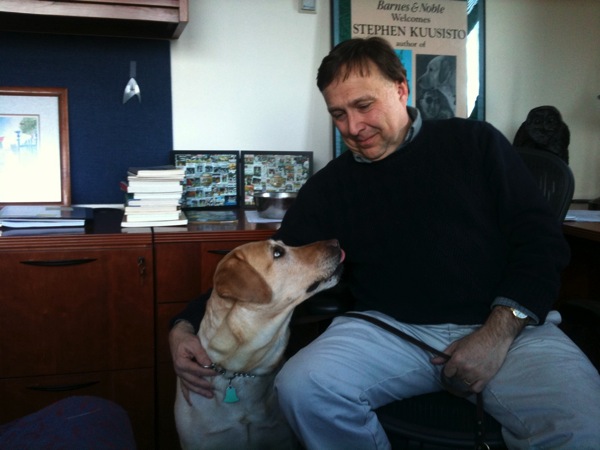
IMG 0048


We know not everything is equal. We suffer from this. 


Nira and walk in every kind of weather and I talk. 


She listens.


Nira, does everyone need a service dog? 


No one runs aground with a good dog. 


Not everything is equal. They think the disabled are only fit for some stony, savage country.


I tell Nira about the time I visited a sheltered workshop for the blind in New Orleans. The blind employees were kept in a dark room where they stitched decals and flags for the military.


Nira, the subtlety of normal life hides the cruelty of marginal experience. 


Could we wear a sandwich board that says something like this? 


Nira, we should take this idea under advisement. 


Nira, we are introduced to goodness every day. We ain’t frightened. 


She wags her tail. 


She sees the pastel colored world through her optic nerves. Dogs see more than black and white. A dog’s vision is something like Monet’s garden. 


Dogs live always on the verge of happenings that are made of motion, smell, color, and sound. What artists the dogs are. 


Human beings make vague inquiries; dogs plunge into the besieged world. 


Nira, how much beauty can you carry?


The Cost of Poetry-Life

All morning I’ve been thinking about the cost of poetry. You might think this is a foolish thing, like thinking about the price of sunlight, something fanciful. I agree. Then again I don’t. I’ve now lived for poetry for over 40 years. I gave up early success, lived in other peoples’ homes, even wrote in my parents’ basement. I probably won’t have enough money for retirement. I joke some days that I will likely die while teaching a class, and the students won’t notice. But right now I’m alive in the dreamy whereto, ignorant of fate. I prefer this place. I’ve always liked these lines by Sara Teasdale who is now largely forgotten:


Spend all you have for loveliness,

Buy it and never count the cost;

For one white singing hour of peace

Count many a year of strife well lost,

And for a breath of ecstacy

Give all you have been, or could be.


**


One way to think of poetry is to see it as ingenuity. Nowadays engineers and business leaders talk a lot about ingenuity. One may define it as taking what you know and extending that knowledge. Give all you have been, or could be. As a praxis, a Horatian chestnut, one can scarcely find anything better than this advice. But what I really like about Teasdale’s stanza is her wisdom about exchange (the poem’s title is “Barter”).

Strife is behind you. Count it as an ingredient in ecstasy. Then raise the ante, the emotional ante as the poet Marvin Bell would call it. Imagine what’s before you, the abstract future air, imagine it as a field, a place of reception, karma if you will, where you may submit what you’ve been and what you may still become. Submit in terms of alchemy—your thoughts have provenance and abiding possibilities, grand ones. You know…


**


The buying and selling, the storms of desire, regrets, the busted wings of toys and choices…The bride becomes a victim, the victim becomes a ghost. The dear house of fortune falls into disrepair and then ruin. The cost of love is steep and the cool shade of the tomb beckons. Who can muster love for this danse macabre? Ah, for one white singing hour of peace. What a line! 


**


My one good eye hurts. I can’t read. Its barely one pm and I need to lie down. Blindness has its damasks, poetry has its corresponding and shining stem ware. I raise a tall, thin glass to strife well lost and a breath of ecstasy. 
 

Canine Dance

I’m wrapped in a yielding air beside my dog, do you understand? 

There are no faded hopes beside a dog, do you understand?

I know the bird’s fever when I’m with with my dog, see?

I am determined, pushed by beauties, and I put behind me the green past, the sad old places. 

With a dog means affection and gravitas and walking in rain, do you see?

Do you see I’m different? We’re different? We’re the play within the play.

My dog doesn’t care about my eyes. 

Doesn’t care about the maniac heroes on TV.

She has no conception of protective lies.

Do you understand? 

Look at us, we’re walking through pitch darkness. 


One Day (A Micro Disability Memoir)


He sees at last infirmity is a trick.

something achieved with string,


a game played best on the floor—

puzzle, wish, fear, and ache


are what a magician is for. 

Its raining as always 


but he has a stick

and he waves it at the orient wind. 


**


“Well, the lamb must face the lion,” he says, entering the halls of medicine. Sometimes he thinks of doctors as howler monkeys. Sometimes he sees them as fish swimming in schools. “Doctors,” he thinks, “think their job is to defeat grief, poor dears.” They think a crippled man or woman can only be (at best) a victim reconciled. He wonders what Doc X was like as a child.


Little House on the Psyche: A Self Interview

I don’t know precisely what’s happening inside me. Old English words have been disturbed like leaves in a lake. Feorhbold, the OE word for “body” has floated up. Feor (as the unconscious knows) is a foreboding. Foreboding (as the unconscious knows) is knowing what’s going to happen to your body. Your body and mine. Feorhbold is also related to feorhus—a little house of fear. 


Inside my left knee are the sad nights of youth, railway arches, dark skies. My left eye (the “good one”) holds residual pennies from foreign trips, the ones I shoved into the back of my sock drawer. There are Old English words for these vestiges of psyche. 


Now of course there are countable fears and uncountable fears. One must be exact with the dictionary. 


**


Walking my guide dog this morning we were passed by a woman driving a big SUV. She waved at us. She knows I can’t see. But she waved. I like that. “But how do you know she waved?” My feorhbold told me. 


**


My demands are multiple. I want honesty from poetry. That’s because people in the village square often can’t muster it.


I want compassion in my nation’s discourse. What kind of fool am I? I’m the one with uncountable fears. 


I want intellect that parts the cause from the effect. I’m tired of the balloon animal class of historians. 


I’m tired of sorcerers.


**


Last night in the little house of fear I lay awake listening to branches scraping the eaves. 


Dog Man and Mutual Aid

“If you’re going to live with a dog” he thought, “then you have to decide what kind of person you want to be.” 


Dog-man was learning essential secrets about himself—what he began calling love’s way of living


He had sufficient irony to understand this sounded like the equivalent of loud kissing. 


He decided he didn’t care. 


He was flying when love’s way of living first came to him. It was a domestic flight from New York to Chicago, the plane one of those “regional jets” with an overcrowded cabin and a prevalent odor that reminded him of gym socks.


The plane hit some turbulence and dropped. A woman beside him, a stranger, screamed and grabbed his arm and shouted “Oh my God, Oh my God!” 


Then Corky, big dog that she was, sat up and put her head in the woman’s lap and then the plane was smooth and the woman began crying and Corky washed her tears and several passengers, seeing this, applauded.


“I have to unlearn much that I was taught,” he thought then. “Much.”