The Old Woman of Laconia

We children hid among trees and watched the old woman who we’d been told “had a lobotomy”and we saw her as a witch. We dug into our foxhole. She came out of her trailer home and swept her garden path with a broom. We were speechless, separate, ambiguous little creatures in the presence of nameless adult suffering. This is why pastoral verse is hopeless. 

This is why memories in the middle of the night can’t be assuaged by TV shows. The sadness of others carries us. Caesar knew. Whitman also. From moment to moment I get down on my knees and touch the ground with my hands. If forgiveness isn’t possible at least I can tap some Morse Code. Dear defenseless dead, do your teeth still chatter?

Dog and Dolorosa


The sight of a blind man and his dog standing in front of paintings causes people to stare. I hold my attention still, absorbing agglutinated browns and pinks. Sometimes I like moving among art objects I can’t see. Its the Dada-ist in me. I pick up associations and feelings without the burden of facts. Most people probably wouldn’t understand this. Sometimes I rent an audio tour. Sometimes I get a docent to accompany me. I’m not static when it comes to my choices. Meditating among inexact colors and shapes is however a contemplative relief for me. 


Once I went to the Chicago Art Institute with Vidal who decided to lick his balls in front of the Mater Dolorosa or “Sorrowing Virgin” from the Workshop of Dieric Bouts (Netherlandish, c. 1410–1475)


I yanked gently on his leash but he was hard at work in his own Netherlandish place and short of strangling him there was nothing I could do. 


Then, predictably, a woman walked up. “That’s unseemly,” she said. “Yes,” I said, “but our job is to outwit Hell with our bodies.” She went away. 


When Vidal was done we went to the modern art section. I figured it would be safer there.

The Narrative Legacy of Blindness

“To everyone, I think, there is always something particularly pathetic about a blind man. Shorn of his strength and his independence, he is a prey to all the sensitiveness of his position and he is at the mercy of all with whom he comes in contact. The sensitiveness, above all, is an almost insuperable obstacle to cope with in his fight for a new life, for life goes on willy-nilly and the new conditions must be reckoned with. In darkness and uncertainty he must start again, wholly dependent on outside help for every move. His other senses may rally to his aid, but they cannot replace his eyesight. To man’s never failing friend has been accorded this special privilege. Gentlemen, I give you the German shepherd dog.”


Dorothy Eustis founder of “The Seeing-Eye” in Morristown, New Jersey


Well Dorothy, its raining in sympathy land. Tiny Tim leans on his crutch and weeps. Shorn of his strength and independence he’s at the mercy of weather. It should be noted, he meets no one. You see, Dorothy, no one sees the cripples. They’re just facts of rain, humanoid extensions of cruel nature. 


It is worse to be blind—eh Dorothy? The blind were shorn of free will, weren’t they? Until dogs came to save them. Gentlemen! 


“In darkness and uncertainty he must start again, wholly dependent on outside help for every move.” 


Oh the intoxication! The flapping of wings! 


Dorothy, admit it, even in your day one could scarcely find anyone—and I mean anyone—who was “wholly dependent on outside help for every move”. 


Dorothy metaphorized the blind as paralytics. And the dog, heroic, pulling the sled of sightlessness…


Sure, she wrote the words in 1928. But consider the narrative legacy of the blind, shorn of free will. Pilot Dogs, a guide dog school in Columbus, Ohio features prominently on its website: “Open your heart for closed eyes.” 


Oh Lord! Dorothy ain’t dead, she’s only sleeping. 


Blindness, a paralytic space, heartless, shorn of lovingkindness. Zoot Alors!


Not all guide dog schools wrap themselves in pathos. I’m fond of the mission statement from Guide Dogs for the Blind in California:


Guide Dogs for the Blind envisions a world with greater inclusion, opportunity and independence by optimizing the unique capabilities of people and dogs.


Nice. 


But pejorative cultural memories linger. The blind are still in a wind tunnel of figurative piteousness. 


And in the popular press every guide dog story is about dogs saving us.


The blind are not damsels in distress. We’re not tied to the railroad tracks of abjection.


Do dogs help some of us? You bet. But they help us because we’re trained to work in tandem. Dogs and blind people save six legged creatures. Gentlemen, I give you the canine-humanoid-dog-man.


Self Interview, January 24, 2014

Can poets (can men in television) 

Be saved? It is not easy

To believe in unknowable justice…


—Auden


All the poets I know despair of poetry. I know a television man, he despairs of TV land. I take this as a good sign. Unknowable justice requires humility. Before humility is an itch. Augustine had it. Siddhartha had it. The justice itch. And justice means loving your fellow kind. 


Auden says later in the same poem: “that we too may come to the picnic with nothing to hide”.

Well, I’m on the “back 9” as a friend says. I’m working as I lumber, throwing away my itchy clothes. It’s hard practice, taking them off. Harder perhaps when you have a disability. The disabled are always being poked like badgers. Yesterday a man accused me of abusing my guide dog because we were walking in the cold. I said: “See? The dog is wagging her tail.” But stranger-man was stuck with his broken record. “You are abusive.” I walked away. I was angry. Anger is sometimes vanity dressed up. I will throw away these itchy shirts and pantaloons. 


The anger-vanity-complex. Like shrapnel in the soft tissues of the mind. 


Anthem


I will praise my maker but not today—here in a green study

at my desk arranged like battle lines 

I’ve nature “tooth and claw” 

and two blind eyes. (I’ve more than this— 

shirts and shoes, 

my children’s clothes, 

abnormal psychology, 

doubts cast in books.)

May praise be scattered like old prayers

til it enters the wheat. May I carve 

with a penknife on a door 

whispers of my household.


May God wait in irregular shadows.


Self-Interview: A Dog Named Prospero

At Guiding Eyes 1996


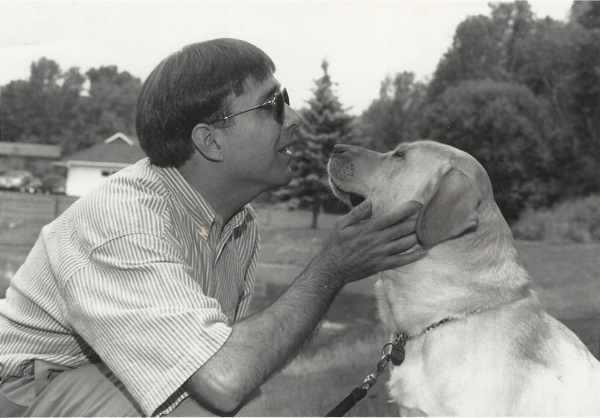
Photo of Stephen Kuusisto and his first guide dog “Corky” on the grounds of Guiding Eyes for the Blind, ca 1995


Nature with tooth and claw doesn’t love us. Nor are the affairs of nature “just”. And some 30,000 years ago dogs entered our circle and helped people by lessening the sting of nature’s cruelty. Dogs are beautiful actors. They should receive annual awards from the Academy of Motion Picture Arts and Sciences. “Best Canine Assuager of Natural Horror” goes to Benjie,” A dog says: “I love you too” and defies the script of nature. Of course horses do this, and cats, and raccoons, but dogs have studied the matter like Prospero. 


Strangers ask: “What’s your dog’s name?” as we stand at a curb, concentrating, getting ready to cross a street. This happens so often that veteran guide dog users have devised a trick: we toss out a false name. “Anastasia” I say. They look at the dog then coo,”Hello Anastasia,” and wonder why she doesn’t look at them. “Not very friendly is she?”


 “Prospero,” I say when we’re out of earshot. “Her name is Prospero.”


**


Why Prospero? He’s Shakespeare’s grand magician in “The Tempest”. He knows the book of nature inside and out.  Nature does his bidding—this is every person’s fantasy.

A dog “is” nature, and she knows it. But she’s willing to go along with our belief in lovingkindness. This is every dog’s genius. Prospero threw his book into the sea; dogs buried theirs. 


**


Nietzsche said something like “man is an animal of promise” and while this is true, we’re endlessly qualifying our nakedness, our instincts, our furtive glances. 


My guide dogs don’t care whether I’m naked or not. This is much like their immunity to blindness. Again, strangers ask: “Does your dog know you’re blind?” “No,” I say, “my dog just thinks I’m stupid.” The joke deflects the insensitivity of the question. But if I raise the emotional ante, my dog knows she must complete me. Here is a ditch. She pushes me away from it. This is easy for her because her instinct to avoid the ditch can be shared without cost. She shares. 


Ode to a Dog's Nose

A dog’s nose takes in the world like a child seeing a Cresh—animals, people, hay, friends, strangers, gifts, food, astonishment. Any dog’s nose finds semantics in the fragrant spaces before it. Up hill and down we go, the blind guy and Labrador. The man hears a radio in a passing car. The dog smells the driver’s fear stinks. The dog smells onions a block away. It goes without saying, the dog is more alive on the smelly planet than the man. 


In Graz, Austria, I opened a window in our hotel and Vidal poked his head out and scented blackbirds. He was like an old man savoring perfume with his eyes closed. Vidal’s smell-joy was palpable.  


I wrote in my notebook: Spend all day with a dog’s nose and try to imagine what’s going on in there. 


Up hill and down we went, Vidal and I. Austrian Dachshunds and their portly owners in the park. 

A woman on roller skates with her Alsatian. Dogs happy with their owners. And Vidal scented everything—uncommonly—working his snout as he’d never worked it before. His was the nose supreme. He smelled the European Turtle Doves—I’m certain he said, “We ain’t got this in New York.”—smelled the Common Cuckoo, a yellow smell, what else would it be? And the Hoopoe and Green woodpecker—they probably smelled like pepper. And Nightingales; European Robins…


I wrote in my notebook: New doors in a dog’s psyche?  Or have they always known these smells—know them from the canine genome? 


We went inside a mountain and navigated tunnels dug by the Nazis. I wondered if Vidal smelled the patina-smoke of misery still clinging to the damp stones. I wondered if there’s a half life to the odor of fear. 


Odors of vulnerability; of losses; of luck… And dogs prancing through them…


Would a dog know losses? Surely he’d smell them. One thinks of Hemingway’s description of a dry fountain giving off the odor of death. Dogs smell everything as optimism. This is one of their secrets. One remembers Helen Keller who said: 


“No pessimist every discovered the secret of the stars, or sailed to an uncharted land, or opened a new doorway for the human spirit.” 


Dog noses open new doorways.


Supporting CRPD


pastedGraphic.png


CRPD National Call 

on January 28th! 


The treaty needs your help – call the Senate back to the table NOW! 

Join us to help develop a national strategy to allow for continued negotiations on the disability treaty! 


What: CRPD Community Leadership Call  

When: Tuesday, January 28th, 1:00 PM ET 

(12:00 PM CT/10:00 AM PT)

RSVP: http://www.surveygizmo.com/s3/1251256/RSVP-for-USICD-DREDF-CRPD-Community-Teleconference


In December, Senator Corker walked out of the CRPD negotiations, much to the shock of Senators Menendez, Barrasso and McCain.


Don’t let your Senator hide behind the EXCUSES of Senator Corker’s false constitutional arguments!


Contact your Senators!


Click here to get a direct link to your Senator’s office:

 www.disabilitytreaty.org 


Tell them that you want the treaty to move forward and ask them to tell SFRC to take up the treaty negotiations once again!


 Tell them we will not give up and they should not listen to the FALSE statements given by Corker. 

We need to let the SFRC know NOW that the treaty is important to all of the world community!  They MUST hear from us! 


Emboucher poof!


NewImage


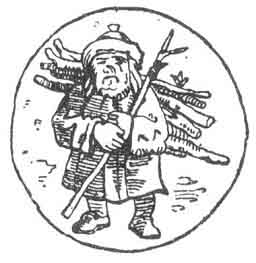
Image of the man in the moon gathering sticks.


Many European legends depict the man in the moon as an old fellow hauling a bundle of willow sticks upon his back (formed from the craters of the moon called Mare SerenitatisTranquilitatis andFoecunditatis). He carries a lantern on a forked stick (the crater Tycho), and he is accompanied by a little dog (Mare Crisium). Shakespeare used this description in Act Five of A Midsummer Night’s Dream. The actor playing Moonshine in the bumpkins’ performance of Pyramus and Thisbe is costumed exactly so.


When I was a kid my mother told me she used to think the final lines o “Silent Night” were: “Sleep in heavenly peas.”


Today in a meeting I thought I heard someone say “sawtooth reduction” but they were saying something else. 


I’m sure this person was saying something perfectly sensible like “leveraged sustainability” or “emboucher poof!” 


Meantime, post meeting, I have this mental image of a very small man with a very small saw. 


Perhaps he’s the man in the moon, the one who collects all the little sticks?