Notebook Entries on Ardor


“O what can love’s intentions do when Prospero can turn the men to pigs or back again?” 

“But Professor, its not Prospero, its Shakespeare.” 

“Ah Skeezix, its what we say about love, not the love itself that matters.”

“Professor, you’ve confused me.”

“Yes, the morphon of the humanities is drained now.” (He shakes a flask.)


**


I like the accidental virtues. I’m with Auden. 


**


A rat loves music in a ratty way.

A wasp is drawn by vibration.

I play jazz in the summer in my mountain cottage. 


**


“Love symmetry, just love it!” (Marsilio Ficcino) 

“Honk if you like my fence!” (Robert Frost)


**


Bram Stoker’s “Dracula” arrived in Britain disguised as a dog. Stoker knew how to scare the English. 


**


What’s the diff between salvation and success? Love. Salvation still understands mutual need. Success is always about next year’s crop. And next year’s crop may or may not require love.

They don’t talk much about this in “sustainability studies” I’m afraid. 


**


Ding Dong! 

“Why look, its Skeezix! Hello Skeezix!”

“Hi Professor! I’ve written a poem!”

“Excellent, let’s hear it.”

Skeezix produces a torn page, glances at it, then says: “Hello rock!”


**


Helsinki, 1982, in Kappeli Pub. 

Me: “Who does Reagan’s hair?”

Finnish Poet: “The crowd, which sees only one thing.”


**


Have you seen all those “love souvenirs” in American offices? The posed family photos; or carved elephants from vacations. They are garlic necklaces, deployed to drive off malicious strangers. Capitalism. Vampires. Trinkets. Most American horror movies are about this. 


**


“I’ll take the impoverishing sky for five hundred,” says the game show contestant.


**


Our subject hasn’t changed. We look up from the well at the circle of love.


A Divulgence


How I envy Auden his sagacious place—

a man’s moral high ground 

With accidental virtues and bookish twists. 

Of “the self” one may ask

“what’s the answer to this or that” 

and hope for refinement.

I think that’s right 

but as always, twilight

and destiny have me 

by the shorthairs—

don’t pretend

you don’t know. You know.

Just imagine tonight

when you sleepily stretch 

at a window, seeing 

in a casual glimpse

a handful of crows 

sideways on a wire

wings ruffling in the dark

you recall the child’s prayer 

if I die before I wake

and see what you can do without poems.

The Ramblings of a Sustainable Cripple

The sustainable cripple differs from last year’s cripple. S/he has a flag. Ye Olde Standard is the first thing you need if you plan to stick around. The aim is to assure disability will have a future. There’s a bad history “mitt der cripples” and the SC doesn’t want to see pages blow backwards. 


The SC knows a physician/researcher who hopes to cure blindness. “I just want to cure the motherfucker,” he says. He might just do it—at least the genetically caused forms of blindness. The SC is with him, for though blindness is not a ticket to second class citizenship, and though the SC tends to see it as a nuisance rather than an affliction, s/he thinks your mother shouldn’t have to go blind from macular degeneration; a child with Stargart’s Disease should have choices. The sustainable cripple struggles with nuance and the articulated taxonomies of disablement. S/he doesn’t want you to “have to be cured” but wishes you options. The sustainable cripple worries s/he may not know precisely what the distinction means. Essentialism has the SC by the scruff and s/he blinks. 


The Society for Disability Studies is hosting a conference in June around the following questions/ideas:


•What does it mean to sustain disability? How do/might/should/will we sustain disability?

•How does/doesn’t your own academic or professional field engage with disability and sustainability?

•What local, regional, national, continental, transnational, global practices and policies are available—or need to be developed—in the intersection between disability and sustainability?

•What practices, processes, policies, and products of the sustainability movement most impact, intersect, overlap, inform, or resonate with disability practices, processes, policies, and products?

•How can/do people with disabilities best carry out—or critique—the sustainability movement?

•Where and how do identities based on class, race, gender, geography, politics, or sexuality further inform, influence, and interact with disability (and) sustainability?

•In what ways do interactions with and practices of Native communities affect or shape disability (and) sustainability?

•How can access be imagined as an element of sustainability?

•Where do current theoretical models—such as impairment/disability; social/medical; (in)dependence/interdependence–coincide or collide with disability (and) sustainability?

•How do disability (and) sustainability fold into or against our understanding of transnational, international, global, and geopolitical “work”?

•What can conversations about disability (and) sustainability offer to global, national, regional, and local healthcare policies and debates?

•When disability (and) sustainability enter into global, national, regional, and local policies and practices around employment, what difference(s) can/does this make?

•How do/can disability (and) sustainability contribute to notions/systems of sustainable food, farming, and land development?


**


The SC tends to think of sustainability in the manner of Levi Strauss: there’s 

the cooked and the raw.  


Raw sustainability is the future understood as intersections of house holding—

of care for environments, for our food, for our neighbors and strangers, all equal.


Cooked is what constituencies (all equal) may bring to architectures and agronomies. 


**


If people with disabilities have trouble with “the cure” vs. “dignity” then the “cure” 

must be sustainable, not disability. The SC means by this a cure that allows 

for difference. 


**


The sustainable cripple leads whenever the subject is difference. 


**


The SC understands that if a limb can feel revulsion there’s still a false move in store.


SC knows imagining tomorrow requires recollections of defeat. 


Architectures: inclusive, no segregation, no separate classrooms or hospitals. 


Governments re-designed to prohibit segregation. 


The abolishment of panopticons.


Teaching with the motto: “presume competence”. 


Neurodiversity understood as human potential.


Economies built for diversity—no more pyramids.


Demand religious leaders stop using disability as metaphor. 


Disability as metaphor is usually hate speech or superstition. 


Sustainable planets do not require hate speech or superstition.


**


Thought early morning. Cold day. Syracuse. 
When Disability Rights and the Nation Are on Life Support

The painter doesn’t like his model so he adds an elaborate background, a proverbial, anal English park where the viewer’s eyes will eventually become lost. You know the story. Its the only analogy I can find for the opposition by GOP senators to the UN treaty on disability rights. Like the woman in the painting, people with disabilities have disappeared against a backdrop illuminated by fantasy and false detail.


That some Republicans hate the United Nations is scarcely news but its old news with a lingering bite.  Our nation (which should be a global leader when it comes to scientific inquiry and human rights) has been bounced from UNESCO because we’ve abdicated our responsibility to support “everything from literacy to press freedom to heritage conservation to HIV/AIDS prevention.” (See link above) The United States has been in wholesale retreat from the UN’s humanitarian work for the past thirty years. It’s not a simple story—the erosion of America’s interest in the very organization it helped to create after the second world war is a considerable topic to be sure—but one can summarize the process by noting Congress has lost  interest in multinationalism except when it supports our military. What’s emerged is a largely GOP lead sequence of paranoid visions, what some have called “black helicopter” stories—narratives foretelling how UN armies will descend on everyone from small handgun owners to parents who home school their children, for the international community really does want to ruin the lives of Americans. 


The Convention on the Rights of Persons with Disabilities is again in the crosshairs on Capitol Hill, having failed to pass in December, 2012. Like so many things in contemporary Washington its been in the crosshairs a long time—deflection and misrule are slow in democracies, especially failing ones but one may suppose Americans with disabilities should be grateful for that. While rightward senators spin what can only be called Rococo disinformation (picture the garish curlicues and gilded lilies of a picture frame) and home schooling advocates argue the UN will dispatch para-military units to the house next door and drag crippled home schooled children to public schools—a canard and falsehood both about the treaty and our nation’s ability to govern itself—while all the lies abound, the broader embarrassment to our country just grows and grows. It doesn’t matter that Dick Morris and the Fox News pundits are lying about the disability treaty—what matters in the age of extremist politics is getting yourself re-elected if you come from a red state and you can lump disability rights in with women’s health, voting rights for people of color, gay rights—worker’s rights—lump it all in with a mounting backwards slide, why you’ve gotten away with something. 


Senator Bob Corker is the latest prominent Republican to walk away from support of the CRPD, claiming the treaty abrogates the power of individual states to manage their affairs—a falsehood that goes unchallenged again and again in GOP circles. But its a falsehood spun from the paranoia of international helicopters, which makes it easy to sell. 


I hate to say it, but I think the treaty will die in the Senate. And I think our banishment from UNESCO is just the start of America’s international decline. Any nation that fears human rights will undermine its own authority is a nation that’s begun to die. Any nation that eschews support for human rights, scientific research, global cooperation, human health—that nation has begun to die. The background in the painting is tricked out with ugly concealments and exaggerated, false diagrams. One of the ugliest deflections holds that we already have the Americans with Disabilities Act—we don’t need to sign no stinkin’ treaty. The logic there is of course inhumane for it assumes America’s disabled citizens don’t travel abroad and need rights, and it supposes the plight of children and the poor has nothing to do with us. Its this latter notion that troubles me the most—we who have left thousands of Iraqi children disabled should, of all nations, have the moral and political honesty to declare the cripples of Baghdad have a few rights.  


Self Interview, January 2, 2014

I return from the world of sleep and feel grudging acceptance of daylight, curtains, clothing. You do too. Oh you’ll tell yourself the snow is novel, the coffee perfect. You’ll resist my impertinent reach, declaring something about fatuousness—for even if what I say is true, even if you’re tired of dear things, you won’t admit it. And I don’t blame you. You have in mind hot yoga and a trip to the mall. The poet Anselm Hollo called American shopping malls “the bloody monolith” which beats anything I might add. 


**


If my identity has value its outside the city walls. The blind are making violins. A man with one leg is eating fallen fruit. If its true folly is unsafe, then these men are unsafe. I know about this. I’m an expert in folly and ostracism. In the ocean of perception I’m suspicious but I still make my violin. The blind are still outside the city walls. Outside. Outside. In the woods. 


**


I’ve entered the long winter of intellectual will at 58. My sentimentality has drained away. I still have a musical heart but its only interested in the later Mahler. My heart don’t give a shit about the Baroque. 


**


Let me not mistake the petty tremors of my mind for insight. If there are still a few gods. I want clarity in old age. 


**


See how these paragraphs grow smaller? 


Standing On Melancholy Rock

My friend and colleague Bill Peace has written a post on his blog Bad Cripple entitled “Anatomy of Melancholy: A Post for my Good Friend Stephen Kuusisto” and my melancholy selves are honored. 

I live in fear that Justice will be replaced by Pity as the cardinal human virtue. (The expression is Auden’s, the fear is general.) 

When I was a kid other boys taunted me for being blind. Some threw stones. Melancholy isn’t sadness. It comes later and steals up on you from within. Today we call it depression but like everything else with our language it doesn’t capture the nuances and tinctures of melancholy which are composed of love and desperation and something akin to crying for the moon. But whatever its recipe melancholy started for me that day in 1960 when the boys threw stones and sang a song about me and I retreated to the unoccupied spaces for the miserably identified—places oh so familiar to children and adults with disabilities. Oh I’ve squeezed some poetry out of those attics and bomb shelters. Melancholy may not be the muse but she’s got her number. And melancholy loves anyone who cries for the moon. 

I take 40 mg of Citalopram (Celexa) per day. It helps me get out of bed. Nowadays its part of a conversational song though I don’t sing it, only arrange it in my head. I won’t share it. Melancholy has her dignity. The anatomy of M is highly articulated like the skeleton of Joseph Merrick. The full song would take a long time to sing like a sea chantey. But the song has a line: “look yonder, there’s melancholy rock.” 


Many Happy Returns to You and Your Shadow

The year is new—hypo allergenic like certain poodles—and you can feel lucky or dreadful but the year (like a poodle) will have none of you, for the year is high strung and indifferent as years must be. I won’t go on with the simile. I’m sorry. Perhaps you love your poodle. I’m sincere. I don’t wish to offend “poodlers”. No one can live without sentiment. Capitalism as its now bruited will do anything to rob you of your last ounce of sentiment. I’m sorry I kicked your poodle. But whatever I say, the year will have only indifference like the stars. 


When I think about the virgin year I’m mindful of just how provisional and difficult the lives of people with disabilities remain worldwide. If you want to know about cruelty and “ranking” (in the crudest sociological sense) than look to disability. Look to it here at home in the United States and you’ll see how the police in Maryland killed a young man with Down Syndrome; see how a blind man and his guide dog were kicked off a US Air flight; see how the liberal press (Chris Hedges, Democracy Now, Alternet, etc.) actively rooted for a disabled American veteran of the Iraq war to kill himself—just so they could pin it on Bush and Cheney. These examples are from the US. When you look at disability globally things are no better. A UNICEF Report on the state of the world’s children highlights the plight of kids with disabilities across the planet—ill clothed, unschooled, without health care, denied food. The virgin year indeed. Don’t let the new year rob you of your heart’s renewal. If you’re an able bodied person I suggest you write your Senator and demand passage of the UN Charter on the Rights of Persons with Disabilities. 


A friend sent me a poem in which he calculates how far William Wordsworth walked in his lifetime and in turn, calculates the poet’s mileage per line of verse. I love this idea. What if instead of watching vulgar automobile commercials (as most Americans will do today, especially if they watch college football—for every sporting event is now sponsored by Lexus, BMW, Audi, and Mercedes Benz. Gone are the days of shaving cream, Schlitz, and Aqua Velva)—what if instead of vulgar car advertisements Americans were challenged to imagine their human and social productivity per mile? Emerson would have championed this. Why I think even Teddy Roosevelt would have endorsed such a plan. Our new year dawns on a nation more politically immune to suffering and the true calling of our souls than at any time in its history. I take no pleasure saying so. 


Here’s wishing you long walks, walks with ideas, chance meetings with wise and kind strangers. And triumphs of the spirit. I’m wishing you those. 


I think we gave away too much when we abandoned Freud and Jung, preferring pills and “big pharma” to the hard work—the acknowledgment—that the unconscious has lots of darkness. America is a nation of terrifying smiles. I can’t find the quote right now, but Alice Munro said recently the most frightening people are the do gooders (paraphrase mine). I tend to think we’re in Fascist times and its proper and necessary both to say it aloud and to know who you’re looking at—whether on television or in a board room or on a street corner. As World War II commenced the poet W.H. Auden wrote the following poem. It strikes an eerie chord, or if not a chord precisely, maybe some thermemin music


Blessed Event


Round the three actors in any blessed event

Is always standing an invisible audience of four,

The double twins, the fallen natures of man.


On the Left they remember difficult childhoods,

On the Right they have forgotten why they were so happy,

Above sit the best decisive people,

Below they must kneel all day so as not to be governed. 


Four voices just audible in the hush of any Christmas:

Accept my friendship or die.

I shall keep order and not very much will happen.

Bring me luck and of course I’ll support you.

I smell blood and an era of prominent madmen.


But the Three hear nothing and are blind even to the landscape 

With its towns and rivers and pretty pieces of nonsense.

He, all father, repenting their animal nights,

Cries: Why did she have to be tortured? It is all my fault.

Once more a virgin, She whispers: The Future shall never suffer.

And the New Life awkwardly touches its home, beginning to fumble

About in the Truth for the straight successful Way

Which will always appear to end in some dreadful defeat.


**


Yes. The Wise Men, poor dears, have walked into a story “in medias res” and damned if every human actor isn’t two actors—one smiling, the other stricken by guilt. What a dramatis personnae. Cue that Theremin music indeed. 


And the new year with its pretty pieces of nonsense is here. 


So if ostensibly I write to you about a clean slate, look behind me to see what my shadow is up to. 


I know for certain, owing to dreams, my shadow is very upset about the children of war. 


Happy new year. Small letters. Happy straight successful Way. Capital “W” for will and work.


Searching the Metaphorical Attic at Year's End

I am rummaging into my life. My dime store sentiments; quicksilver fears; old laughter—its all here. The vanquished powers of youth are next to a premeditated revenge, now harmless. A handkerchief embroidered via minima; reason denied, love ignored. The past is much like weather: I see where it hindered or helped. There were novels that set me back—Knut Hamsun; Malraux; and some that furthered—Ben Okri; Virginia Woolf; The Adventures of Augie March… One recalls seasons of learning…One winter day in Finland I discovered Neruda’s trick—how to make a wall of memory fall away. On the other side, the eyes, all the eyes were bright, wide, and curious. That was a single day from boyhood. Despair forgets. Again I’m spinning the globe in secret while my family sleeps. The worn objects of wisdom are all about. As Auden said, time makes old formulas look strange.

Astrology Tautology

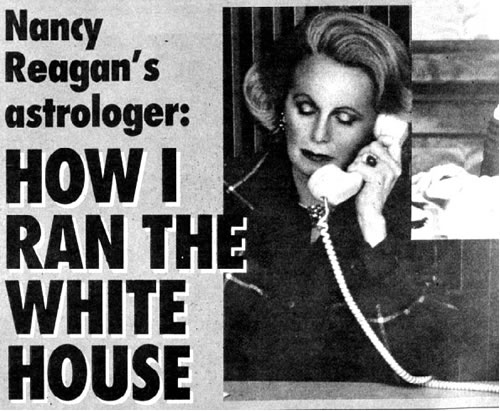
NewImage 

Photo depicts front page of tabloid newspaper, headline reads: “Nancy Reagan’s astrologer: How i Ran the White House” 


Walking in the snow this morning I was shivered not by the ordinary cold but by the realization everyone in America is walking around believing in his or her own Socratic Sign—that each creepy citizen has a daemonic harmonic gassing his or her cerebellum. I recalled Nancy Reagan and her astrologer. 


It was cold alright. I wondered what became of Nancy’s astrologer, Joan Quigley. I came in from the snow and did a quick internet search. Quigley is 86 and apparently still living in San Francisco. There the trail ends. I picture Ms. Quigley in a room filled with star charts. Perhaps she has a butler named Max. Maybe when the charts are right, she tells Max to get the car. 


Perhaps she and Nancy Reagan still talk. This is the season. Man its cold. Maybe they’re talking right now. 


Amazing what happens when you take the dogs out. I love the wild, post-diluvian world. Wouldn’t want to live anywhere else. I suppose that’s my Socratic Sign. A little voice says, “keep on walkin’ and talkin’!”


Back to Joan Quigley: I do think it would be marvelous to have a phone pal who lives alone among Gnostic scrolls; who I could call anytime; who would say things like: “Go back to bed until 4 pm, then get up and have a taco.” Or: “go out today but for only 45 minutes. Then go home and read Charles Dickens.” 


Well There's Plenty of Advertising to Go Around

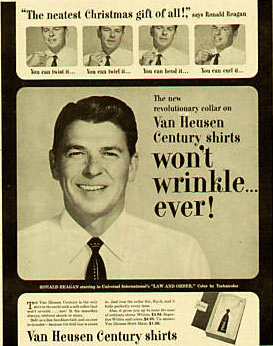
NewImage


(Photo of 1950’s magazine ad featuring Ronald Reagan. Slogan: “Van Heusen Century shirts won’t wrinkle…ever! 


In his poem “The Quest” written at the beginning of World War II Auden wrote: 


Out of it steps our future, through this door

Enigmas, executioners and rules,

Her Majesty in a bad temper or

A red-nosed Fool who makes a fool of fools. 


This stanza occupied me on Christmas day. America has opened a door, its hinges slick. From corporate prisons, racially motivated laws, and the snooping of nation states, to wars on the poor, the disabled, and women’s rights my country (and yours) has extravagantly reconditioned Auden’s opening lines.  


Fate is sentimentality disguised as history. Each time a politician says diplomacy represents appeasement (Munich) or in turn says slavery wasn’t as bad as welfare, red-nosed big “F” fools assure us a darker fate than our children deserve. By spooning up the treacle of history they tell us things were better in the past and clearer. Can’t you see how clear it was? Santa Claus was white. The poor were grateful. And we open the door to misery.


The American poet Kenneth Rexroth said: “Since all society is organized in the interest of exploiting classes and since if men knew this they would cease to work and society would fall apart, it has always been necessary, at least since the urban revolutions, for societies to be governed ideologically by a system of fraud.”

Rexroth also said: “The masters, whether they be priests or kings or capitalists, when they want to exploit you, the first thing they have to do is demoralize you, and they demoralize you very simply by kicking you in the nuts. This is how it’s done. Nobody is going to read any advertising copy if he is what the Reichians call orgastically potent. This is a principle of the advertising copy writer, that he must stir up discontent in the family.”

**

I received an email late in the day: “There’s just one more gift to get. Yours.” Apple Computer wants me to buy something just for me. I thought of Rexroth. Of getting kicked in the nuts. A red-nosed Fool who makes a fool of fools. I’d been kicked by Apple Claus. 

**

I wrote in a notebook on Xmas afternoon: 


This is a test of the sub-Cartesian epistemology system:

For the next sixty seconds I will think nothing at all.

During that time I will effectively cease to exist. 

Any sightings of me will be strictly imaginary.


**


My wife Connie asked me yesterday morning what I was thinking. I said, “Oh not much.” But see the above. 


Are the holidays hard on you too?