Perception: a Guest Post by Author Sheila Applegate

Sometimes the miracles of life are just beyond the rules of logic.
When we change our perspective, we just might let a little magic into our life!


Please help me welcome new author and CNY neighbor Sheila Applegate to the Planet of the Blind.  Sheila is hosting a virtual book tour, assisted by my wife, Connie, via Authors' Virtual Solutions.  In her guest post below, Sheila brings a fresh new perspective to this planet of mine.

Tell me, have you ever had an experience like this?  If so, please feel free to share it in a comment below.

Perception

by Sheila Applegate

How we perceive the world around us has everything to do
with how we experience this world.

Have you ever been faced with a frustrating situation that
no matter how hard you tried to solve there just seemed to be nothing you could
do to change it?

Finally there is the moment of surrender in which you give
up because you do not know what else to do. 
Then out of nowhere you are presented with an alternative that you never
would have believed possible. A simple change in perspective seems to create an
opening for a magical solution.

I experienced this in the middle of an apple orchard on a
beautiful autumn day just this past September.
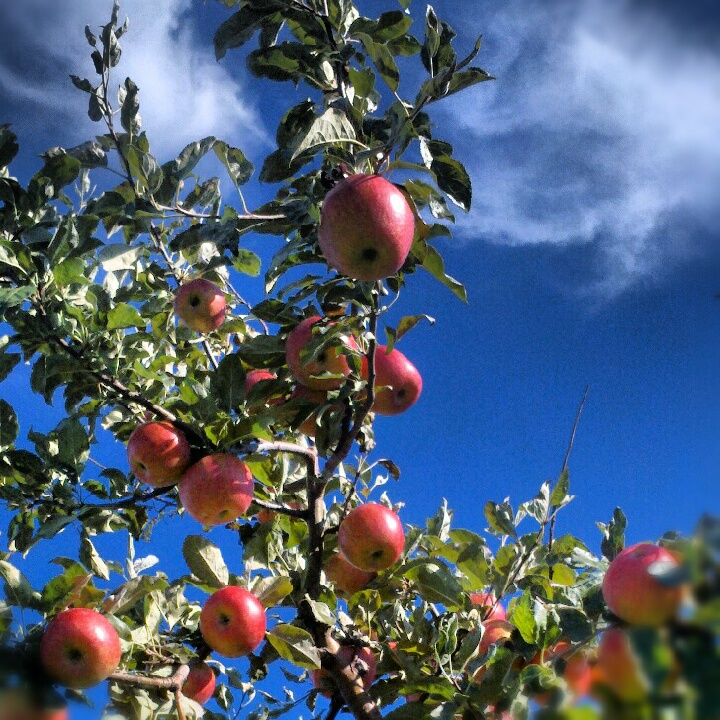
IMG_20120911_194137Image: photo taken looking up at branches of an apple tree highlights ripe red apples against a bright blue sky

The leaves were just beginning to change, radiating warm
colors against a crisp blue sky. As soon as my kids got home from school, I
piled them into the car for our first apple-picking excursion of the season.

We arrived at the orchard just in time to hop onto the wagon
for a ride deep into the orchard. My 7 year old niece was with us. She was
filled with such excitement that even my teenage children were as giddy and excited as they were when they were her
age.

As we arrived at the designated section the tractor driver
instructed us to stay within the two red flags, giving us about 5 rows to pick
from.

It was a picture perfect day as we picked apples and nibbled
on a few as we went. My kids showed their younger cousin how to take a bite of
an apple while it remained on the tree, a favorite prank their dad had
taught them when they were young.

It was a perfect afternoon.

Once our bags were full we piled them onto the wagon and
climbed up for the ride back to the parking lot. By now we were hot, thirsty and ready to head home. I reached into my
pocket for my keys, only to find an empty pocket. After a long search at the
car we all piled back onto the wagon, explaining to the perplexed driver why we
were heading back into the orchard.

This time, as he told the newly arriving apple pickers to
stay in between the flags he also announced to the group that we had lost a set
of keys, asking people to keep their eyes out for them.

Walking up and down the lanes of trees over and over we
could not find the keys anywhere. Wagonloads of people came and went. Each new group was instructed to keep an eye out for our lost keys.

Nothing.

The kids reached their limit. So I called for help. My
sister came to drive the children home. My friend brought me the spare key I had
at home. Unfortunately, the spare key did not have a computer chip and was
limited to opening the doors. So it was of no use in starting the car.

A call to AAA informed me that a locksmith would be sent to
the orchard to make a new key for a mere $200!  My bagful of fresh apples was starting to look
very expensive!

As my friend and I
waited for the locksmith we decided to walk into the now-closed orchard for
one more look. My friend threw his keys onto the ground in front of me.
Pointing out how easily it should be to
see my lost keys in the grass

I was shocked. As the
search had drawn out for so long, I was now starting to feel like I was looking for a needle in
a haystack. How on earth could I be missing something so easy to spot?

We reached the
familiar red flagged area and as my friend began his search I felt like I was past
my limit.

The thought of walking down this same grassy tree line again
gave me a stomachache. It was as if I could not look for one second longer.

Then I heard a voice from within,  "change your perspective".

A little intrigued, I lifted my gaze from the muddy earth
and once again noticed the incredible view of the horizon that had filled me
with such surrendered joy only a few hours earlier.

I felt my body begin to relax.  As I scanned the horizon, breathing the beauty
in for the first time in hours, I suddenly caught the shimmering silver of my
keys!

They were chest high, hanging on a branch, five trees away from where I stood, deeper into the
orchard than I even believe I had gone! 

I actually paused before going to them as my brain
recalculated the impossible.

There is still no logical answer for how those keys got into
that tree. Everyone has his or her own idea of how this happened. Not one of them
seems logical.

Sometimes the miracles of life are just beyond the rules of
logic.

When we change our perspective, we just might let a little
magic into our life!


~~~~~~~~~~~~~~~~~~~~~~~~~~~~~~~~~~~~
SA_image2

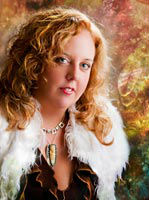
As a clinical therapist, motivational presenter, author & teacher, Sheila's passion is to provide a forum for people to process emotion & integrate spiritual understanding into their daily lives. Her new book, Enchanted One: The Portal to Love, provides readers with a guide to embracing love in every moment. www.sheilaapplegate.com
In celebration of the release of Enchanted One, Sheila is offering this raffle contest for multiple chances to win one of two Amazon Gift Cards.

TAKE NOTE (if I may be so bold)! PLEASE… Share your thoughts and comments below and to show my appreciation and support I am making this special offer (in addition to the raffle contest offer above!).
(Click all links for details).

Late in the Day


“In late September many voices

Tell you you will die.

The leaf says it. That coolness.

All of them are right.”


–Robert Bly


Shadows lengthen under the apple trees. It’s a princely trouble I’m feeling–a problem from a thousand years ago. Something uncoils and I carry it into the house where it rests among my books. This presence, this siren is like a many armed figure of Durga waving her axe, riding a lion over a mound of skulls–but she’s the smallest Durga in the world, small and green as the inch worm I discover scaling the Collected Poems of Wallace Stevens.


Fathoms down, under the waves, my long, informal apprenticeship.


Theory and Practice of Winter


“Memory is not an instrument for exploring the past but its theatre. It is the medium of past experience, as the ground is the medium in which dead cities lie interred.”

–Walter Benjamin


Ruminant cold; clouds like machine parts, nothing fancy, a set of gears low on the horizon, gulls walking sideways in the market square.


My childhood wasn’t magical.


There were reindeer and old men and drunken sailors.


There were trolley cars filled with tough old Finns who had survived two wars with Russia and now retained entire dissertations on hunger in their heads.


Lights came on early. Helsinki. A darkness inside a darkness–weather “became” philosophy.


“Anxiety is the dizziness of freedom.” (Kierkegaard) Snow comes like a sequence of mathematical ideas.


The cold is numerical tension.


“Don’t spoil my circles,” said Archimedes. I see a very old man making circles on the esplanade–looping circles built by oversized feet in the Finnish twilight.


“Nothing exists except atoms and empty space; everything else is opinion.” (Democritus)


Look! A city of opinions!


Architectures of opinion!


But like Einstein, the snow does not believe in mathematics.


The city of my boyhood is a great polyhedron of shadows.


I have found in general that shadows are more reliable than ideas of heaven; more of scale with mathematics and poetry; shadows are the daughters of time.


Winter in the far north is a miracle multiplied beyond necessity.


Leibniz wouldn’t like it here.


Even the ravens of Helsinki know the unconscious arithmetic of winter.


This is no joke or conceit.


I once saw a raven standing in an empty baby carriage.


This was just outside a downtown department store.


The raven was lifting one foot, then the other, carefully, as though composing a stationary dance.


The mind is a question, asked of another question, the imperative, shadow asked of shadow.


When the parents came out with their baby the raven was gone.


Gorilla Spotting from a Wheelchair in Rwanda

Frank Gardner: Gorilla Spotting From A Wheelchair
(The Telegraph)
January 3, 2013

KIGALI, RWANDA– [Excerpt provided by Inclusion Daily Express] In the damp, cool air halfway up a volcano in equatorial Africa, I smelt an odor I had never encountered before. Musty, pungent, tangy, hard to describe yet definitely overpowering. “We are close now,” whispered Augustin, the khaki-clad ranger assigned as our escort. “Please be very alert.” Every one of us who had trekked up the valley that morning was on tenterhooks, aware that something big was about to happen.

We had flown into Rwanda the day before from London, an exhausting 15-hour journey via Nairobi. My wife’s friend Karen had bid successfully at a charity raffle for a three-day gorilla trek, so my wife said, “Go on, you’ve always wanted to see the mountain gorillas; and let’s face it, this is not one for me.”

It was one of those insane now-or-never moments, blowing more than £2,000 on a mad 72-hour dash to a country that deserves weeks of anyone’s time, if not more. But back in the dark days in hospital after I was shot and disabled eight years ago, I remember thinking, “Damn! I wish I had gone to such-and-such a place before I lost the use of my legs.”

And here it was, a dream on a plate, a chance to see the world’s largest primate in its remote natural habitat with a tour company that commendably made light of my disability. “We’ll get you up there no problem,” I was assured via email. I was curious to see how.

Entire article:
Rwanda: Gorilla spotting from a wheelchair

http://tinyurl.com/0103136

Hollywood Tackles Sex And Disability

Hollywood Tackles Sex And Disability
(The Independent)
January 2, 2013

HOLLYWOOD, CALIFORNIA– [Excerpt provided by Inclusion Daily Express] It’s long been said in Hollywood that portraying someone with a disability fast-tracks you to Oscar glory. Yet show them having sex, and film executives squirm. But A-listers such as Helen Hunt and Marion Cotillard — in films funded by some of the world’s biggest studios — are debunking the myth that disabled people can’t have sex on screen, heralding a new cinematic sexual revolution.

The award-winning The Sessions, which opens in the UK on 18 January, is one of the first Hollywood films to explore the subject of a disabled person losing his virginity. The film follows the real-life story of the American poet Mark O’Brien – a polio survivor who uses an iron lung. At 38 years old he sought the help of a sex surrogate, someone who helps people with sexual problems explore their bodies, played by Helen Hunt.

The film, which won the Special Jury Prize and Audience Award at the Sundance festival this year, is written and directed by a polio survivor, Ben Lewin, but is based on the late O’Brien’s account of his own story. “I was taken by the frankness and explicitness of it — which is rarely associated with discussions of sex,” Lewin said. “When I was a kid, we didn’t talk about sex and disability. I get the impression people are more open-minded now. There is an interesting disability-chic movement, and a number of movies looking at similar themes.”

One of these was this year’s Untouchable, which tells the story of a quadriplegic and his carer, who encourages him to pursue love. And Rust & Bone, which won the top prize at the London Film Festival, stars Cotillard as a double amputee who embarks on a sexual relationship.

Entire article:
Hollywood tackles sex and disability

http://tinyurl.com/ide0102136

Disability and the Fiscal Cliff

I love it when the press invents a term that doesn’t actually describe what’s happening. The “fiscal cliff” is just the latest example. Do you remember “mop up operation” during the Viet Nam war? Or the “Gulf of Tonkin Incident”? 

It’s entirely possible that what we’re watching in Washington right now is a fiscal mop up incident disguised as a cliff operation. Another way to say this is that the rich will inevitably come out ahead, and the middle classes and the poor are going over the edge. And this is hardly a histrionic statement–the proposed cuts to social programs that the Obama administration have placed on the table will inevitably be exceeded whether there is a deal or not. The name of the game is really darker than “the fiscal cliff”–especially since the “cliff” doesn’t really exist but the poor will in fact go under the bus. 

Patricia Wright’s excellent article “The Fiscal Cliff Impacts People with Disabilities” pinpoints how proposed cuts to IDEA and Medicaid will impact education for children with special needs. Even job programs for people with disabilities in the department of defense are at risk.

This is not a fiscal cliff: it’s a “defund education and send them into the streets to beg” “Les Miserables” Redux. That is, of course just me being uncharacteristically polite. Here’s an excellent snippet from a fine article by Steve Vogel

The incoming chairman of the Senate Veterans Affairs Committee, joined by the leaders of a number of veteran groups, attacked proposals that would cut disability benefits for veterans as part of a budget deal during a news conference Wednesday on Capitol Hill.
“We must do deficit reduction, but not by cutting programs for people who lost arms, legs and eyes defending our country,” said Sen. Bernie Sanders, (I-Vt.), who is replacing Sen. Patty Murray as chairman of the Senate committee. “We must not balance the budget on the backs of men and women who already sacrificed for us in Iraq and Afghanistan.” 
Among the plans being considered by the White House and Congress as budget deficit negotiations continues are ones that would change how annual cost-of-living adjustmentsare calculated for most federal entitlement programs, including the 3.2 million veterans receiving disability compensation.
 

In the end it probably doesn’t matter what we call it–this is just cruelty, aided and abetted by irresponsible mainstream reporting.  

Death by Bedsores

My friend and colleague William Peace writes about bioethicist Art Caplan over at Bad Cripple in a post about an elderly man who had a series of debilitating strokes and decided he wanted to die of bedsores–in effect he instructed his nurses not to turn him over in bed. Caplan argues that the man should have the right to demand withholding medical treatment–though he spends a good deal of time arguing that the process of letting a patient die of bedsores inevitably affects the morale of caregivers. Caplan argues that there’s a delicate balance between end of life decision making and the morale of caregivers but in the instance above, the old man’s wish to die should trump the feelings of the nursing staff. It’s interesting to assess Caplan’s argument because its a palimpsest of philosophical assertions and I must confess I like a good palimpsest as much as Umberto Eco. Caplan writes:


If I thought the care of others was being compromised by these morale issues and staff problems, I might override a patient’s wishes. I might not honor his request in the name of other people’s rights. In my opinion, there may be limits to what you can request when it affects the care that others can receive. That is a tradeoff that has to be weighed at all times. As tough as this case was, it provides lessons to take home. Autonomy and patient rights may have some limits when they begin to affect others and the care that others can get. It may be important to think about this kind of dilemma in advance, and be ready to say as soon as a request comes that this is the patient’s right, but it is not something we can accept at this facility.


This is a tautological argument driven by good old fashioned Freudian “reaction formation”–“these morale issues and staff problems” are not consequential to Caplan because they are simply emotive and the role of a philosopher is to embrace logic. And all looks well enough until one considers what is not being said: the patient in question has asked to be allowed to die in terrible pain, to die slowly, and by extension, to ask a staff of trained medical professionals to bear witness with no more feeling or morality than an encyclopedist might possess while erasing a word. 


Human beings cannot be erased in secret. And whether Caplan likes it or not, medicine, even hideous, post-modern, corporatized, neo-utilitarian “hospitalist” driven medicine is still a community. The passive acceptance of pain in others undermines not only medicine but civic life itself, a matter that Franz Kafka underscored famously in his story “A Hunger Artist”


Art Show

By Andrea Scarpino


Northern Michigan University’s Senior Art Show. I walk from piece to piece through a crowd of excited students, their friends, their parents. It’s warm in the museum, a crush of bodies and winter coats and excited speaking. And then I see the black and white photographs along one wall: two legs from underneath a hospital gown, one smaller than the other, discolored, bruised. Feet in a bathtub. Feet on a bed of nails. And under the photographs, a small table with a book: Living with RSD. A sunflower on its cover.


I stare at the photographs, their gray shades, stare at the book, try to make sense of what I’m seeing. Two legs like my own legs once looked. Depictions of pain. I feel myself sweating. Spinning. My legs pulsing with blood. I’m suddenly filled with shame. This illness that shaped my childhood, that I kept hidden from most of my friends, that was completely misunderstood by teachers, relatives— hanging on the wall of an art museum for anyone to see. Exposed. My biggest secret captured and displayed.


Then I overhear a student speaking with her mother. ‘How does it feel to see yourself up there?’ she asks. I turn to look: her mother stands with crutches under her arms. I interrupt, say to the mother, ‘Are you the one with RSD?’ I realize that my words are abrupt, that I’ve stepped outside my politeness training, my training in disability. The woman at first seems taken aback, then nods her head. ‘I had RSD too,’ I say. ‘Growing up. I had it for eight years.’ And suddenly the daughter is crying, and her mother is crying, and I’m concentrating hard not to cry as well.


The woman starts asking me questions: what treatments did I have? What hospitals? What stage was my diagnosis? How did I reach remission? We’re speaking the language of medicine, of pain, a secret club for a secret illness. I write down the name of my treatments, offer to share my medical records.


‘This is exactly what I was hoping would happen,’ the daughter says as we exchange cards, phone numbers. And I think, yes. This is one thing art does, isn’t it? Brings our deepest hurts to the light, helps those hurts speak to another, connects us to another. Saves us from feeling utterly alone. Saves us from despair.


Gregory Orr writes, ‘That poem you love,/ That saved your life,/ Wasn’t it given to you?’ My anesthesiologist gave me the poem that saved my life while he administered one of my final treatments for RSD: ‘The Journey’ by Mary Oliver. I loved my anesthesiologist like I have loved no other doctor—he read me poetry regularly, asked about my dreams, told me his, played me his favorite music, took me seriously, a teenage girl no one else much believed. When the veins collapsed in my foot and he couldn’t get an IV started to administer a treatment, he cried, apologized again and again. When I struggled with dizziness waking up from anesthesia, he sat with me, held my hand, made me laugh until my blood pressure rose enough for me to be released.


Poetry spoken in a hospital’s recovery room. Photographs hung on a museum wall. Stories shared from person to person. Because art can save our lives. Art can record the secrets we didn’t know we should share. Can bring them to the light. Can free us of them. Art can be given to us in unexpected ways, at unexpected times. Kindness, too. I hug the student and her mother. Walk the rest of the show with sorrow in my heart. And lightness. And hope. A secret pain shared with another. Released.

I Didn't Vote for This

Dear MoveOn member,

Standing up to a President we fought so hard to elect, right after an election, isn’t easy.

Which is why we urgently need your advice.

As part of the ongoing fiscal negotiations in Washington, President Obama has offered a massive concession to Republicans: A deal that would slash Social Security benefits by $112 billion over the next decade. And we have to make a decision right now about what to do.

According to the AARP, “A typical 80-year-old woman will lose the equivalent of 3 months worth of food annually” under this plan.1

This is a bad deal for current retirees. And it’ll hit future retirees even harder, because the proposal cuts Social Security more and more with each passing year. After 10 years, benefits would be cut by about $500 a year for the average retiree. After 20 years, benefits would be cut by about $1,000 a year. And beyond that, it just gets worse.2

But here’s the good news: There’s still time to block this deal. The U.S. Senate is full of Social Security champions.3 And Social Security is central to the Democratic Party’s legacy.

Still, just like standing up to the President isn’t easy for MoveOn members, it isn’t easy for Democratic senators. But if Social Security champions who are rejecting this plan in the Senate know we’ve got their backs, we have a chance to push President Obama to do the right thing.

So we have a decision to make right now: Should MoveOn keep standing with champions of Social Security and make a big final push to oppose any cuts?

“Yes. Let’s make a big final push to stop the proposed cuts to Social Security.”

“No. I don’t think we should do that.” (And tell us why.)

If we do this, here’s what we have in mind:

We have a powerful TV ad that we can run in the states of vulnerable Senators who are up for re-election.

We’ll make sure that champions of Social Security, Medicare, and Medicaid know we have their backs, by publicly thanking them and running ads in support of their leadership.

We’ll continue to remind Democrats that MoveOn-backed primary challenges for those who vote to slash our social safety net are a real possibility.

We’ll organize on-the-ground events at district offices, while Senators are home this week.

And we’ll continue jamming phone lines in Congress and the White House, flooding offices with petitions, and doing whatever else we can to show significant opposition to any deal that cuts Social Security, Medicare, or Medicaid.

Click to vote on our plan:

“Yes. Let’s make a big final push to stop the proposed cuts to Social Security.”

“No. I don’t think we should do that.” (And tell us why.)

Last time there was talk of a “grand bargain,” progressives united behind a simple message: No cuts to Social Security, Medicare, or Medicaid. And, after a long fight, we won.

This is not necessarily an easy choice, though. If there’s agreement on a “grand bargain,” President Obama will use the power of his office to try and sell it to the American people. Going up against that is hard. It will require significant resources. And of course, we just got done making a major financial investment to win his election.

So it’s up to you. Thanks so much for your input.

–Justin, Vicki, Garlin, Ilya, and the rest of the team

Sources:

1. “AARP to Congress and the President: Don’t Cut Social Security,” AARP, December 18, 2012

http://www.moveon.org/r?r=285712&id=59599-23289850-KxRVi3x&t=7

2. “Social Security COLA Cut,” Strengthen Social Security, December 18, 2012

http://strengthensocialsecurity.org/colacut

3. “Harry Reid: ‘We Are Not Going To Mess With Social Security’,” Huffington Post, November 8, 2012

http://www.moveon.org/r?r=285713&id=59599-23289850-KxRVi3x&t=8

End of the World

By Andrea Scarpino

The world is supposed to end this week, at least according to some poorly researched interpretations of the Mayan calendar. It seems the world is supposed to end frequently these days, because of computer malfunction, alien invasion, Biblical prophesy, or the Mayans, a people we don’t take very seriously except for their possible connection to doomsday.


Even NASA has gotten into the discussion, issuing a statement and accompanying video (called ‘Why the world didn’t end yesterday’) explaining how the Mayan calendar actually works, and including such reassurances as, ‘neither is a rogue planet coming to destroy us’ and ‘If there were anything out there like a planet headed for Earth, it would already be one of the brightest objects in the sky. Everybody on Earth could see it. You don’t need to ask the government. Just go out and look. It’s not there.’


I often wonder why we incessantly tell these stories about the end of the world, our seeming need for a crisis of that magnitude—particularly in how we tend to conceive of it: angry (alien) or indifferent (asteroid) outside forces doing us in. Last week, a mass shooting which left 27 people dead, 20 of them children. Isn’t this an end of the world? American drone ‘double tap’ attacks targeting first responders —isn’t this an end of the world? The multitude of ways in which we harm one another through physical and emotional harm—isn’t each an end of the world? Overpopulation, unequal distribution of food and water, global warming: each its own end of the world. And these ends come from us, not from mythic stories or cosmic forces. They come from humans deciding the world as we know it isn’t worth saving.


Jack Gilbert writes, ‘I believe Icarus was not falling as he fell,/but just coming to the end of his triumph.’ Maybe that’s where we are right now, coming to the end of our human triumph. Unable to see our triumph as we spiral out of control. Unable to have the hard conversations necessary to keep ourselves flying. Unable to remember, as Terry Tempest Williams writes, ‘that the world is meant to be celebrated.’ Maybe it’s easier to obsess over poorly interpreted Mayan predictions instead of examining the hard truths of our lives: that so far, at least, we end in human fire, human blood, human tears.