National Federation of the Blind Responds to Goodwill Statement on Subminimum Wages

Logo- National Federation of the Blind

Baltimore, Maryland (June 11, 2012): The National Federation of the Blind (NFB) today respondedto a statement issued by Goodwill Industries International, Inc., regarding its payment of subminimum wages to workers with disabilities.

Dr. Marc Maurer, President of the National Federation of the Blind, said: “Goodwill frames its opposition to fair wages for workers with disabilities in terms of choice.  Goodwill wants the public—and in particular its own employees with disabilities—to believe that the only choice that Americans with disabilities have is between receiving subminimum wages or receiving no wages at all.  This is a false choice based on inaccurate and self-serving propaganda put out by Goodwill and other subminimum-wage exploiters.  The reality is that workers with disabilities are not limited to the false choice presented by the industry that exploits them.  Workers with even the most severe disabilities can and do engage in competitive employment every day.  The way to lower the high unemployment rate among workers with disabilities is to enhance and expand existing programs—and to create new ones—that help them to find and maintain competitive employment, not to exploit them in subminimum-wage sweatshops.  These sweatshops proclaim by their policies and behavior to the public, to other employers, and to the employees themselves that the workers aren’t good enough to be regular employees earning real wages in regular business.  Disabled Americans reject this false and misleading representation.”

Goodwill issued its statement in response to an inquiry from WUSA, the CBS television affiliate in Washington, D.C.  WUSA made the inquiry in its report on the NFB’s call for a boycott of Goodwill Industries, which was issued last week after repeated attempts to meet with Goodwill officials.  NFB representatives were interviewed on camera and, along with the WUSA reporter, sought to speak with Goodwill’s president and chief executive officer, but Goodwill declined a meeting or to be interviewed on camera.
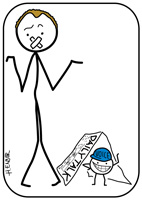

 

Comedian Uses Speak It! On iPad To Deliver Punch Lines


Lost Voice Guy

We at POTB recommend "Lost Voice Guy"!


(The Guardian)
June 6, 2012

SUNDERLAND, ENGLAND– [Excerpt provided by Inclusion Daily Express] A sense of apprehension fills the club as Lee Ridley, who has cerebral palsy and cannot speak, walks on stage. As he jabs at his iPad, awkward laughter trickles through the capacity crowd. Then, through a text-to-speech app called Speak It!, he tells the audience he'd like to begin by dealing with their laughter and the elephant in the room. "Don't worry about it," he says. "It's fine. It happens all the time and I'm used to it. You were thinking, 'Here comes another wanker with his iPad.'"

Ridley assures the crowd, at the Mission comedy club in Sunderland, that he is definitely disabled, though; it's not just "really good acting" and he's not drunk either — despite what embarrassed parents tell their children when they are asked "awkward questions" as he passes. He continues his set, mixing the abstract and the absurd with attacks on Cameron's welfare reform. There are anecdotal jokes as well as sharp one-liners and, although it doesn't define his routine, disability is a constant theme.

"When I realised I'd never be able to talk again," he says, "I was speechless." Sometimes the monotone, somewhat staccato delivery of his iPad adds to a punchline; occasionally it detracts. But the strength of his material shines through: he selects skits from a vast bank of recorded stuff depending on crowd reaction, yet also keys in "live" stuff off the cuff, too.

Durham-born Ridley, now 31, was diagnosed with cerebral palsy, which affects muscle control and movement, when he was just six months old, after becoming ill and falling into a coma. "It means I can't speak and my right side is weaker than my left. So I walk funny, too. I also developed epilepsy as a teenager. Obviously, I didn't have enough to cope with."

Entire article:
Lee Ridley: making comedy out of silence

http://tinyurl.com/ide0606127


Ah, Budapest!

Budapest

By Andrea Scarpino


Budapest: Scenes The baths: blue and yellow and white tiles lining the floors and walls and ceilings, a labyrinth of mineral pools ranging from cold to tepid to steaming hot. One pool reeks of sulphur, and the metal handrails leading down the pool steps are corroded and discolored by the water's sulphur content. One steam room overwhelms with eucalyptus– "I feel like we're inside a tub of Vic's Vapor Rub," I whisper to Zac. Some pools have bubbling jets that you can use to massage your feet or back, and the extra-hot pools are usually placed near extra-cold pools so you can move back and forth between them. When I do this, my legs tingle and shake. "It's good for circulation," an older man next to me says. He's just had a total knee replacement, and he's spending all day in the bath moving from hot to cold pools as part of his rehabilitation. One bath's steam and sauna rooms are separated by sex–and thus able to be used without a bathing suit–and groups of women friends chat lazily as they sit naked next to one another in broiling heat. I can only stay in the 120 degree steam room for four minutes before my nose stings with each inhalation and the floor burns my feet. In those four minutes, I have sweated more than I think I've ever sweat. Massage: a tall, wide woman with bright red hair and a halting accent leans her entire body into mine, kneads my legs with more force than they have ever felt, digs her elbows hard into my spine. While working on my legs, she explains "Hungary's hard history," but when she begins work on my back, I can't pay attention to anything she says; all of my energy is consumed by not bursting into tears from the pain. With each knead or push or stretch, my muscles feel like they're tearing in half. "You more flexible now," she says when the massage is finished. "I hope so," I reply. For two days, my back and neck ache. The streets: feel like Paris: wide and open with trees everywhere, zooming cars. Gelato on every corner, wine bars, huge open outdoor restaurants with TVs showing Euro Cup soccer games. I walk for hours, past museums and art galleries, past cute clothing stores, just to be walking through Budapest, just to see and smell everything. I cross each of Budapest's bridges, stare into the Danube, take photographs of monuments and public art. I eavesdrop on people speaking Hungarian, a language different from any I have studied–I can't understand even the simplest sounding words. I step into supermarkets, hold vegetables and fruit I've never seen before, wonder at aisle after aisle of pickled products: cabbage, beets, peppers stuffed with sauerkraut, cucumbers, eggs, vegetable medleys. All my guidebooks say Hungarian cuisine isn't vegetarian friendly, but the supermarkets are full of delicious looking vegetables and fruits, grain-filled bread, freshly made paper-wrapped cheese. The apartment we're renting has a kitchen, and I make huge salads with greens I can't identify and an amazingly creamy feta cheese. Buda Hills: lush and green and overlooking the Pest side of the city. White stone castle and tower walls, liberty statues, people picnicking, stalls selling knickknacks–post cards, shot glasses, Hungarian dolls and ceramic pitchers. I try over and over to take a good photograph of sprawling Pest–that's why I climbed all this way in the first place. But the photos don't come out big or important or clear enough. There's a feeling to this city that I can't capture in a 5×7 inch space–a grandness, an elegance, a liveliness. I give up, put the camera away, and just stare, try to absorb all that I can into my memory.

Dear Ableist America:

I used to want very much to play with you but now I see right through you. What a coward you are, afraid of your own feet and hands, your knees, your lungs. You’re afraid to stand on your own, frightened of thinking itself. Even your eyes terrify you. As the old song goes: “I don’t want to play in your yard, I don’t like you anymore…”


Yep, I’d rather play Solitaire than hang out with you. You’re so afraid of becoming crippled you actually give off a smell. It’s an odor like shoe polish and burning wires. You know exactly what I’m talking about. There aren’t enough sporting events and fast cars to save you. Not enough Botox.


I would pity you but I’ve lived all my life with yours for me so I know it’s stupid. What you really need is a just and equitable health care system but of course you’re afraid of this for thinking about it forces you to think about your bodies rather than a new BMW.

You poor poor lambkins.


Fear is the parent of cruelty. Fear is in the soup, it’s even in the drinking water as prescription drug runoff. You ableists are now peeing your fear into the drinking water.


“He who is not everyday conquering some fear has not learned the secret of life.” That’s Emerson. I think of this when you ask me how I can go places when I can’t see.


I know more secrets than you and I can’t bear your gibbering. Grow up. Conquer your terror about your own mortality. Get over yourselves to find at least one secret.


BTW Ableist America, I like my solitude. Capiche?


Leaving Italy


By Andrea Scarpino

We leave Crotone in the middle of the night. Not because we’re being run out of town but because our bus for Rome is a redeye–we’ll wake to Rome’s groggy pre-tourist activity, to shopkeepers opening their stalls and business people taking shortcuts through the Basilica on their way to work. Until then, my Italian family stands at the bus depot waving goodbye to us, blowing kisses and demanding we visit again next summer. For a few minutes, a younger cousin climbs into the bus’ luggage compartment and says he’s coming with us.

In the last few hours of dinner and celebration, they’ve given us gift after gift: hand crotched lace typical of Calabria, a beautiful necklace from a Crotone-born jeweler, homemade walnut liquor that Zia Antonietta poured into two plastic water bottles so we wouldn’t raise the suspicions of Customs, a tray full of almond cookies, packages of Calabrian spicy red chili powder.

“Think of us when you use this,” Zia says. And, “Send us a postcard from time to time.” I assure her that we will stay in good contact, that we will visit again. I tell her I will think of her every time I wear the necklace. After having felt forgotten, after having lost so many family members who moved to the US for work only to find they never earned enough money to return, they are eager to know Zac and I won’t forget them, that we won’t be lost to the US as well.

And we’ve already started planning the next visit–maybe we could all rent a beach house on the Ionian for a few weeks next summer, maybe we could visit one of the family’s mountain homes or Patrizia’s home in Toscana. I assure everyone that we will work hard on our Italian and speak better by the time we return.

The best part of the trip: feeling so welcomed by everyone, seeing clear family resemblances: similar hair, a similar nose, similar eyes. The worst: struggling more than I would have hoped with my Italian. As Zac says after the bus pulls away, this trip was a real risk–flying halfway around the world to stay with people we’d never before met. But the payoff has been incredible.

Once we reach Rome, we’ll fly to Budapest, where Zac has a philosophy conference and where I plan to wander aimlessly for days on end, taking in some of Budapest’s famous mineral baths (hopefully they can cure overeating?). It will be a relaxing end to our European adventures. Until then, we bump along in the bus in the middle of the night leaving behind–only for now–my Italian family.


Italian Trouble

By Andrea Scarpino

The only trouble with being in Crotone is that I never really know what’s about to happen–which means, in part, that I never know how much food I may be expected to eat. I don’t speak Italian well enough for complex conversations, and even though I’ve dusted off my French to speak to one cousin, and Zac has gone professional in Google Translate iPad-style, we’re still often fumbling from place to place and person to person, not entirely sure what’s going to happen next.


Case in point: lunch in Sersale, which is the town from which my grandfather moved when he came to the US in the 1920s. We eat lunch with one of my father’s first cousins who, even though she’s in her 80s, has prepared a feast: two kinds of spaghetti, two kinds of eggplant, zucchini parmesan, sautéed wild mushrooms, green salad, fresh ricotta, six other cheeses, bread, olives, bowls of fresh cherries, and two kinds of pastries. We’re also served–at lunch, mind you–white wine and artisanal sparkling red wine, as well as homemade cream limoncello. My stomach becomes physically sore, stretched beyond any normal limit. Not eating, however, is clearly not an option–as soon as I say “no thank you,” my father’s cousin looks devastated and asks, “You don’t like it?” So I pile more on my plate.


Lunch begins at 1pm, and by the time we leave her house with home-dried chili peppers and oregano, three pieces of lace that she has crocheted especially for us, and a homemade soap that I’m pretty sure is made from pig, it’s almost 4pm. We’ve been eating for three hours. But, it turns out, we’re not done. We’re taken to another of my father’s first cousins for a visit, and as we chat about all that we’ve just eaten, his wife disappears from the living room. A few minutes later, she returns with lemon sorbet that she’s just purchased from a grocery on the corner. “This will help with your digestion,” she says.


Again, it’s clear that we can’t refuse, so I spoon the sorbet into my mouth as quickly as I can, hoping she may actually be right. My stomach has reached baby-bump proportions and shows no signs of retracting because of additional food, sorbet or otherwise. At one point, Zac slips into a sugar coma, and from across the room, I try to will him awake. But there’s more to come: thick almond milk at the home of another cousin.


Again, Zac and I try to refuse, but my relatives throw an all-out tantrum. My cousin, a man in his late 70s, actually begins to stomp his feet, while his wife (who can’t be any younger) whines, her voice becoming frantic and high pitched. I finally manage to say something like, “Okay, we drink” so that the tantrum ends, but I’m growing more and more confident that an emergency room visit from a ruptured stomach is in my future.


When we finally head home to Crotone, a dinner of pizza, fried calzones, focaccia, and beer awaits us. By bedtime, we’ve been eating for 9 straight hours. Which I might have thought blissful had I not actually endured it. On the plus side: I’m pretty sure I’ve carb loaded enough for every run I do the rest of the year.

From Disability Rights International: Calling for Justice

<![CDATA[


The United Nations calls again for investigation of JRC’s shock treatments

http://platform.twitter.com/widgets/tweet_button.1338995330.html#_=1339159735463&count=horizontal&counturl=http%3A%2F%2Fwww.disabilityrightsintl.org%2F2012%2F06%2F05%2Fthe-united-nations-calls-again-for-investigation-of-jrcs-shock-treatments%2F&id=twitter-widget-0&lang=en&original_referer=http%3A%2F%2Fwww.disabilityrightsintl.org%2F&size=m&text=The%20United%20Nations%20calls%20again%20for%20investigation%20of%20JRC%E2%80%99s%20shock%20treatments%20&url=http%3A%2F%2Fwww.disabilityrightsintl.org%2F2012%2F06%2F05%2Fthe-united-nations-calls-again-for-investigation-of-jrcs-shock-treatments%2F%23.T9H0tnYMPj4.twitter

https://plusone.google.com/_/+1/fastbutton?bsv=pr&url=http%3A%2F%2Fwww.disabilityrightsintl.org%2F2012%2F06%2F05%2Fthe-united-nations-calls-again-for-investigation-of-jrcs-shock-treatments%2F&size=medium&count=true&origin=http%3A%2F%2Fwww.disabilityrightsintl.org&hl=en-US&jsh=m%3B%2F_%2Fapps-static%2F_%2Fjs%2Fgapi%2F__features__%2Frt%3Dj%2Fver%3Dl9xafNDlycA.en_US.%2Fsv%3D1%2Fam%3D!PemfnfjrL2yI81ARQg%2Fd%3D1%2Frs%3DAItRSTPblCJvoWHsMeVNOsKiKGakP1copQ#_methods=onPlusOne%2C_ready%2C_close%2C_open%2C_resizeMe%2C_renderstart&id=I0_1339159735221&parent=http%3A%2F%2Fwww.disabilityrightsintl.org

June 5, 2012–Washington, DC– A scathing article concerning the abuses against children with disabilities at the Judge Rotenberg Center (JRC) was published Saturday by the Guardian of London. Juan Mendez, the United Nations Special Rapporteur on Torture, told the Guardian he is “very concerned,” about the use of electric shocks as aversive treatment on children with disabilities at JRC. “I feel very strongly that electricity applied to a person’s body creates a very extreme form of pain. There are a lot of lingering consequences including mental illness that can be devastating,” Mendez said.

According to the Guardian, Mendez has opened discussions with the US mission to the United Nations, plans on contacting the US State Department, and has the option of reporting the abuses to the UN human rights council. In 2010, Mendez’s predecessor as the Special Rapporteur, Manfred Nowak, responded to an urgent appeal filed by DRI finding that the electric shocks at JRC constituted torture. “I have no doubts about it,” said Nowak, “It is inflicted in a situation where a victim is powerless. And, I mean, a child in the restraint chair, being then subjected to electric shocks, how more powerless can you be?”

Following DRI’s 2010 report, the controversy over JRC has reached a critical tipping point. Most recently, the family of Andre McCollins, a former student and victim of electric shocks for 7 hours sued the Rotenberg Center for malpractice. The case was settled for an undisclosed amount; however, as a result of the lawsuit, a horrifying video of Andre being shocked was released to the public for the first time and has brought JRC into the national and international spotlight once again. The electric shocks used at the school are “a horrific form of torture,” DRI President Laurie Ahern is quoted as saying in the Guardian. “What happened in that video is worse than anything I have ever seen done to a prisoner of war or a political victim around the world.]]
>

La Famiglia Scarpino

By Andrea Scarpino

Calabria

Photo

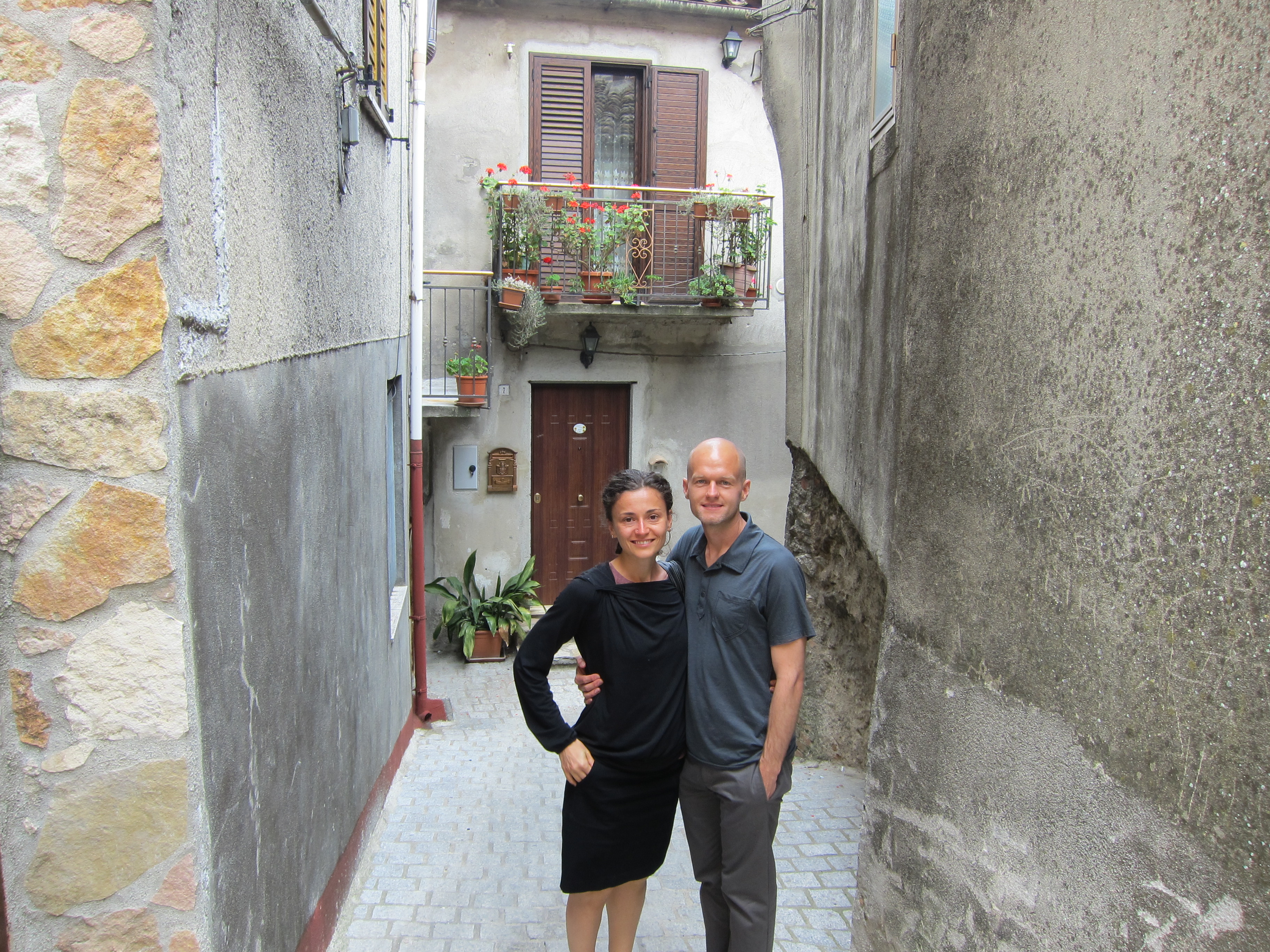
Zia Antonietta is my father's first cousin and the keeper of Scarpino family history. She is the one who asked Salvatore to look for me on the internet, and she is who Zac and I are staying with in Calabria, the region from which my grandfather moved. Really, she is the one responsible for this entire trip, as she immediately wrote me (through Salvatore) about visiting, immediately offered her home to me, immediately made sure I would be taken care of.

So far, we have explored Crotone in depth–home to Pythagoras' university, to millennia of artifacts from Greek and Roman and Turkish invaders, to destructive earthquakes, to centuries of poverty. To the sea–Ionian. To mountains and twisting roads built into them. One day, we visit Zia Antonietta's summer home in a national park one hour above Crotone. She builds a fire in the fireplace to warm her unheated house, and immediately makes us an amazing meal–without the use of running water. My cousins' boys play soccer with Zac in the yard, dried thistles litter the grass from last summer, and cows wander from neighboring pastures at will, eating the herbs and grass as they go, the bells around their necks ringing.

Another day: the sea. The Ionian has very high salinity–I taste salt immediately when I dive in–and it feels like you could float for hours without getting tired. We sunbathe and play games and eat lunch in a pine forest near the beach. Then we visit the remains of a nearby castle and eat the best gelato I've ever had–dark chocolate and coffee and vanilla and pistachio. One cousin, Ottavio, eats his gelato in a brioche bun–a hamburger made from ice cream.

A third day: Sersale, my grandfather's town. We visit his house and the houses of many other relatives, the name "Scarpino" on apartment doors and businesses everywhere. Zia Antonietta brings drawers and suitcases of old photographs out of storage for us to look through–photos of my father I've never seen before, photos of my grandfather before he moved to the US, photos of his brothers who remained in Italy. She tells stories I've never heard about my father's sister Lucy, raised her first seven years speaking nothing but Sersale's dialect and terribly punished once she began school in New York for not knowing any English. My father was younger than Lucy and Zia and I wonder if that's why he never spoke Italian–maybe his family learned from Lucy's school experience and didn't instill in him the same love for the country they had left behind.

"I think," Zia says, "your father was tired of Italy." And that is an explanation I understand. For me, Italy is a luxury–I can visit when I want, claim my Italian heritage when it suits me, look at photographs–or not. For my father, maybe the weight of Calabria was too much; maybe he felt more oppressed by our history than enamored with it. Whatever the case, when Zia tells people in Sersale that I am Pasquale's daughter, they immediately smile. One even bursts into tears, says, "Pasqualino"–little Pasquale–and grabs my hand, shaking. 


National Federation of the Blind Urges Boycott of Goodwill Industries

FOR IMMEDIATE RELEASE

CONTACT:

Chris Danielsen

Director of Public Relations

National Federation of the Blind
(410) 659-9314, extension 2330
(410) 262-1281(Cell)
cdanielsen@nfb.org

National Federation of the Blind Urges Boycott of Goodwill Industries

Condemns Practice of Paying Subminimum Wages to Workers with Disabilities

Baltimore, Maryland (June 7, 2012): The National Federation of the Blind (NFB), one of the oldest and largest organizations of Americans with disabilities, today called for a boycott of Goodwill Industries International, Inc., the nonprofit manufacturer and retailer, for its payment of subminimum wages to many of its workers with disabilities. Freedom of information requests filed by the NFB confirmed that Goodwill Industries employees have been paid as low as $1.44 an hour. The NFB and over forty-five other organizationssupport legislation, the Fair Wages for Workers with Disabilities Act (H.R. 3086), which would phase out and then repeal the nearly seventy-five-year-old provision of the Fair Labor Standards Act that permits special certificate holders to pay subminimum wages to workers with disabilities.

Dr. Marc Maurer, President of the National Federation of the Blind, said: “Goodwill Industries is one of the most well-known and lucrative charitable organizations in theUnited States, yet it chooses to pay its workers with disabilities less than the federal minimum wage. While this practice is currently legal and many entities engage in it, many other nonprofit organizations have successfully transitioned to paying their employees the minimum wage or higher. That Goodwill Industries exploits many of its workers in this way is ironic, because its president and chief executive officer is blind. Goodwill cannot credibly argue that workers with disabilities are incapable of doing productive work while paying its blind CEO over half a million dollars a year. Goodwill should be ashamed of such blatant hypocrisy. We are calling upon all Americans to refuse to do business with Goodwill Industries, to refuse to make donations to the subminimum-wage exploiter, and to refuse to shop in its retail stores until it exercises true leadership and sound moral judgment by fairly compensating its workers with disabilities.”

For more information on this critically important issue, please visitwww.nfb.org/fairwages.